Primary & Preventive Care Wellness
Small Bowel Obstruction Nursing Care Plan Template
A comprehensive small bowel obstruction nursing care plan template provides stru...

March 13, 2026

Discover free eBooks, guides and med spa templates on our new resources page


Buy now, pay later is now available in Pabau

Read case studies from our satisfied clients

Compare Pabau with alternative systems
 Integrations
 Measure Pabau savings
  Our security commitment
  About us
Learn why this holistic care and aesthetic medicine clinic chose Pabau to power patient care and performance.
Read more

GAD-7 anxiety assessment template is a validated 8-item screening tool for generalised anxiety disorder
Scores range from 0-21, with 8+ indicating clinical threshold for anxiety
Digital form workflows automate scoring and integrate directly into patient records
Pre-appointment completion improves clinic efficiency and patient engagement
The GAD-7 anxiety assessment template is a brief, evidence-based clinical screening tool that helps mental health practitioners identify and quantify anxiety symptoms in patients. Developed by Dr. Robert L. Spitzer and Dr. Kurt Kroenke, this seven-item questionnaire measures severity of generalised anxiety disorder and tracks treatment progress through standardised scoring. For psychology practices, therapy clinics, and psychiatric settings, the GAD-7 anxiety assessment template serves as a foundational intake and follow-up measurement tool-enabling practitioners to document baseline anxiety levels, monitor response to intervention, and make informed clinical decisions based on objective patient data.
An 8-item screening questionnaire for measuring anxiety severity and monitoring generalised anxiety disorder symptoms in clinical practice. Includes patient-friendly Likert scale ratings and functional impact assessment.
Download template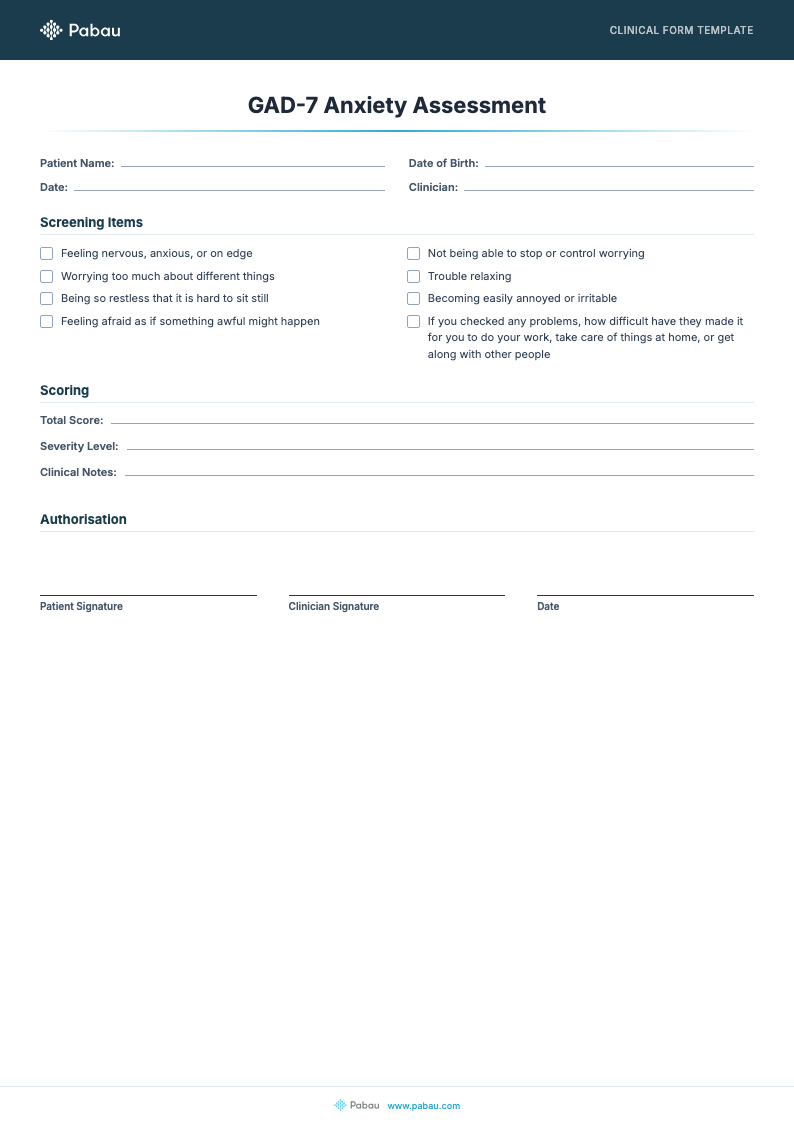
A GAD-7 anxiety assessment template is a standardised clinical form used to screen and measure the severity of generalised anxiety disorder in patients. The “7” refers to the seven core symptom items evaluated on a Likert scale (0-3 per item, total score 0-21). The eighth item measures functional impairment-how much anxiety symptoms interfere with work, home, or social relationships.
Clinically, the GAD-7 serves dual purposes: initial screening and longitudinal monitoring. A score of 8 or greater indicates clinical threshold for anxiety requiring further assessment or intervention. Scores of 10-14 suggest mild anxiety, 15-21 moderate to severe anxiety. This creates a simple, objective framework for risk stratification and treatment planning in mental health settings.
Legally and operationally, the GAD-7 anxiety assessment template addresses informed consent and documentation requirements. By collecting baseline anxiety data at intake, practitioners create a record of patient baseline status-essential for compliance with treatment planning standards, insurance documentation, and clinical audit requirements. The form signals informed consent around mental health screening and positions the practitioner as evidence-based and measurement-focused, which reinforces trust and professional credibility.
Using a GAD-7 anxiety assessment template follows a structured workflow that integrates seamlessly into appointment schedules and patient management systems. The following five operational steps ground the process in real clinic workflows.
Evidence-based screening tool for measuring anxiety severity
Over the last two weeks, how often have you been bothered by the following problems?
Your score indicates minimal anxiety symptoms. Continue monitoring your mental wellbeing and maintain healthy lifestyle habits.
No immediate intervention required. Consider regular self-assessment and maintain stress management techniques.
The GAD-7 uses a 4-point Likert scale for each of the seven core symptom items, creating a total score range of 0-21.
| Score Range | Severity Level | Clinical Interpretation |
|---|---|---|
| 0-4 | Minimal | No significant anxiety symptoms detected |
| 5-9 | Mild | Mild anxiety; watchful waiting and monitoring recommended |
| 10-14 | Moderate | Moderate anxiety; probable GAD diagnosis; treatment planning indicated |
| 15-21 | Severe | Severe anxiety; active intervention required; referral recommended |
| Response Option | Point Value |
|---|---|
| Not at all | 0 |
| Several days | 1 |
| More than half the days | 2 |
| Nearly every day | 3 |
“The GAD-7 provides objective, standardised measurement that transforms anxiety assessment from subjective impression into evidence-based quantification—enabling measurement-based care and longitudinal tracking of treatment response.”
— Dr Robert L. Spitzer, Developer of the GAD-7| Score | Intervention Level | Recommended Actions |
|---|---|---|
| 0-4 | None to minimal | Psychoeducation, lifestyle counselling, routine monitoring |
| 5-9 | Watchful waiting | Self-help resources, stress management, re-assess in 2-4 weeks |
| 10-14 | Active treatment | CBT or other evidence-based psychotherapy; consider medication |
| 15-21 | Intensive intervention | Combined therapy + medication; specialist referral; weekly monitoring |
This workflow supports digital intake forms that auto-score and integrate directly into clinical notes, eliminating manual calculation errors and ensuring data consistency across the patient journey.

Automate GAD-7 distribution, scoring, and clinical documentation in one integrated workflow. Reduce manual data entry and improve measurement-based care consistency across your practice.

Psychology practices conducting routine mental health intake benefit immediately-the GAD-7 anxiety assessment template provides objective data on anxiety severity during the first appointment, informing diagnostic clarity and treatment urgency. Therapists, counsellors, and psychologists use it to quantify baseline symptoms before cognitive behavioural therapy (CBT), dialectical behaviour therapy (DBT), or other structured interventions.
Psychiatry clinics rely on the GAD-7 anxiety assessment template to monitor medication response. When a patient starts an SSRI or anxiolytic, the form provides objective week-to-week tracking-did the score drop? If not, does the medication need adjustment? This measurement-based approach aligns with clinical best practice and supports insurance documentation.
Primary care and general practice teams increasingly use the GAD-7 anxiety assessment template as a screening gate. A high score prompts referral to mental health services or brief intervention (mindfulness, sleep hygiene coaching). GP practices managing high-prevalence anxiety populations benefit from this structured approach-it reduces diagnostic uncertainty and ensures no patient slips through unidentified.
Occupational therapy and speech therapy clinics integrated with mental health services use the GAD-7 anxiety assessment template to assess comorbid anxiety alongside their primary discipline. An occupational therapy client with work anxiety needs concurrent anxiety assessment to understand functional limitations fully.
The GAD-7 anxiety assessment template delivers operational, clinical, and compliance benefits simultaneously. From a workflow perspective, the tool is brief-eight items take 3-5 minutes to complete, fitting seamlessly into appointment structures without adding burden. Practices report improved efficiency because the template eliminates unstructured conversation about anxiety severity; the form data speaks for itself.
Clinically, the standardised scoring creates objective progress tracking. Rather than subjective judgments (“The patient seems better”), you document: “GAD-7 score declined from 16 to 9 over 8 weeks on sertraline 50 mg”-evidence-based language that justifies continued intervention and informs next steps. This measurement-based care approach is now a quality indicator in many healthcare systems (NHS, private insurance assessments).
Compliance-wise, the GAD-7 anxiety assessment template documents informed consent for mental health assessment and creates a baseline record aligned with regulatory standards (HIPAA in the US, GDPR in the UK/EU). Auditors and regulators recognise the tool as a validated clinical instrument-using it demonstrates professional standards and risk mitigation. Documentation quality improves because the form structure prompts consistent data collection across all patients.
Patient engagement increases when anxiety severity is validated through an objective tool. Patients feel heard (“My anxiety is real and measurable”) and motivated when they see scores improve over time. This psychological effect-objectivity building alliance-is well-documented in therapy research.
Pair the GAD-7 anxiety assessment template with the PHQ-9 (depression screening) at intake to capture comorbid mood symptoms. Many anxious patients have concurrent depression; dual screening ensures comprehensive mental health assessment and prevents missed diagnoses that complicate treatment planning.
The GAD-7 anxiety assessment template sits within a broader movement called measurement-based care (MBC)-the systematic use of validated outcome measures to guide treatment decisions. Unlike impression-based care (clinician intuition), MBC relies on structured instruments to document baseline severity, monitor progress, and adjust intervention if improvement stalls.
The GAD-7 joins peer instruments like the PHQ-9 (depression), psychiatric evaluation templates, and the AUDIT (alcohol screening). Across these tools, practices create a holistic mental health snapshot at intake-enabling stratified care pathways: mild anxiety may warrant psychoeducation and lifestyle intervention; moderate-to-severe anxiety warrants psychotherapy + medication. This tiered approach optimises resource allocation and improves population outcomes.
For insurance and outcomes reporting, practices that implement MBC demonstrate superior clinical outcomes and cost-effectiveness. Health systems increasingly reward practices that use validated instruments through quality metrics, bundled reimbursement, or credentialing preference. The GAD-7 anxiety assessment template is therefore not just clinical best practice-it’s a strategic operational asset that supports practice sustainability.
Manual GAD-7 anxiety assessment templates (printed PDFs) work but introduce friction: patients forget to bring them, clinicians lose papers, scoring happens manually with calculation errors. Digital workflows eliminate these inefficiencies. AI-powered clinical documentation can auto-score the GAD-7, generate a summary sentence (“GAD-7 score 14 consistent with moderate anxiety severity”), and populate it directly into the clinical note-all in seconds.
Distribution improves too. A patient portal sends the GAD-7 anxiety assessment template automatically 24 hours before the appointment, with reminders if unopened. Completed forms arrive back auto-scored, ready for clinician review before the appointment. This pre-appointment workflow reduces appointment time spent on data collection and maximises time for therapeutic work.
Longitudinal tracking becomes scalable. Instead of hunting through paper files for previous GAD-7 scores, a clinical dashboard displays all anxiety measurements over time-visualising trend lines that communicate progress at a glance. Practices managing 20-200 patients benefit enormously from this visibility.

Need a structured approach to anxiety assessment? Psychology practice software with integrated assessment workflows automates GAD-7 distribution and scoring throughout your patient population.
Looking to track measurement-based outcomes? Measurements tracking software captures anxiety, depression, and functional outcomes longitudinally so you can demonstrate clinical impact.
Want to improve patient engagement during intake? Digital intake forms deliver questionnaires pre-appointment, auto-score responses, and integrate data directly into clinical records without manual data entry.
The GAD-7 anxiety assessment template is a clinically validated, operationally efficient tool that bridges diagnostic clarity and treatment accountability. By implementing structured anxiety screening at intake and follow-up, practices create objective data pathways that improve patient outcomes, satisfy regulatory requirements, and position themselves as evidence-based, measurement-focused clinics. Whether delivered on paper or integrated into digital workflows, the GAD-7 is foundational to modern anxiety care delivery.
Use the GAD-7 anxiety assessment template at intake appointments for all new patients presenting with anxiety concerns, and at regular intervals (every 4-8 weeks) during ongoing treatment to track symptom change. It is also useful as a screening gate in primary care to identify undetected anxiety.
Psychologists, therapists, counsellors, psychiatrists, psychiatric nurses, GPs, and occupational therapists can all administer the GAD-7 anxiety assessment template. It is a patient-rated tool requiring no specialist training to distribute or score, making it accessible across mental health and primary care settings.
A complete GAD-7 anxiety assessment template includes eight items (seven core anxiety symptoms plus one functional impairment question), each rated on a 0-3 Likert scale; demographic fields (patient name, date); and scoring guidance (-21 total range, with interpretation thresholds). Optional additions: space for clinician notes, trend tracking from previous assessments, and recommendations based on score.
Modern practice management platforms include pre-built GAD-7 templates in their digital form libraries. Simply activate the template, set it to auto-distribute via patient portal before appointments, enable auto-scoring, and configure it to populate anxiety scores directly into clinical notes. No manual coding or design required.
GAD-7 scores range from 0-21. A score of 8 or greater indicates anxiety requiring clinical attention. Mild anxiety: 8-14; moderate: 15-18; severe: 19-21. Use the score to inform treatment intensity, referral urgency, and medication adjustment decisions. Compare scores across appointments to document treatment response objectively.
Yes, the GAD-7 anxiety assessment template itself is not regulated differently than other clinical forms. Compliance depends on how you store and transmit the form. Use HIPAA-compliant practice management systems with encrypted storage, secure patient portals, and audit trails to ensure your GAD-7 workflow meets regulatory standards.