Primary & Preventive Care Wellness
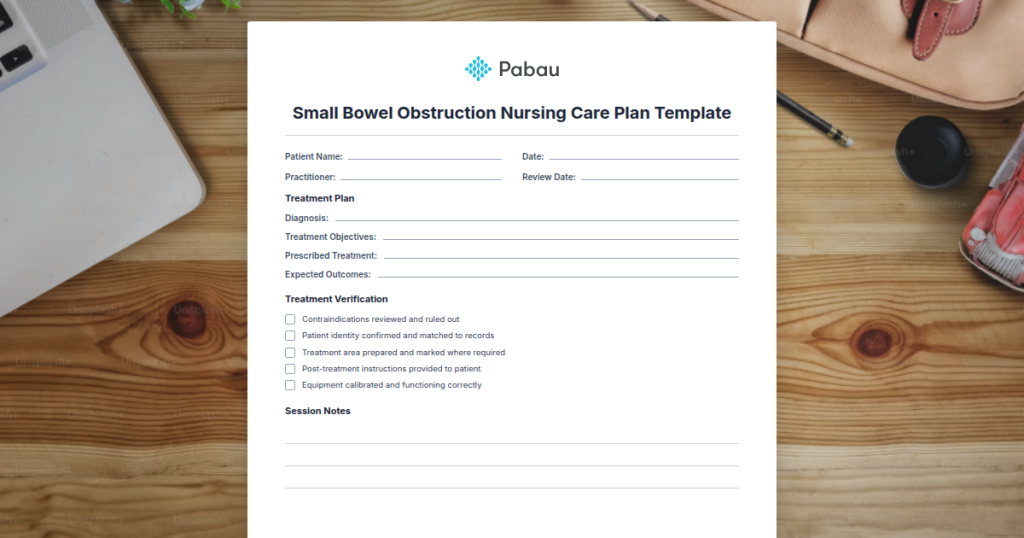
Small Bowel Obstruction Nursing Care Plan Template
A comprehensive small bowel obstruction nursing care plan template provides stru...

March 13, 2026

Discover free eBooks, guides and med spa templates on our new resources page


Buy now, pay later is now available in Pabau

Read case studies from our satisfied clients

Compare Pabau with alternative systems
 Integrations
 Measure Pabau savings
  Our security commitment
  About us
Learn why this holistic care and aesthetic medicine clinic chose Pabau to power patient care and performance.
Read more

Visual mapping connects patient assessment data to diagnoses and interventions
Concept maps improve critical thinking and clinical decision-making for nursing students
Free downloadable template ready to use in clinical practice or academic settings
Step-by-step process guides completion from assessment through outcome evaluation
A nursing concept map template is a visual organisational tool that helps nursing students and practitioners structure patient assessment data into a coherent clinical picture. Rather than relying on narrative notes alone, a nursing concept map template transforms complex patient information into interconnected visual relationships-linking assessment findings to nursing diagnoses, nursing interventions, and expected patient outcomes. This approach strengthens clinical reasoning and ensures no critical element of patient care gets overlooked.
Nurses working in acute care, community clinics, and educational settings benefit from using a concept map because it clarifies how different clinical factors interact. For example, a patient’s vital signs, medical history, and presenting symptoms connect directly to specific nursing diagnoses, which then guide intervention selection. The visual structure makes these relationships explicit-something narrative documentation often obscures. Many nursing programmes now require concept maps as part of care planning assignments because they demonstrate deeper clinical understanding than checklist-based care plans.
A ready-to-use visual planning tool for mapping patient assessment data, clinical diagnoses, nursing interventions, and outcomes. Includes sections for medical history, contraindication screening, consent declarations, and signature blocks for educator or clinician sign-off.
Download template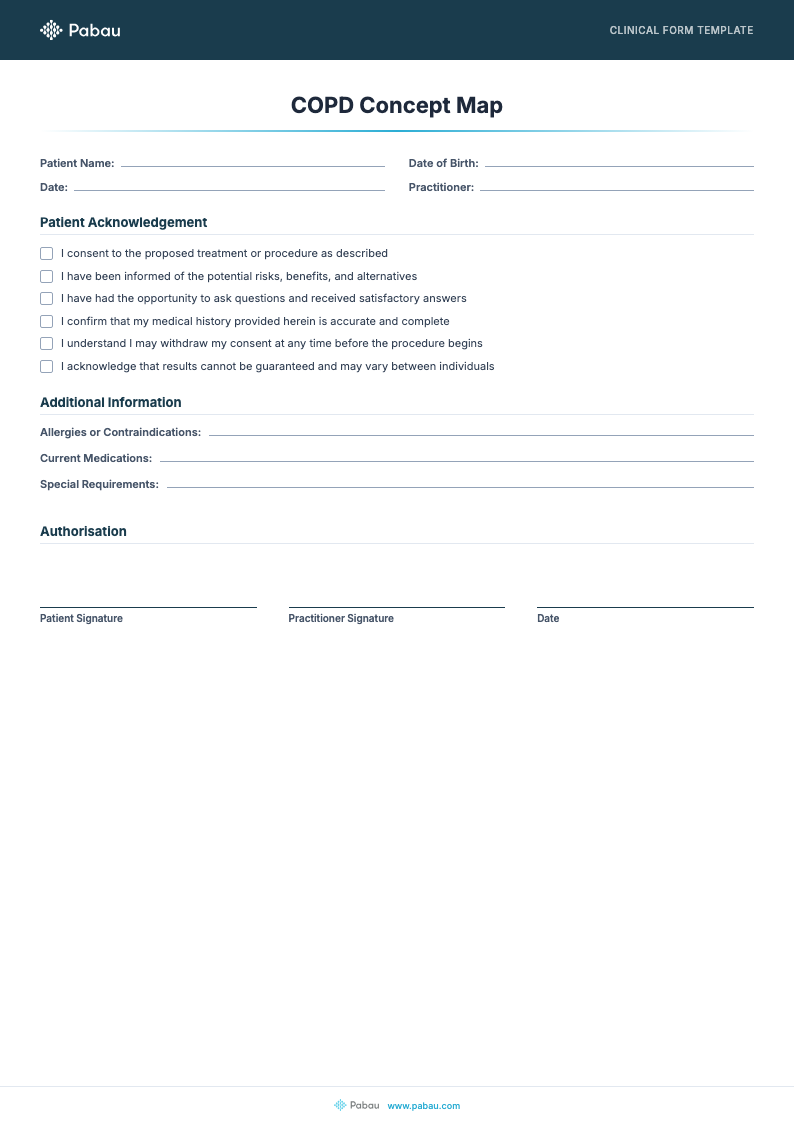
A nursing concept map is an educational and clinical tool that visually represents the relationships between patient assessment data and clinical decision-making. Unlike traditional linear care plans, a concept map organises information in a spatial, interconnected format-typically with a central patient diagnosis or presenting problem surrounded by linked concepts such as risk factors, symptoms, nursing diagnoses, interventions, and expected outcomes. The connections between these elements are labelled with linking phrases like “leads to,” “caused by,” “as evidenced by,” or “monitors,” making the clinical reasoning transparent.
The purpose of a nursing concept map extends beyond documentation. It serves as a teaching tool that helps nursing students develop higher-order thinking skills-specifically, the ability to analyse how different clinical factors interact. The American Nurses Association (ANA) recognises concept mapping as an evidence-based pedagogical approach for developing critical thinking in nursing education. By requiring students to draw connections between assessment findings and clinical decisions, concept maps build the diagnostic reasoning that underpins safe, effective nursing practice.
From a compliance perspective, concept maps support regulatory expectations for documented clinical reasoning. When auditors or educators review patient care records, a completed concept map demonstrates that the nurse considered the full clinical picture-not just applied protocol mechanically. This documentation approach aligns with standards set by regulatory bodies and academic accreditation organisations for nursing programme oversight.
Completing a nursing concept map follows a structured five-step process that mirrors clinical assessment and care planning workflows. Each step builds on the previous, ensuring comprehensive coverage of patient data and clinical reasoning.
The strength of this structured approach lies in its transparency. When a nursing concept map is completed thoroughly, anyone reviewing it-whether an educator, colleague, or auditor-can immediately see your clinical reasoning. This clarity reduces miscommunication and ensures consistent care delivery across shifts and care settings.

Automate clinical intake forms, concept maps, and care planning templates with AI-powered documentation tools.

Nursing students form the primary audience for concept map templates, particularly those in pre-licensure programmes (ADN and BSN students). Nursing faculty require concept maps as graded assignments because they demonstrate clinical reasoning development. However, the tool’s value extends well beyond the classroom.
Graduate nursing students pursuing advanced practice roles (nurse practitioner, clinical nurse specialist, nurse educator) use concept maps to develop more sophisticated diagnostic reasoning. Mental health nurses, community health nurses, and occupational health nurses incorporate concept mapping into their practice because it reveals complex interactions between physical health, psychological factors, and environmental stressors. Mental health clinics and therapy practices particularly benefit from concept-based care planning when managing patients with comorbid conditions or complex psychosocial presentations.
Nurse educators and clinical preceptors use concept maps as teaching tools to assess student understanding of patient care. Rather than reviewing narrative notes alone, educators can quickly visualise whether students have identified all relevant clinical data and made appropriate diagnostic connections. This visual assessment method saves time during student evaluation and provides clearer feedback on reasoning gaps.
Enhanced critical thinking: Concept maps force explicit connection between assessment data and clinical decisions. Rather than accepting diagnoses at face value, nurses must justify how specific findings support each diagnosis. This process strengthens diagnostic reasoning and reduces reliance on automatic thinking patterns that can mask clinical errors.
Comprehensive patient assessment: The visual structure ensures systematic coverage of all patient domains. A blank concept map acts as a checklist, prompting consideration of factors a narrative care plan might inadvertently omit. This comprehensive approach improves care quality and patient safety by preventing gaps in assessment.
Clear documentation of clinical reasoning: When auditors, regulators, or colleagues review a completed concept map, your clinical thought process becomes transparent. This accountability aligns with standards set by the National League for Nursing (NLN) and supports institutional compliance with documentation requirements for nursing care.
Improved collaborative communication: Concept maps created using consistent visual conventions allow nurses on different shifts or in different care settings to quickly grasp the full clinical picture. This shared understanding reduces care fragmentation and improves handoff communication.
Support for evidence-based practice: Mapping interventions directly to specific diagnoses makes it easier to justify your approach using research evidence. Auditors reviewing your documentation can immediately see whether you selected interventions aligned with current clinical guidelines.
Traditionally, concept maps were drawn by hand on paper or created using generic diagramming software. Modern clinical practice increasingly incorporates digital concept mapping tools integrated into electronic health record (EHR) systems and practice management platforms. Digital forms and clinical templates allow nurses to complete concept maps within the same interface where they document assessments, orders, and outcomes-reducing redundant data entry and improving workflow efficiency.
Digital platforms also enable visual linking and templated structure that guides users through concept map creation. Rather than starting with a blank canvas, clinicians select from predefined components (assessment categories, common nursing diagnoses, standard interventions) and create visual connections. Some platforms use AI-assisted documentation tools to suggest relevant diagnoses and interventions based on assessment data entered-accelerating the concept mapping process while maintaining clinician oversight of final documentation.
The integration of concept mapping into digital workflows transforms it from an academic exercise into a practical tool for daily clinical practice. Nurses working in busy acute-care or community settings can complete structured concept maps in minutes rather than hours, supporting both clinical reasoning and documentation compliance without adding administrative burden.
Use clear, specific linking phrases: Rather than drawing lines between concepts, label each connection explicitly. Phrases like “leads to,” “caused by,” “as evidenced by,” “prevents,” and “monitors” make your clinical reasoning transparent. Vague connections obscure reasoning and undermine the educational value of concept mapping.
Organise by hierarchy or colour-coding: Position more central or severe diagnoses near the patient at the map’s centre. Use colour to reflect clinical priority-red for acute risks, yellow for moderate concerns, green for stable areas. This visual organisation helps any reviewer quickly grasp the acuity hierarchy without reading every label.
Include specific, measurable data: Rather than writing “fever,” document “temperature 39.2°C at 14:30 hours.” Rather than “breathing difficulty,” record “respiratory rate 28/min, oxygen saturation 89% on room air.” Specific data strengthens your diagnostic justification and supports evidence-based intervention selection.
Link every intervention to a diagnosis: Do not list interventions in isolation. Show explicitly how each action addresses a specific nursing diagnosis. This link demonstrates that you did not apply interventions automatically, but selected them based on patient needs identified through assessment.
Filter your concept map during handoff. Highlight the most critical diagnoses and current interventions using colour or markers, and walk the incoming nurse through these high-priority areas first. This focused approach ensures patient-specific safety concerns transfer clearly between shifts.
A nursing student caring for a 68-year-old patient with COPD might create a concept map positioning “Impaired gas exchange” at the centre, with supporting assessment data (low O₂ sat, productive cough, barrel chest) linked by “as evidenced by.” From that diagnosis, arrows connect to three nursing interventions: “Position upright,” “Monitor oxygen saturation,” and “Teach pursed-lip breathing.” Each intervention then links to expected outcomes: “Oxygen saturation ≥94%,” “Dyspnoea reduced by patient report,” and “Patient demonstrates correct breathing technique.”
A mental health nurse might structure a concept map around “Ineffective coping” for a patient presenting with anxiety and insomnia. Assessment data (racing thoughts, difficulty concentrating, no sleep in 48 hours) connect to the diagnosis, which then branches into nursing diagnoses like “Sleep deprivation” and “Anxiety disorder.” Interventions include “Teach progressive muscle relaxation,” “Create consistent sleep schedule,” and “Arrange psychiatrist consultation.” This visual structure reveals how the nurse addressed root causes rather than just symptoms-supporting holistic care evaluation during clinical supervision.

Want a structured framework for clinical intake? Pabau’s digital capture forms streamline initial patient assessment collection and integrate seamlessly with concept mapping workflows.
Need to organise patient assessment data visually? Client record management systems provide structured data entry that supports concept map creation and retrieval during care planning.
Looking for educational resources on nursing diagnosis? Mental health EMR documentation includes diagnostic frameworks and assessment tools aligned with nursing concept mapping approaches.
Start with your patient’s central health problem or presenting complaint at the map’s centre. Collect comprehensive assessment data and position it around the patient. Link assessment findings to appropriate nursing diagnoses using phrases like “as evidenced by.” From each diagnosis, draw connections to specific nursing interventions and expected outcomes. Use clear labelling and visual organisation to show all relationships.
Yes. Concept maps are particularly effective for collaboration because they make clinical reasoning explicit and visual. When team members review the same concept map, they understand the shared care priorities and can identify any gaps or disagreements in reasoning. Digital concept maps allow multiple clinicians to contribute and update the map in real-time, supporting coordinated care across shifts and disciplines.
The primary purpose is to develop and demonstrate critical clinical reasoning. Concept maps require nurses to move beyond task-focused care to systems thinking-understanding how different patient factors interact. This approach strengthens diagnostic accuracy, supports evidence-based intervention selection, and provides transparent documentation of clinical decision-making for educators, supervisors, and auditors.
Yes. Beyond traditional paper-based templates, nursing programmes and healthcare institutions use digital diagramming software (Lucidchart, Creately, Canva) and integrated EHR platforms that include concept mapping features. Many modern practice management systems now include templated concept map creation, reducing manual drawing time and improving consistency across the organisation.
Concept maps transform care planning from a checklist exercise into evidence-based clinical reasoning documentation. By linking assessment data to diagnoses and interventions, concept maps ensure comprehensive coverage of patient needs and justify intervention selection using assessment findings. This approach improves care quality, supports student learning, and provides clear documentation of how clinical decisions were made.
A nursing concept map template transforms scattered assessment data into structured clinical reasoning-making your diagnostic thinking visible and transparent. Whether you are a nursing student developing critical thinking skills, an educator assessing student understanding, or a practising nurse streamlining care planning, a concept map template provides the scaffolding for comprehensive, evidence-based patient care. Download the free template provided above and begin mapping patient assessments today. Your clinical reasoning will become sharper, your documentation clearer, and your team collaboration stronger.