

Primary & Preventive Care Wellness
Small Bowel Obstruction Nursing Care Plan Template
A comprehensive small bowel obstruction nursing care plan template provides stru...

March 13, 2026

Discover free eBooks, guides and med spa templates on our new resources page


Buy now, pay later is now available in Pabau

Read case studies from our satisfied clients

Compare Pabau with alternative systems
 Integrations
 Measure Pabau savings
  Our security commitment
  About us
Learn why this holistic care and aesthetic medicine clinic chose Pabau to power patient care and performance.
Read more

Treatment plans improve patient compliance and clinical outcomes by 40% when clearly communicated
SOAP note integration creates continuity between sessions and supports insurance documentation
Weekly progress reviews catch stalled treatment early and enable timely intervention adjustments
A structured assessment phase reduces session-to-session variation and improves consistency
A chiropractic treatment plan is the cornerstone of effective patient care. It transforms initial assessment findings into a actionable clinical roadmap, detailing specific interventions, measurable goals, and re-evaluation timelines. Without one, chiropractors risk inconsistent treatment, poor patient compliance, and documentation gaps that invite regulatory scrutiny.
This guide covers how to structure a comprehensive chiropractic treatment plan, integrate it with SOAP note workflows, communicate it to patients, and use it to track progress across weeks and months. You’ll also find a free downloadable template designed for immediate clinic adoption.
A comprehensive documentation template for structuring patient care pathways in chiropractic practice. Includes assessment sections, treatment goal hierarchies (primary, short-term, long-term), weekly progress reviews, monthly re-assessment protocols, and practitioner notes fields for continuity of care.
Download template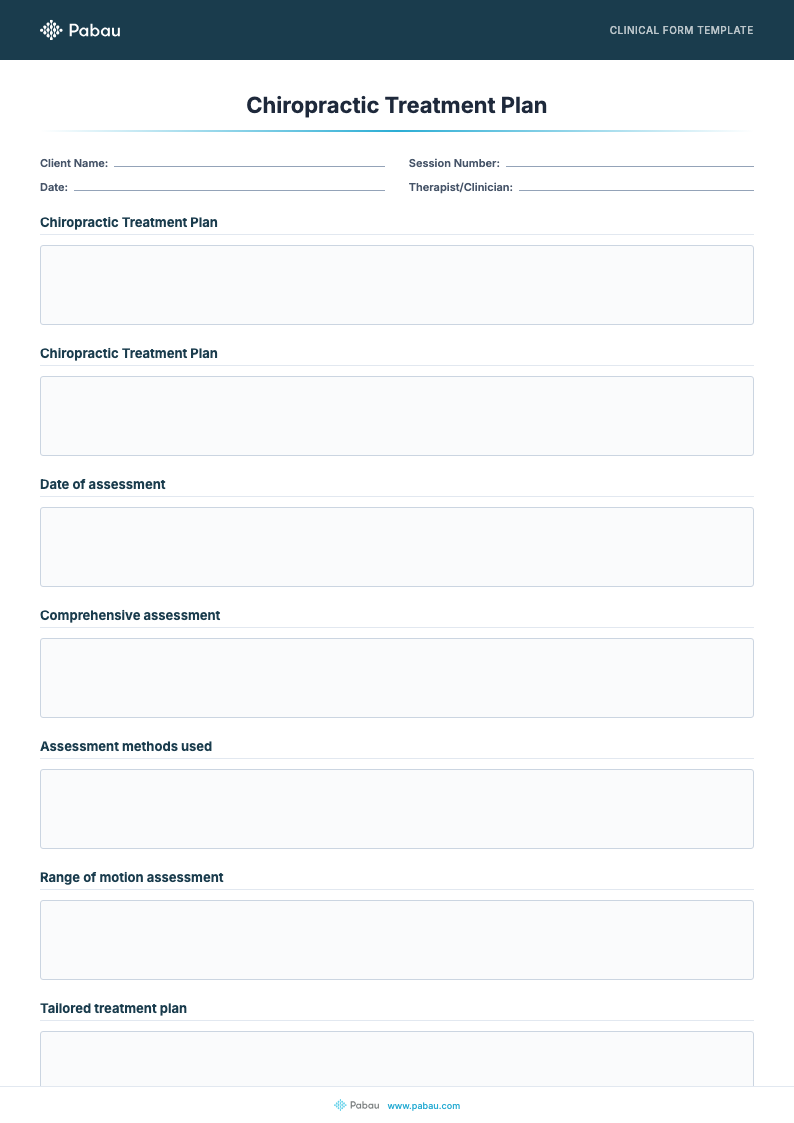
A chiropractic treatment plan is a written document that outlines the structured approach to patient care. It captures the clinical findings from the initial assessment, translates them into specific, measurable treatment goals (primary, short-term, and long-term), and defines the interventions, frequency, and timeline required to achieve them.
Unlike a casual clinical note, a treatment plan serves as a contract between clinician and patient. It sets expectations, establishes accountability, and creates a documented reference point for measuring progress. For chiropractors working in regulated jurisdictions (UK, US, Canada, Australia), a written treatment plan is often a professional standard and a compliance requirement under healthcare documentation laws.
The plan typically includes: patient presenting complaints, assessment findings, diagnosis (where applicable), goal hierarchy, proposed interventions, treatment frequency, re-evaluation dates, and space for ongoing clinical notes. It sits at the intersection of clinical documentation and patient communication-it must be precise enough for professional audit yet clear enough for a patient to understand without medical training.
Many chiropractors integrate treatment plans with SOAP note workflows. The SOAP structure (Subjective, Objective, Assessment, Plan) documents each session, while the treatment plan provides the overarching strategy those individual sessions execute. Together, they create a continuous record of clinical decision-making, which is essential for both patient safety and regulatory compliance.
Creating and maintaining an effective chiropractic treatment plan requires a systematic workflow. The following five operational steps ensure your documentation is both clinically sound and audit-ready.
Throughout the course of treatment, reference the plan at every session. Use the “Practitioner notes/comments” and “Additional notes” sections to log progress against stated goals. If goals are met ahead of schedule or stalled, document the reason and adjust accordingly. This running record of decision-making is invaluable if a claim arises or a regulator conducts an audit.

Pabau's digital forms and clinical notes features help you create, store, and track treatment plans across all patient records with built-in compliance checkpoints.

The chiropractic treatment plan template applies across multiple clinical and business contexts. Solo practitioners rely on treatment plans to standardise their own workflows. Multi-practitioner clinics use them to ensure consistency when patients see different chiropractors on different days. Clinic owners and practice managers use treatment plans as a quality assurance tool-they’re measurable evidence that the clinic delivers structured, goal-oriented care rather than reactive, session-to-session adjustments.
Chiropractors working in regulated markets (UK with CQC oversight, US with state licensing boards, Canada with provincial regulators) find treatment plans essential for demonstrating clinical governance. Insurance companies-whether private health insurers, workers’ compensation programs, or auto injury claims-expect written treatment plans as supporting documentation. Without one, claim denials citing “lack of documented medical necessity” are more likely.
Sports medicine clinics, rehabilitation facilities, and integrative practices also benefit. Any setting where multiple patients rotate through multiple practitioners requires a shared, written reference point. Treatment plans bridge that communication gap. Patient-facing clinics (those marketing wellness or preventive care) find that written treatment plans increase perceived professionalism and patient buy-in-patients are more likely to commit to a structured program than to open-ended appointments.
Regulatory compliance and audit readiness. The presence of a written, signed treatment plan demonstrates to CQC inspectors, licensing boards, and insurance auditors that your clinic operates with documented clinical governance. If a complaint arises, a treatment plan with contemporaneous notes shows you acted deliberately and with patient consent, not reactively.
Improved insurance reimbursement. Payers scrutinise claims for medical necessity. A treatment plan showing clear assessment, measurable goals, and a defined timeline significantly reduces claim denials. It answers the payer’s question: “Why is this patient receiving this treatment?” with documented clinical reasoning rather than guesswork.
Increased patient compliance. Patients who see their goals in writing, understand the frequency commitment, and receive regular re-assessment feedback show higher compliance rates. Written plans create psychological accountability. Patients are less likely to drop out mid-course when the pathway is explicit and progress is being tracked.
Reduced clinical variation. In multi-practitioner settings, a shared treatment plan ensures all clinicians are working toward the same goals. This reduces the “which practitioner did I see last week and what did they do?” confusion that undermines patient experience and clinical continuity.
Measurable progress tracking. Treatment plans with quantified short-term goals (e.g., “increase cervical rotation from 30° to 40° by week 2”) create objective benchmarks. This enables real-time detection of treatment plateaus. If a patient isn’t progressing as expected, you catch it early and adjust (additional imaging, referral, treatment modification) rather than continuing ineffective care.
Document baseline measurements during the initial assessment. Record pre-treatment range of motion, pain scores, postural deviations, and functional limitations. Use the same measurement tools and positions at every re-assessment. Consistency in measurement methodology makes goal attainment objective and auditable.
The SOAP note format (Subjective, Objective, Assessment, Plan) is the industry standard for clinical documentation across healthcare. For chiropractors, SOAP notes and treatment plans serve complementary functions: the treatment plan is the strategy document; SOAP notes are the tactical, session-by-session execution record.
Subjective section: Record what the patient reports about their symptoms, functional limitations, progress since the last visit, and any lifestyle factors affecting recovery. “Patient reports decreased neck stiffness over the past week. Still unable to turn head fully to the right. Pain level down from 7/10 to 5/10.”
Objective section: Document clinical findings from your assessment: palpation, range of motion measurements, orthopedic tests, imaging results if relevant. Tie measurements to baseline. “Cervical rotation to the right: 35° (baseline 25°, goal 45° by week 4). Trigger point tenderness in upper trapezius reduced compared to previous session.”
Assessment section: Synthesise the subjective and objective findings. Reference the overarching treatment plan. “Patient tracking toward short-term goal of improved cervical mobility. No red flags observed. Continue current intervention plan.”
Plan section: Document interventions delivered this session and modifications to future sessions. “Continued manual therapy to upper trapezius and cervical spine. Prescribed home exercises (neck stretches, postural corrections). Next session: re-assess rotation and discuss occupational ergonomics. No changes to frequency at this time.”
A clinic using AI-powered clinical documentation tools can generate SOAP note structure automatically from voice dictation, reducing documentation time whilst maintaining the detail required for continuity and compliance. Pairing AI-assisted notes with a structured treatment plan creates a powerful record-keeping system.
One of the most critical decisions in your treatment plan is defining frequency. Underscore it, and patients may not improve. Overscore it, and patients may drop out due to cost or time burden. Evidence-based guidance helps navigate this balance.
A common pattern in chiropractic practice: acute musculoskeletal conditions (recent neck or back injury) often respond best to 3-4 visits per week for the first 2-4 weeks, tapering to 2-3 visits weekly for weeks 4-8, then 1 visit weekly for maintenance or resolution. This graduated approach front-loads treatment during the acute inflammation phase when tissues are most responsive, then pulls back as function improves.
Subacute or chronic conditions (pain duration 4-12 weeks) may begin at 2-3 visits per week for 4-6 weeks, then transition to weekly or bi-weekly visits. Chronic long-standing conditions (pain > 12 weeks) often stabilise at 1-2 visits per week indefinitely or until functional plateau is reached.
Patient compliance correlates strongly with clarity. When your treatment plan explicitly states “Week 1-4: 3 visits per week. Week 5-8: 2 visits per week. Week 9 onwards: 1 visit per week as needed,” patients know what to expect. They can plan their schedules and budget accordingly. Ambiguity (“come in as often as you can”) leads to missed appointments and treatment abandonment.
Use your weekly progress review checkpoints to validate your frequency assumption. If a patient shows good progress at current frequency, maintain it. If stalled, consider whether increasing frequency might help-or whether the diagnosis or intervention strategy needs revision. Document the reasoning behind any frequency change. This demonstrates clinical thinking rather than arbitrary decision-making.
Avoid vague language. Do not write “pain improved” or “patient doing well.” Instead: “Pain decreased from 8/10 to 5/10 on numeric pain rating scale” or “Able to sit at desk for 2 hours without symptom exacerbation (previously 30 minutes).” Specificity is auditable. Vagueness invites scepticism from payers and regulators.
Use consistent measurement tools. If you measure cervical range of motion with an inclinometer at baseline, use the same tool and positioning at every follow-up. Document the method: “Cervical rotation measured supine with subject’s head in neutral. Inclinometer placed at vertex. Measured to first resistance.” This consistency makes goal attainment verifiable.
Link each note to the treatment plan. In your SOAP note, reference the patient’s stated goals: “Progress toward short-term goal: patient now able to drive 30 minutes without neck stiffness (goal: drive 1 hour by week 4).” This creates an auditable trail showing you’re tracking the patient’s own priorities, not just applying generic treatment.
Document informed consent explicitly. At the initial treatment plan meeting, note that you discussed the findings, goals, frequency, timeline, and potential risks or limitations. If the patient has contraindications (e.g., severe osteoporosis, anticoagulant therapy), document how you’ve modified the treatment plan to account for them. “Patient on warfarin; plan excludes high-velocity thrusts; soft tissue mobilisation and flexion-distraction prioritised.”
Many chiropractors use digital forms and templates within their practice management system. Structured digital forms guide clinicians through required fields, reducing omissions. They also create searchable, timestamped records that are easier to audit than handwritten notes.

Looking for guidance on clinical outcome measurement? Safer Clinical Notes provides a framework for documentation that meets professional standards and withstands regulatory scrutiny.
Need to understand post-treatment care communication? Pre- and Post-Care Features allow you to send automated, personalised home exercise and lifestyle guidance to patients, reinforcing the treatment plan between sessions.
Want to streamline patient intake for treatment planning? Chiropractic Intake Form Template captures the presenting complaint, medical history, and lifestyle factors needed to inform your treatment plan efficiently.
A well-structured chiropractic treatment plan transforms patient care from reactive, session-to-session adjustments into a deliberate, measurable clinical pathway. It protects your practice through documentation, improves patient compliance through clarity, and enables objective progress tracking through goal hierarchies and re-evaluation schedules.
The template provided above gives you a ready-to-use framework. Integrate it with SOAP note documentation, define realistic treatment frequencies based on evidence and patient need, and document your clinical reasoning at every step. The result is a record that satisfies both your clinical instincts and your regulatory obligations-a powerful combination for a sustainable, professional chiropractic practice.
Requirements vary by jurisdiction. In the UK, CQC-regulated clinics are expected to maintain documented care plans. In the US, state licensing boards and insurance companies often require written treatment plans to support medical necessity claims. In unregulated settings, whilst not legally mandated, a treatment plan is a professional standard that demonstrates competence and protects against complaints.
Review the plan at every session and formally re-assess at the scheduled checkpoints (typically weekly for acute cases, monthly for others). If the patient has made significant progress toward a goal, document it. If stalled, modify the plan-adjust frequency, change interventions, or refer for imaging or secondary opinion. Documenting the reason for any change shows clinical reasoning.
No. A generic template is a starting point, but each plan must be tailored to the individual patient’s presentation, comorbidities, lifestyle, and functional goals. A 65-year-old with osteoporosis and chronic neck pain needs a different frequency and intervention strategy than a 35-year-old athlete with acute sports-related whiplash. Document what makes each plan specific to that patient.
Discuss the rationale. Explain your assessment findings, goals, and the evidence supporting the proposed frequency. If the patient prefers a different approach (e.g., fewer visits), document their preference and your clinical advice. You might agree on a modified plan or obtain written acknowledgement that the patient is declining your recommended treatment. This respects autonomy whilst protecting your record.
Insurers expect documented medical necessity. A treatment plan showing your assessment, measurable goals, and defined timeline demonstrates that each session serves a clinical purpose. Claims supported by a clear treatment plan have higher approval rates than those submitted without documentation of the treatment strategy.
Yes. Digital practice management systems often include customisable treatment plan templates. Digital completion is faster, easier to edit during follow-up sessions, searchable, and automatically timestamped. It also integrates with patient records and SOAP note workflows, creating a cohesive documentation system.