

Primary & Preventive Care Wellness
Small Bowel Obstruction Nursing Care Plan Template
A comprehensive small bowel obstruction nursing care plan template provides stru...

March 13, 2026

Discover free eBooks, guides and med spa templates on our new resources page


Buy now, pay later is now available in Pabau

Read case studies from our satisfied clients

Compare Pabau with alternative systems
 Integrations
 Measure Pabau savings
  Our security commitment
  About us
Learn why this holistic care and aesthetic medicine clinic chose Pabau to power patient care and performance.
Read more

Systematic ADHD screening improves early detection and treatment planning.
The 20-item screening format captures inattention, hyperactivity, and impulse control.
Pre-appointment completion increases clinical efficiency and patient engagement.
Digital screening workflows integrate seamlessly into intake processes.
Screening results inform referrals for further diagnostic evaluation.
An ADHD screening test template provides clinicians with a structured, evidence-based tool to systematically assess potential attention deficit hyperactivity disorder symptoms during patient intake. This adhd screening test template captures the core behavioural patterns-inattention, hyperactivity, impulsivity, and childhood history-that inform whether further diagnostic assessment is clinically indicated. Mental Health America and the Attention Deficit Disorder Association (ADDA) emphasise standardised screening as a foundational step in responsible ADHD assessment, particularly in primary care and mental health settings where time constraints often compress diagnostic evaluation.
A comprehensive 20-item screening questionnaire covering attention difficulties, hyperactivity symptoms, impulse control challenges, and childhood history to support initial ADHD assessment.
Download template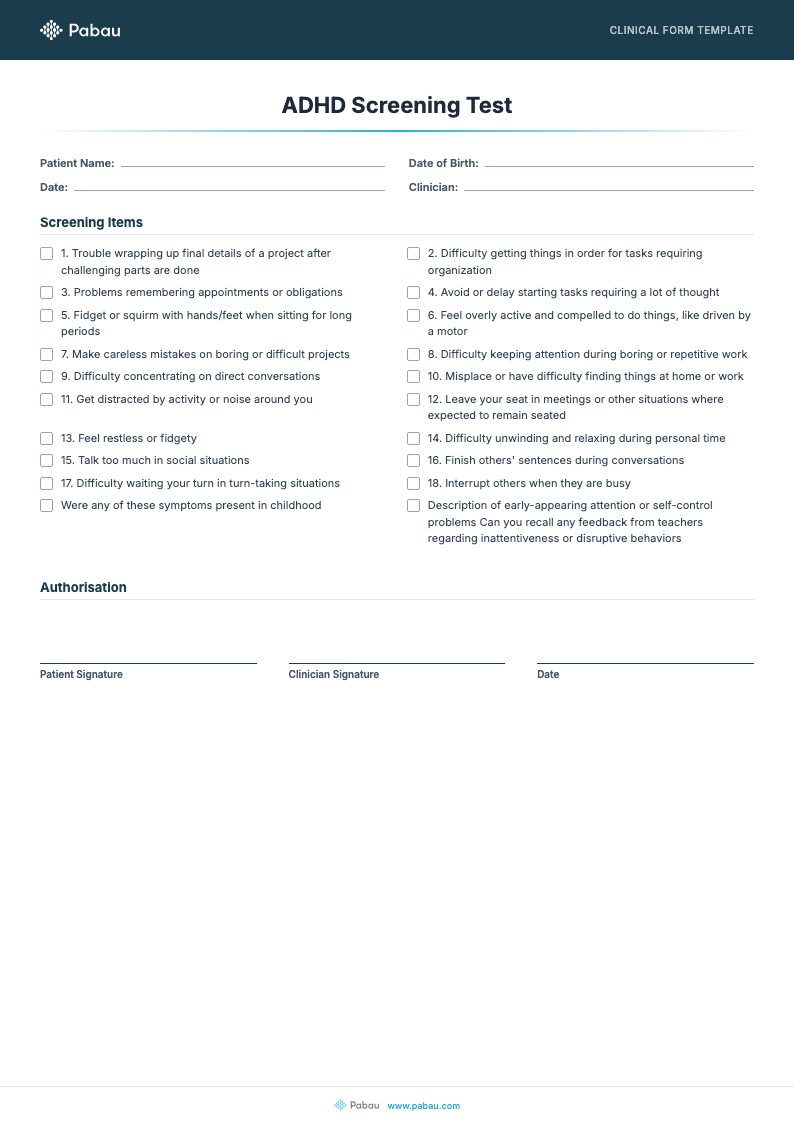
An ADHD screening test is a validated self-report instrument designed to identify behavioural patterns consistent with Attention Deficit Hyperactivity Disorder. Unlike a diagnostic assessment, which requires specialist evaluation and formal testing, a screening questionnaire provides clinicians with objective, systematically collected data to determine whether further evaluation is warranted.
The template typically contains 15-20 items assessing three core symptom domains: inattention (trouble completing tasks, disorganisation, forgetfulness), hyperactivity (restlessness, fidgeting, excessive talking), and impulsivity (interrupting others, difficulty waiting turns, rushing through tasks). The questionnaire also asks about symptom onset in childhood-a key diagnostic criterion in DSM-5 ADHD diagnosis.
From a clinical and legal standpoint, standardised screening forms document that you have employed a systematic, evidence-based approach to identifying potential ADHD. This protects both patient safety (ensuring appropriate referrals) and clinical liability (demonstrating professional care standards). The form becomes part of the permanent health record, providing a baseline for longitudinal tracking and treatment monitoring.
Implementing the ADHD screening test in your clinical workflow involves five practical steps:
Using digital screening tools automates this workflow. Patients complete the questionnaire online, responses populate automatically into the clinical record, and you receive a summary before the appointment-eliminating paper shuffling and improving clinical preparation.

Pabau's digital forms platform lets you deploy screening questionnaires pre-appointment, auto-populate patient records, and track responses over time-all within one integrated system.

ADHD screening templates serve multiple healthcare practitioner types and settings:
Mental health clinicians-psychologists, therapists, counsellors, and psychiatrists-use the template to screen patients presenting with focus complaints, restlessness, or emotional dysregulation. ADHD often co-occurs with anxiety, depression, and trauma, making systematic screening essential during initial intake.
Primary care practitioners-GPs, nurse practitioners, and physician assistants-employ screening questionnaires in routine physical exams and chronic disease visits. Adult ADHD often goes undiagnosed until adulthood when occupational demands expose organisational and time-management weaknesses.
Occupational therapists and speech-language pathologists working with neurodevelopmental populations screen for ADHD as part of comprehensive functional assessment. ADHD impacts executive function, sensory processing, and communication-all within their scope of evaluation.
Coaching practices and wellness clinics serving clients seeking performance optimisation or life planning often encounter undiagnosed ADHD. A brief screening helps identify whether medical referral is appropriate before proposing behavioural coaching.
Standardised assessment: A validated screening questionnaire ensures every patient is evaluated using identical criteria. This reduces clinician bias, improves reliability, and aligns with best practices endorsed by Mental Health America and ADDA.
Efficiency: Pre-appointment completion saves appointment time. Rather than conducting a lengthy unstructured interview, you review completed responses, clarify responses, and focus on functional impact and treatment planning.
Documentation clarity: The questionnaire creates an objective, time-stamped record of symptom endorsement at baseline. This supports clinical decision-making, referral letters, and insurance prior authorisation requests. If treatment begins, you have a documented baseline for measuring progress.
Patient engagement: Self-report forms invite patients into the diagnostic process. Many adults recognise themselves in screening items, validating their experience and increasing willingness to pursue further evaluation or treatment.
Regulatory compliance: Systematic screening demonstrates that your practice employs evidence-based protocols. If a complaint is ever filed, documentation of standardised assessment strengthens your position and shows professional accountability.
Filter responses by symptom domain. After reviewing the completed screening, count inattention items vs hyperactivity vs impulsivity. A patient endorsing primarily inattention items may present differently from one endorsing primarily hyperactivity-this distinction shapes your follow-up questions and referral recommendations.
Practices providing ADHD assessment and treatment rely on layered intake documentation. The screening questionnaire is your first-line tool; it is followed by deeper clinical history, cognitive assessment, or referral testing if indicated.
A comprehensive ADHD intake typically includes: (1) validated screening questionnaire (what you’re downloading here), (2) detailed developmental and medical history form, (3) symptom rating scales specific to ADHD presentation (e.g., ASRS-v1.1 for adults, Vanderbilt for paediatrics), (4) functional impact assessment (how symptoms affect work, relationships, self-care), and (5) childhood records or parent/teacher feedback when available.
The template provided aligns with DSM-5 diagnostic criteria for ADHD and captures the symptom domains assessed in clinical research. When combined with AI-powered clinical documentation tools, your follow-up notes can reference specific screening endorsements, creating a seamless narrative from screening → assessment → diagnosis → treatment planning.
A critical diagnostic criterion for ADHD is symptom onset in childhood. Adult patients often struggle to remember early school or family experiences, which is why the screening template includes direct questions: “Were any of these symptoms present in childhood?” and “Can you recall any feedback from teachers regarding inattentiveness or disruptive behaviours?”
Some adults discover ADHD only when occupational stress peaks-university, full-time employment, parenthood. Prior to that, high intelligence, supportive environments, or shorter task demands may have masked symptoms. Your screening dialogue should explore: Did teachers ever note daydreaming, incomplete homework, or behavioural concerns? Did parents struggle with organisation or punctuality? Understanding the developmental trajectory helps distinguish ADHD from situational stress or other disorders.
Store screening responses longitudinally. If a patient returns 6 months or 1 year into treatment, readministering the questionnaire quantifies symptom improvement and informs medication adjustments or therapy modifications.

Looking to deepen your ADHD assessment approach? Psychiatric Evaluation Template expands screening into full diagnostic formulation, covering comorbid conditions, medication history, and safety considerations.
Need to track ADHD treatment response over time? Measurements Tracking Software enables longitudinal symptom monitoring and automated progress reporting for your clinical team.
Want to integrate screening into automated intake workflows? Mental Health EMR Software embeds screening questionnaires into appointment scheduling, so patients complete forms before arrival and responses auto-populate clinical records.
An ADHD screening test template is an essential clinical tool that brings structure, consistency, and efficiency to mental health and primary care intake. By systematically assessing attention, hyperactivity, impulsivity, and childhood history, you create an objective foundation for diagnosis and treatment planning. The template supports both patient safety-ensuring appropriate referrals and avoiding missed diagnosis-and clinical accountability, documenting that you employed evidence-based assessment practices.
Downloading and implementing this free template today positions your practice to identify ADHD earlier, refer appropriately, and monitor treatment response with confidence.
Screening identifies potential ADHD symptoms and determines whether further evaluation is warranted. Diagnosis requires comprehensive assessment, often including standardised testing, cognitive evaluation, and rule-out of other conditions. A screening questionnaire is your starting point; referral to a psychiatrist or specialist clinic completes the diagnostic process.
This template is designed for adolescents and adults. Paediatric ADHD screening requires age-appropriate language and norm-referenced rating scales (e.g., Vanderbilt, CBCL). Consult paediatric ADHD specialists or your professional association for child-specific screening tools.
The template captures symptom endorsement. Tally inattention, hyperactivity, and impulsivity items. Patients endorsing ≥6 items in multiple domains warrant further assessment. However, screening scores are not diagnostic thresholds-they are conversation starters. Clinical context, functional impairment, and developmental history inform your clinical judgment.
Screening-positive patients should be referred to a psychiatrist, psychologist, or ADHD specialist for formal diagnostic evaluation. Your role is to identify the potential concern and facilitate appropriate specialist referral. Document your screening findings and include them in the referral letter to guide the specialist’s evaluation.
The template itself is a clinical tool. HIPAA and data protection compliance depends on how you store and transmit completed forms. Digital screening platforms that are HIPAA-compliant ensure patient data is encrypted, access-controlled, and audited. Verify your practice management software’s compliance status before deploying digital screening workflows.
Yes. While the core 20 items represent validated screening content, you may add practice-specific fields (location, clinician name, insurance information) or expand the childhood history section. Avoid removing core symptom items, as this may reduce screening sensitivity and validity.