










Key takeaways
HCPCS code H2033 describes multisystemic therapy (MST) for juveniles, billed in 15-minute increments under HCPCS Level II.
H2033 is reimbursed through Medicaid and state behavioral health programs. No national Medicare fee schedule rate applies.
Missing modifiers, incorrect unit counts, and thin supervisor oversight records are the top three reasons H2033 claims are denied.
Practice management software like Pabau helps behavioral health practices track H2033 units, modifiers, and session documentation in one place.
HCPCS code H2033 is the HCPCS Level II code for multisystemic therapy (MST) for juveniles, billed per 15 minutes. Each unit covers 15 minutes of direct MST service time.
H-codes cover mental health and substance use services that CPT codes describe poorly. CMS maintains the code set, but each state Medicaid program sets its own unit limits, modifiers, and documentation rules for H2033.
What is multisystemic therapy for juveniles?
Multisystemic therapy (MST) is an intensive, evidence-based intervention for youth aged roughly 12 to 17. It is used with young people who show serious antisocial behavior, including juvenile justice involvement, substance use, and severe behavioral health concerns. The AAPC HCPCS reference lists H2033 in the H-code range covering behavioral health and substance use services.
MST therapists work with the whole family system, including parents, teachers, peers, and community contacts. Sessions happen in the home, school, or community rather than a practice office. That delivery model is why MST is billed under H-codes instead of CPT psychotherapy codes, which assume an outpatient setting.
The Substance Abuse and Mental Health Services Administration (SAMHSA) recognizes MST as an evidence-based practice. Practices billing H2033 need to deliver a clinically faithful version of the model. State Medicaid programs and MST Services, the model developer, may require therapist certification as a condition of reimbursement.
- Population served: Juveniles aged 12 to 17 with serious behavioral and emotional problems
- Delivery setting: Home, school, and community environments
- Session format: Intensive and time-limited, typically three to five months of active treatment
- Evidence base: Recognized by SAMHSA as an evidence-based practice
- Model fidelity: Therapists may require certification by MST Services, so confirm with your state Medicaid agency
H2033 provider eligibility: Who can bill this code?
Provider eligibility for HCPCS code H2033 varies by state Medicaid program. There is no single federally mandated provider type for this code. Most state programs allow billing by the categories below, subject to state credentialing and enrollment rules:
- Licensed clinical social workers (LCSWs)
- Licensed professional counselors (LPCs) or licensed mental health counselors (LMHCs)
- Licensed psychologists
- Master’s-level therapists with MST certification
- Certified MST therapists working under a licensed clinical supervisor
- Behavioral health organizations enrolled as Medicaid providers in states with agency-level billing
Practices offering mental health services to juveniles should check their state Medicaid agency’s provider qualification rules before billing H2033. Some programs require billing under a licensed clinician’s supervision, with the supervisor’s NPI on the claim. A few states require the treating organization to hold MST program certification from MST Services.
Practices running MST inside a wider psychiatry service face one more question. Confirm whether your state permits billing under individual clinician NPIs, or requires agency-level enrollment for H-codes.
Billing units, time requirements, and claim submission
H2033 is a time-based code billed in 15-minute increments. Each unit represents one 15-minute block of direct MST service time. A 60-minute session generates 4 units, and a 90-minute session generates 6 units.
Many state Medicaid programs apply a midpoint rounding rule to partial units. Under that rule, 8 or more minutes rounds up to the next unit, and fewer than 8 minutes is not billable.
Maximum units per day are set by individual state Medicaid programs, not by CMS nationally. Some states cap H2033 at 8 units per day, while others impose weekly or monthly maximums.
Check the daily and periodic unit limits in your state’s Medicaid billing manual before submitting claims. Exceeding a state limit is one of the most common denial triggers for this code.
Pro Tip
Document the start and end time of every MST contact in the session note, not just the total duration. Many state Medicaid audits for H2033 require time-stamped entries to verify that billed units match the time the therapist spent with the family. A note that says ‘one-hour session’ without start and end times will not survive scrutiny.
Modifiers used with HCPCS code H2033
Modifiers clarify the circumstances under which H2033 was delivered. Several are commonly required by state Medicaid programs and managed care organizations. Submitting without a required modifier is a primary denial reason for behavioral health H-codes.
Modifier rules are state-specific. HN, HO, and HP are staff-level modifiers that many Medicaid programs use to distinguish the credential of the person delivering the service. U1 through U9 are free-form state-assigned modifiers, so their meaning differs across programs. Review your state Medicaid behavioral health billing manual before applying one.
Medicaid reimbursement and fee schedule for H2033
HCPCS code H2033 has no national Medicare fee schedule rate. H-codes are excluded from Medicare payment, which the CMS Physician Fee Schedule lookup tool confirms. Payment comes from state Medicaid programs, Medicaid managed care organization (MCO) contracts, and some state-funded behavioral health grant programs.
Rates vary widely. A state with dedicated MST waiver funding may pay materially more per unit. A state where MST is not carved out in the fee schedule can pay far less.
Get current rates directly from your state Medicaid agency’s published fee schedule, and from every MCO you contract with. MCO rates can sit above or below the base Medicaid rate.
H2033 fee schedule 2025 to 2026
The table below gives illustrative reimbursement ranges drawn from publicly available state Medicaid fee schedules. Treat the figures as benchmarks. Rates change annually and vary by state, MCO, and contract type.
How to confirm your state’s H2033 rules
Four checks cover almost everything that varies between states. Work through them once for each state you bill in, then again whenever the fee schedule is reissued.
- The rate: find H2033 on the state Medicaid behavioral health fee schedule and note the effective date
- The unit cap: record the daily, weekly, or monthly maximum, then compare it to a typical MST week
- The modifiers: confirm which staff-level and state-defined modifiers the program treats as mandatory
- Prior authorization: check whether authorization is required before the first session, and how many units it covers
Save the answers next to the fee schedule’s effective date. That gives your billing team one place to look when a claim denies, and a prompt for when the checks need repeating.
H2033 documentation requirements
Documentation is where H2033 claims succeed or fail at audit. Medicaid programs review behavioral health H-codes closely, and MST requirements go beyond a standard outpatient session note. Practices using structured documentation workflows meet those requirements more consistently.
- Session start and end times: record the exact time the billable contact began and ended, not just the total duration
- Individuals present: list every participant, such as the youth, family members, a teacher, or a probation officer
- Treatment goals addressed: note which treatment plan goals or MST targets the contact focused on
- Interventions used: describe the specific MST intervention strategies applied during the session
- Youth and family response: document the observable response to the intervention, not only what the therapist did
- Plan for next contact: include the planned focus and expected participants for the next session
- Supervisor oversight records: most state programs require evidence of weekly clinical supervision in the client record
- MST model fidelity: some states require quarterly adherence assessments or MST Services consultation logs
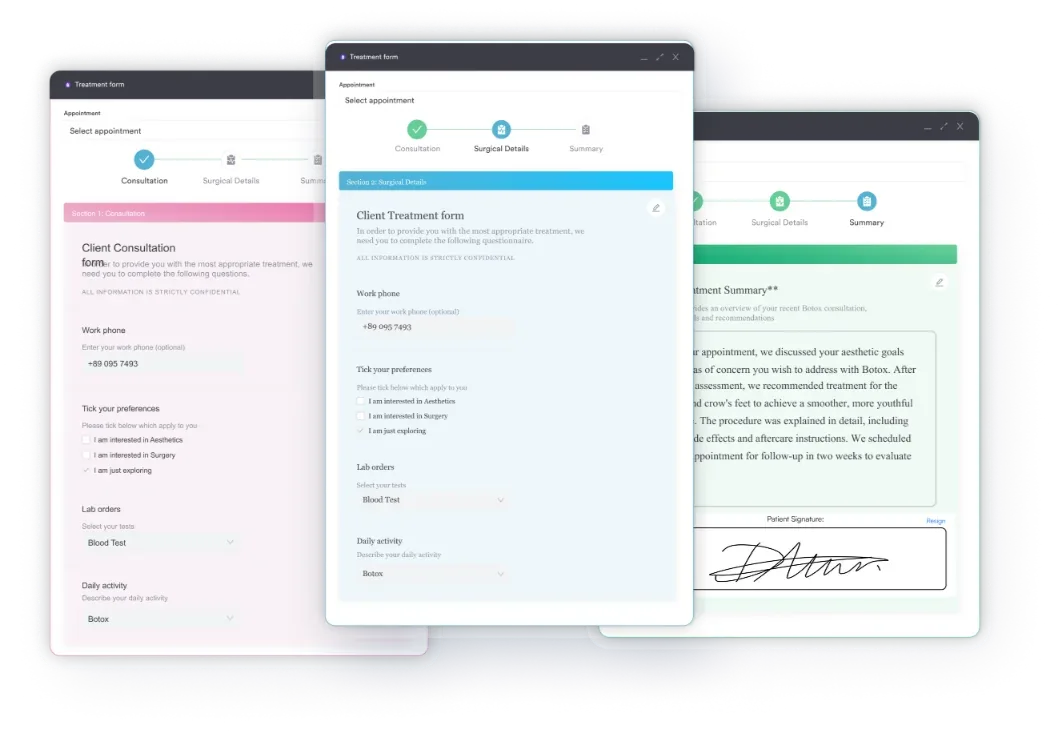
Build these requirements into your digital intake forms and session notes. A biller is then far less likely to submit a claim without the supporting records attached. A shared progress note format keeps every clinician capturing the same elements in the same order.
HIPAA-compliant storage of these records is a baseline requirement. Review your HIPAA documentation practices to confirm that behavioral health session records are handled correctly.
Pro Tip
Audit your own documentation quarterly, before Medicaid does it for you. Pull 10 random H2033 claims from the prior 90 days and check that every required element is present in the matching session note. Practices that find the missing pieces themselves can fix them without the financial exposure of a formal audit finding.
Common billing errors and how to avoid them
Denials for HCPCS code H2033 cluster around a consistent set of preventable errors. Knowing the pattern lets billers build pre-submission checks that catch problems before a claim reaches the payer.
- Incorrect unit count: billing scheduled time rather than contact time is the most frequent error. Count only the time the therapist was engaged with the youth or family.
- Missing or wrong modifier: many state programs require a staff-level modifier on every H2033 claim, and submitting without one usually means automatic denial
- Exceeding state unit limits: billing more units per day, week, or month than the state allows will trigger a denial
- Thin session documentation: notes that omit start and end times, individuals present, or goals addressed leave the claim open to post-payment recoupment
- Wrong NPI on the claim: billing under a non-enrolled NPI, or an individual NPI where the state requires agency-level billing, will deny
- Billing H2033 for non-MST services: using the code for general counseling or family therapy outside the MST model is improper billing and creates audit risk
- Missing prior authorization: several state programs require authorization for H2033, so check before the first session rather than after
Check that the ICD-10 diagnosis on the claim reflects the clinical presentation documented in the record. A mismatch between the diagnosis and the treatment described in the session note is a red flag in a Medicaid audit.
Related HCPCS behavioral health codes
H2033 sits in a cluster of HCPCS H-codes used for intensive behavioral health services. Knowing the adjacent codes helps billers pick the right one for each service type, and avoids upcoding or downcoding.
H2033 is the only HCPCS code that names multisystemic therapy, so there is no per-diem MST code to switch to. If your state pays for MST on a daily basis, look for a state-defined code on the fee schedule rather than assuming another H-code applies.
The confusions worth watching are H0036 and H2019, since both also cover 15-minute community-based contacts. Use those codes when the service is community psychiatric support or behavior-focused work rather than MST.
How practice management software simplifies H2033 billing
MST billing creates administrative work that generic billing setups handle badly. Therapists work in homes and schools, session lengths vary, and several family members may take part in one contact. Documentation requirements also go well beyond a standard SOAP note.
Tracking units, modifiers, and supervision records by hand leaves plenty of room for error. One therapist may carry four to six active MST cases at a time, each with several contacts a week.
Behavioral health practices using practice management software built for complex clinical billing can automate several of the error-prone steps:
- Unit calculation: logging session start and end times and calculating billable units removes manual counting from the process
- Modifier prompts: claim fields that ask the biller for the staff-level modifier before submission head off the most common denial cause
- Documentation linkage: attaching the session note to the claim means auditors can reach the supporting record immediately
- Supervision log tracking: keeping oversight records alongside client records holds the clinical and billing history in one place
Practice management software like Pabau brings the session note, the units, and the claim into one client record. Our claims management software supports behavioral health billing, including time-based code tracking and documentation attachment.
Practices running MST alongside other services can use automated workflows to cut the manual steps between a finished session and a submitted claim. Compliance management tools keep those records audit-ready, so a Medicaid request for documentation is a search rather than a scramble.

Simplify behavioral health billing with Pabau
Track H2033 units, attach session documentation, and manage Medicaid claims in one place. See how Pabau helps behavioral health practices reduce denials and keep documentation audit-ready.

Conclusion
H2033 is a simple code carrying complicated rules. Two practices billing identical MST sessions in different states can face different unit caps, mandatory modifiers, and authorization requirements.
So treat your state’s billing manual as part of the clinical workflow, not something you open after a denial. Log start and end times, confirm the staff-level modifier, and keep supervision notes in the client record. Those three habits prevent most H2033 denials and most recoupments.
If you want to lower your H2033 denial rate and keep documentation audit-ready, book a demo. We will walk you through behavioral health billing and compliance in Pabau.

Continue your research
Need a structured mental health documentation framework? Psychiatric evaluation template sets out a step-by-step format for the assessments that sit behind behavioral health billing codes.
Managing HIPAA obligations for your practice? HIPAA compliance for medical offices covers the storage and access rules that apply to Medicaid-funded behavioral health records.
Working with juveniles at risk of self-harm? Mental health safety plan gives you a format for agreeing warning signs and coping steps with a young person.
Tracking whether MST is working? Outcome rating scale is a short session-by-session measure you can file alongside the progress note.
Assessing what drives a young person’s behavior? Motivation assessment scale helps you identify the function of a challenging behavior before you plan the intervention.
Frequently asked questions
What does HCPCS code H2033 mean?
HCPCS code H2033 covers multisystemic therapy (MST) for juveniles, billed per 15 minutes. It is an HCPCS Level II code used mainly for Medicaid billing. The services are intensive and community-based, delivered to youth aged 12 to 17 with serious behavioral or emotional problems.
Does Medicare cover HCPCS code H2033?
No. H2033 is not covered by Medicare and has no national Medicare fee schedule rate. Payment is available only through state Medicaid programs, Medicaid managed care organizations, and some state-funded behavioral health grant programs.
How many units of H2033 can be billed per day?
Maximum daily units are set by each state Medicaid program, not by CMS nationally. Many states cap H2033 at 8 units per day, but limits vary. Check the unit limit in your state’s Medicaid behavioral health billing manual before submitting claims.
Who can bill HCPCS code H2033?
Eligible provider types vary by state Medicaid program. They usually include licensed clinical social workers, licensed professional counselors, licensed psychologists, and master’s-level therapists with MST certification. Some states require billing under an agency NPI rather than an individual clinician’s NPI, so confirm eligibility with your state Medicaid agency.
What modifiers are required with H2033?
Commonly required modifiers are HN for bachelor’s-level staff, HO for master’s-level staff, and HP for doctoral-level staff. The modifier reflects the credential of the clinician who delivered the service. Some states also require state-defined U-modifiers, so check your state Medicaid billing manual.
What is the reimbursement rate for H2033 under Medicaid?
State Medicaid fee-for-service rates for H2033 typically run from about $10 to $25 per 15-minute unit. Rates vary widely by state and change annually. Managed care organization rates are negotiated separately and may differ from the base state rate, so obtain current figures from your state fee schedule.
Is H2033 covered by private insurance?
Rarely. HCPCS H-codes are generally not standard in commercial insurance contracts, which use CPT codes for behavioral health services. If a patient has private insurance, contact the payer before billing H2033 to confirm that the code is recognized under that plan.