









Key takeaways
CPT code 21485 covers closed treatment of a complicated temporomandibular dislocation that needs intermaxillary fixation or splinting.
Use 21485 instead of 21480 only when the dislocation is complicated and fixation or splinting is clinically necessary.
Pair the code with a laterality-specific jaw dislocation code such as S03.01XA, because the parent code S03.0 is not billable.
Most denials trace back to upcoding out of 21480, a missing -LT or -RT modifier, or thin complexity documentation.
Practice management software like Pabau ties the encounter note to the claim, so the evidence for complexity travels with the code.
CPT code 21485 covers the closed treatment of a temporomandibular dislocation that is complicated, for example recurrent, and that requires intermaxillary fixation (IMF) or splinting.
It applies to the initial encounter and to subsequent encounters in the same episode. The code sits in the fracture and dislocation procedures on the head section of the AMA’s CPT code set.
The word that decides the claim is “complicated.” Without documented complexity, the encounter belongs under CPT 21480, the simple dislocation code. Payers look hard at that difference, so the note has to carry it.
CPT 21485 vs 21480 vs 21490: Choosing the right code
Picking between these three codes causes most claim errors for oral and maxillofacial surgery teams. Complexity decides between 21480 and 21485. Whether the joint is reduced surgically or by closed means decides between 21485 and 21490.
AAOMS guidance is clear that intermaxillary fixation or splinting is the procedural trigger for 21485 over 21480. Simple manual reduction without those measures stays under 21480, whatever the patient’s history.
When the dislocation counts as complicated
A dislocation counts as complicated when the joint will not hold its own reduction. Recurrence is the most common trigger, but it isn’t the only one. These are the scenarios that most often call for 21485:
- Recurrent TMJ dislocation. The chart documents prior dislocations, and conservative management has not held them.
- Habitual or chronic dislocation. The condyle dislocates repeatedly without significant trauma, so reduction alone will not keep the joint stable.
- Post-reduction instability. The joint reduces and then slips out again, which is why IMF or splinting goes on to hold it.
- Bilateral dislocation requiring splinting. Both joints are involved at once, which raises complexity and usually calls for stabilization.
- Prolonged dislocation. The joint has been out for an extended period, so muscle spasm keeps it from self-stabilizing after reduction.
Each scenario needs explicit documentation in the encounter note. Writing “recurrent dislocation” is not enough on its own. The note has to describe the findings that made IMF or splinting necessary.
ICD-10 codes to pair on the claim
Pairing the right ICD-10-CM diagnosis code with 21485 is a clean claim requirement. Jaw dislocations sit in the S03.0 category, but S03.0 on its own is not billable.
The code needs a laterality character and a 7th character for the encounter. Confirm each one against the current year’s ICD-10-CM web tool before you submit.
Two habits send these claims back. The first is submitting a category header instead of a code. Neither S03.0 nor M26.61 can be billed, so pick the side-specific member of the family. The second is a 7th character that contradicts the visit, such as S03.01XA on a follow-up or S03.01XD on the first reduction.
The same discipline runs through the rest of the Chapter 19 injury codes. Mandible fracture codes like S02.651K and S02.600D use the 7th character for healing status as well as encounter type.
Modifiers and when to append them
The modifier you need depends on the side treated and on the payer’s policy. Verify requirements with each payer before submitting, because the rules vary. These are the modifiers that come up most often on 21485 claims.
Pro Tip
Check whether the payer wants -LT or -RT on a bilateral TMJ claim that already carries -50. Some commercial payers reject -50 on its own for jaw procedures. They want -LT on the primary line and -RT on a second line instead. Read the payer’s own modifier stacking rules before you submit.
Reimbursement and the Medicare fee schedule
Medicare pays 21485 through the Resource-Based Relative Value Scale (RBRVS). Rates vary by locality and update every year. Pull the current figure for your region from the CMS Physician Fee Schedule lookup tool rather than quoting a national average.
RVU components that drive payment
Relative Value Units (RVUs) are the building blocks of Medicare payment. Total RVU multiplied by the annual conversion factor gives you the payment amount. The work, practice expense and malpractice values for 21485 move with each fee schedule, so read them from the current file.
Commercial rates for 21485 are negotiated separately from Medicare and generally sit above it. Compare your contracted rate against adjacent trauma codes such as CPT code 20102 to see where this one sits in your fee schedule.
Documentation requirements for a clean claim
Recurrent TMJ claims draw more payer scrutiny than most head and neck procedure codes. The note has to do more than state a diagnosis. It has to show why 21485 applies rather than 21480. These are the elements that support medical necessity documentation on a complicated dislocation claim.
- History of prior dislocations. Record how many episodes came before, their dates where known, and what was tried. Payers read this to confirm that “complicated” is justified rather than upcoded.
- Clinical findings at this encounter. Describe joint mobility, range of motion, muscle spasm and pain level. Objective findings outweigh subjective complaints on audit.
- Complexity justification. State plainly why IMF or splinting is required. “Habitual bilateral dislocation with post-reduction instability requiring splinting” is the kind of language that holds.
- Procedure description. Document the reduction method, the type of fixation or splint, how it was applied, and how long it stays on.
- Follow-up plan. Note the expected duration of stabilization and the date set for splint or IMF removal. This is what supports the subsequent encounter claims in the same episode.
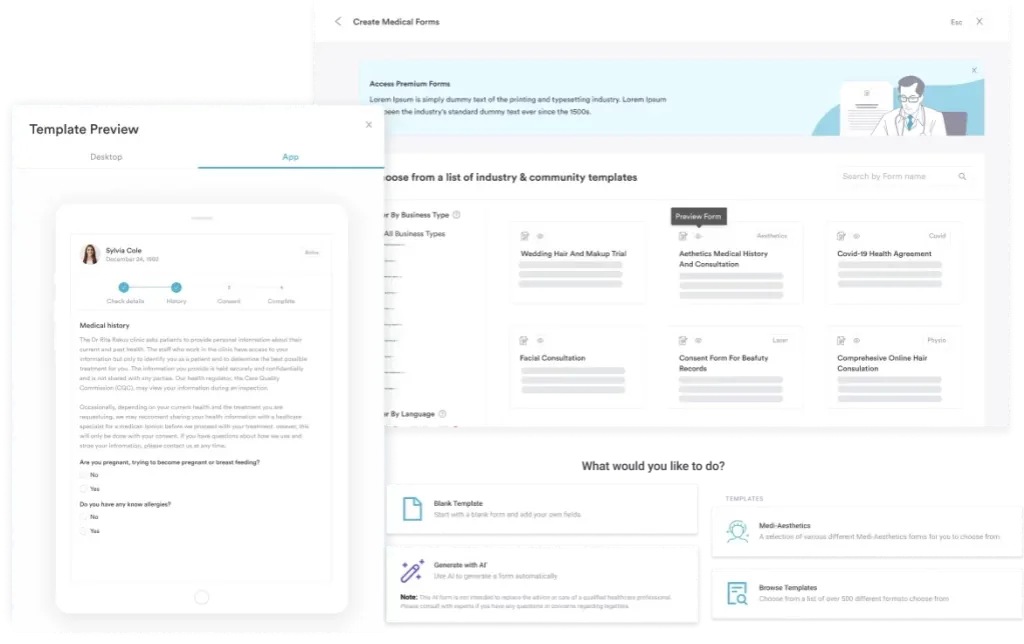
Practices using digital documentation forms can build these elements into a structured template, so nothing is missing from a note a payer may later read. A group that bills facial surgery as well as oral surgery can hold one template set in a plastic surgery EMR. Complexity language then doesn’t vary by surgeon.
The episode doesn’t end when the splint comes off, either. Jaw movement is usually monitored for weeks afterwards. A practice that runs that rehabilitation in-house can keep those notes on the same record in a physical therapy EMR.
Common billing errors and denial reasons
Denials on 21485 cluster around a short list of causes. These are the ones oral surgery billing teams report most often on complicated TMJ dislocation claims.
- Upcoding from 21480. The claim says 21485 but the note supports a simple closed reduction. Either add the complexity elements above, or bill 21480.
- Missing laterality modifier. Many payers reject a unilateral 21485 that arrives without -LT or -RT, even when bilateral treatment was never involved.
- A non-billable or mismatched diagnosis. S03.0 on its own will not pay, and S03.01XA on a follow-up visit contradicts the encounter type.
- Evaluation and management billed without modifier -25. A significant, separately identifiable E/M service on the same day needs -25, or the payer bundles it into the procedure.
- Global period violations. A second 21485 inside the global period needs -76 or -79. Without one, the payer treats the visit as already paid for.
Practices that treat denial management as a monthly habit catch these before they compound. Code-level reporting shows you when 21485 denies more often than 21480, which points straight at documentation or modifiers.
How payers cover complicated TMJ dislocation
Coverage for 21485 varies by payer, so verify it before submitting. Local Coverage Determinations (LCDs) and commercial policies both change. The general landscape looks like this.
- Medicare. Coverage generally follows once documentation establishes a complicated or recurrent dislocation. There is no National Coverage Determination for TMJ dislocation treatment, so general surgical coverage policy applies. Some Medicare Administrative Contractors (MACs) publish their own LCDs for TMJ procedures, so check yours directly.
- Medicaid. Coverage varies widely by state, and many programs require prior authorization for TMJ procedures. Confirm your state’s policy before you schedule.
- Commercial payers. Most cover medically necessary treatment of recurrent TMJ dislocation. Some ask for prior authorization on 21485 specifically, because it pays more than 21480.
- Dental plans. TMJ care can straddle medical and dental benefits. Some patients hold TMJ coverage on a dental plan that exhausts before the medical benefit starts, so clarify the carve-out first.
How billing software keeps 21485 claims clean
Manual lookup adds transcription risk at every step. You choose one code from a three-code family, attach the modifier, pair the encounter-specific diagnosis, and check the global period. Any one of those steps can break the claim.
Practice management software like Pabau connects those steps to the patient record instead. Our claims management software keeps code selection, documentation and submission in one platform, so coders aren’t copying figures out of a separate reference database.
That matters most on a code that needs modifier stacking and an exact diagnosis pairing. The note that justifies “complicated” sits with the claim that bills it. Anyone who picks up the denial has the supporting evidence already in front of them.
Reporting closes the loop. A single practice management workflow shows denials by code. When 21485 rejects more often than 21480, you know to go back to the note template.

Streamline your oral surgery billing workflows
Pabau’s claims management tools help oral surgery and maxillofacial practices validate CPT codes, attach modifiers, and submit cleaner claims. See how it fits your billing workflow.

Conclusion
The line between 21480 and 21485 is a documentation line, not a clinical opinion. If the note shows why the joint needed fixation, the higher code holds up. If it doesn’t, no modifier or appeal letter will rescue the claim later.
So capture the complexity language while the patient is still in the chair, and pair it with the laterality-specific diagnosis code. The trade-off is a few extra fields at the point of care against an audit you never have to defend.
Book a demo to see how Pabau keeps oral surgery documentation and claim data on one record.

Continue your research
Billing another surgical code this week? CPT code 19316 shows how modifiers and current-year rates come together on a surgical claim.
Still fixing rejections after the fact? Medical claims clearinghouse explains how claims are scrubbed and routed before they ever reach the payer.
Got patients who keep redislocating? Patient education covers the materials and workflows that help patients stick to post-procedure instructions.
Need another laterality worked example? S42.302K walks through billing a nonunion with the right side and 7th character.
Coding a late effect instead? S66.399S shows how a sequela code is sequenced and documented.
Frequently asked questions
What is CPT code 21485 used for?
CPT code 21485 is used to report closed, non-surgical treatment of a complicated temporomandibular joint dislocation. It applies when the dislocation is recurrent or otherwise unstable and needs intermaxillary fixation or splinting. It covers both initial and subsequent treatment encounters in the same episode.
What is the difference between CPT 21480 and 21485?
CPT 21480 covers simple, uncomplicated closed TMJ dislocation treatment by manual reduction only, with no fixation required. CPT 21485 applies when the dislocation is complicated and requires intermaxillary fixation or splinting. The clinical need for IMF or splinting is the key differentiator.
Which modifiers apply to CPT 21485?
Common modifiers are -LT for the left side, -RT for the right side, and -50 for a bilateral procedure. Repeat procedures take -76 for the same physician and -77 for a different physician. Modifiers -78 and -79 cover an unplanned return to the OR and an unrelated procedure in the global period. Applicability depends on payer policy, so verify before submitting.
What does Medicare pay for CPT 21485?
Medicare payment for 21485 varies by geographic locality and updates annually. Retrieve current rates from the CMS Physician Fee Schedule lookup tool at cms.gov, using this year’s conversion factor and the code’s RVU values. National averages are not published here, because they change every year and vary by location.
Which ICD-10 codes pair with 21485?
Pair 21485 with a laterality-specific jaw dislocation code. Use S03.01XA for the right side, S03.02XA for the left, S03.03XA for bilateral, or S03.00XA when the side isn’t documented. Swap the 7th character to D for a subsequent encounter or S for a sequela. The parent code S03.0 is not billable on its own.
What documentation is required to bill 21485?
The note must document prior dislocation history, which establishes recurrence, plus the objective clinical findings at this encounter. It must also state why IMF or splinting is clinically necessary. Record the procedure performed, including fixation type and technique, and the follow-up plan. Generic language such as “recurrent dislocation” without clinical detail commonly triggers denials on audit.