



CCSD code G5100: Bypass of duodenum billing guide
CCSD code G5100 bills a bypass that leaves the duodenum in place CCSD code G5100...

Last Updated: Oct 16, 2026

CPT code 19316 reports a mastopexy, the breast lift that repositions the nipple-areola complex and removes excess skin.
Medicare treats the procedure as cosmetic by default, so coverage turns on documented functional impairment rather than appearance.
The 2026 national payment is roughly $729, built from 21.83 total RVUs and a $33.4009 conversion factor.
Bill a bilateral lift on one line with modifier -50, because payment is capped at 150% of the single-side fee.
Practice management software like Pabau pre-fills the claim from the patient record and checks required fields before submission.
A mastopexy looks like a purely aesthetic upgrade. The surgeon lifts the breast, repositions the nipple-areola complex higher on the chest, and removes the skin left behind. Nothing is implanted, and no meaningful volume disappears. That absence is exactly what makes CPT code 19316 a hard code to bill.
Payers see “breast lift” and start from cosmetic, so the claim has to prove function before anything pays. Get the operative note, the modifier, and the coverage argument right, and 19316 behaves predictably. Miss one of the three, and you’ll spend the next quarter appealing denials instead of collecting on them.
According to the American Medical Association, 19316 sits in the repair and reconstruction section of the breast codes, the 19300 series. That is separate from the augmentation and reduction codes it is often billed alongside.
Ptosis grading is where the coverage argument begins. The Regnault system starts at Grade I, where the nipple sits level with the inframammary fold. Grade III sits well below it. Payers that cover mastopexy at all tend to want Grade II or Grade III, supported by photographs and exam findings.
Record that grade at the consultation and store it alongside the photographs. Plastic surgery practice management systems keep both attached to the encounter. The evidence then travels with the claim, rather than being reconstructed from memory months later.
Medicare’s 2026 national payment for 19316 is $729.14. That is the price before geography is applied, and it says nothing about whether the claim will be covered. For most Medicare patients, the coverage answer is still no.
Three relative value units build that figure. Work covers the surgeon’s time and effort, practice expense covers staff and supplies, and malpractice covers liability. CMS republishes all three every quarter in its relative value files.
Now run the math. Multiply 21.83 total RVUs by the 2026 conversion factor of $33.4009, and the result is $729.14. Clinicians who qualify as alternative payment model participants use the higher factor of $33.5675, which comes to $732.78.
Both figures are national. Your Medicare Administrative Contractor (MAC) applies three geographic indices before it pays. A surgeon in Manhattan and one in rural Mississippi see different amounts for identical work. The CMS fee schedule lookup gives you the number for your own locality.
Bilateral cases change the arithmetic. Because 19316 carries a bilateral surgery indicator of 1, Medicare pays the lower of two amounts. One is your total billed charge for both sides. The other is 150% of the single-code fee, which works out to roughly $1,093 nationally.
CMS flags the code with an “NA” non-facility indicator. In plain terms, the agency does not price mastopexy for an office setting. The procedure is almost always done in a hospital or a surgery center. The practice expense value is identical in both columns, so there is no richer office rate waiting to be claimed.
That has a practical consequence at charge entry. A 19316 line carrying place of service 11 will attract attention before anyone reads the operative note.
Pull 19316’s payment policy fields from the CMS relative value file rather than a fee calculator. The file gives you the global period, the bilateral rule, and whether the code is priced for an office setting. Those three fields decide more claims than the dollar amount does.
Bilateral mastopexy belongs on a single claim line. Report 19316 with modifier -50, one unit, and the charge for both sides. That one habit prevents the most common payment error on this code.
The rest of the modifier set is short, but the 90-day global period keeps it busy. Anything the surgeon does in the three months after the operation needs a modifier to explain itself.
When a -50 line arrives, the contractor compares two numbers and pays the lower one. The first is your total billed charge for both sides. The second is 150% of the fee schedule amount for a single side. In effect, the first breast pays in full and the second pays at half.
Splitting the case into an -LT line and an -RT line usually produces a duplicate rejection instead. It also runs straight into the unit limit covered further down this page.
Commercial payers vary, and plenty of them do want the two-line format. Check each major payer’s surgical billing policy once, write the answer down, and stop guessing claim by claim.
Most commercial payers take Medicare’s position. Mastopexy is cosmetic, sits outside the medical benefit, and pays only when the record shows the ptosis is causing a physical problem.
No national coverage determination exists for this procedure. Coverage lives in payer medical policy, and on the Medicare side in whatever a MAC has published locally. Read the specific policy before the surgery date, because reading it afterwards changes nothing.
Where a payer does allow the procedure, the authorization file usually needs all of the following:
Prior authorization is rarely optional with these payers. Ask for it in writing, log the authorization number in the patient file, and keep the correspondence. Store it wherever the rest of your regulated records live, under the same HIPAA rules you already apply.
Newer practices often discover all this the hard way. Anyone opening a new cosmetic surgery practice should settle the pre-authorization workflow before the first surgical booking, not after the first denial.
Authorization is only half the job. The operative note has to carry the same argument, or the payer recovers the money after it pays.
Notes fail audits when they describe the result instead of the reason. An auditor who reads “excellent aesthetic outcome” has been handed the payer’s argument for free. Six elements do the heavy lifting:
Photographs deserve a workflow of their own. Images sitting on a phone camera roll, or in a folder nobody has linked to the surgical encounter, will not count as documentation. Keeping before-and-after photos inside the patient record is what makes the evidence chain hold together.
None of this is unique to mastopexy. The same discipline behind HIPAA-compliant records applies to every surgical claim a practice sends out.
The pair everyone asks about, 19316 with 19325, carries no procedure-to-procedure edit at all. The National Correct Coding Initiative (NCCI) pairs mastopexy with a different set of codes, and breast augmentation is not among them.
Here is what the current practitioner NCCI edit table holds for this code.
Column two is the code that gets denied. So when 19316 and 19318 land on the same claim, the reduction code drops off. In the last three rows the position flips, and mastopexy is the line that disappears.
Every one of these edits carries a modifier indicator of 1. A bypass modifier can therefore override the edit when the note genuinely supports two distinct services. That is permission, not an invitation to reach for one by default.
Some payers still run their own bundling logic on 19316 with 19325. Where that happens, the correct bypass is modifier -59 or -XU. Modifier -XS does not fit, because both procedures happen on the same breast rather than on separate organs or structures.
The same test applies to skin work done through the same incision. Report Report 11302 or 11103 or 11103 alongside a mastopexy only when the note describes a separate lesion, a separate purpose, and its own specimen.
The practitioner medically unlikely edit for 19316 is one unit per date of service. Its adjudication indicator is 2, which CMS defines as an absolute date-of-service limit.
That combination has teeth. A second unit denies with reason code 151 and remark N362, and no modifier bypasses it. Medical necessity appeals fail too, because the limit rests on policy rather than on a judgment about the patient.
This is the practical reason bilateral mastopexy belongs on one -50 line. Two units of 19316 on a single date will simply deny.
A mastopexy claim passes through six checkpoints, and it can stall at any of them. Knowing where your own claims tend to stop is most of the fix.
Two checkpoints cause most of the trouble. Step two stalls when nobody chases the written approval. Charge entry stalls when the coder cannot find the ptosis grade anywhere in the chart.
Handoffs get harder as the practice grows. In a group practice, the surgeon who dictates the note rarely builds the claim as well. Anything left implicit tends to vanish between the two.
Most systems can enforce this list. Whichever medical software your practice runs, build the check into the workflow rather than into someone’s memory.
A written compliance checklist turns this into a two-minute habit before submission, rather than a cleanup exercise at the end of the month.
Denials cluster in practices that bill 19316 a few times a year rather than weekly. Aesthetic practices feel it most, because almost everything else they do is self-pay. Five rejections account for the bulk of them. A clean claim rate below the practice benchmark usually points at one recurring coding or eligibility error.
The claim denied as not medically necessary. The payer read the note as cosmetic. Check whether the functional symptom appears in the operative note itself, not only in the consultation. Appeals succeed when the surgeon’s own dictation names the symptom.
Only one side paid on a bilateral case. That is usually the 150% cap working as designed. Compare the allowed amount against 150% of the single-side fee before you spend an hour on an appeal.
The second unit denied with reason code 151. That is the unit limit, and no modifier will move it. Rebill the case as one line with modifier -50 instead of appealing the units.
The lift bundled into the reduction. NCCI treats 19316 and 19318 as mutually exclusive. If the surgeon genuinely performed both, the note has to show separate indications before a bypass modifier is defensible.
A post-operative visit denied. The 90-day global period absorbs routine follow-up. Only unrelated care, flagged with -79, or an unplanned return to surgery, flagged with -78, pays separately.
A fair share of mastopexy miscoding comes from picking a neighbor by accident. The 19300 series is dense, and several codes describe work that looks similar in an operative note.
A coder who touches these codes weekly builds the distinctions into muscle memory. Everyone else needs them written down, either in a payer grid or inside the plastic surgery software the practice already uses.
Coverage is the whole difference. Code 19318 removes breast tissue and skin to reduce volume, and commercial payers cover it routinely when macromastia causes documented symptoms. Code 19316 repositions the breast without removing meaningful volume, so it inherits the cosmetic label instead.
NCCI also treats the two as mutually exclusive, so one of them drops off a shared claim unless the note defends both. When a surgeon genuinely performs both, write the indication, the technique, and the tissue handled for each one separately.
In many practices the surgical note lives in one system and the photographs live in another. The claim then gets rebuilt by hand in a third. Every retype is another chance for the laterality or the modifier to drift.
Practice management software like Pabau keeps all three in the same record. The CPT code attached to the service lands straight on the charge line. ICD-10 slots are seeded from the patient’s recorded problem list. Photographs stay tied to the encounter they belong to.
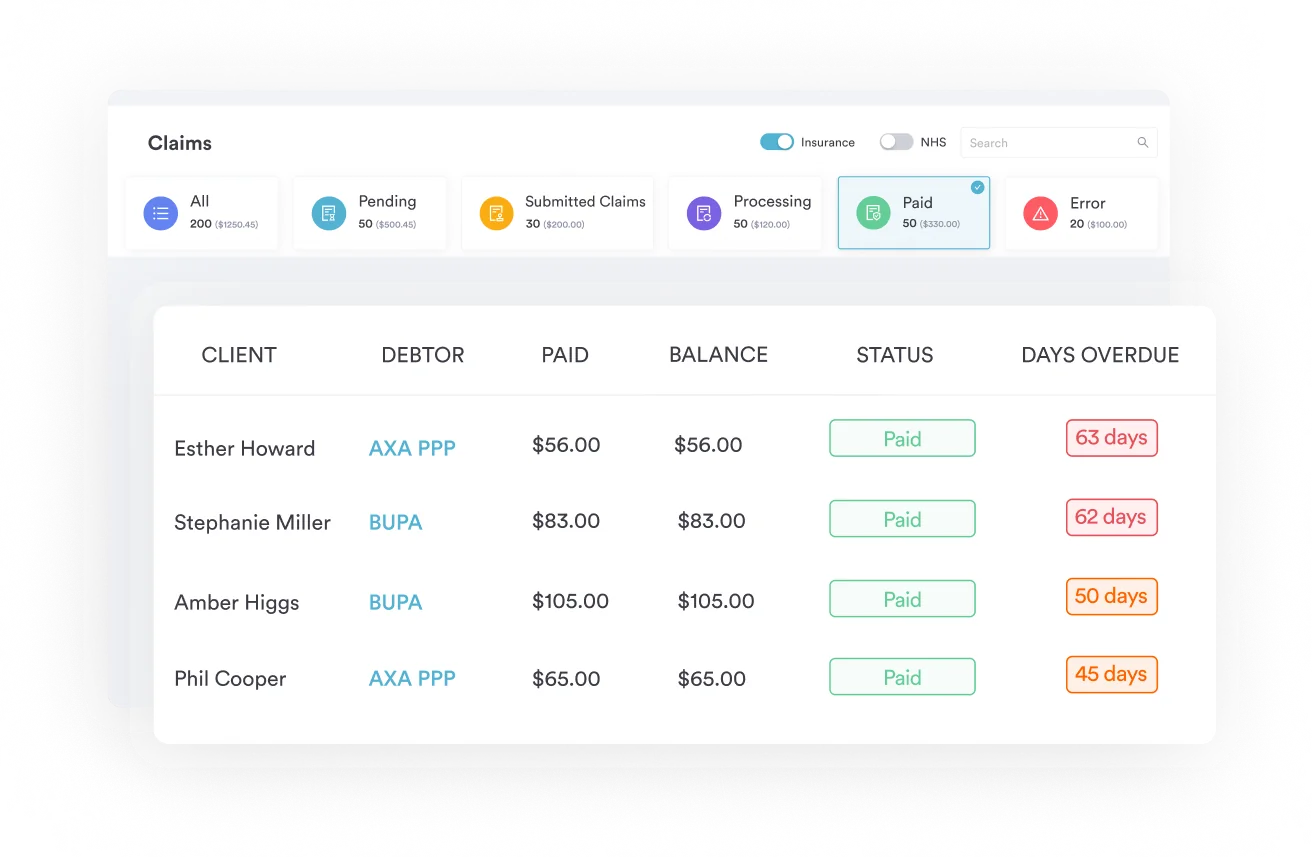
Before a claim can go out, Pabau’s claims management software checks that the fields your payer requires are filled in. On the US pipeline it also runs eligibility checks and posts electronic remittance. A five-stage status shows where each claim sits, from pending through to paid or error.
Choosing the modifier stays the coder’s call. What a plastic surgery EMR removes is the retyping between the chart and the claim form. The biller works from the same record the surgeon dictated into.

Pabau pre-fills the claim from the patient record, checks the fields your payer requires, and tracks each claim through to payment. Your billers stop retyping what the surgeon already documented.

Reporting 19316 is straightforward once the rules sit in writing. One line for bilateral, one unit a day, a facility setting, and a 90-day global period. Getting the procedure covered is the harder job, and it is decided long before the claim goes out.
Coverage is won at the consultation, when someone records the ptosis grade and the symptom that goes with it. So the highest-value change for most practices sits upstream of billing. Fix the consultation template and the operative note template, and the modifier questions largely answer themselves.
If your surgical notes and your claims currently live in different systems, that is where the money leaks. Book a demo to see how Pabau keeps the operative note, the photographs, and the claim in one patient record.

Billing another code in the breast family? 19284 sits alongside 19316 in the same section and follows a very different set of add-on rules.
Coding a body contouring case? 15876 is another plastic surgery code that payers default to cosmetic unless the record argues otherwise.
Finishing a reconstruction case? 11922 covers intradermal tattooing used to correct color defects of the skin.
Coding a specific type of hair loss? nonscarring hair loss code sits within a nuanced corner of dermatology coding, where specificity requirements are strict.
Coding a confirmed vitiligo diagnosis? vitiligo diagnosis code is the specific, billable code for vitiligo, distinct from broader pigmentation disorder codes.
Often, yes. The Women’s Health and Cancer Rights Act applies to group health plans that cover mastectomy. Those plans must also cover surgery on the other breast for a symmetrical appearance. A mastopexy performed on the healthy breast to match a reconstruction usually falls inside that benefit. Cite the reconstruction on the claim and keep the mastectomy history in the record.
N64.81 is the specific ICD-10-CM code for ptosis of breast, and it is the usual primary diagnosis. On its own it rarely wins coverage. Add codes for the symptoms driving the request, such as intertrigo or back and neck pain. The diagnosis set then matches the functional argument in the note.
Yes. Medicare excludes cosmetic surgery by statute, so the patient is responsible and a formal advance beneficiary notice is voluntary rather than required. Many practices issue one anyway and collect a signed estimate up front. Commercial plans follow their own waiver rules, so check the contract before you bill the balance.
It can. CMS assigns 19316 an assistant at surgery indicator of 2. Payment is not restricted, so an assistant may be paid when the note supports one. Co-surgeons are also permitted with documentation. Append modifier -80 for an assistant, or -62 for co-surgeons, and make sure each surgeon dictates their own portion.



