HIPAA compliant texting: What you can send patients & how to communicate securely
HIPAA compliant texting is possible when a text holds no protected health inform...

Last Updated: Oct 16, 2026

Patient education is a structured, two-way process where clinicians help patients understand their conditions, treatment plans, and self-care responsibilities.
Patients forget 40 to 80% of medical information immediately after a consultation, so verbal instruction alone rarely sticks.
Low health literacy affects roughly 36% of US adults, which makes plain-language materials and teach-back confirmation essential.
Automated pre-appointment emails and post-treatment aftercare sequences deliver consistent education without adding to staff workload.
Pabau’s pre- and post-care automation, digital consent forms, and client portal give practices a scalable education system at every touchpoint.
A clinician spends eight minutes explaining aftercare, the patient nods, and two days later calls in confused. One widely cited review in the Journal of the Royal Society of Medicine found that patients forget 40 to 80% of medical information immediately. Almost half of what they do remember is recalled incorrectly.
Patient education, delivered systematically, fixes most of that. This guide covers what it involves, the barriers that undermine it, and the strategies that work. It also covers how to measure whether any of it is landing. Practice management software like Pabau makes consistent delivery achievable at scale.
Patient education is a planned, interactive process. Clinicians help patients understand their diagnosis, treatment options, and the self-care behaviors that support recovery. A single handout at checkout does not count.
The Agency for Healthcare Research and Quality (AHRQ) defines it as a range of activities. Those activities help patients understand their health conditions and act on that understanding. The World Health Organization goes further with its therapeutic patient education framework. It describes a continuous, patient-centered partnership that evolves alongside the care plan.
For practice owners, the operational case is clear. Better-educated patients arrive prepared, follow aftercare instructions more reliably, and need fewer follow-up calls. They are also more likely to come back.
For clinicians, it cuts the frustration of preventable complications caused by misunderstood instructions. For patients, it turns passive receipt of treatment into active participation in their own outcomes.
Understanding the obstacles is the first step to fixing them. Health literacy is the barrier with the strongest evidence behind it. NIH-indexed research links it directly to how well patients act on care instructions. The other barriers below come from what practices report day to day, and they cut across specialty and size.
None of these barriers require a large budget to address. Most need a change in delivery timing and a commitment to plain language. They also need a system that sends information after the visit, not only during it.
Structuring how education is delivered makes a measurable difference. Peer-reviewed evidence supports teach-back and shared decision-making in particular. The other approaches below are widely used in practice and rest on separate bodies of research. They work best layered together rather than applied in isolation.
Build the teach-back step into your consultation template as a named field, not an optional add-on. When it appears on the clinical note as a required entry, clinicians complete it consistently. When it lives only in a verbal protocol, it is the first thing to drop when consultations run long.
MedlinePlus guidance on patient education materials points to three criteria that decide whether a resource works. Those are reading level, cultural fit, and a format that matches how the patient prefers to learn.
Reading level matters more than most clinicians expect. US data from the National Center for Education Statistics puts around 36% of adults at or below a basic reading level. Materials written above Grade 6 are out of reach for a large share of most patient populations.
Running your existing handouts through a readability checker once a year is low-effort and pays back in fewer confused phone calls. You can also build digital intake forms around plain-language wording, so the terminology patients sign matches what they are told.
Format selection should follow the patient profile, not staff convenience. Here is where the common formats fit:
Digital delivery changes what patient education can achieve without extra staff time. Portal software, automated messaging, and structured follow-up sequences let a practice reach every patient consistently. Delivery no longer depends on which practitioner remembered to print something.
The benefits of patient portals go well beyond appointment booking. Portals give patients a persistent, personalized place to find care summaries, preparation guides, and aftercare plans.
A patient who gets an automated portal message the evening after a procedure follows aftercare far more reliably. The patient portal software worth choosing ties those messages to clinical records. Each resource then stays attached to the treatment actually delivered.
Key digital tools for patient education include:
Chronic condition management changes the equation. A patient with type 2 diabetes, hypertension, or a long-term skin condition needs education that adapts as the condition evolves. One handout at diagnosis is not enough.
The WHO therapeutic patient education framework addresses this directly. It defines the work as a structured process that helps patients acquire and keep the skills for self-managing a chronic condition. That applies to dermatology practices treating rosacea, weight loss programs supporting lifestyle change, and primary care managing cardiovascular risk.
Understanding patient compliance patterns helps you design education schedules that match realistic adherence windows. The same logic applies to routine screening. A parent who understands why screening for lead poisoning matters will bring the child back for the follow-up test.
Practical approaches for chronic condition education:
Education is easy to deliver and hard to evaluate. The metrics below give a practical signal without research-grade measurement tools. Each one can be pulled from records you already keep.
Start with one or two metrics rather than tracking everything at once. Post-treatment support contacts and follow-up attendance are the easiest to pull from existing records. Both give a clear before-and-after signal when education delivery changes.
Tracking patient satisfaction scores tied specifically to information clarity adds a patient-reported layer on top of the operational data. Set measurable targets before you roll changes out, which is where frameworks for improving patient engagement help.
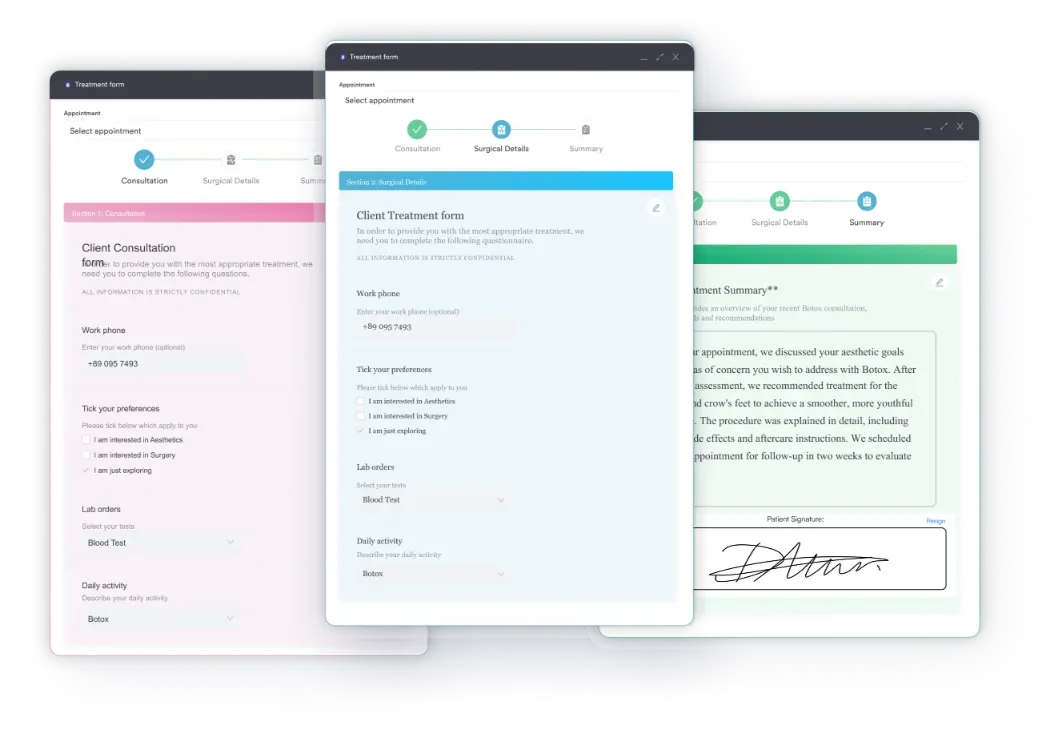
Most practice management platforms handle scheduling and billing. Pabau, an all-in-one practice management system, also covers the education layer. Its features map onto three jobs. Prepare patients before treatment, reinforce instructions afterward, and cut avoidable follow-up contact in between.
A solo practitioner running 30 appointments a week cannot personalize aftercare by hand. Neither can a group practice working across several locations. Automation is what makes consistent delivery achievable at either size.
Practices notice it in what clients say back. Clients at Balanced Aesthetics by Jam singled out the automatic aftercare messages as part of what made the practice feel polished.
Pabau Scribe, our AI scribe feature, also transcribes consultations automatically. That frees the time clinicians used to spend writing notes, so more of the appointment goes to explaining and answering questions.

From pre-appointment preparation emails to post-treatment aftercare sequences, Pabau delivers consistent patient education at every touchpoint. Your team does not take on extra work. Book a demo to see it running.

Inconsistent patient education is one of the most correctable problems in clinical practice. Patients who leave without a written aftercare plan will make avoidable mistakes. So will patients who never get a check-in or cannot see their own care summary.
Fixing that does not mean hiring a patient educator. It means deciding what every patient should receive at each stage, writing it once in plain language, and letting the system send it. The trade-off is some setup time now against a permanent drop in confused phone calls.
Pabau’s pre- and post-care automation, digital forms, and client portal run that system in the background of every appointment. Book a demo to see how it fits your treatment types and your team’s workflow.

Ready to compare full practice management platforms? Best patient management software ranks nine systems by practice type to help you compare options.
Looking for a practical way to capture patient feedback? How to capture patient feedback outlines methods for gathering structured data on the patient experience.
Want to win back patients who stopped booking? Patient reactivation software compares tools that re-engage lapsed patients through targeted SMS, email, and recall campaigns.
Not sure these two terms mean the same? Patient satisfaction vs experience clarifies the difference so feedback programs measure care outcomes, not just feelings.
Curious how communication gaps affect patient loyalty? Patient relationship management guide explains how missed follow-ups and recalls quietly cost practices their patients.
Patient education is a structured process through which clinicians help patients understand their diagnosis, treatment plan, and self-care requirements. It covers verbal explanation, written materials, digital resources, and follow-up reinforcement. It differs from general health promotion because it is tailored to one patient’s condition and care plan.
Patient education improves treatment adherence and reduces avoidable complications. It also cuts unnecessary follow-up contact, because patients understand and can act on their care instructions. Published research links effective patient education to better outcomes, fewer preventable return visits, and higher satisfaction scores.
The teach-back method, staged information delivery, and paired verbal and written summaries all outperform verbal-only instruction. Shared decision-making and motivational interviewing work particularly well for behavior-change goals such as chronic disease self-management.
Chronic disease education is a progressive, ongoing process rather than a one-time event. The WHO’s therapeutic patient education framework describes a structured program that helps patients build and keep self-management skills. That calls for spaced education across multiple visits and regular review, rather than front-loading everything at diagnosis.
Health literacy is the patient’s ability to read, understand, and act on health information. Patient education is the clinician’s deliberate effort to provide that information in an accessible way. Good patient education accounts for health literacy by using plain language, teach-back confirmation, and multiple formats. Comprehension then does not depend on the patient having advanced literacy skills.
Practice management software automates education delivery across the care journey. It sends preparation materials before the appointment, triggers aftercare instructions when the appointment closes, and opens portal access to care summaries. This removes the dependence on clinician memory, so every patient gets consistent education however busy the practice is.