










Key takeaways
ICD-10 code S06.2X9D is a billable code for diffuse traumatic brain injury with loss of consciousness of unspecified duration, subsequent encounter.
The 7th character D applies only while the patient is still in active treatment, never at a monitoring-only visit.
Diffuse axonal injury falls under the Applicable To note for this code, while traumatic diffuse cerebral edema (S06.1X-) is an Excludes1 partner.
Report S06.A- for traumatic brain compression or herniation, and F06.7- for mild neurocognitive disorder, whenever either is documented.
Practice management software like Pabau keeps TBI notes, encounter history, and claim data on one record, so coders work from a complete chart.
ICD-10 code S06.2X9D is a billable code for diffuse traumatic brain injury with loss of consciousness of unspecified duration, subsequent encounter. Coders reach for it when a patient returns for active TBI treatment after the initial encounter has already been coded.
The S06.2X series is one of the more nuanced injury families in ICD-10-CM. The initial, subsequent, and sequela characters change the code on every return visit. This reference covers the definition, the 7th character logic, documentation requirements, MS-DRG mapping, and the codes reported alongside S06.2X9D.
ICD-10 code S06.2X9D: definition and billable status
ICD-10 code S06.2X9D is a billable, specific ICD-10-CM diagnosis code valid for reimbursement in HIPAA-covered transactions. The 2026 edition of ICD-10-CM S06.2X9D became effective on October 1, 2025. The full official description is: Diffuse traumatic brain injury with loss of consciousness of unspecified duration, subsequent encounter.
The code sits within the S06 intracranial injury chapter, under the S06.2X subcategory for diffuse traumatic brain injury. The 9 in the sixth-character position signals that the duration of loss of consciousness is unspecified. The final character D identifies this as a subsequent encounter. The encounter character is set by the treatment being provided, not by a physician-dictated „follow-up“ label on the chart.
Quick reference: S06.2X9D code details
The table below summarizes the core data points coders need before billing a claim with S06.2X9D.
Understanding diffuse traumatic brain injury
Diffuse traumatic brain injury (diffuse TBI) describes widespread microscopic damage across the brain rather than a single focal lesion. The most clinically recognized form is diffuse axonal injury (DAI), where rotational or deceleration forces shear axons throughout the white matter tracts. DAI is listed in the Applicable To notes for the S06.2X series. It codes directly to S06.2X9D when the encounter is subsequent.
Focal TBI, by contrast, involves a specific, localized area such as a contusion or hematoma. Coders seeing documentation of focal contusion, intracerebral hemorrhage, or subdural hematoma should look outside the S06.2X subcategory. Those findings belong in the S06.3 to S06.6 range, which classifies focal injury and intracranial bleeding by site.
Loss of consciousness (LOC) is another required element. The „9“ position in S06.2X9D signals that the LOC duration is unspecified. Clinicians document LOC when the patient was unconscious at the time of injury, but cannot determine the precise duration from available records. This is common in patients transferred from another facility or whose injury was unwitnessed.
What does the 7th character D mean?
The 7th character D designates a subsequent encounter. The patient is receiving active treatment for the diffuse TBI after the initial episode of care has been coded. The ICD-10-CM Official Guidelines set that definition in Chapter 19. A subsequent encounter applies while treatment is still active, not where the patient is only monitored or seen for a resolved complication.
The three 7th character options for S06.2X9 are:
A common coder mistake is treating every return visit as a subsequent encounter. A patient seen only for lab monitoring, with no active treatment provided, does not qualify. Residual cognitive deficits presenting years after a resolved TBI take the sequela character S.
Other injury families expand this set. Fracture codes such as S42.463G add separate characters for routine healing, delayed healing, nonunion, and malunion. The S06 intracranial series uses only A, D, and S.
When to use S06.2X9D
S06.2X9D applies when all four of these conditions appear in the clinical record:
- The injury is diffuse (not focal) traumatic brain injury, with documentation supporting widespread or axonal involvement
- Loss of consciousness occurred at the time of the original injury, and the duration was not recorded or cannot be determined
- The patient is returning for active treatment, such as neurological rehabilitation, cognitive therapy, or medication management related to the TBI
- The initial encounter for this injury was previously coded, typically with S06.2X9A
Rehabilitation settings generate most S06.2X9D encounters. Neurologists, physiatrists, and physical therapy practices running post-TBI recovery programs use this code repeatedly across a course of treatment.
Sports medicine practices see it less often. Most sports concussions belong in the concussion subcategory, and only an event documented as diffuse TBI moves into S06.2X.
Confirming the ICD-10-CM code details against the CDC/NCHS ICD-10-CM web tool before submission is a practical safeguard, particularly after annual October code updates.
Documentation requirements for diffuse brain injury coding
Claim denials for S06.2X9D most often trace back to incomplete physician documentation, and coders cannot assign what the record does not support. Payers usually return these as denial codes citing an invalid or unsupported diagnosis. Accurate clinical documentation tools capture all three of the elements below:
- Diffuse injury type confirmed: The note must identify the injury as diffuse, not focal. „TBI“ alone is insufficient. Documentation of diffuse axonal injury, shear injury, or widespread brain involvement satisfies this requirement.
- Loss of consciousness documented: The record must state that LOC occurred. If the duration is truly unknown, the note should reflect why (e.g. unwitnessed injury, transfer from another facility with incomplete records). Coders should not assume unspecified duration without supporting documentation.
- Subsequent encounter confirmed: The note must make clear that the patient is returning for active treatment of the TBI, not simply for monitoring. A rehabilitation progress note, therapy session record, or medication adjustment note typically satisfies this.
Digital intake forms can prompt clinicians for injury type, LOC status, and encounter purpose at every TBI visit. That cuts the number of incomplete records reaching the coding queue. Practices running an ongoing TBI panel can pre-configure those prompts inside their EHR workflow.

Pro Tip
Flag charts where LOC duration is described as ‚unspecified‘ but no explanation is present. Query the treating physician before coding S06.2X9D to confirm the unspecified duration is clinically supported, not a documentation oversight.
ICD-10-CM coding guidelines and notes for S06.2X9D
The ICD-10-CM Tabular List carries several instructional notes that apply directly to S06.2X9D. Coders must review them before finalizing any claim. The notes below follow the Tabular List entries for the S06 category, cross-checked against the AAPC Codify reference:
Understanding these notes supports HIPAA-compliant billing workflows and reduces audit exposure. Each note type carries a specific coding obligation:
The Excludes1 note carries the most weight here. An Excludes1 instruction means the two conditions are mutually exclusive by definition. If the record documents both diffuse TBI and traumatic cerebral edema, the clinician and coder decide which condition is being treated at this encounter. Reporting both codes together is a coding error.
MS-DRG mapping for diffuse traumatic brain injury
For inpatient settings, S06.2X9D groups to one of three Medicare Severity Diagnosis Related Groups. The DRG assigned sets the reimbursement weight. Dollar amounts vary by hospital and CMS updates them annually, so check the current IPPS final rule before quoting any estimate.
The DRG ultimately assigned depends on whether documented comorbidities and complications meet the CC or MCC threshold. Complete comorbidity documentation at each encounter directly affects DRG assignment and therefore inpatient reimbursement.
S06.2X9D code hierarchy in the S06 family
Understanding the code hierarchy helps coders verify they are in the right branch of ICD-10-CM before finalizing selection. S06.2X9D sits within the injury chapter as follows:
- S00-T88: Injury, poisoning, and certain other consequences of external causes
- S00-S09: Injuries to the head
- S06: Intracranial injury
- S06.2: Diffuse traumatic brain injury
- S06.2X: Diffuse traumatic brain injury (with 6th character extension)
- S06.2X9: Diffuse traumatic brain injury with loss of consciousness of unspecified duration
- S06.2X9D: Subsequent encounter
The S06 category covers the full range of intracranial injury codes. Coders frequently need to differentiate S06.2X9D from adjacent codes in the same family. The most common confusion points are with S06.9X9D (unspecified intracranial injury, subsequent encounter) and with focal injury codes in the S06.3-S06.8 range.
Commonly associated codes to report with S06.2X9D
S06.2X9D rarely stands alone in a TBI patient’s active treatment record. The codes below are the ones most often reported with it, drawn from the Tabular List instructions for the S06 category. Sequencing rules apply. S06.2X9D is normally listed first as the principal or primary diagnosis, with the associated codes following.
Brain compression or herniation is the additional code most often missed on inpatient TBI records. It needs its own documentation from the treating clinician, not an inference drawn from an imaging impression. Reporting each documented condition on the first pass is what turns a TBI encounter into a clean claim.
Pro Tip
Before adding S06.A- alongside S06.2X9D, confirm the provider has documented brain compression or herniation as a finding being treated. A radiology impression on its own does not support the additional code.
ICD-10 to ICD-9 crosswalk for S06.2X9D
Legacy system integrations and historical data comparisons sometimes require mapping S06.2X9D back to its ICD-9-CM equivalent. The General Equivalence Mapping (GEM) crosswalk, available via ResDAC’s ICD coding resources, identifies the closest legacy codes. The approximate crosswalk is:
ICD-9-CM had no 7th character system for injury encounter types, so the backward GEM mapping from ICD-10 to ICD-9 stays approximate. Use GEM files for reference only, never for direct claim submission.
How Pabau supports accurate TBI coding
Accurate use of S06.2X9D depends on two things. The clinical note has to record injury type, LOC status, and encounter purpose. The billing workflow then has to read from that same record.
Practice management software like Pabau keeps the treatment note and the claim on one patient record. Its claims management software pulls data already stored on that record into a pre-filled claim, then submits and tracks it electronically. Coders review a complete chart rather than hunting for a note held somewhere else.

On the documentation side, Pabau Scribe, our AI scribe, drafts the TBI progress note from the consultation itself. The template surfaces the fields coders need, including injury classification, LOC status, and encounter purpose. Coding accuracy starts in the clinical note rather than at the billing desk.
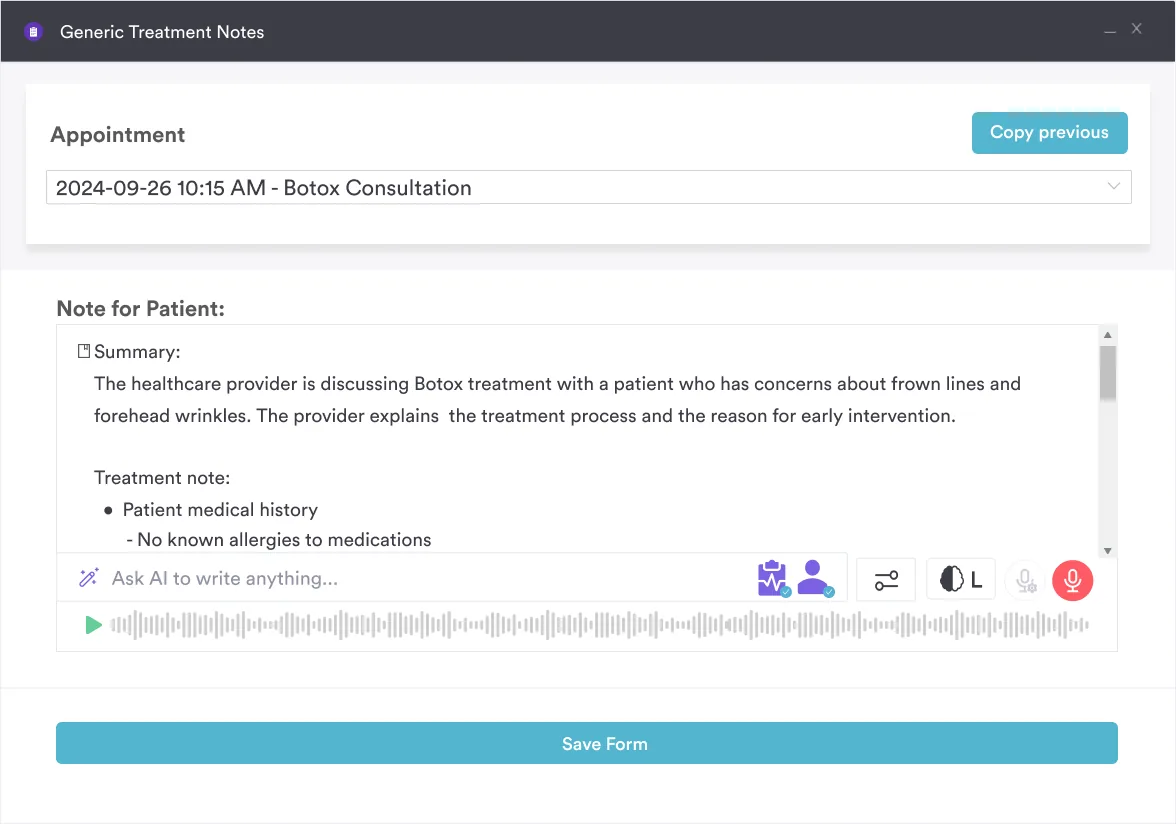
Practices tracking post-TBI patients across several providers can use Pabau’s patient management tools to follow the encounter sequence. Seeing initial, subsequent, and sequela visits on one timeline keeps the 7th character consistent and gives payer reviewers a clear audit trail.

Keep TBI notes and claims on one record
Pabau holds treatment notes, encounter history, and claim data on a single patient record. Coding teams work from a complete chart instead of chasing documentation across separate systems.

Conclusion
S06.2X9D has narrow boundaries: diffuse TBI, loss of consciousness of unspecified duration, and active treatment at a subsequent encounter. Most denials come from the edges of that definition.
Set the encounter character from the treatment being provided, not from how long ago the injury happened. If the visit changes the care plan, D is right. If it only checks on an injury that has healed, S is right. Holding that judgment steady across a whole rehabilitation panel matters more than any single claim.
For practices carrying ongoing TBI patients, a practice management platform keeps the clinical note and the claim on the same record. Coding accuracy is then built into the workflow instead of audited after the fact. Book a demo to see how Pabau handles TBI documentation and encounter tracking.

Continue your research
Losing TBI claims to avoidable rejections? Denial management in healthcare sets out how to triage, appeal, and prevent the denials that follow injury coding.
Need your billing to hold up under audit? Medical billing compliance covers the documentation standards that keep coded claims defensible.
Chasing payment on a subsequent encounter? Timely filing limits explains the payer deadlines that catch out long rehabilitation courses.
Reconciling what the payer actually paid? Electronic remittance advice walks through reading an ERA and posting it against the original claim.
Verifying coverage before the rehab visit? Insurance eligibility verification shows how to confirm benefits before a TBI patient is seen again.
Frequently asked questions
What does ICD-10 code S06.2X9D mean?
ICD-10 code S06.2X9D describes diffuse traumatic brain injury with loss of consciousness of unspecified duration at a subsequent encounter. It is a billable ICD-10-CM code valid for HIPAA-covered transactions, effective in the 2026 edition from October 1, 2025. The „D“ indicates the patient is receiving active treatment following a previously coded initial encounter.
When should I use S06.2X9D instead of S06.2X9A?
Use S06.2X9A for the first time a patient receives active treatment for a diffuse TBI with unspecified LOC duration. Use S06.2X9D for all subsequent encounters where the patient continues to receive active treatment for the same injury. Once active treatment ends and only late effects remain, transition to S06.2X9S (sequela).
What is the difference between S06.2X9D and S06.2X9S?
S06.2X9D is used during active treatment after the initial encounter; the condition is still being managed. S06.2X9S is for sequela, meaning the acute phase has ended and the patient now has late effects or residual conditions resulting from the original TBI. Cognitive deficits, personality changes, and chronic post-TBI conditions documented after active treatment ends are coded to S06.2X9S.
Is S06.2X9D a billable ICD-10 code?
Yes, S06.2X9D is a billable and specific ICD-10-CM code. It is valid for reimbursement in HIPAA-covered transactions and became effective in the 2026 ICD-10-CM edition on October 1, 2025. It can be submitted as a principal or additional diagnosis depending on the clinical scenario.
What additional codes should be reported with S06.2X9D?
The ICD-10-CM Tabular List instructs coders to use an additional code for traumatic brain compression or herniation (S06.A-). It also calls for mild neurocognitive disorder due to a known physiological condition (F06.7-) where that is documented. Traumatic diffuse cerebral edema (S06.1X-) is an Excludes1 partner and cannot be reported with S06.2X9D. External cause, place of occurrence, activity, and status codes are added per Chapter 20 guidelines.
What MS-DRG does S06.2X9D map to?
S06.2X9D maps to MS-DRG 082, 083, or 084, depending on the presence of documented complications and comorbidities. MS-DRG 082 applies with a major complication or comorbidity (MCC), 083 with a complication or comorbidity (CC), and 084 without either. DRG weights and associated reimbursement amounts are updated annually by CMS.
What is diffuse axonal injury and how is it coded?
Diffuse axonal injury (DAI) is a form of diffuse TBI where acceleration-deceleration forces shear axons throughout the brain’s white matter tracts. Under the ICD-10-CM Applicable To note for the S06.2X series, DAI is classified within this subcategory. When the encounter is subsequent and LOC duration is unspecified, DAI is coded with S06.2X9D without a separate additional code for DAI itself.