HIPAA compliant texting: What you can send patients & how to communicate securely
HIPAA compliant texting is possible when a text holds no protected health inform...

Last Updated: Oct 16, 2026

An MSO, or Management Service Organization, runs the business side of a med spa while a separate clinical entity keeps patient care.
You mainly need an MSO for med spas if you are not a licensed physician and your state enforces Corporate Practice of Medicine rules.
Washington, Michigan, Texas, Pennsylvania, California, and Arizona require the structure for non-physician owners. Ohio does not.
The two biggest payoffs are compliant ownership and scaling across several locations without drowning in admin.
An MSO can never provide medical care, so practice management software like Pabau is the lighter option for day-to-day operations.
“Do what you love, and you’ll never have to work another day in your life.”
Some physicians stop believing that line about six months after opening their own medical spa. Instead, payroll, staff schedules, marketing, and accounts eat the hours they meant to spend treating patients.
An MSO for med spas is a separate management company that takes on every non-medical responsibility, so the clinical side can concentrate on patient care.
In fact, in some states it’s more than a convenience. If you’re not a licensed physician, the MSO structure may be the only legal route to owning a med spa at all.
Below you’ll find what an MSO can and can’t do, which states require one, and how to judge whether the structure earns its fee. To weigh that fee against software costs, our ranking of the best med spa software covers total cost of ownership.
Management Service Organizations, or MSOs, supply the operational and administrative support a medical practice needs to work as a business.
In other words, an MSO is a company that runs non-clinical operations for a practice without ever practicing medicine itself.
The MSO healthcare model isn’t unique to aesthetics. Primary care groups, dental chains, and specialty practices use the same split. Med spas adopted it because their ownership rules are unusually strict.
What an MSO covers runs from administrative support through to regulatory compliance and financial management.
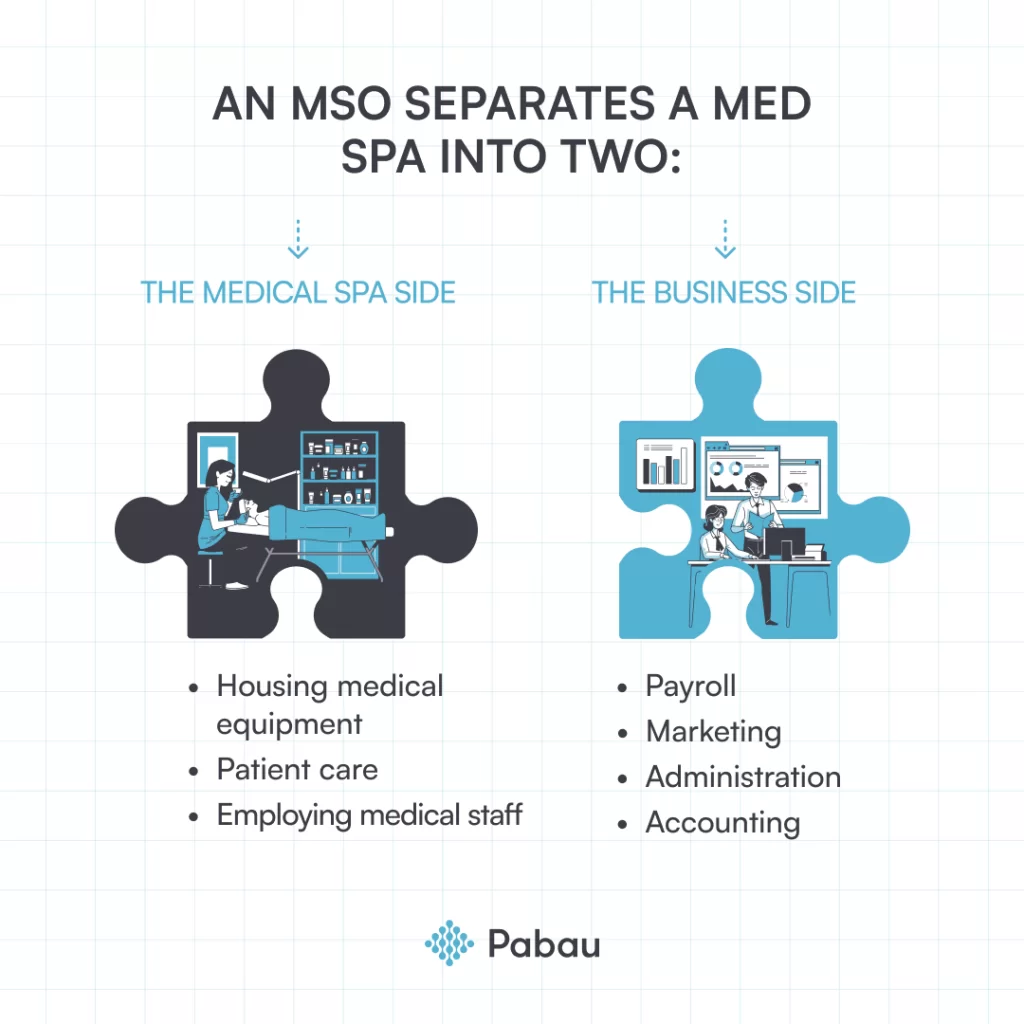
In practice, an MSO divides the medical spa into two distinct institutions:
One med spa team described what that division looks like on a normal working day:
Based on our experience at NuView, MSOs are the backbone of operational efficiency as they assist us with appointment scheduling and refined patient flow. Our patient flow is more coordinated and responsible. The moment they walk in the door, clinicians in our center do not have to worry about them. We can focus on treating the patient. Our MSO works behind the scenes so that every patient feels supported and cared for.
NuView
The MSA is the contract between the MSO and the medical spa.
Specifically, it sets out the MSO’s responsibilities and tasks, and it defines exactly what the MSO may do on behalf of the med spa.
The MSA should also cover the financial arrangements, including leases for any offices the MSO owns or manages. Read the exit clauses as carefully as the service list.
You need an MSO for one of two reasons. Either you want the business side off your desk, or your state won’t let a non-physician own the medical entity.
Most physicians open a med spa to treat patients. But within a year, staffing, accounting, and marketing are eating the days they meant to spend in treatment rooms.
That workload is what dents the enthusiasm people start with. As a result, the clinical work they trained for becomes the part of the week they have to defend.
Not everyone has a head for business, and that’s fine. Recognizing your strengths and outsourcing the rest is a reasonable call rather than an admission of defeat.
The MSO takes the non-medical duties so the clinical side keeps both its time and its attention.
The reason non-physicians need this structure has a name. It’s the Corporate Practice of Medicine doctrine, usually shortened to CPOM.
CPOM rules stop a corporation or an unlicensed person from owning a medical practice or employing physicians to practice medicine. Many states enforce some version of it, and the strictness varies widely.
The MSO, often set up as a limited liability company (LLC), is the route the doctrine leaves open. A physician owns the medical entity, and the non-physician owns the management company that runs everything else.
So a nurse asking whether they can open a med spa in California does have an answer. Yes, but only through this split.
Ownership and scope of practice are separate questions, and this is where new owners trip. However, owning the business doesn’t expand what your license allows you to perform.
Check what your team can legally deliver before you build a service menu. Whether nurses can do Botox depends on your state, not on whose name is on the LLC.
Planning to open a medical spa? Work through the compliance checklist for medical spas before you sign anything.
An MSO gives you back the hours you spend on admin, plus a compliance team and buying power you couldn’t justify hiring alone.
Most also train your team, so reception and clinical staff work to the same standard at every site. Here are the five benefits that matter most day to day.
A med spa sits underneath a stack of state board rules, federal privacy law, and device regulations that change without announcement.
An MSO’s compliance staff track those changes and write your policies around them. That covers record-keeping, patient privacy, and clinical standards.
What you’re really buying is early warning. Someone whose full-time job is compliance notices a rule change before an inspector does.
An MSO absorbs the operational load. That means payroll, human resources, appointment systems, staff schedules, and financial management.
Most bring their own systems and processes rather than asking you to buy and configure them yourself.
What changes day to day is who owns the follow-up. Nobody on your clinical team is chasing a payroll error at 8pm.
Running several sites multiplies every admin task. Staffing, marketing, payroll, and customer service all have to happen in each location.
A well-run MSO centralizes that work. Because the volume is pooled, it can afford finance, marketing, and operations specialists that a single site could never hire.
If you already run med spas in multiple locations, weigh the management fee against a lighter option. Cloud software for spas that handles every site from one login solves much of this on its own.
An MSO’s finance team manages billing, insurance contracts, and reporting. It also negotiates supplier pricing using the combined buying power of every practice it serves.
That last point is usually where the money is. Bulk purchasing on injectables and devices moves your cost per treatment in a way one site can’t.
Detailed financial reporting should come as part of the management fee. Ask to see a sample report before you sign, not after.
Most MSOs arrive with a technology stack. That typically includes practice management software, patient records, and the reporting tools sitting on top of both.
The catch is that you inherit their choices. If the MSO runs three systems that don’t talk to each other, your team does the copying between them.
Integrated medical spa software avoids that problem whether or not an MSO is in the picture. Ask which platform they use before you commit.
An MSO can take on every non-clinical function in the building, from compliance and billing through to hiring, supplies, and technology. Here’s the full range.
Note what doesn’t move. The MSO buys the software, but the practice stays accountable for patient data under HIPAA.
That distinction matters when something goes wrong, so check how the MSO’s chosen tools keep patient data secure before you hand over the login list.
An MSO keeps your med spa on the right side of the federal and state rules that govern medical practices. Its compliance team tracks each of the following and builds your policies around them.
The second half of the list covers the clinical side: how care gets delivered, documented, and signed off.
If you’re a licensed physician, no. You can own and operate a medical spa without setting up an MSO.
If you’re a registered nurse (RN), nurse practitioner (NP), physician assistant (PA), or an entrepreneur with no clinical background, it depends on your state.
The variation traces back to CPOM. States that enforce the doctrine strictly demand the ownership split. However, states that enforce it loosely let more license types own a practice outright.
These rules also move, and they move at board level rather than in the news. Before you file anything, check your own state. Texas med spa licensing shows how much detail sits underneath a single yes.
An MSO can’t provide any form of medical service, and it can’t make a clinical decision.
The physician or physician-owned med spa makes the medical decisions. It also carries responsibility for malpractice complaints and any other medical issue.
The MSO carries the business-related risks instead. That line is what keeps the structure legal, so an MSO that starts influencing treatment plans is a compliance problem.
Here’s how Dr. Mo Janson weighs up the benefits and limitations of MSOs.
MSOs play an increasingly significant role in supporting medical practices, including med spas, by offering a range of non-clinical business services.
Benefits of MSOs
- Economies of scale: MSOs give med spas access to bulk purchasing for supplies and equipment, which can result in substantial cost savings.
- Regulatory compliance: They stay abreast of healthcare regulations, helping med spas maintain compliance with HIPAA, OSHA, and other regulatory bodies.
- Administrative efficiency: MSOs excel at billing, coding, payroll, and human resources, which frees medical professionals to focus on patient care.
- Marketing and expansion: They often have robust marketing teams and strategies that can grow the med spa’s brand and attract new clients.
- Technology integration: MSOs can provide advanced IT support, including patient record systems, which streamline operations.
- Financial management: Expertise in financial planning, analysis, and management helps med spas optimize their profitability.
Limitations of MSOs
Dr. Mo Janson
- Generic services: Some MSOs offer a one-size-fits-all approach. It doesn’t account for the unique needs of individual med spas, such as specialized treatments or service nuances.
- Cost: While MSOs can save money in some areas, their fees need to be considered carefully against the potential return for the med spa.
- Control and autonomy: Physicians and spa owners might find that partnering with an MSO reduces their control over certain business decisions.
- Cultural fit: An MSO’s corporate culture may not align with the methods of a boutique med spa, which can affect staff morale and client satisfaction.
Two of those limitations are worth testing before you sign. Ask for a client list inside aesthetic medicine specifically, and ask how the MSA accommodates a treatment protocol that is unique to your practice.
An MSO isn’t the only way to get admin off a physician’s desk. If your problem is workload rather than ownership law, practice management software like Pabau covers the same day-to-day operations without a second legal entity.
Start with multiple locations, because that’s where owners usually reach for an MSO first. Pabau runs every site from one platform, so you coordinate rooms, equipment, and staff schedules across all of them.

Consent is the second job an MSO usually inherits, and it’s the one that most often slips. Pabau sends the consent forms the moment a patient books their appointment.
When the patient arrives at your med spa, the system flags whether their form is complete. If it isn’t, the patient is prompted to finish it before treatment starts.
So the paperwork is done before anyone picks up a needle. The signed form lands on the patient record instead of in a pile waiting to be scanned.
Third comes the reporting an MSO’s finance team would otherwise produce for you. Pabau’s reporting tools give you revenue by treatment, practitioner, and location, drawn from the same records that hold the appointments.
None of that replaces an MSO where CPOM makes one legally necessary. It does mean, though, that the admin argument on its own rarely justifies a second company and a monthly management fee.

Pabau centralizes scheduling, staff schedules, consent forms, and reporting across every site you own. The admin an MSO would absorb never piles up in the first place, so your clinical team keeps its time.

An MSO buys back the hours you were losing to payroll, marketing, and compliance. For a non-physician owner in a CPOM state, it may be the only structure that makes ownership legal at all.
It’s not automatic, though. Weigh the management fee against what you would actually hand over. Check that the agreement leaves room for the personal touch your patients come back for.
Ask for a track record inside aesthetic medicine, put the scope of services in writing, and read the exit clauses before you commit. An MSO that suits a 12-site group can smother a boutique practice.
If your obstacle is admin rather than ownership law, you probably don’t need a second company. Book a demo to see how Pabau centralizes scheduling, consent, and reporting across every med spa location you run.

Ready to add a site rather than a management company? How to open a second med spa location walks through the staffing, licensing, and cash-flow decisions in order.
Still pinning down the category? What is a med spa sets out the treatments, staffing, and oversight that separate a med spa from a day spa.
Want the MSO finance function without the MSO? 9 best medical spa accounting software options compares the tools that handle bookkeeping and reporting in-house.
Treating a patient after silicone injection? Silikon 1000 aftercare instructions cover permanence disclosure, risk acknowledgment, and swelling timelines.
Need capital before you restructure? How to get a business loan for your med spa covers what lenders look for and how to prepare the numbers.
An MSO, or Management Service Organization, handles the non-medical side of running a med spa – payroll, staffing, scheduling, marketing, accounting, and compliance. It effectively splits the business in two: the medical spa that employs clinicians and delivers patient care, and a management company that runs operations. That frees physicians to focus on treating patients rather than admin.
The MSO is the organization that provides business and administrative support. The MSA, or Managed Service Agreement, is the contract between the MSO and the med spa. It spells out exactly what the MSO is permitted to do on the practice’s behalf. It also covers financial matters, including leases for any offices the MSO owns or manages.
Often, yes. The Corporate Practice of Medicine doctrine, or CPOM, stops non-physicians from owning a medical practice in many states. An MSO, usually set up as an LLC, splits the business side away from the clinical entity. That, in turn, lets a registered nurse, nurse practitioner, physician assistant, or entrepreneur own the med spa legally. California is the strictest example.
Washington, Michigan, Texas, Pennsylvania, California, and Arizona require one for non-physician owners. Elsewhere the rules differ. In Illinois and North Carolina, nurse practitioners and physician assistants don’t need one, but registered nurses do. Ohio has its own arrangements. Because requirements vary so much, always check your own state first.
An MSO can’t provide any form of medical service or make medical decisions. That stays with the physician or physician-owned med spa. The same entity carries responsibility for malpractice and other medical issues. The MSO takes on the business-related risks instead. In short, it supports the operation but never crosses into clinical care.
If you’re a licensed physician, no – you can operate a med spa without one. Some non-physicians do need an MSO depending on their state. If you’d rather not set one up but still want operations running smoothly, there is a lighter route. Practice management software like Pabau centralizes appointments, staff schedules, reporting, and consent across one or multiple sites.
MSO stands for Management Service Organization. In an MSO healthcare arrangement, that company owns the administrative and business operations of a practice. A separately owned clinical entity employs the clinicians and delivers the care. The split exists so ownership rules are respected without clinicians having to run payroll.