










Key takeaways
ICD-10 code H05.9 covers an unspecified disorder of orbit, and it is a billable ICD-10-CM code for FY2026 claims.
Reach for H05.9 only after every H05 subcategory has been ruled out against the documentation in front of you.
H05.89 fits when the clinician names the condition but ICD-10-CM has no dedicated code for it.
FY2026 added H05.83 for thyroid orbitopathy, so thyroid eye disease no longer belongs under an unspecified orbit code.
Practice management software like Pabau pre-fills the claim from the patient record and checks required insurer fields before submission.
ICD-10 code H05.9 covers an unspecified disorder of orbit, the billable H05 code you reach for only when nothing more specific fits the note yet. FY2026 narrowed how often that applies: a new code, H05.83, now covers thyroid orbitopathy, so thyroid eye disease no longer belongs under H05.9.
The other nuance coders miss is H05.89, which covers a condition the clinician names but has no dedicated code, a different situation from H05.9’s “not yet determined.”
Getting the choice right matters because unspecified codes draw closer payer scrutiny, and a thin note behind one is a common reason claims get denied. Here’s how to tell H05.9 apart from its siblings and document it so the claim holds up.
What ICD-10 code H05.9 covers and when it’s billable
ICD-10 code H05.9 is the billable ICD-10-CM code for an unspecified disorder of orbit. It sits in the H05 category, Disorders of orbit, inside the H00-H59 chapter for diseases of the eye and adnexa.
The FY2026 edition took effect on October 1, 2025. It is valid on every HIPAA-covered transaction, according to the CDC ICD-10-CM web tool.
Being billable is the easy part. Payers read an unspecified code as an open question about the note behind it. Denials on orbit claims usually trace back to documentation that never explained why a specific H05 diagnosis was out of reach.
FY2026 also moved the goalposts. A new code, H05.83 for thyroid orbitopathy, took one of the most common orbit presentations out of unspecified territory. Anyone still coding thyroid eye disease the old way is now coding it wrong.
H05.9 code details at a glance
Coders and billers need these fields confirmed before a claim goes out. The table pulls every reference detail for H05.9 into one place.
Where H05.9 sits in the orbit code hierarchy
H05.9 is the last stop in its branch, so it only makes sense once you know what sits above it. CMS publishes the full tabular list each fiscal year, and the FY2026 branch runs like this.
- H00-H59 Diseases of the eye and adnexa
- H05 Disorders of orbit
- H05.0 Acute inflammation of orbit
- H05.1 Chronic inflammatory disorders of orbit
- H05.2 Exophthalmic conditions
- H05.3 Deformity of orbit
- H05.4 Enophthalmos
- H05.5 Retained (old) foreign body following penetrating wound of orbit
- H05.8 Other disorders of orbit, including the new H05.83 for thyroid orbitopathy
- H05.9 Unspecified disorder of orbit
The rule that carries over from the WHO ICD-10 classification is the one ICD-10-CM applies too. Assign the most specific code the documentation supports. H05.9 is what remains when nothing else fits.
Check every H05 sibling before you settle for unspecified
Before H05.9 goes on a claim, work through the sibling list. The table shows what each subcategory covers and what extra characters it needs, so you can tell in seconds whether something more specific applies.
Nearly every H05 code needs an extra character for laterality, meaning right, left or bilateral. H05.9 carries no laterality requirement at all, which suits an encounter where even the affected side is unclear.
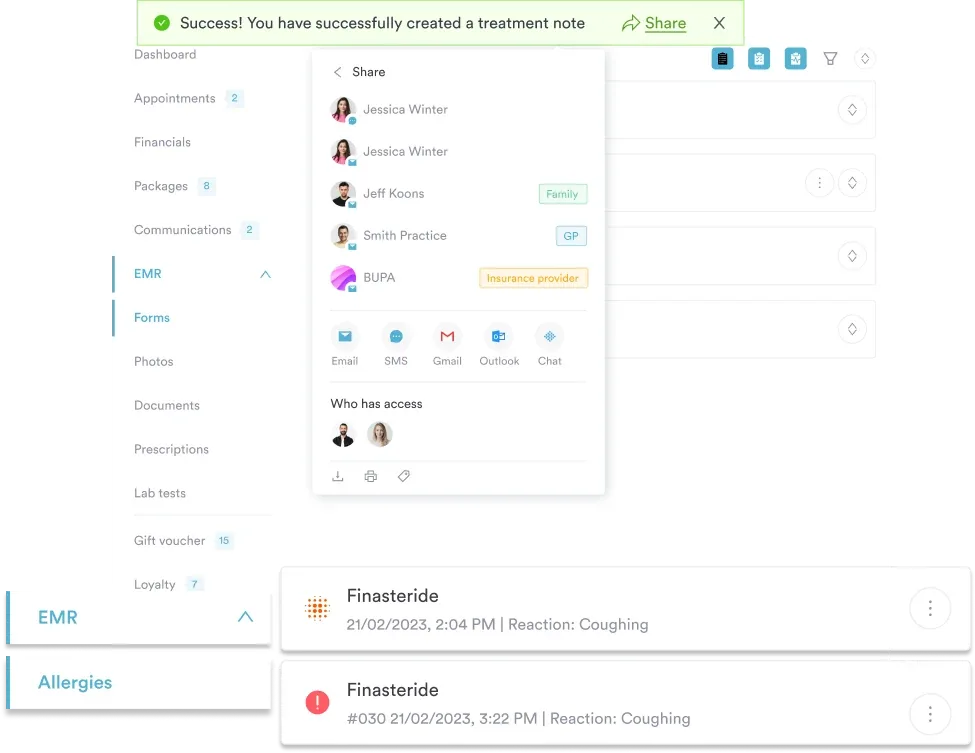
Practice management software like Pabau pre-fills the claim from the patient record. Its claims management tools then hold the submission until every insurer-required field is complete.

Pro Tip
Run a monthly audit of the claims filed under H05.9. Pick a threshold, say one in five orbit submissions. Anything above that points back to the encounter note, not the coder.
Two situations where H05.9 is the right call
H05.9 fits two scenarios and nothing else. Miss that and you either undercode a billable subcategory or overcode an encounter where the diagnosis was already settled.
- Diagnosis not yet confirmed: The patient presents with orbital symptoms such as proptosis, pain or visual disturbance. Imaging and labs are still pending, so nothing specific has been confirmed.
- Workup complete, still undifferentiated: Testing is finished, but the pathology fits no H05 subcategory with confidence. This is rare, and the note should say why a specific code was not assignable.
- Not appropriate for: thyroid eye disease, confirmed orbital cellulitis, or enophthalmos. Those have dedicated codes at H05.83, H05.01 and H05.4x.
ICD-10-CM indexes three approximate synonyms for H05.9. They are orbital disorder, disorder of orbit proper, and orbital disorder recorded as an eye condition.
Spotting one of those phrases in a note does not settle the code on its own. The same caution applies to other unspecified eye codes such as H46.9.
H05.9 vs H05.89: the difference an auditor looks for
This is the most common error inside the H05 family. The two codes sit next to each other and get swapped in practice. They describe different clinical situations, and they carry very different audit risk.
The practical test is short. If the clinician named a condition in the note, even one without its own subcategory, H05.89 is the correct choice.
Reserve ICD-10 code H05.9 for encounters where the orbital disorder is genuinely uncharacterized. A fully specified diagnosis such as H46.3 always defends itself better on audit than an unspecified one.
CPT codes that commonly pair with H05.9
H05.9 usually appears alongside ophthalmology evaluation and orbital procedure codes. The AAPC code lookup holds the crosswalk data behind the pairings below. Medical necessity documentation still has to support each one.
Payers often ask for supporting documentation when imaging is billed with H05.9, especially MRI and CT. A short clinical rationale in the note, explaining why orbital imaging was needed, does most of that work. Oculoplastic and plastic surgery practices billing 67400 should expect the request as routine.
Linking the diagnosis to the order in one place saves a retrospective hunt through three systems. Good patient records management keeps every imaging order and its supporting diagnosis on the same record.
Documentation that keeps an unspecified orbit claim paid
Unspecified codes attract more scrutiny than specific ones, so the note has to work harder. When H05.9 genuinely is the right code, the chart should show why a specific diagnosis could not be established.
Run through this list before you submit:
- State the presenting symptoms: Record orbital pain, proptosis, swelling, visual change or diplopia, with onset, severity and the side affected.
- Record the workup performed: List the imaging ordered, the labs reviewed and any specialist input. This shows the unspecified designation followed a proper workup.
- Say why a specific code was not assignable: A line such as “orbital mass, etiology pending further workup” gives the payer a defensible basis.
- Update the code at follow-up: Once a diagnosis is established, move to the matching H05 subcategory. Leaving H05.9 on repeat claims is a common audit trigger.
- Note the affected side anyway: H05.9 has no laterality extension, but recording which orbit is involved strengthens the note considerably.
- List supporting diagnoses: Other codes recorded at the same encounter, such as H54.8, help the payer see the whole picture.
Capturing all this at the point of care beats reconstructing it two weeks later. Medical intake forms built into the workflow collect orbital symptom detail while the patient is still in the chair. Periorbital swelling often walks into a dermatology practice first, and the same rules apply there.
Storage matters as much as capture. HIPAA compliance requirements govern how orbital disorder records are held and accessed. Structured, searchable notes also speed up the coder, which is where AI clinical documentation tools earn their place.
Pro Tip
Add two fields to your orbit encounter template. First, ask whether a specific H05 diagnosis was established, yes or no. Second, if no, capture the reason a specific code was not assignable. Every H05.9 claim then carries its own audit trail.
Coding guidelines and the Excludes notes H05.9 inherits
Several rules in the ICD-10-CM Official Guidelines for Coding and Reporting apply directly to H05.9. The CMS ICD-10 guidelines set out the principles that govern every unspecified code.
- Specificity first: Assign the most specific code the documentation supports. H05.9 is valid only once every H05 subcategory has been ruled out.
- Unspecified is not automatically wrong: Where the information genuinely is not available, an unspecified code is appropriate and defensible. The encounter note has to justify it.
- Excludes notes carry down: H05 has a Type 1 Excludes for congenital malformation of orbit at Q10.7, so those two codes never appear together. The chapter also excludes eye trauma, which belongs in S05.
- HIPAA transactions: H05.9 is valid on professional 837P and institutional 837I claims alike.
- FY2026 validity: The FY2026 edition took effect on October 1, 2025 and runs to September 30, 2026. Check the edition again every October.
Training staff on those rules cuts H05.9 misuse faster than any review after submission. It helps to know the denial codes your payers return, because a specificity denial and an eligibility denial need completely different fixes.
How Pabau keeps unspecified orbit claims moving
Most orbit claims stall for administrative reasons rather than clinical ones. A membership number is missing, the referring provider field is blank, or the diagnosis never made it from the note onto the claim form. Staff then chase the same details twice.
Pabau closes that loop. The claim form fills itself from the patient record, so the diagnosis captured at the encounter lands on the charge line without retyping. Coders search built-in ICD-10-CM and CPT libraries from the same screen, which keeps a code lookup from becoming a browser tab.
Pabau also checks required insurer fields before the send button unlocks. In the US, claims route through a clearinghouse with real-time eligibility checks, remittance posting and claim-status tracking. You can see where a claim stands without phoning the payer.
None of that decides whether H05.9 or H05.89 is the right code, and it should not. That judgment stays with your coder. What the software removes is the second category of denial, the one caused by an incomplete form rather than a debatable diagnosis.

Send orbit claims out complete, first time
Pabau pre-fills each claim from the patient record and searches 20,000+ ICD-10 and CPT codes in one place. It also checks that required insurer fields are complete before the claim goes out.

Conclusion
H05.9 holds up when the note shows the work behind it. Run the H05 list, check what FY2026 added, then record why nothing more specific fits. That habit settles most audit questions before anyone thinks to ask them.
The trade-off worth remembering is volume. One unspecified claim rarely draws attention. A steady run of them across the same providers reads as a documentation problem. Payers act on patterns long before they act on single lines.
Pabau’s claims management pre-fills orbit claims from the patient record and checks required insurer fields before submission. Book a demo to see how that fits an ophthalmology billing workflow.

Continue your research
Working out where an unspecified eye code is defensible? H46.9 applies the same specificity-first test to optic neuritis.
Need the wider billing-code picture? Medical coding cheat sheet collects the code families and modifiers coders reach for most often.
Chasing fewer rejections on first submission? Clean claim explains what a payer checks before it accepts a claim.
Denials already piling up? Denial management in healthcare sets out how to work a denial queue without losing the appeal window.
Coding an eye exam with a named optic nerve finding? H46.3 shows what a fully specified alternative looks like.
Frequently asked questions
Does H05.9 need a 7th character?
No. H05.9 is complete at four characters, and ICD-10-CM adds no laterality or encounter extension to it. If a payer rejects the claim as incomplete, the problem is usually the code choice rather than a missing digit.
Can I use H05.9 for an orbital injury?
No. The eye chapter carries a Type 2 Excludes for injury of eye and orbit, which sends traumatic findings to the S05 codes. Use H05.9 only for a separate non-traumatic orbit problem at the same encounter.
Does H05.9 cover eyelid or tear duct problems?
No. H05 covers the bony orbit and its contents, apart from the eyeball itself. Eyelid, lacrimal and conjunctival conditions sit in H00 to H04, so a swollen lid on its own never justifies an orbit code.
Which MS-DRG does H05.9 group into?
On inpatient claims, H05.9 groups to MS-DRG 124 or 125, other disorders of the eye with or without a major complication. Outpatient ophthalmology billing is unaffected, since payment there follows the CPT code.
Do I need an external cause code with H05.9?
Only where the cause is known and relevant. The eye chapter asks you to add an external cause code after the eye condition. That extra line helps the payer see the clinical picture.
Does H05.9 apply to an orbital tumor?
No. Neoplasms are excluded from the eye chapter and code to C00 through D49. If imaging shows a mass but pathology is still pending, H05.9 can hold the encounter until the biopsy result lands.