











Key takeaways
The arm squeeze test tells you whether arm pain is coming from the cervical spine or from the shoulder itself.
Use a pincer grip on the middle third of the upper arm, thumb behind over the triceps and fingers in front over the biceps.
The test is positive when the upper arm score sits at least 3 points above both the AC joint and subacromial scores.
Gumina et al. (2013) reported 96% sensitivity and 91% to 100% specificity, so the test helps rule cervical radiculopathy out and in.
Practice management software like Pabau records each pain score in its own field, so findings stay consistent between appointments.
Your patient rubs the outside of their shoulder and says the ache has been there for six weeks. Nothing in the story points cleanly at one structure. The neck feels stiff, the arm feels heavy, and reaching overhead hurts.
That presentation is common, and it is easy to get wrong. Cervical nerve root irritation refers pain straight into the shoulder and arm. Shoulder tests can turn positive even when the neck is the source, which sends treatment down the wrong road.
The arm squeeze test was built for exactly this decision. You squeeze the upper arm, squeeze two spots on the shoulder, and compare what the patient tells you. It takes under a minute and needs nothing but your hand.
Why neck and shoulder pain look the same in the room
Cervical radiculopathy happens when a nerve root in the neck is compressed or irritated. Disc herniation and foraminal stenosis are the usual causes. The result is pain, paresthesia, or weakness traveling down the arm.
Those symptoms sit on top of the shoulder’s own problem list. Rotator cuff tears, impingement, and acromioclavicular pathology all refer pain to the same patch of skin.
Shoulder provocation tests such as the drop arm test can read positive when the neck is the source. Pain and weakness inhibit the movement being tested.
Guessing has a price. Treat the shoulder when the neck is the driver and recovery stalls. You also end up with imaging that answers the wrong question, and sometimes with a shoulder intervention that was never going to help.
The arm squeeze test goes straight at that fork in the road. It will not tell you which nerve root is involved. It tells you which region deserves the next ten minutes of your assessment.
How to perform the arm squeeze test in under a minute
Accuracy comes from the comparison, not from the squeeze. You press three sites, collect three pain scores, and read the difference between them.
What you need before you start
- A pain scale the patient understands, either a 0 to 10 numeric rating or a visual analog scale
- A relaxed arm, with no overhead loading in the minutes beforehand
- A clear upper arm, free of bruising, wounds, or recent surgery
- A handheld dynamometer, which is optional but useful for calibrating your grip
The protocol, step by step
- Seat the patient with the tested arm relaxed and hanging at their side
- Explain the 0 to 10 scale and check that they can rate pain reliably
- Find the middle third of the upper arm, between the deltoid insertion and the lateral epicondyle
- Place your thumb behind the arm over the triceps and your fingers in front over the biceps
- Squeeze thumb and fingers together at roughly 7 kg, three times, with the same strength each time
- Record the score, then squeeze the AC joint with the same force and record that score
- Squeeze the anterolateral subacromial area, record the score, and compare all three
The grip is where most people go wrong
A whole-hand squeeze is the most common error. It spreads pressure over the deltoid and the elbow end of the arm, so you are no longer testing the tissue the original protocol tested. Use a pincer grip and keep the pressure on the middle third of the upper arm.
Force is the second problem. The original protocol standardized compression at 7.2 kg, plus or minus 1.6 kg, measured with a MicroFET handheld dynamometer. The reported range ran from 5.9 to 8.1 kg, and each patient was squeezed three times with the same strength.
That is firmer than most hands guess. Press a dynamometer a few times until 7 kg feels familiar, then trust your hand. Matching the force across all three sites matters more than hitting the number exactly.
Why you squeeze the shoulder twice
A high arm score on its own means nothing. Plenty of people find firm pressure on the upper arm uncomfortable. The two shoulder squeezes give you that patient’s own baseline for the same force.
Take the acromioclavicular joint first, then the anterolateral subacromial area. Both sit over structures that hurt when the shoulder itself is the problem. So if the shoulder is the source, those two scores should be the high ones.
Recording all three numbers is what makes the test repeatable. Build the comparison into your digital assessment forms and every practitioner fills the same three fields. Nobody logs a bare positive or negative.

A 3-point difference is what makes the test positive
The test is positive when the upper arm score sits at least 3 points above both shoulder scores. That difference, rather than where the patient points, is what separates a cervical source from a shoulder source.
An example makes the threshold concrete. A patient rates the upper arm squeeze 8 out of 10, the AC joint 2, and the subacromial area 3. The smaller of the two differences is five points, which clears the threshold comfortably.
A positive result stops short of naming the level. It also does not rule out a shoulder problem sitting alongside the cervical one. Record all three scores and the difference, so the next clinician reads your reasoning rather than a verdict.
Teams that follow good practice in safer clinical notes log the three numbers rather than the word positive.
Sensitivity and specificity are high, but rest on one study
Gumina et al. reported 96% sensitivity and specificity between 91% and 100%. Both figures come from a single 2013 paper in the European Spine Journal.
The authors compared patients with cervical nerve root compression against controls and against five shoulder conditions.
Specificity depended on which shoulder condition the cervical patients were measured against:
- 96% against asymptomatic controls
- 96% against rotator cuff tear
- 98% against adhesive capsulitis
- 100% against acromioclavicular arthropathy
- 98% against calcifying tendonitis
- 91% against glenohumeral arthritis
The sensitivity figure is what makes a negative test useful. Almost everyone with genuine cervical radiculopathy scored at least 3 points higher on the arm. So when the difference is not there, turn your attention to the shoulder.
Specificity is what makes a positive test worth acting on. Few patients with isolated shoulder disease clear the 3-point margin. A positive result therefore moves the diagnosis a long way toward the neck, which is why the authors proposed it for doubtful cases.
Likelihood ratios put the same point in numbers. At 96% sensitivity and 96% specificity, the positive likelihood ratio is roughly 24 and the negative ratio roughly 0.04. Both sit well inside the range clinicians treat as useful.
One warning applies to every number above. They come from a single study with pre-selected diagnostic groups. In an undifferentiated caseload, expect accuracy to be lower.
Where the arm squeeze test breaks down
Every bedside test has a failure mode, and this one has a few worth knowing before you rely on it.
- Specificity varies by comparison group. It was lowest against glenohumeral arthritis at 91%, so degenerative shoulder disease is where false positives are most likely.
- Local arm pathology confounds the result. Biceps tendinopathy, a contusion, or myofascial pain can lift the arm score with no cervical involvement at all.
- Patients must be able to score pain. Cognitive impairment, language barriers, or widespread pain sensitization make the 3-point comparison unreliable.
- Contraindications limit who you can test. Avoid the test after acute upper arm trauma, or with suspected fracture, open skin conditions, or acute lymphedema in that limb.
- Reproducing the force takes practice. The study calibrated compression to 7.2 kg with a dynamometer, and an uncalibrated hand blurs the comparison.
- The evidence base is one study. Independent replication of Gumina et al. (2013) remains limited, so treat the accuracy figures with appropriate caution.
Practices building structured assessment protocols can flag these limits inside the documentation template itself.
The clinician then records the result and anything that might have skewed it. Clinical assessment tools are only as good as the context recorded next to them.
Which tests to pair with the arm squeeze test
Nobody uses this test on its own. Each cervical test provokes a different mechanism, so a cluster of two or three is much harder to fool than any single one.
The arm squeeze test is unusual in scoring high on both axes. Spurling’s test and the distraction test trade sensitivity for specificity, which is the normal pattern. Their numbers also rest on far more studies than this one does.
Two other checks are worth keeping in the same sequence. A thoracic outlet screen such as the Wright test covers a different route of compression. Sensory mapping with a two-point discrimination test adds detail once you suspect a nerve root.
One more check earns its place when the arm itself feels tender. A biceps tear test tells you whether local tissue is inflating the squeeze score.
A widely used cervical radiculopathy test guide makes the same argument for combining tests. What matters afterwards is how you record them. Give each test its own field in the note, so the cluster stays visible instead of dissolving into free text.
Pro Tip
Run the arm squeeze test first when you plan a cluster. A negative result makes cervical radiculopathy unlikely before you spend time on neural tension testing. A difference of 3 points or more justifies moving straight to cervical assessment.
When to use the test, and when to skip it
Reach for it when arm pain has no clear owner. Skip it when the arm itself is injured, because local tissue will drive the score whatever the neck is doing.
Practices that agree in advance which tests apply to which presentation get more consistent reasoning across the team. A shared physical therapy EMR keeps that decision in front of everyone, rather than in one clinician’s head.
What to do after a positive result
A positive result changes the direction of the assessment, not the diagnosis. Your next moves confirm the cervical source, find the level, and decide whether anyone else needs to see the patient.
- Add corroborating tests. Spurling’s test and the cervical distraction test both carry high specificity, and the ULNT adds information on neural mechanosensitivity.
- Screen the neurology. Check C5 to C8 myotomes, dermatomal sensation, and the biceps, brachioradialis, and triceps reflexes to localize the level.
- Look for red flags. Progressive weakness, gait change, hand clumsiness, or bilateral symptoms point toward myelopathy and need urgent medical review.
- Start conservative care where appropriate. Many patients improve within six to twelve weeks with activity modification, manual therapy, and neck pain exercises.
- Refer for imaging when the picture demands it. Symptoms that persist or worsen past that window, or any red flag, warrant MRI and a specialist opinion.
Write the sequence down, not just the finding. A note carrying the three pain scores, the corroborating tests, and the neurological screen shows why the neck became the focus.
Evaluation complexity feeds the code you select, and 97161 sits at the low end of that range.
How Pabau keeps special test scores out of free text
Most practices record a special test as a sentence. The note says arm squeeze positive, the three scores never make it in, and the comparison disappears once the appointment ends. Six weeks later nobody can tell whether the difference is shrinking.
Practice management software like Pabau handles this with structured fields instead. Physical therapy and sports medicine practices can build an upper limb template where each squeeze gets its own numeric field. Because those entries are numbers, measurement tracking charts them across visits.
Structured patient records keep those fields alongside the rest of the client’s history. The next practitioner reads your reasoning instead of rebuilding it. Pair the scores with an outcome measure such as the QuickDASH and you get a trend rather than a snapshot.
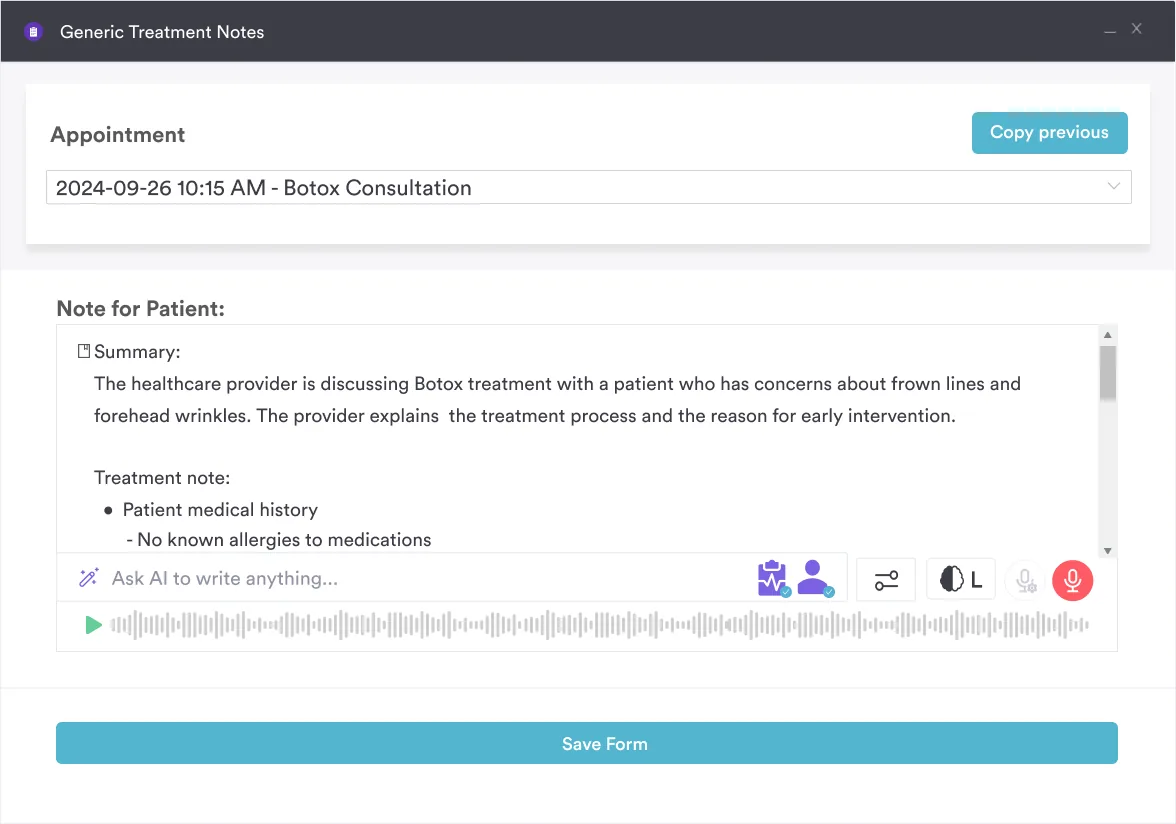
Some clinicians would rather talk than type. Pabau Scribe, our AI scribe, turns spoken findings into structured note entries, so the documentation happens while the detail is still fresh.
Consistent records also carry weight outside the treatment room. They strengthen referral letters, support medico-legal review, and make a governance audit far less painful. If you are still building that layer, start with the medical forms your assessments actually need.

Document every assessment finding, every time
Structured digital forms and patient records let clinicians capture each special test score in its own field, so nothing gets lost between appointments. Built for physical therapy and sports medicine practices.

Conclusion
The arm squeeze test earns its place because of what a negative result buys you. At 96% sensitivity, you can stop chasing the cervical spine and spend the time on the shoulder instead.
A positive result is worth more than most bedside findings, with specificity between 91% and 100%. Still, treat it as a strong signal rather than proof. The evidence is one study, so confirm anything that changes management with Spurling’s or the distraction test.
What decides whether any of this helps the patient is the note. Three numbers and a difference, written down every time, turn a subjective impression into something the next clinician can act on.
Pabau keeps those numbers in structured fields instead of a free-text box. Book a demo to see how it fits a physical therapy caseload.

Continue your research
Screening the cervical spine for dizziness instead? Smooth pursuit neck torsion test helps separate cervical from vestibular causes after a neck injury.
Want another fast bedside strength check? Pinch grip test covers the technique, the grading, and what a weak result points to.
Working through a suspected nerve problem in the hand? Hand nerve tests walks through the bedside checks for median, ulnar, and radial involvement.
Assessing the elbow rather than the neck? Milking maneuver sets out the ulnar collateral ligament test step by step.
Planning a return to sport once symptoms settle? Return-to-running protocol covers evidence-based progression criteria for post-injury rehabilitation.
Frequently asked questions
Should you squeeze the other arm as well?
Yes, and it costs you ten seconds. The asymptomatic arm shows how that patient rates the same pressure without symptoms. Treat it as a useful reference rather than part of the scoring. The 3-point threshold is still measured against the two shoulder points on the affected side.
Can you bill separately for the arm squeeze test?
No. Special tests belong to the evaluation, so they sit inside the physical therapy evaluation code rather than a charge of their own. What the test does affect is complexity. Three recorded scores, a confirmatory cluster, and a neurological screen all support the evaluation level you select.
What if the arm and the shoulder both score high?
That usually means two problems at once. The test only flags a cervical contribution when the arm sits at least 3 points clear of both shoulder scores. If everything scores 7 or 8, the margin is gone. Assess the shoulder and the neck, then treat what you find.
Can you repeat the test at follow-up?
Yes, and the numeric scoring makes it a reasonable re-test. Use the same grip, the same force, and the same three sites. A shrinking difference suggests the cervical component is settling. Log all three scores every time, otherwise the comparison turns into guesswork.
Does a positive test mean the patient needs an MRI?
No. It tells you where to examine next, not what to image. Imaging follows red flags, progressive weakness, or symptoms that fail to settle with conservative care. On its own, a positive squeeze test is a reason to assess the neck properly.