GLP-1 diet plan
A GLP-1 diet plan is a structured eating framework for patients taking semagluti...

2
Last Updated: Oct 13, 2026

The pinch grip test screens the anterior interosseous nerve by asking the patient to make an O with the thumb and index finger.
A positive result is pulp-to-pulp contact instead of a true O, which points to weakness in the flexor pollicis longus and index profundus.
Quantitative testing uses a calibrated pinch gauge to record lateral, tip, and palmar pinch, then compares the mean of three trials against published norms.
The most-used adult norms come from Mathiowetz and colleagues, published in pounds, so record your gauge model and units before comparing anyone to a table.
Practice management software like Pabau keeps serial pinch readings in the client record, so the trend stays visible across a rehabilitation episode.
The pinch grip test targets the anterior interosseous nerve (AIN), a motor branch of the median nerve. You ask the patient to touch the tip of the thumb to the tip of the index finger. If that O collapses into a flat, pinched shape, the AIN becomes the prime suspect.
That same movement has a second, quantitative life. With a calibrated gauge, pinch strength turns into a number you can defend in a report and track week by week. Both versions live or die on setup.
A positive pinch grip test means the patient cannot form a true tip-to-tip O shape. The thumb and index finger meet pulp to pulp instead, flat and wide.
That substitution happens because two muscles have stopped pulling. The flexor pollicis longus (FPL) bends the thumb at its end joint, and the flexor digitorum profundus (FDP) bends the index fingertip. Both take their nerve supply from the AIN.
So the shape of the failure is the finding. The distal joints stay straight, the pinch flattens, and most patients have no idea anything looks unusual. For physical therapy practices and hand therapy services, this is one of the quickest screens in the upper-limb examination.
The AIN branches off the median nerve in the proximal forearm, near the two heads of pronator teres. It is purely motor, so it supplies no skin at all.
That detail does a lot of diagnostic work. Motor weakness in the thumb and index finger with normal sensation points to the AIN. Numbness or tingling suggests the problem sits elsewhere, and a wider run of hand nerve tests will help place it.
When sensation is the question instead of strength, the Moberg pick-up test times how fast a patient handles small objects with the eyes closed. It reports what the hand can do by touch alone rather than what the fingertip detects.
Three muscles sit downstream of the nerve:
Thenar wasting alongside a positive test changes the picture. Chronic compression of the median nerve at the wrist is the more common cause of that pairing. Think about a higher or mixed lesion rather than an isolated AIN problem.
Three pinch patterns show up in hand therapy, and they are not interchangeable. Lateral pinch reads highest, tip pinch reads lowest, and palmar pinch lands between the two.
Tip pinch matters most for AIN screening because fewer muscles share the load. A weak FPL shows up there first. Lateral pinch is the better measure of day-to-day function, which is why it appears in most return-to-work reports.
Standardized positioning is not optional. Change the elbow angle or the chair height and the readings move with it, which makes side-to-side and session-to-session comparison meaningless.
Digital and analog gauges are both acceptable, provided the device is calibrated on the manufacturer’s schedule.
The B&L pinch gauge is the instrument behind the most widely quoted norms, so note which gauge you used. Most of those norms follow the assessment standards published by the American Society of Hand Therapists (ASHT).
Write the gauge model and calibration date into every assessment note. If the equipment changes mid-episode, take a fresh baseline before you compare anything. Gauge-to-gauge variation is easily large enough to hide the clinical change you are looking for.
Reading the screening version is binary. The patient either forms a clean O or does not.
A positive test on its own diagnoses nothing. What it earns is a referral for electromyography and nerve conduction studies, particularly alongside proximal forearm pain, recent heavy lifting, or an old forearm injury.
Strength readings are the better tracker over time. A systematic review of outcome measures after carpal tunnel decompression found tip pinch the most responsive to change among the pinch and grip measures studied.
The adult norms in daily use come from Mathiowetz and colleagues, published in 1985. Their figures were collected with a B&L gauge and reported in pounds. The table shows right-hand means for men and women.
Convert before you compare if your gauge reads kilograms. Divide the pounds figure by 2.2, so a 26 lb key pinch is roughly 11.8 kg.
These are group means from 628 adults in one US region, not diagnostic cut-offs. Norms shift with population, gauge, and protocol, so choose the table that matches your equipment and your patient.
Norms place the patient in a population. The uninvolved hand tells you what is normal for this person, which is usually the more useful comparison.
In the Mathiowetz sample, the right hand was only slightly stronger than the left, and hand dominance made little difference to average scores. A large side-to-side difference is therefore worth chasing, rather than shrugging off as handedness.
Record both hands every time. The percentage difference between them is the number most referrers read first.
Run both, because they measure different mechanisms. Power grip, measured on a Jamar dynamometer, recruits the whole hand. Pinch isolates the precision muscles at the thumb and index finger.
Someone with an isolated AIN lesion can still post a near-normal power grip. The ring and little finger flexors are intact, and they carry the dynamometer between them. Pinch testing catches what that reading hides.
The opposite pattern is informative too. Inflammatory arthritis usually drags both scores down together, which points toward the joints rather than a single nerve.
This is not a single-condition tool. It shows up across hand therapy, occupational therapy, sports medicine, and orthopedic outpatient work, usually for one of these reasons:
Most unreliable pinch data comes from habit, not equipment. These are the slips worth designing out of your routine.
No single special test confirms a diagnosis, and this one is no exception. Knowing its edges keeps the referral decision honest. The gauge records pinch strength only. Thumb-to-index taps that slow and shrink with each repetition need a bradykinesia test.
A single number is not a record. To stay useful months later, the entry needs everything that could explain a change in that number.
Then add one line of interpretation. A note reading “right lateral pinch 12 lb, mean of three trials, 54 percent of the left hand” gives the raw picture. Adding “consistent with AIN weakness on examination” finishes the entry.
The habits behind safer clinical notes apply here as well. Write the entry at the time, and record what you measured rather than only what you concluded.
In most practices, pinch scores live in free text. The number sits in one note, the gauge model sits in another, and the trend only appears if someone scrolls back through six appointments.
Practice management software like Pabau treats those readings as data instead. Measurements tracking stores each score against the date it was taken, so lateral, tip, and palmar values chart themselves inside the client record.
The setup details travel with them. Digital assessment forms capture the gauge model, calibration date, and positioning once, at the start of the episode. Every later reading is then taken under the same conditions.
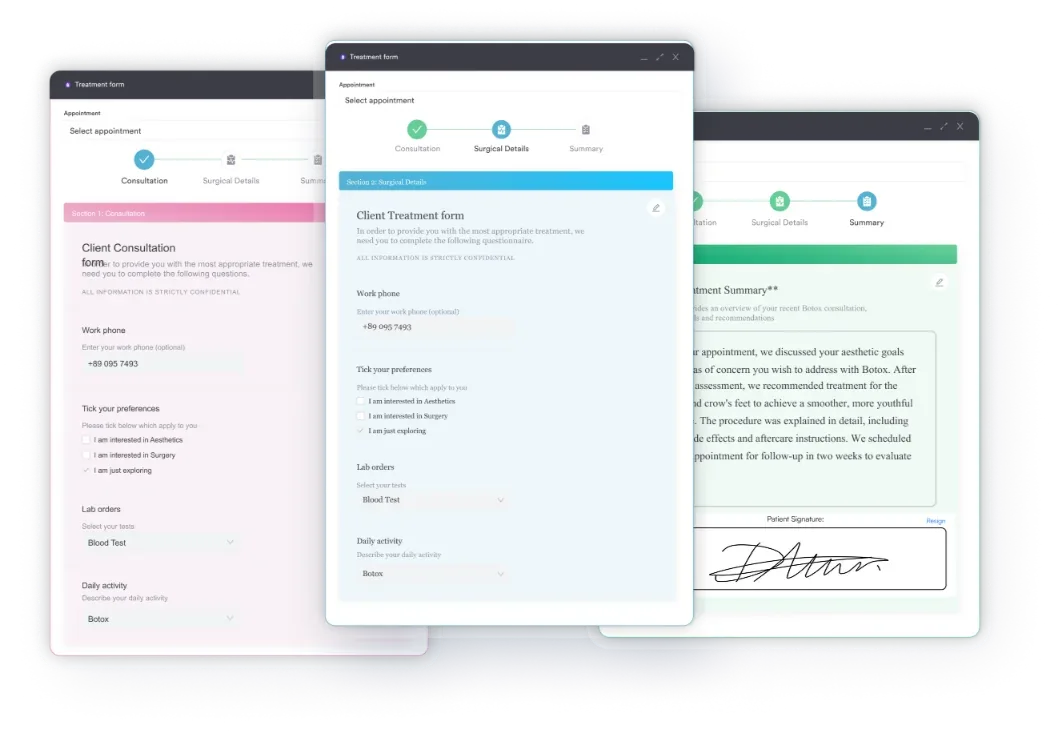
Whoever picks up the case next sees the same conditions the first assessor used, so the comparison holds. Discharge summaries and outcome reports then come straight out of the record.

Pabau stores hand assessment scores as structured data, charts them across an episode of care, and keeps the gauge and positioning details attached. Your team can see progress without digging through old notes.

The pinch grip test is only as good as the conditions around it. Keep the chair, the gauge, the trial count, and the instructions identical, and the numbers start to carry real weight.
Get that right and one short test does two jobs. It flags a nerve problem worth investigating, and it produces a figure you can still defend in a report six months later.
If your pinch scores are still buried in free-text notes, the trend disappears exactly when a referrer asks for it. Book a demo to see how Pabau records hand assessments and shows the progress across a whole episode of care.

Want a worked example of norm-referenced scoring? Sensory Profile 2 scoring shows how standardized scores are calculated and recorded in occupational therapy.
Assessing visual-motor skills as well as hand strength? Beery VMI scoring walks through another normative test, from raw score to interpretation.
Screening for fear of falling? Falls efficacy scale is a 10-item scale where patients rate confidence in daily activities, with scores above 70 flagging fear of falling.
Measuring balance during walking? Functional gait assessment template helps identify mobility impairments, quantify fall risk, and track functional improvement during everyday walking activities.
Planning a home safety visit? Home safety assessment checklist is a room-by-room tool for spotting fall hazards, injury risks, and medication safety concerns, with modification recommendations.
Yes, both names describe the same screen for anterior interosseous nerve function. Neurology and emergency medicine tend to say OK sign, while hand therapy says pinch grip test.
No, a dynamometer measures whole-hand power grip, so it cannot capture pinch. You need a pinch gauge, and published norms assume one. Using a different instrument makes your readings incomparable with any norm table.
Thumb base osteoarthritis is a common cause, along with inflammatory arthritis, thumb tendon injury, and long-term disuse after immobilization. Pain alone can also lower a reading, which is why effort quality belongs in the note.
Yes. Mathiowetz and colleagues published separate grip and pinch norms for ages 6 to 19 in 1986. Adult tables should never be applied to a child, since strength is still developing through those years.
Every four to six weeks suits most rehabilitation episodes, plus a reading at assessment and at discharge. Testing weekly rarely helps, because normal variation between sessions can be larger than the change you hope to see.