HD Brows consultation form: Free template and guide
HD Brows is a seven-step brow treatment that combines consultation, tinting, wax...

1
Last Updated: Oct 13, 2026
An aesthetic interest questionnaire template is a pre-consultation form that captures a new patient’s goals, concern areas, and medical history before their first visit. Because it collects medical history, HIPAA compliance is a factor in where you store it, a topic our comparison of medical spa systems covers.
The complete template sits further down this page, organized into six sections and free to copy. No signup, no purchase, no waiting on a file. Skip straight to the template if that is all you came for.
In practices we onboard, this is the first form a new patient ever completes. The answers decide how much of the consultation goes on history-taking rather than treatment planning.

An aesthetic interest questionnaire collects a prospective patient’s goals, concern areas, and medical history before the first consultation.
The full template is published on this page as the 6-part aesthetic intake framework, free to copy with no signup.
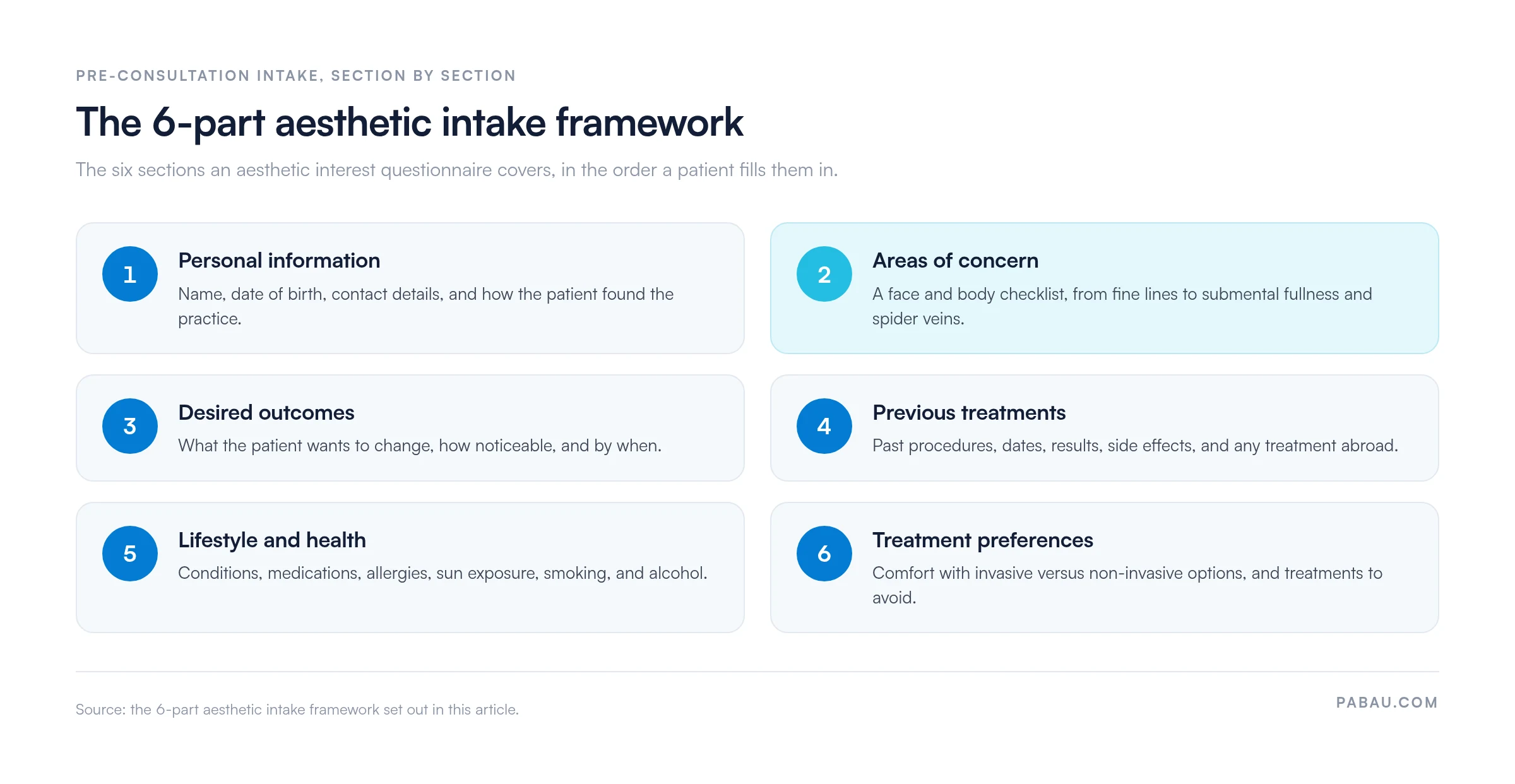
The six sections are personal information, areas of concern, desired outcomes, previous treatments, lifestyle and health, and treatment preferences.
A concern-to-next-step table maps each commonly ticked concern to the treatment category it usually opens at consultation.
Sent digitally through practice management software like Pabau, the answers land in the patient’s record before the patient arrives.
An aesthetic interest questionnaire matters because it moves history-taking, goal-setting, and suitability screening out of the consultation room and into the week before it.
Collecting that detail up front gives you a treatment plan to discuss rather than a blank page. You already know the patient’s goals, their expectations, and the medical history that might rule an option out.
A completed questionnaire lets you walk into the consultation with two or three options already matched to what the patient said they wanted.
Two patients asking for a fresher face rarely want the same treatment. One means the hollowing under the eyes. The other means a jawline that has softened. The form tells you which, days before either of them sits down.
Written answers give the patient and the practitioner the same starting point, which is where most expectation mismatches get caught early.
Patients arrive with a picture in their head shaped by filtered images. Asking them to describe the result in their own words, in writing, brings that picture into the open. You can then correct it gently, with time to prepare, instead of improvising mid-consultation.
Sending the questionnaire out with the booking confirmation saves the first ten minutes of every consultation, because nobody is filling in a clipboard in reception.
Pairing the form with your medical spa scheduling software means the send happens automatically at booking. Good medical spa software then carries those answers into every future visit, not just the first consultation.
Practice management software like Pabau stores the completed form against the patient’s record. Your team can open one screen and see goals, concerns, and medical history together. The same applies in skin clinics running dermatology practice management software.
The framework has six sections: personal information, areas of concern, desired outcomes, previous treatments, lifestyle and health, and treatment preferences.
Each section answers a question you would otherwise ask in the room. The examples below show what each one is for. The complete, copy-ready question set comes later, in the template itself.
Personal information covers the patient’s name, date of birth, contact details, and how they found your practice.
The last field earns its place twice over. A referral source tells your marketing which channel is paying for itself. The same answer tells the practitioner whether this patient came on a friend’s recommendation or an advert.
Areas of concern works best as a tick-box checklist split into face and body, so patients mark what bothers them instead of writing an essay.
On the face, the items patients tick most often are:
On the body, the common ones are:
Leave one open field underneath. Patients describe concerns a checklist never anticipates, and that sentence is often the one you lead the consultation with.
Desired outcomes tells you whether the patient wants a subtle refresh or a visible change, and how quickly they expect to see it.
Ask for the motivation as well as the result. A patient booking before a wedding has a deadline you need to plan backwards from. A patient who simply feels tired-looking has no deadline at all, and a very different tolerance for downtime.
Previous treatments tells you what has already been done, when, by whom, and whether anything went wrong afterwards.
Dates matter more than most forms allow room for. Knowing a patient had filler four months ago rather than four years ago changes what you can safely plan at the first appointment.
Ask directly whether the patient has had treatment abroad, and whether they experienced any complications. Both answers change whether this is a patient you want to take on.
Lifestyle and health considerations flags the conditions, medications, allergies, and habits that change recovery time or rule a treatment out entirely.
How many questions you need here depends on your menu. A solo injector can keep this section short. A multi-location medspa offering laser, body contouring, and injectables needs an extra block of questions for each modality it runs.
Treatment preferences asks how far the patient is willing to go, from topical treatments through to injectables and surgery.
Some patients arrive open to surgery and will sign a cosmetic surgery consent form at the first visit. Others want lasers and topical creams only. Minimally invasive treatments such as botulinum toxin and fillers rose by over 70% in 2022 compared with 2019. That figure comes from Fox 13’s investigation into the plastic surgery boom.
Knowing where a patient sits on that scale before the consultation stops you pitching something they were never going to accept.
The table below maps each commonly ticked concern to the treatment category it usually opens and what the patient should have ready.
| Concern the patient ticks | Face or body | Treatment category usually discussed | What to ask the patient to have ready |
|---|---|---|---|
| Fine lines and wrinkles | Face | Neuromodulator injectables | Dates and brands of any previous injections |
| Facial volume loss | Face | Dermal fillers, sometimes energy-based tightening | A photo from a few years ago, if they have one |
| Submental fullness | Face | Fat-reduction treatments or skin tightening | Any weight change in the past year |
| Pigmentation and sun damage | Face and body | Lasers, IPL, prescription skincare | Their current skincare routine, product names included |
| Spider veins and broken capillaries | Face and body | Vascular lasers or sclerotherapy | Where the veins are, and how long they have been there |
| Stubborn fat and body shape | Body | Body contouring, or a surgical referral | Weight history over the past year |
Nothing in that table is a recommendation. Suitability is decided in the consultation, by the practitioner, against the patient’s full history. The table exists so your front desk knows what to ask for in advance, and so the practitioner is not starting cold.
Here is the full aesthetic interest questionnaire template, free to copy, organized into the six sections of the framework above.
Paste it into your form builder, your EMR, or a printed handout, then cut the questions that do not apply to your treatment menu. The structure below is the map.
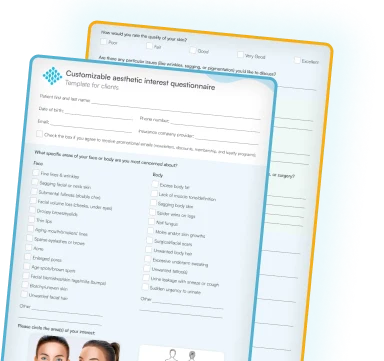
Which areas of your face concern you? Tick all that apply.
Which areas of your body concern you? Tick all that apply.
Then ask the four follow-up questions.
Pabau sends the questionnaire with the booking confirmation, collects it on the patient’s phone, and writes the answers straight into their record.
Without a digital form, the send-out stays manual. Someone emails a PDF, the patient prints it or forgets, and reception ends up handing over a clipboard on arrival. The answers then get retyped into the system, or left in a paper file nobody opens again.
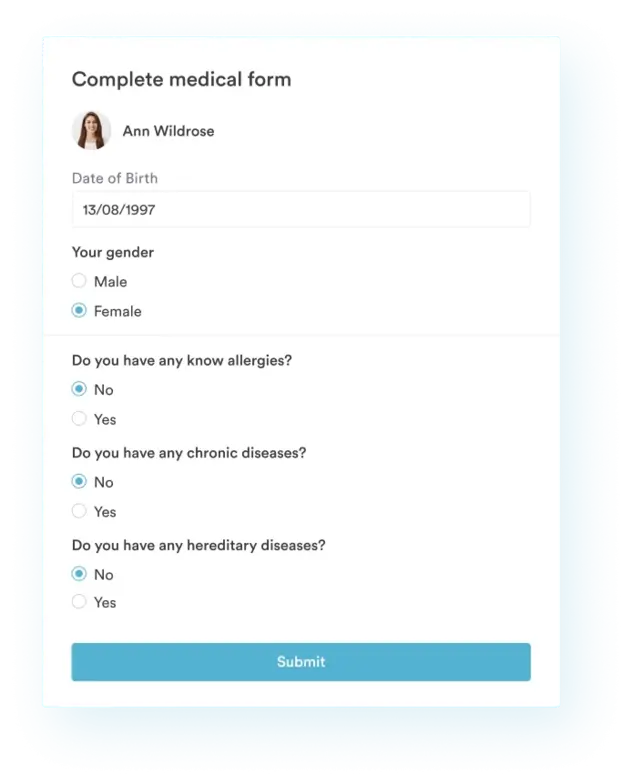
What happens after the patient hits submit is the part that changes the workday. The answers attach to that patient’s record automatically, so there is no retyping and no second version of the truth. Pabau GO, our iOS app for practitioners, shows the same answers as a pre-appointment checklist.
Your practitioner opens the record before the patient walks in and already knows the concern areas, the previous treatments, and the medical history. The consultation starts at the treatment plan instead of at the paperwork. Practices also use this moment to prepare for the consultation properly.

Pabau sends your aesthetic interest questionnaire with the booking confirmation and files every answer against the patient’s record. Your practitioners open one screen and start the consultation already briefed.

A questionnaire only earns its keep if it reaches the patient early and reaches the practitioner unaltered. A paper form handed over in reception fails on both counts.
So take the six sections above, cut what does not fit your treatment menu, and put the result somewhere it sends itself. The questions are the easy part. The send-out and the filing are what decide whether anyone reads the answers.
Book a demo to see how Pabau sends your intake forms at booking and files the answers against each patient’s record.

Running botulinum toxin treatments? Botox treatment note template sets out the fields a treatment record needs alongside your intake questionnaire.
Taking before-and-after photos? Before and after photo consent form requirements explains what your consent wording has to cover.
Running facial consultations too? Facial intake form covers the skin history and questions that belong on a facial consultation form.
Offering surgical procedures? Cosmetic surgery consent form gives you the consent document that follows this questionnaire.
Preparing for the appointment itself? How to prepare for a cosmetic consultation covers what to do with the answers once you have them.
Yes. The full question set is published on this page and you can copy it without paying or signing up for anything.
The complete question set is published on this page, section by section, so you can copy it into your own form builder. A download form also sits above it.
Before the first consultation, ideally at the moment of booking. Sending it with the booking confirmation gives the patient time and gives your practitioner answers to read beforehand.
With a digital form, the answers write straight into the patient’s record. The practitioner opens one screen and sees goals, concern areas, and medical history together, before the appointment starts.
Aim for under ten minutes on a phone. Tick-box checklists for concern areas and yes or no health questions keep it short, with open fields only where the wording matters.