Yeoman’s Test Template
Yeoman’s test is a prone provocation test for sacroiliac joint (SIJ) pain....

3
Last Updated: Sep 28, 2026

Who can own an IV therapy business depends on your state’s Corporate Practice of Medicine rules; most states require a physician medical director.
Licensed physicians, nurse practitioners, physician assistants, and registered nurses (under supervision) can administer IV therapy, though scope varies by state.
Core setup covers a business license and healthcare facility license, malpractice and general liability insurance, HIPAA-compliant records, and a good-faith exam and consent workflow.
Decide your service menu (hydration, immune, NAD+, athletic, and beauty drips) and your model: fixed location, mobile, or an IV therapy franchise.
At eight to ten clients a day, an IV therapy business can reach around $600,000 in revenue and $210,000 in profit, according to IV Therapy Academy.
Prioritizing your health is more than just a trend, and it’s easy to see why IV hydration and wellness centers have surged in popularity in recent years. Opening an IV therapy business rides that same wave, but it carries medical licensing, staffing, and compliance rules a typical startup never has to think about.
IV therapy offers a quick fix for many health-related issues, so it’s no wonder Hollywood stars such as Rihanna, Hailey Bieber, and John Legend have a couple of IV clinics on speed dial after world tours or long working weeks on set.
According to research conducted by IBIS World, industry revenue has constantly been increasing. The US IV therapy market reached $2.1 billion in 2024, and the market has been growing at roughly 2% a year.
What are the uses of IV therapy?
Several of these goals, especially immune support and reducing inflammation, are also where ozone therapy protocols are used, which is why some IV clinics offer both.
IV hydration clinics may be on the rise, but these businesses are still medical facilities, and strict regulations are set for how they should operate.
The first thing you should consider is the laws and regulations. In the US, rules about who can start an IV hydration clinic can vary significantly from state to state, while the UK operates under different authorities.
Generally, a licensed physician must be present at the clinic, and in some instances, an IV drip cannot be administered without their supervision.
Much of this comes down to the Corporate Practice of Medicine (CPOM) doctrine, which in many states limits ownership of a medical business to licensed physicians. Several states also require a good-faith exam of each patient before treatment, so build a physician or qualified provider into your model from day one.
Before you lock in an ownership structure, confirm your state’s Corporate Practice of Medicine and medical-director rules with a healthcare attorney. It is far cheaper to structure it correctly now than to unwind it after you open.
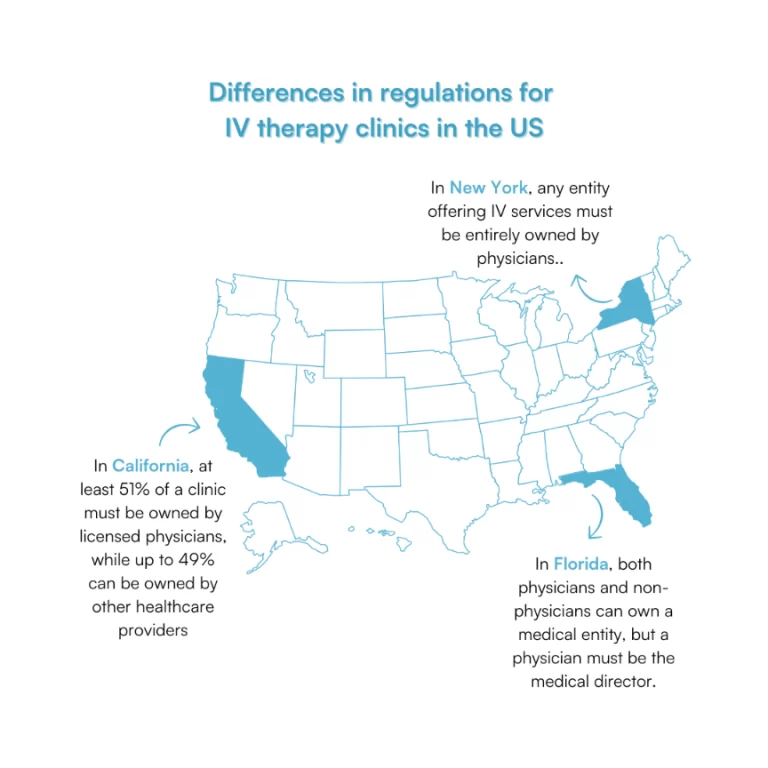
The rules and laws differ slightly from one state to another. Here a couple of IV therapy regulation examples:
Legislation in several states has tightened up recently in response to incidents at poorly regulated IV clinics, where underqualified staff led to tragic outcomes for patients.
Now that we’ve determined who can open an IV therapy clinic, it’s time to get into the specific requirements needed to establish your IV drip therapy clinic.
Among the numerous licensing requirements, one is considered the key element to opening your own IV therapy clinic — having a licensed medical practitioner on board. More often than not, they are the medical directors of the facility.
The rules might be different depending on the state you reside in. In some instances, a licensed physician must be appointed the medical director, while in other states, the licensed practitioner only needs to provide oversight.
Medical oversight means supervising and guiding medical care to ensure it’s safe, effective, and meets standards. It involves experienced healthcare professionals monitoring other medical staff to ensure quality care and reduce errors.
Another crucial thing to remember when opening an IV drip clinic is to make sure you get insurance. Medical facilities most often get insurance that covers:
This way, you can rest assured that you’ll be protected in case of any malpractice claims or similar liabilities.
Being HIPAA (Health Insurance Portability and Accountability Act) compliant is crucial. HIPAA is a law that protects patients’ private health information and ensures it stays confidential. It also gives patients rights over their health information and sets rules for how it can be used and shared.
Learn how Bank MediSpa optimized operations with Pabau’s secure digital patient record system.

Choosing the right facilities for your IV therapy clinic is crucial. Ensure it has both a prep room and a patient room, as well as a reception area.
You’ll need to quip the clinic with essential supplies like IV components (catheters, IV bags, medical equipment), emergency supplies, a medical refrigerator, wheel carts, and oxygen tanks.
During the licensing process, you’ll get a detailed list of required equipment and facility standards.
Professionals such as licensed physicians, nurse practitioners, registered nurses, and physician assistants are typically qualified to administer IV therapy. Of course, these staff members must have the necessary education and certifications.
In addition to the medical staff administering the IVs, you may also need an experienced front-of-house team, a practice manager, and even a marketing hire to ensure that you’re able to deliver a great client experience from start to finish.
You don’t always have to hire more people, though. Practice management software like Pabau is packed with features that make running a healthcare business easier, with a lot of options to use to your advantage — well worth keeping in mind when you compare EHR platforms like those in our Jane App vs SimplePractice breakdown, or specialty roundups like the best occupational therapy practice management software.
Circling back to our earlier point, most states require an IV drip clinic to have a licensed practitioner as the medical director. Nurses need state-issued certifications and licenses.
To administer IV infusions, a nurse must have an RN license (a Registered Nurse license), which can be obtained with either an ADN (Associate Degree in Nursing) or a BSN (Bachelor of Science in Nursing) degree.
The following medical professionals are authorized to administer IV therapy:
Note: Licensed practical nurses (LPNs), Licensed vocational nurses (LVNs), and Physician Assistants (PA) with extra training and authorization from an RN or physician can start intravenous therapy. In some states, EMTs (Emergency Medical Technicians) or paramedics are also permitted to administer IVs.
According to an article by American Med Spa, there are a few differences between states regarding who is able to administer IV therapy. Here are some examples:
Establishing a solid business plan and financial management practices is crucial for any business, including an IV infusion therapy clinic.
As with any business, there are start up costs to consider. While the revenue potential might have drawn you in, steady financial management will keep you afloat. Unexpected costs will pop up, no matter how carefully you plan.
Make sure you have a system to keep track of overheads like equipment, consumables, staff pay checks, and operational costs. Consistently track your finances, prioritize budgeting, and make wise investments as you grow.
Remember, slow and steady wins the race.
Managing clinic operations can be challenging.
You’ll need to manage bookings, keep up-to-date client records, collect intake forms and medical questionnaires before appointments, and follow up with pre-care and post-care. A paperless approach could be your best strategy.
If you’re operating from a mobile clinic or you do home visits, you can keep track of everything remotely and manage your start-up clinic from wherever you are.
Here’s the good news: Pabau is practice management software, specifically developed for IV clinics, med spas, and other healthcare businesses. Its sole mission is to help you operate efficiently and scale your business.
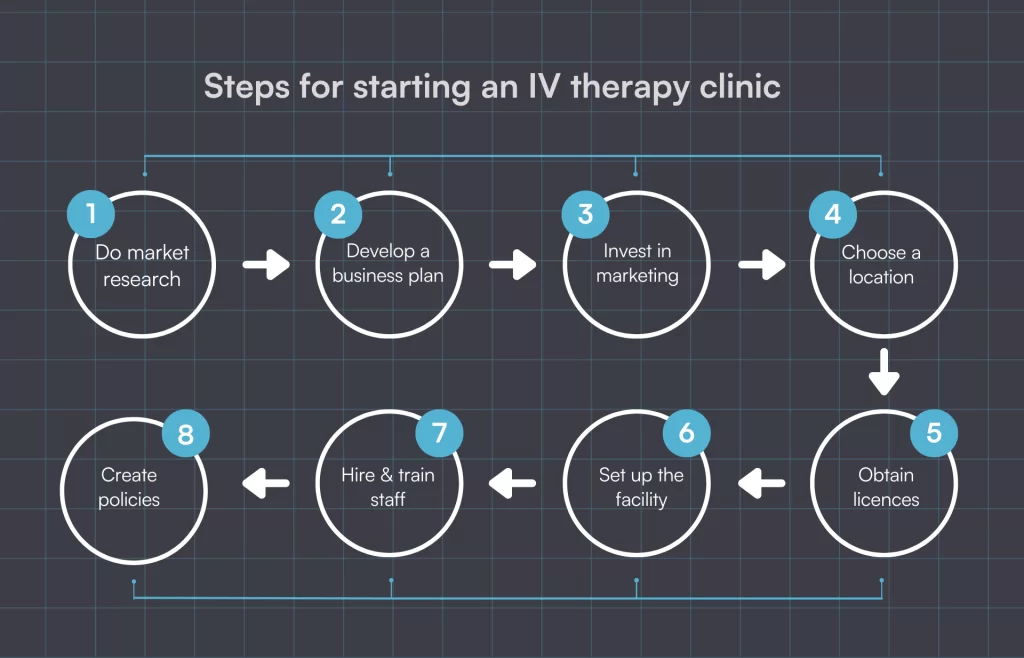
After understanding the legal requirements, the next step is to bring your business idea to life by building it from the ground up. Here are some key steps to focus on:
Create an IV therapy business plan that outlines your services, target market, financial projections, budgeting strategies, and marketing approaches. If this isn’t you area of expertise, hiring a consultant might be a good option for your start-up.
Your menu is a business decision as much as a clinical one. Map each drip to the demand you actually see locally, then price and package around it. Common IV therapy services include:
Turn the services with steady repeat demand into memberships or packages so revenue is predictable rather than walk-in by walk-in. If you offer drips alongside facials or aesthetics, skin clinic software keeps both service lines in one system. If weight-loss injections join the menu, the GLP-1 cost and retention data shows what patients pay and how many stop within two years.
Launch with three or four core drips you can staff and stock reliably, then add higher-ticket options like NAD+ once you have proven local demand. A shorter menu is easier to price, train on, and keep in inventory.
With everyone chronically online, marketing and promotion are truly important parts of owning and managing a business.
Put resources aside for marketing to grow your client base. Despite the growing popularity of IV therapy clinics, effective marketing remains crucial.
Establish a robust online presence through a well-optimized and professional-looking website, and active social media channels.
Our advice includes sending out newsletters, developing a review strategy, setting up gift vouchers and packages, and responding to clients online.
Choose a strategic location that’s accessible, visible, and meets health and safety standards.
For IV therapy clinics, you can either operate a full-time facility with home visits or opt for a mobile clinic.
A third route is buying into an IV therapy franchise, which trades some independence for an established brand, supplier deals, and ready-made clinical protocols.
Mobile IV hydration services have often operated in a gray area without clear guidance on licenses or permits.
However, states are gradually creating stricter regulations. For instance, in Virginia, businesses offering home IV infusion services must secure a Home Care Organization (HCO) license from the Virginia Department of Health.
Since IV therapy clinics are considered medical facilities, they must comply with regulations such as HIPAA and CMS (Centers for Medicare and Medicaid Services). You must also implement systems for managing patient records — including the billing codes you’ll actually use, such as CPT code 96360 for IV hydration and ICD-10 code E86.0 for dehydration — and provide staff training on compliance requirements.
If you’ve already picked a location, the hard part is over. But even after getting all the necessary equipment, you still need to create a welcoming environment.
Make your clinic client-friendly. Clients should feel comfortable and safe, even if they’re coming in voluntarily. They might still be anxious or stressed.
Eco-conscious clients notice waste, too, so consider ways to make your clinic more sustainable from day one.
Your staff will be the face of your clinic. Recruit qualified, experienced individuals who match your brand’s values and who can deliver exceptional care.
Provide training to ensure they deliver great customer service.
Establish clear operating procedures, emphasizing client care, safety protocols, compliance standards, and consent form processes.
Having clear documentation of your policies and procedures is really important for any clinic. What is your policy if a client no shows on a appointment – do you have a booking or a cancellation policy? What if you receive a complaint? If you have a documented process in place your team will know how to handle it.
Having robust client records also helps to protect your clients, and your business. That way, if you’re dealing with a difficult client, you’ll be able to evidence that there was no malpractice or negligence on your end.
Build your clinical protocols into those procedures too: a good-faith exam and informed consent before every infusion, contraindication screening at intake, and a written plan for adverse reactions so any staff member knows exactly what to do if a patient reacts badly.
Keep an emergency kit and your written adverse-reaction protocol at every treatment station, and rehearse it with new hires during onboarding, not after an incident.
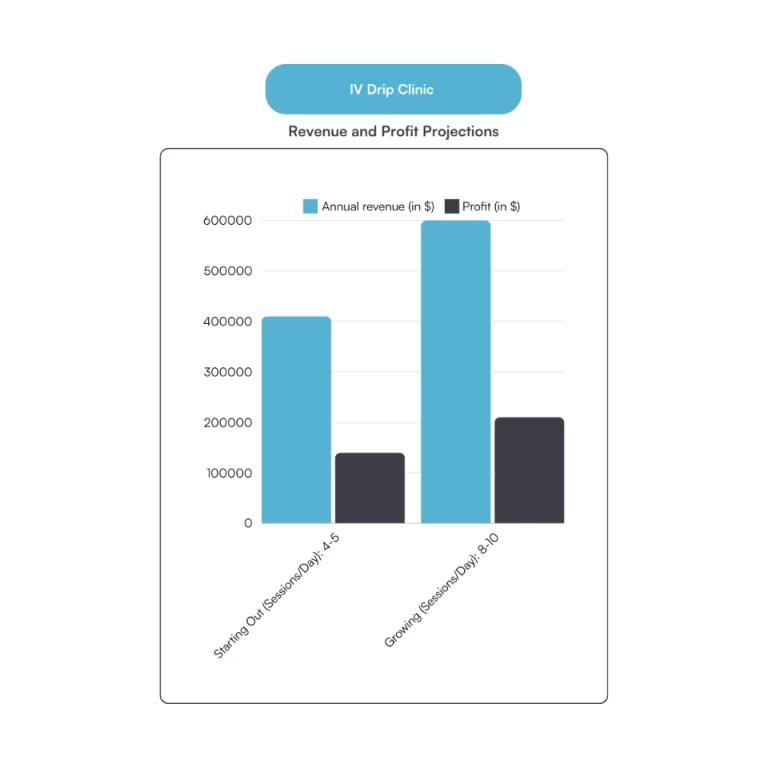
And now, the fun part — money and profit.
According to an article by IV Therapy Academy, the best-case scenario for starting an IV drip clinic is making an estimated profit of $210,000 annually.
The math behind this is simple: if you have four or five sessions booked in per day (with a single IV hydration session costing $280 on average), the annual revenue could reach $410,000, with $140,000 solely in profit.
However, as your business grows and you start booking eight to ten clients daily, your annual revenue could grow to $600,000, with a $210,000 profit.
Naturally, as your business scales, these numbers will grow as well, so use these numbers to get a general idea of the revenue/profit information.
That is the full process of starting an IV therapy business, from state rules and staffing to your service menu and profit potential. The last piece is the software that runs the day to day. An all-in-one practice management system like Pabau pulls scheduling, records, intake, and marketing into one place, so you can:
Pabau helps you save time, practice safely, and scale, so you can grow the business without the need for pen and paper.

Pabau brings online booking, intake forms, client records, and marketing into one place, whether you run a fixed location, home visits, or a mobile service. Patients complete medical questionnaires before they arrive, so every drip starts from a complete record.

The order of your decisions matters more than any single one. Settle ownership and your medical director under your state’s Corporate Practice of Medicine rules before you sign a lease or buy equipment. That structure decides who can own the business, who can prescribe, and who can start a drip.
Once that is in place, profit comes down to volume, not menu size. On IV Therapy Academy’s figures, moving from four or five sessions a day to eight to ten adds roughly $70,000 in annual profit. So plan for rebooking and repeat visits from day one, not just your launch drips.
Book a demo to see how Pabau handles booking, intake forms, and client records for IV therapy practices from your first appointment.

Choosing your software? The best EMR for IV therapy compares what to look for in a clinical system.
Building your drip menu? Our Myers’ cocktail protocol breaks down one of the most requested IV blends.
Planning for safety? IV therapy complications covers the reactions to screen for and how to respond.
Not always. It depends on your state’s Corporate Practice of Medicine rules. Some states let non-physicians own the business as long as a licensed physician serves as medical director, while others, like California, require a physician to hold majority ownership. Settle the ownership structure before you register.
It depends on your model. A mobile service is cheaper to launch than a fixed clinic because you skip the lease and build-out. Your main costs are a medical director retainer, nursing staff, IV supplies, insurance, and practice management software. Buying into an IV therapy franchise raises the upfront cost but bundles branding and clinical protocols.
In many states, yes, but a registered nurse usually administers IV therapy under a physician or nurse practitioner’s supervision rather than prescribing independently. Whether a nurse can own the business outright comes down to state ownership rules, so check your state board first.
Most IV therapy businesses need a general business license and a healthcare facility license, plus HIPAA-compliant systems and appropriate malpractice and general liability insurance. Mobile operations may also need a home care organization license depending on the state.