










Key takeaways
A dexterity test is a standardized measure of hand and finger control, used to set a baseline and track rehabilitation progress.
Six instruments cover most clinical needs, and the Nine-Hole Peg Test is the most used one in neurological rehabilitation.
Scores only mean something against age- and sex-matched norms, so never read a pediatric result against adult tables.
Reliability figures vary by population, so cite the study behind any norm or reliability number you quote.
Practice management software like Pabau keeps dexterity scores inside the patient record, so progress is easy to chart and share.
A patient tells you their hand feels clumsy. Grip strength looks fine, the arm moves well, and nothing in the chart explains it. Without a standardized measure, that complaint stays a comment in the file.
A dexterity test puts a number on speed and control in the hand, scored the same way in every session, by every clinician on your team.
Running the test is the easy part. The skill sits in picking the right instrument and scoring it against the right norms. Then you write it up so the next clinician can act on it.
A dexterity test puts a number on hand function
A dexterity test is a standardized assessment of controlled hand and finger movement. Some instruments measure gross manual dexterity, the broad reach-and-move actions. Others measure fine motor control, the pinch and manipulation work that fills a patient’s working day.
Occupational therapists, hand therapists, and neurological rehabilitation teams reach for these tools for four jobs:
- Setting a baseline before treatment starts
- Tracking progress across a course of therapy
- Supporting return-to-work and pre-employment decisions
- Screening for neurological impairment in the upper limb
Without a standardized instrument, you are left with subjective observation. That cannot be compared across sessions, clinicians, or settings.
The American Occupational Therapy Association treats standardized functional assessment as a cornerstone of evidence-based practice. Dexterity tests are among its most used instruments for upper extremity function.
That matters commercially as well as clinically. A referrer who receives a number with a norm reference behind it will send you the next patient. Occupational therapy practices that report scores consistently also spend less time defending their treatment plans at review.
Fine motor and gross motor tests measure different things
Before you choose an instrument, decide which motor domain the referral question sits in. That single decision shapes both the test you pick and the way you read the score.
Fine motor tests target precise finger and pinch movements, close to what a pinch grip test isolates at a single joint. Gross motor tests measure broader arm-and-hand coordination instead.
A few instruments straddle both domains. The Purdue Pegboard is the clearest example, because its subtests run from single-hand pin placement through to two-handed assembly. That range is why it shows up so often in vocational screening.
Six instruments cover almost every clinical situation
Here is the working reference for each instrument: how it runs, how it scores, and where the evidence is strongest.
1. Nine-Hole Peg Test (NHPT)
The NHPT is the most used fine motor dexterity test in neurological rehabilitation. The patient places nine pegs into a pegboard, then removes them, as fast as they can. Each hand is tested separately, and the score is completion time in seconds. Lower is better.
Normative data exist for adults from 20 to 75 and over, split by sex and hand dominance. The Shirley Ryan AbilityLab database is the usual first stop for those values.
Reliability depends heavily on the population you are testing. Post-stroke samples report test-retest intraclass correlation coefficients around 0.91 to 0.99, while studies in healthy adults have reported values as low as 0.49. So quote the figure from a study that matches your patient group, rather than a single headline number.
2. Purdue Pegboard Test
The Purdue Pegboard runs four subtests: dominant hand, non-dominant hand, both hands together, and an assembly task pairing pins with washers and collars. Each subtest scores the number of pins or assemblies completed in a fixed time window. Those bilateral and assembly scores are what make it the default for assembly and manufacturing roles.
3. Box and Block Test (BBT)
The BBT measures gross manual dexterity. The patient moves one-inch wooden blocks over a central partition, from one side of the box to the other, in 60 seconds. The score is the number of blocks transferred. Separate adult and pediatric norms exist, and adult norms must never be applied to a child.
4. Grooved Pegboard Test
The Grooved Pegboard uses pegs with a key along one side. Each peg has to be rotated to match a randomly angled slot before it goes in. That rotation adds a visuospatial demand the NHPT does not have, which is why the instrument is popular in neurological work. Both hands are tested, and scoring is time-based.
5. Minnesota Manual Dexterity Test (MMDT)
The MMDT uses a board with 60 circular discs. The Placing subtest moves discs from the bin into the board holes as fast as possible. The Turning subtest asks the patient to lift each disc, flip it, and replace it. Both score on time, and both suit vocational settings where arm-and-hand speed is the performance question.
6. Functional Dexterity Test (FDT)
The FDT looks at tripod pinch and functional grip. The patient turns a row of pegs using a three-point grip against the clock. Penalties are added for dropped pegs and for grip patterns that break the pattern being tested. The adjusted score therefore reflects technique as well as speed, which is useful after hand surgery.
How to administer the test without adding measurement error
Every instrument has its own manual, and the manual wins any argument. A shared pre-test routine still cuts error across all of them, so work through this sequence before you start the clock.
Before you start: The six-step setup
- Position the patient the same way every time. Seated, both feet flat, testing surface at elbow height. Table height changes reach mechanics, and reach mechanics change the score.
- Check the equipment. Count the pegs, blocks, or discs and look for damage. Lay everything out in the starting position the manual specifies, and replace worn parts before testing.
- Read the script and demonstrate once. Use the manual’s wording rather than your own. Show the task a single time, and give no coaching during the practice attempt.
- Run one practice trial per hand. Keep it untimed. This absorbs the learning effect, so the scored trial reflects ability rather than unfamiliarity.
- Test the dominant hand first. Most protocols specify that order, but check your manual. The Purdue Pegboard uses a fixed right-left sequence instead of a dominance-based one.
- Time it and record it properly. Start the clock on your “go”, not on first contact. Note the raw score, plus any deviation such as a dropped peg or a repeated question.
Mistakes that invalidate a score
None of the following will make a session feel wrong at the time. Each one, though, makes the number impossible to compare later.
- Skipping the practice trial. First-attempt scores run slow, so the next session looks like improvement when nothing has changed.
- Coaching mid-trial. A quick “use your thumb” or “faster” changes the task, and the norms no longer apply.
- Substituting equipment. A different peg diameter or container height produces different times, even with identical instructions.
- Testing a fatigue-sensitive patient at a different time of day. In multiple sclerosis especially, an afternoon retest can hide a genuine gain.
- Recording the total only. Without the dominance, the norm table, and the deviations, the number cannot be interpreted in six weeks.
- Ignoring tremor or sensory loss. Both change how the patient solves the task, so note them next to the score.
A raw score means nothing without the right norm table
Scoring splits into two families. Time-based tests, including the NHPT, Grooved Pegboard, MMDT, and FDT, record how long the task takes. Count-based tests, such as the BBT and the Purdue subtests, record how much gets done in a set window.
Both need an age- and sex-matched comparison before they mean anything.
Convert the raw score into an age- and sex-matched percentile using the tables in the published manual. A number on its own tells you very little.
The same principle runs through other standardized tools, and the guides on sensory assessment scoring and developmental score interpretation walk through it in more depth.
When you compare two sessions, check the published minimal detectable change (MDC) for that instrument and population first. A difference inside measurement error is not clinical change, however encouraging it looks on the page.
Then tie the number to something the patient cares about. A four-second gain on the NHPT matters because buttons, keys, and cutlery get easier, and that is the language a progress report should use.
Where the plan includes hand exercises for arthritis or a graded therapy program, the retest is what shows the exercises are working.
Match the test to the question you are actually asking
The most common selection error is reaching for the instrument you know best, whatever the referral says. Use the scenarios below as a quick sanity check before each assessment.
Where the referral hints at nerve involvement rather than slow hands, pair the score with hand nerve tests. A dexterity result tells you what the hand can do, not why it cannot do it.
Practices seeing both neurological and hand therapy caseloads should keep two or three instruments on the shelf, plus a written rule for when each applies.
That rule is what stops default bias from skewing your data over a year. For physical therapy practices, it also keeps scores comparable between clinicians at case review.
Pro Tip
Ask which hand the patient uses to write, and record the answer before you test. Hand dominance decides which normative bracket applies. A perfectly administered test is still uninterpretable if you read it against the wrong norm table.
Pre-employment dexterity screening is allowed, within limits
Dexterity tests are common in industrial and vocational screening, and the rules are narrower than most hiring teams assume. They also differ between the US and the UK.
In the US, EEOC guidance draws the line at physiological measurement. A functional task such as placing pegs or moving blocks is not a medical examination, so it can be given before any job offer.
Measure a biological response, though, such as heart rate or blood pressure, and the same session becomes a medical examination.
Medical examinations, along with tests designed to reveal an impairment rather than job capability, are only permitted after a conditional offer. So the safe design is a task that mirrors the job, timed and scored, with nothing physiological recorded alongside it.
In the UK, section 60 of the Equality Act 2010 restricts health and disability enquiries before a job offer. Functional testing against genuine job demands remains possible, but the health questions around it do not.
Whichever side of the Atlantic you work on, document four things:
- The job demands you tested against
- The instrument and subtest used
- The norm reference applied
- Any reasonable adjustment you considered
That record protects the employer and the assessor if the decision is later challenged. Digital clinical forms with fixed fields make it much harder to leave one of the four blank.
Good documentation is what makes the score useful later
A score on a paper form, filed away from the patient record, cannot be used for longitudinal tracking. Write the result into the structured clinical note during the session, not from memory at the end of the day.
Five fields make an entry usable by whoever reads it next:
- Instrument and subtest: “Nine-Hole Peg Test, dominant hand”
- Raw score: “24.3 seconds”
- Norm reference: “Mathiowetz et al. 1985, females 20-24 years, mean 17.9s, SD 2.9”
- Interpretation: “Roughly the 2nd percentile for this age and sex bracket, consistent with moderate fine motor impairment.”
- Goal link: “Return to within 1 SD of the age norm inside eight weeks of upper limb therapy.”
If a change clears the instrument’s published MDC, flag it in the assessment part of the note rather than leaving it in the raw numbers. That flag is what triggers a plan review instead of another identical block of therapy.
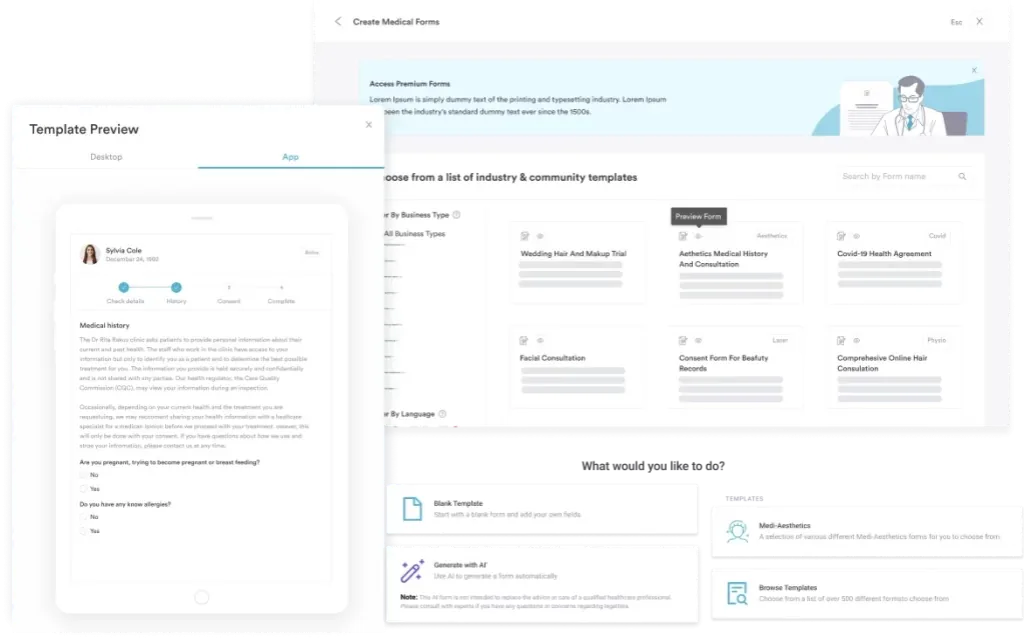
Practices working from structured patient records can build these five fields straight into an assessment template. Every clinician then captures the same data, and scores can be pulled into a progress report without retyping anything.
How Pabau keeps dexterity scores inside the patient record
In most practices, a dexterity score gets written twice. Once on the test form, then again in the note, if the clinician has time. The form ends up in a folder, so nobody can chart six visits of progress without digging through paper.
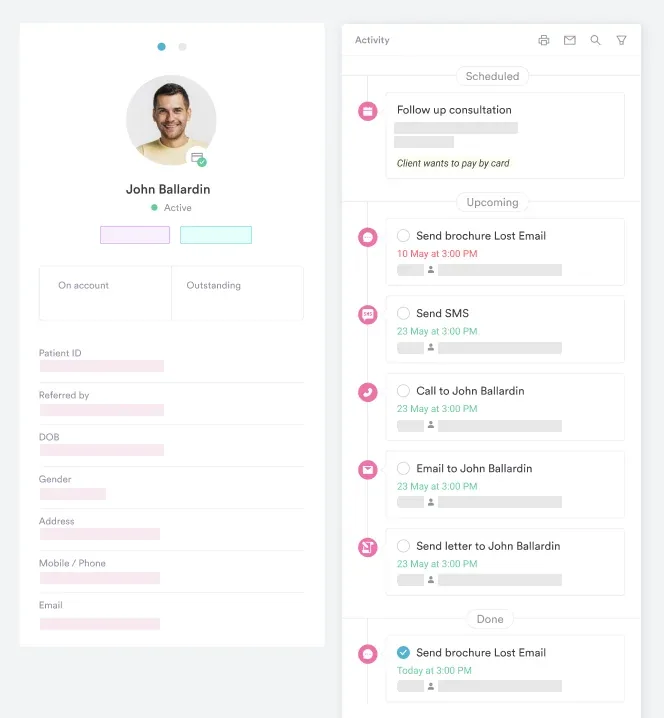
Practice management software like Pabau, an all-in-one system for practices, keeps the score where it belongs. Pabau’s outcome measurement tracking stores structured scores against the patient file, so a therapist can see the whole series in one view. Automated workflows send out the right form before the appointment, so reception is not chasing paperwork on the day.
Pabau Scribe, our AI scribe, then drafts the note at the point of care. The interpretation gets written while the patient is still in the room.
Every subscription includes every feature, so a solo hand therapist works from the same toolkit as a multi-site rehabilitation group. The wider picture sits in our guide to practice management software.
The outcome is a shorter admin tail. Scores stay comparable between clinicians, progress reports write themselves from data you already captured, and a referrer’s question about session four takes seconds to answer.

Keep every dexterity score in one patient record
Pabau gives occupational therapy and rehabilitation practices structured outcome tracking, digital forms, and automated workflows. Every assessment score then sits with the right patient and the right treatment goal.

Conclusion
Dexterity testing rewards discipline far more than equipment. The pegs are cheap. What makes the score worth anything is the same chair height, the same script, and the right norm table. Add a note saying what the number means for this patient.
So pick two instruments that fit your caseload, learn their manuals properly, and keep the protocol identical between sessions. Do that, and a four-second improvement becomes evidence you can show a referrer, an insurer, or the patient. Skip it, and you have a number nobody can defend.
Book a demo to see how Pabau stores dexterity scores against the patient record. Progress then becomes easy to chart and easy to share at review.

Continue your research
Assessing stroke patients as well as their hands? NIHSS score sheet gives you a structured stroke severity record to sit alongside your dexterity results.
Working with children who need age-appropriate norms? Bayley Scales of Infant Development shows how developmental motor scoring is structured for early years assessment.
Building a fuller intake picture around the score? Comprehensive assessment template covers the history and function sections that give a dexterity result its context.
Need a multi-domain assessment format to copy? Psychiatric evaluation template shows how to structure goal-linked documentation fields across several assessment domains.
Choosing between two scoring instruments? SCORAD vs EASI comparison walks through picking one standardized measure over another and tracking it over time.
Frequently asked questions
Can dexterity tests be used for pre-employment screening?
Usually, yes. EEOC guidance treats a functional dexterity task as a job test, not a medical examination, so it can be given before an offer. It becomes medical once you measure a physiological response, such as heart rate. In the UK, section 60 of the Equality Act 2010 limits pre-offer health enquiries.
How often should you repeat the test?
Retest intervals follow the treatment plan, not the calendar. Every two to four weeks suits acute rehabilitation. Every three months is enough for slowly progressing conditions. Retest sooner if function changes suddenly.
Do you need certification to administer one?
No formal certification exists for the common pegboard tests. You do need the published manual, standardized equipment, and practice with the exact instructions. Employers and insurers usually expect a licensed therapist, or a trained assistant, to run and interpret the assessment.
Is dexterity the same as grip strength?
No. Grip strength measures force with a dynamometer. Dexterity measures speed and control on a manipulation task. A patient can have a strong grip and poor dexterity, which is why hand assessments usually include both.
Can you use homemade equipment instead of the official kit?
You can, but you lose the norms. Peg diameter, board spacing, and container height all change completion times. Once the equipment differs from the manual, published normative tables no longer apply, so the score compares only against that patient’s own baseline.