GLP-1 diet plan
A GLP-1 diet plan is a structured eating framework for patients taking semagluti...

2
Last Updated: Oct 13, 2026

A comprehensive assessment evaluates medical history, mental health, functional capacity, and social context to guide diagnosis and treatment planning.
Licensed clinicians run the assessment using structured interviews, validated screening tools such as the PHQ-9 and GAD-7, and documented clinical judgment.
Recording each score next to its severity band tells the next clinician what that number meant on the day it was taken.
Documenting findings straight into the patient record supports HIPAA and CQC compliance and keeps care continuous.
Practice management software like Pabau embeds validated questionnaires and keeps every assessment inside the patient record.
A structured clinical form covering patient history, mental health screening, functional capacity, and the social factors that shape recovery. Each section carries its own prompts and space for scores, so you can customize it and put it to work this week.
Download templateA comprehensive assessment is a systematic evaluation of a patient’s whole health picture. It covers medical history, mental health screening, functional capacity, and social context. Clinicians use what it surfaces to reach a diagnosis and build a treatment plan the patient can actually follow.
What makes an assessment useful six months later is the scoring and the write-up. A PHQ-9 total of 16 means very little on its own. Recorded as moderately severe depression, with the date and the clinician’s read alongside it, that same number becomes something the next person can act on.
A comprehensive assessment is a thorough evaluation that goes well beyond symptom review. It gathers information across the medical, psychological, functional, and social domains. Together those four establish a complete picture of the patient’s current health and history. That picture then informs diagnosis, treatment planning, and level-of-care decisions.
Unlike a focused assessment, which targets one complaint, it spans the patient’s whole health story. It is usually done at the start of care, at an initial medical or psychiatric evaluation, or when a condition changes significantly. According to the National Institutes of Health, the process combines structured interviews, validated screening tools, and clinical judgment. Those three together surface risk factors, treatment needs, and the resources a patient already has. A psychology practice running several assessments needs them scored and stored the same way each time.
Every assessment covers the same core domains. The questions and the tools shift by setting, whether that is mental health, primary care, or home health. The framework itself stays the same.
Each domain feeds the treatment plan. A patient who reports social isolation alongside low mood needs a referral and a plan for getting out of the house. The medication list carries the same weight. A full medication review often explains fatigue or flat mood that looks psychiatric at first glance.
Clinicians choose between the two based on clinical need and the time in front of them. That choice also decides how much of the day’s schedule an appointment takes.
Many practices alternate between the two. They run the full assessment at intake, then use focused check-ins to track a single domain, such as mood every two weeks during therapy. Prehospital teams compress the same logic into minutes, which is why EMT patient assessment follows a fixed sequence.
Licensed clinicians with the right training conduct comprehensive assessments. Depending on the setting, that includes:
Scope of practice varies by state and by country. In the UK, CQC regulation 9 requires providers to assess a person’s needs before care is planned. Staff must also work inside their own professional boundaries. In the US, each state decides which professions can assess independently and which work only as part of a team.
Most assessments embed validated questionnaires. They turn a subjective impression into a number that any clinician can compare over time. The common ones are:
Self-report has limits where attention is the question. An objective ADHD visual test measures performance directly, so the result does not depend on how a patient recalls their week.
A raw total is only useful next to its band, so record both. These are the thresholds the two most common instruments use.
Mental health practices lean on these instruments hardest, but the same scoring discipline holds in primary care. Digital intake forms in Pabau let patients answer the questionnaires before they arrive. Scores calculate themselves and land in the patient record, so nobody adds up a column of numbers by hand.
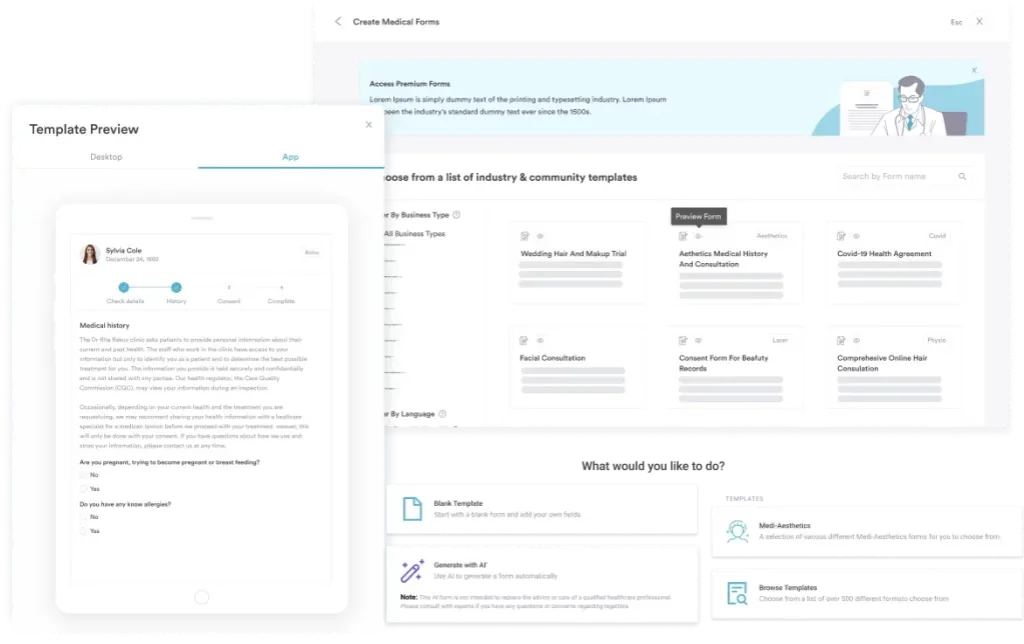
Documentation is what turns an assessment into a clinical and legal record. The write-up has to support the diagnosis, justify the treatment, and stand up to an audit. Six steps get you there.
Why this matters: Clear documentation protects the patient, the clinician, and the practice. Vague notes lead to missed diagnoses, repeated testing, and findings at your next inspection.
Documented findings are what turn an assessment into action. Once they are recorded, the care team moves into treatment planning and coordination:
Patients can also track what they notice between visits. A brain dump journal captures scattered thoughts quickly, which gives you material to review at the next appointment.
Scheduling and follow-up tracking decide whether any of this happens on time. A referral nobody books is the most common way a good assessment goes to waste.
Practices that standardize the assessment see fewer diagnostic misses and calmer audits. A fixed set of domains means the same questions get asked whoever is in the room. Scores from the same instruments can then be compared across visits and across clinicians.
Going paperless adds what a printed form cannot do on its own. Scoring is automatic, follow-up tasks are assigned to a person, and the whole team reads the same record. The trade-off is setup time, because somebody has to build the form properly once.
Most practices still run an assessment across three separate places. The questionnaire is on paper, the scoring happens in someone’s head, and the notes get typed up long after the patient has gone home. Findings then sit in a folder nobody opens before the next visit.
In Pabau, the intake form, the scores, and the clinical note share one patient record. Patients complete the questionnaires before they arrive, so the consultation starts with the answers already in front of you. Pabau Scribe, our AI scribe, drafts the clinical note from your dictation while the detail is still fresh.
The outcome is one record the whole team can act on. Every score, observation, and treatment goal sits in the same profile, behind the access controls HIPAA and CQC expect. Nothing gets rekeyed, and no finding waits in a drawer for someone to notice it.

Pabau’s digital forms score the questionnaires as patients answer them, and the results land straight in the patient record. Your team plans treatment from one place.

An assessment is only as good as what someone can read back six months later. Choose your instruments, use them the same way every time, and write the severity band next to every score you record.
Start with the template and adapt the wording to your setting. The part worth protecting is where the findings end up, because a thorough assessment in a filing cabinet helps nobody. Book a demo to see how Pabau scores intake questionnaires and keeps every assessment in the patient record.

Helping a client challenge black-and-white thinking? Dichotomous thinking worksheet walks clients from spotting the thought through evidence-based challenge to a balanced alternative.
Assessing cognitive decline over time? Global deterioration scale stages function and cognition so repeat assessments stay comparable.
Getting past anger to what’s underneath? Anger iceberg worksheet helps clients explore the vulnerability, unmet needs and core beliefs hidden beneath outbursts.
Turning a vague feeling into a number? Anger meter worksheet scales anger intensity from one to ten alongside physical signs and coping plans.
Identifying anger triggers in a client? Anger scale questionnaire assesses anger levels and triggers to help you plan the right intervention.
Include medical history, current symptoms, and mental health screening with validated tools such as the PHQ-9 or GAD-7. Add functional status, social support, living situation, employment, and substance-use history. Document each finding so it feeds the diagnosis and the treatment plan.
The first full assessment happens at intake. Repeat it when the patient’s condition changes significantly, when treatment goals shift, or at a set interval such as annually. Between those points, use brief focused assessments to track a single domain.
It establishes a baseline of the patient’s health across every relevant domain. That baseline supports an accurate diagnosis, an individualized treatment plan, and the right level of care. Repeating the same instruments later shows whether the patient is improving.
Document in the patient’s medical record using structured fields. Cover demographics, chief complaint, history of present illness, past medical and psychiatric history, medications, allergies, and family history. Then record screening scores with their severity bands, clinical observations, the diagnosis, and the treatment plan.