HIPAA compliant texting: What you can send patients & how to communicate securely
HIPAA compliant texting is possible when a text holds no protected health inform...

Last Updated: Oct 16, 2026
Personalized aesthetic treatment plans are documented, sequenced courses of treatment built around one patient’s goals, skin assessment and medical history. Building one is the practitioner’s job. Making it repeatable is the practice’s. On injectable plans, part of that work falls to the injection chart. Our guide to medical spa software compares how each platform handles it.
A usable plan carries six fields. Those are the goal in the patient’s words, the assessment, the sequenced treatments, the review date, the cost and the consent. We call that the six-field plan record. A plan missing one of those fields will not survive a handoff to a second provider.
This guide is written for the practice, not for the patient. The owner, the manager and the injector all have to build these plans, standardize them and hand them over. What follows is the record structure, the ordered procedure, a sequencing table with sourced intervals and one plan written out end to end.
Want to see a plan, its sequence and its signed consents sitting in one patient file? Book a demo.

A personalized aesthetic treatment plan is a written, sequenced course of treatment matched to one patient’s goals, assessment and budget.
The six-field plan record is what lets a second provider pick a plan up cold, without phoning the practitioner who wrote it.
Sequencing comes from product and device retreatment intervals, not from the patient’s diary, so build the plan backwards from those.
Who may author and sign a plan is set by state scope-of-practice rules, so confirm the position with your own state board.
A plan with a review date attached turns the next appointment into a booking the patient has already agreed to.
A personalized aesthetic treatment plan is a written course of treatment matched to one patient’s goals, skin assessment, medical history and budget.
The word doing the work in that sentence is written. Two practitioners can assess the same face and reach the same conclusion. Only one of them has produced a personalized treatment plan. Only one wrote it down in a form somebody else can act on.
A personalized aesthetic treatment is a single appointment. A plan is the sequence those appointments sit in, priced and dated. That distinction decides how the front desk books the patient, and whether a customized treatment can be repeated the same way in six months.
Two figures get quoted constantly in aesthetics marketing, and they are worth reading carefully. A study by Epsilon found 80% of consumers are more likely to buy from a brand offering personalized experiences. Bolt’s lifetime beauty report found 75% of shoppers would pay more for beauty products with a personalized shopping experience.
Both are consumer purchasing figures, not clinical outcomes. Read as a practitioner, they say something narrower and more useful. Patients will pay for a plan that is visibly theirs. They will not pay for one they cannot see. Handing the plan over in writing beats describing it across a consultation.
A plan record needs six fields: the goal in the patient’s words, the assessment, the sequenced treatments, the review date, the cost and the consent.
Plans rarely fail during the treatment. They fail at handoff, when the patient books a stage with a different provider and that provider has notes but no plan. The six fields below are what close that failure, and the diagram shows how a plan moves through the practice once they are in place.
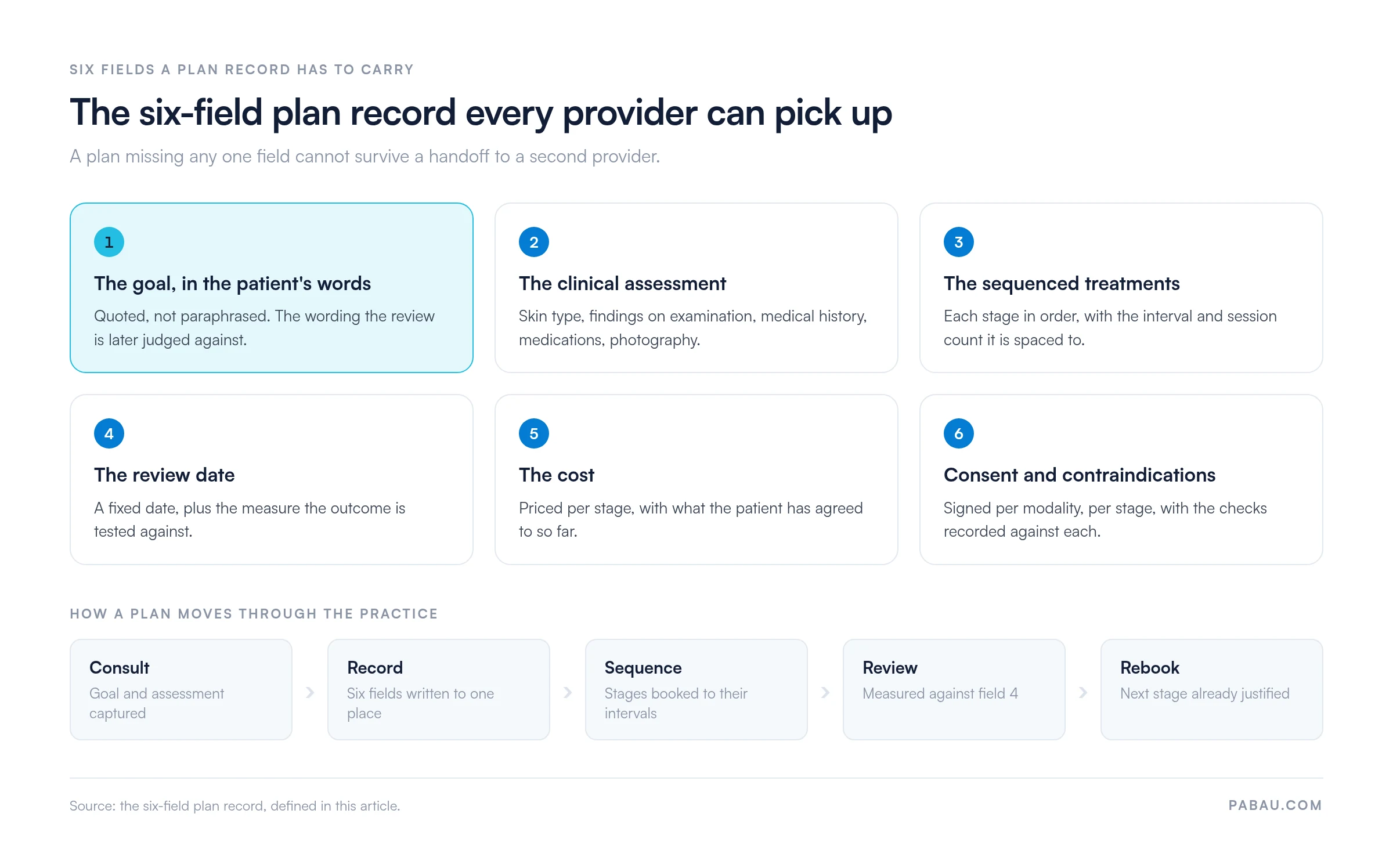
Quote the patient, do not paraphrase them. I look tired in photographs is a usable goal. Patient seeks facial rejuvenation is a category, and a category cannot be reviewed against. The quoted wording is what the review in field four is judged against, so it has to survive contact with a different provider months later.
Skin type, findings on examination, medical history, current medications and standardized photography. This field is the reasoning that connects the goal to the treatments, and it is the field most plans leave implicit. A second provider who cannot see why a treatment was chosen will either repeat the consultation or guess.
Each stage in order, with the interval and session count it is spaced to. A list of treatments is not a sequence. Write the stage number, the modality, the area, the interval and the number of sessions expected. The front desk can then book the whole run rather than one appointment at a time.
Set a fixed date and name the measure at the same time. Review in 12 weeks against the baseline photographs is a review. Follow up as needed is not. Naming the measure at the point the plan is written stops a review from turning into a second opinion.
Price the plan per stage, and record which stages the patient has agreed to so far. Aesthetic plans run over months, so a single total tends to drift out of date. Recording the price against each stage also shows which stage patients most often stop at. That stage tells you where the price stops feeling worth it to them.
Consent is signed per modality and re-signed per stage, not once at the top of the plan. A consent taken in January does not cover a laser stage added in April. Record the contraindications screened against each modality too, including pregnancy, active infection, isotretinoin use and a history of keloid scarring.
In our experience, the field most often missing is field one. Notes are thorough, consents are signed, and nobody wrote down what the patient asked for.
Personalized treatment planning runs in seven steps: consult, assess, sequence, price, consent, document, then review on a fixed date.
Those seven steps are the phases of treatment plan work a practice can standardize. Run them in order and developing a treatment plan stops depending on which practitioner happens to be in that day.
Here is one plan written out end to end, as an example of the format rather than of a patient.
Notice that the wedding date sets the review, and the retreatment intervals set the sequence. Those two constraints do most of the planning work between them.
A consultation has to produce six named inputs, or the plan built from it will have holes in the assessment field.
Standardizing those six inputs on one form is what keeps them comparable between providers. A med spa consultation form gives you a starting structure to adapt rather than a blank page.
Smart treatment plan goals name a measurable change, a specific area and the date the plan gets tested against.
Softening of the glabellar lines at rest, reviewed at week 12 against the baseline photographs, is a goal you can pass or fail. A younger appearance is not. The difference matters at the review, because a goal nobody can measure turns every review into a negotiation about whether the plan worked.
Where a patient’s stated goal is genuinely not achievable, the plan records that too. Writing the limit down at the start is easier than raising it at stage three.
Treatments are sequenced by their own retreatment intervals rather than by the patient’s diary, so a plan is built backwards from the manufacturer’s spacing.
Guidance on combining treatments usually stops at which treatments pair well together. The table below gives the spacing too, with the source named for every figure, so the numbers can be checked rather than taken on trust.
| Patient concern | Typical modality | Typical interval between sessions | Typical number of sessions | Source |
|---|---|---|---|---|
| Frown lines and other dynamic lines | Botulinum toxin | No more often than every 3 months | One treatment per visit, lasting about 3 to 4 months | Botox Cosmetic prescribing information |
| Volume loss in the cheeks, lips or chin | Hyaluronic acid filler | Reviewed at 12 to 24 months, depending on product and area | One treatment, plus a touch-up where needed | Juvederm, Allergan Aesthetics |
| Texture, photodamage and fine lines | Non-ablative fractional laser resurfacing | 2 to 4 weeks apart | An average of 5 | Solta Medical, maker of Fraxel |
| Uneven tone and visible surface vessels | IPL photorejuvenation | 2 to 6 weeks apart | 3 to 5 | Lumenis |
| Acne scarring and texture | Microneedling | Every 2 to 4 weeks | 3 to 5 | American Academy of Dermatology |
| Dull tone and superficial scarring | Superficial chemical peel | Every 2 to 5 weeks | 3 to 5 | American Academy of Dermatology |
| Skin laxity | RF microneedling | No standard interval published by the device manufacturer | Not published, so set by the treating provider | InMode publishes neither figure |
Sources, in order. The three-month floor for botulinum toxin is in the Botox Cosmetic prescribing information. The filler longevity figure comes from Juvéderm, made by Allergan Aesthetics. The peel and microneedling figures come from the American Academy of Dermatology’s chemical peel guidance and its microneedling guidance. The laser figure comes from Solta Medical, maker of Fraxel. The IPL figure comes from Lumenis.
Treat these as typical planning intervals that practices work to, not as medical advice or a protocol. The treating provider sets the interval for the patient in front of them.
Two points fall out of the table. The first is that the last row is honest. Some devices ship without a published interval, and a plan that pretends otherwise is inventing a number. The second is that the intervals differ by an order of magnitude, from two weeks to two years. A sequence therefore cannot be booked as a course of six evenly spaced appointments.
Three rules hold across most combinations. Treat the settling time as part of the interval, because a result you cannot see yet cannot be assessed. Keep energy-based treatments away from a filler stage until swelling has resolved. And where a stage carries downtime, put it where the patient’s calendar has room, not where the sequence looks tidiest.
Where a plan crosses disciplines, say aesthetics plus dermatology or a prescribing physician, it becomes a multidisciplinary treatment plan. One person then has to own the sequence. Published aesthetic guidelines from device makers and professional bodies give you the spacing. They do not decide who holds the plan, and that is a practice decision worth making once rather than per patient.
Treatment protocols are the standard recipes a practice runs for a given concern, and a plan is one patient’s application of one.
The protocol lives at practice level. It says how your practice treats moderate acne scarring: which device, which settings band, how many sessions, what aftercare. The clinical treatment plan lives at patient level, and records which protocol was chosen, what was changed for this patient and why.
Practices that skip the protocol layer end up writing each plan from scratch, which is slow and produces plans that vary by practitioner. Practices that skip the plan layer end up applying a protocol to a patient it does not quite fit. Both layers are needed, and the plan is the one that records the deviation.
Customized treatment plans survive a multi-provider practice only when every plan is written into the same fields, in the same place.
A solo injector can hold a plan in their head and still deliver it. A three-provider practice cannot. A patient books stage two with whoever has the slot. At that moment the plan has to be legible to somebody who was not in the room for stage one.
Standardization is what makes that possible, and it costs less than it sounds. Agree one set of customizable treatment plans as your starting templates, one skin classification, one photography setup and one place the plan lives. Practitioners keep their clinical judgment. What they give up is the freedom to record it in six different formats.
Authorship and supervision are set by state scope-of-practice rules, so the answer depends on where the practice operates.
In broad terms, a physician or a nurse practitioner may assess, diagnose and author a plan, with prescribing and independent-practice authority varying by state. A physician assistant works under physician supervision, again on terms the state sets. A registered nurse without a prescribing qualification administers treatments under a prescriber’s instruction rather than authoring the plan.
Those are the usual shapes, not a rule for your state. Medical director requirements, delegation and supervision ratios differ enough that the only reliable source is your own state medical and nursing board. Check the position, write it into your protocol, and record on each plan who authored it and who signed it off.
A review measures what the goal named, on the date the plan set, against the photographs taken at the start.
Reviewing is a narrower job than it sounds, and the narrowness is the point. Pull up field one, pull up the baseline photographs, and answer whether the quoted goal has been met. Any other concern raised in that appointment is a new conversation.
Three events trigger a change to the plan.
Record which of the three applied. A plan with a change history tells you more than one that was quietly rewritten.
Standardized photography is what makes any of this reviewable. Same distance, same lighting, same angles, taken at every stage rather than at the start and the end. Without that, a review comes down to whether the patient remembers how they looked in March.
The review date also does work at the front desk. A documented plan with a review date has already booked the next appointment. The front desk confirms a stage the patient agreed to months ago, so that conversation stays short.
Personalized aesthetic care falls apart in the admin, not in the treatment room. The six fields end up spread across a paper consultation form and a consent PDF in an email. The photographs sit on somebody’s phone and the plan is a note in the calendar. Nobody can hand that over.
Practice management software like Pabau exists to put those six fields in one patient file. The plan becomes the record itself, rather than a summary of one. Below are the four parts of Pabau that carry the plan, and what each one does for the practice running it.
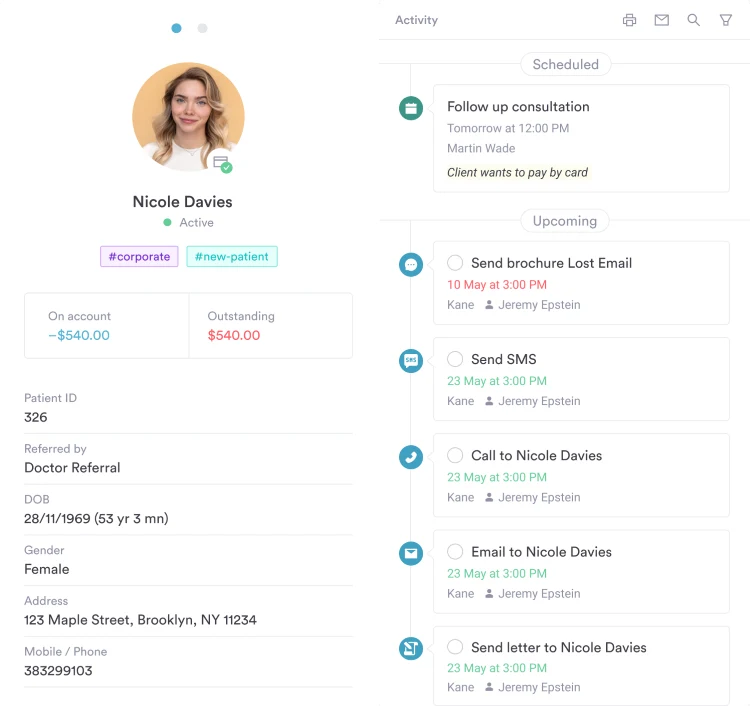
The client card carries medical history, allergies, signed consents, photographs and every past treatment against one patient. Treatment notes sit in the same file, so the assessment that justified a stage stays attached to the stage itself. Pabau Scribe, our AI medical scribe, drafts those notes from the consultation so the practitioner writes less and records more.
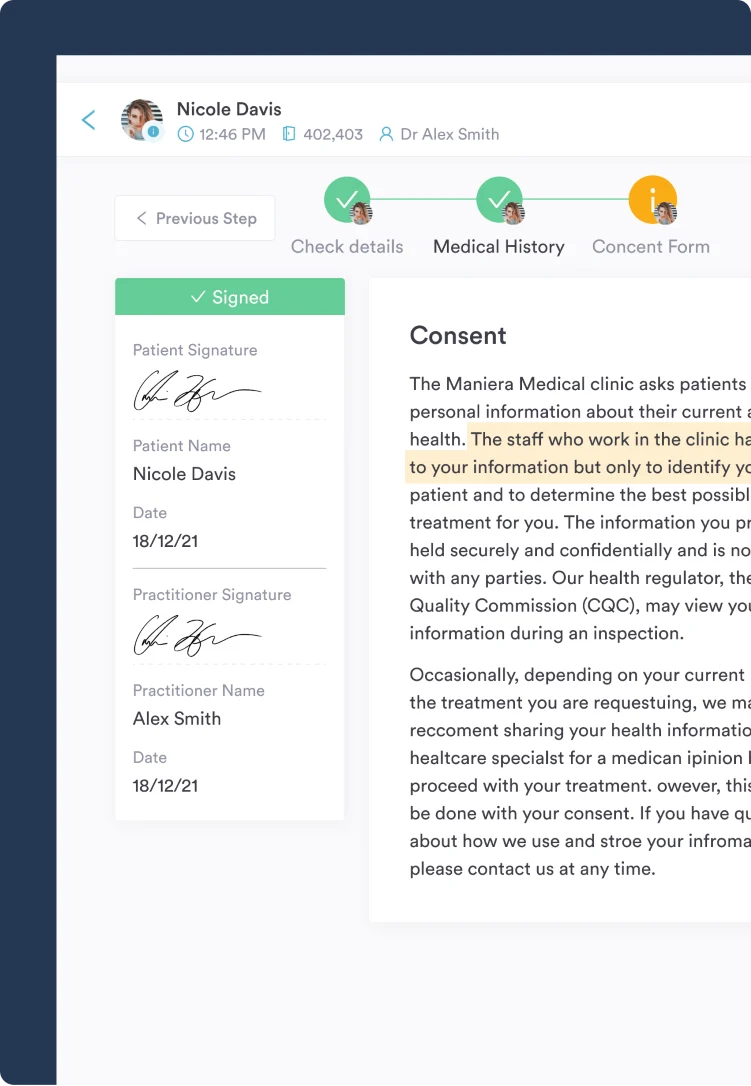
Forms are where standardization takes hold. Build one consultation form and one consent per modality, using text fields, checkboxes and dropdowns for the inputs you need captured every time. Completed forms land on the patient file rather than in an inbox. An alert tells the team a form is back, so the plan can be finished.
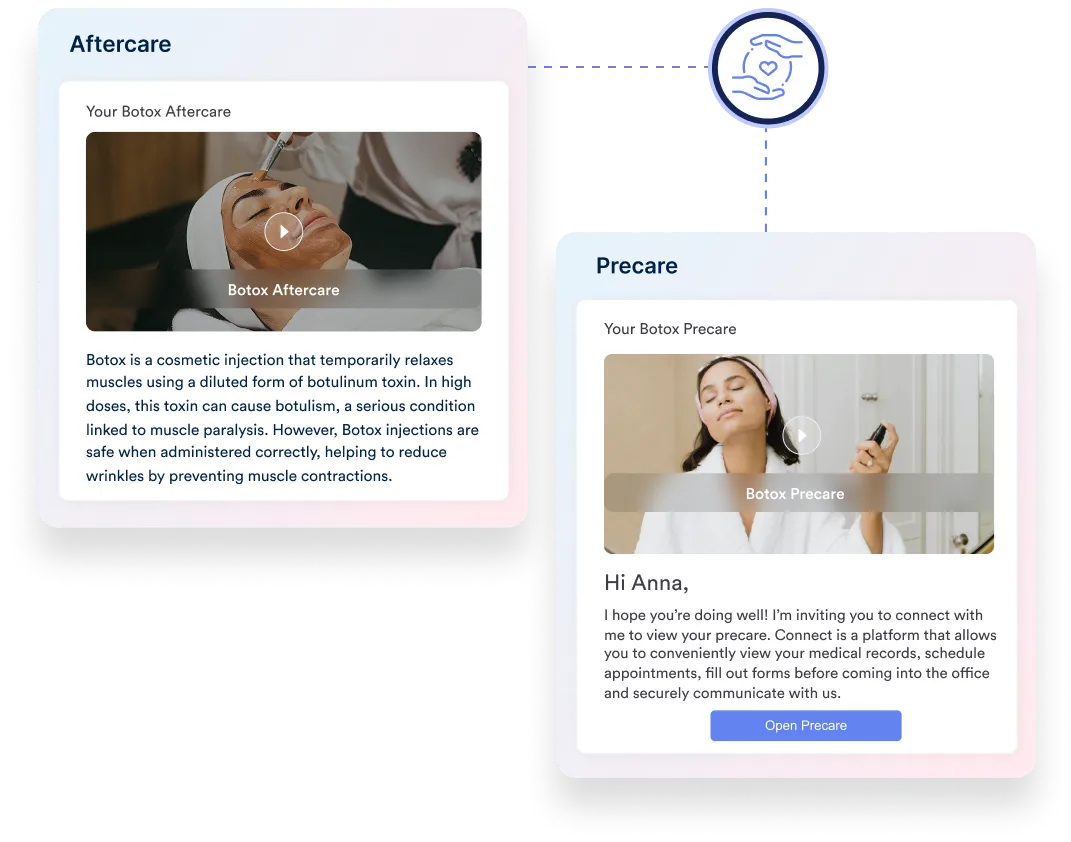
An aesthetic plan spends most of its life in the intervals. Pre-care and aftercare instructions can be written per treatment and sent on the schedule that treatment needs, from Pabau’s ready-made templates or your own. The practitioner stops typing the same aftercare email, and the patient gets the right instructions for the stage they just had.
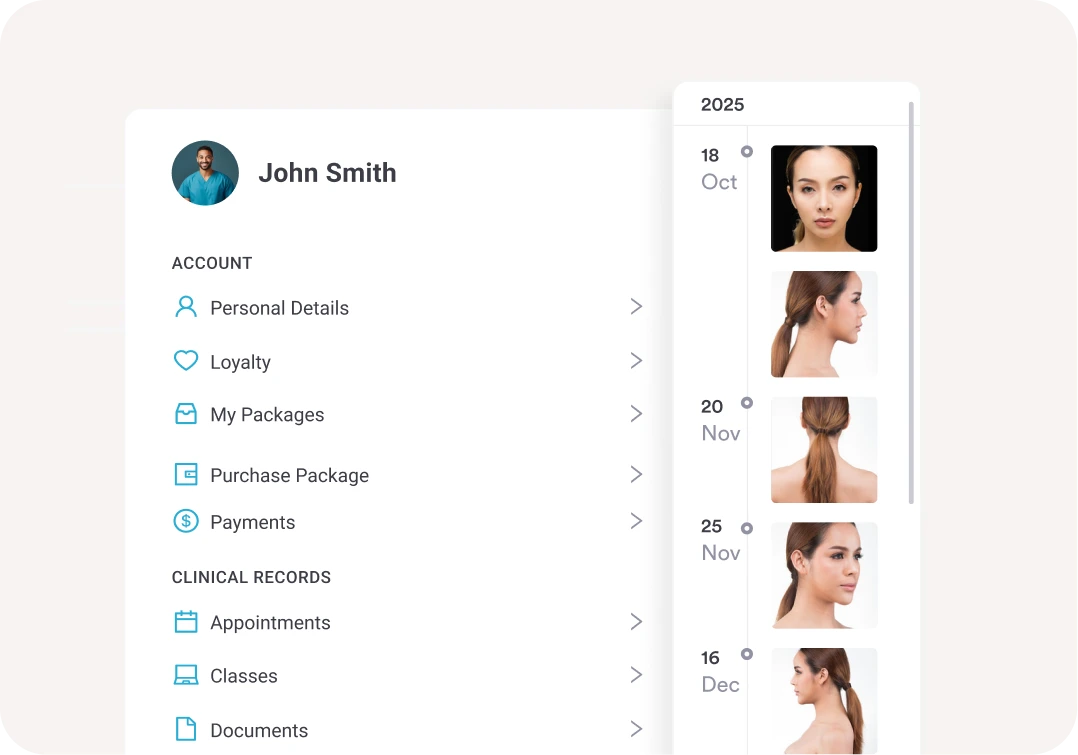
Online booking and the Client Portal give the patient a way to complete outstanding forms, check what is booked and request the next stage. You choose which fields are mandatory at booking, so missing information gets collected before the appointment instead of at reception. Practices comparing systems for this can start with our guide to medical spa EMR software.
Pabau was built for medical aesthetics, and every subscription includes every feature, so the plan record is not something you upgrade into. Practices weighing it against other options can read more on our medical spa software page.

Pabau holds the goal, the assessment, the sequence, the consents and the review date against one patient record. Any provider in your practice can pick up a plan and run the next stage without repeating the consultation.

Personalized aesthetic treatment plans stall for filing reasons far more often than clinical ones. The deciding factor is whether a colleague can open the plan and read all six fields.
So the work worth doing this quarter is mechanical. Pick the six fields, agree one place they live, and hold every practitioner to writing all six. The intervals are published, the consent rules are known, and the scope-of-practice position is a phone call to your state board. What is usually missing is the record.
Get that right and the review appointment stops being a sales conversation. The patient already agreed to the next stage when the plan was written. Book a demo to see how Pabau keeps the six-field plan record in one place across your whole team.

Need the intake form that feeds field two? Medical spa client intake form covers the history, medications and consent questions a plan’s assessment field depends on.
Want a consultation note you can reuse? Aesthetic consultation notes gives you one structure for recording the quoted goal and the findings behind it.
Grading skin the same way across the team? Skin analysis form keeps every practitioner classifying skin against the same criteria.
Wondering what happens between stages? Automated pre and aftercare emails shows how to prepare patients for the next stage without manual chasing.
Running the consultation that starts the plan? How to do a Botox consultation walks through the assessment and the consent conversation in order.
Personalized treatment means the treatment chosen, its dose and its timing are set by one patient’s assessment rather than by a standard package. In aesthetics that usually means two patients with the same concern get different strengths, different areas, or a different order of treatments.
Here is the worked example from this article. The patient’s quoted goal is looking rested for a wedding. Stage 1 is botulinum toxin at week 0. Stage 2 is hyaluronic acid filler at week 4. Stage 3 is three IPL sessions from week 8, with a review at week 24. Developing a treatment plan for acne scarring looks different: a course of microneedling every 2 to 4 weeks, then a review against baseline photographs.
Six factors, in order. The patient’s stated goal, the clinical assessment and skin type, and the medical history. Then current medications, the retreatment intervals of the treatments chosen and the cost of each stage. Last, the contraindications screened for every modality. Lifestyle factors that affect healing, such as smoking and sun exposure, belong in the assessment too.
A written plan gives the patient something to act on between appointments, which is where most of an aesthetic plan happens. Patients who can see the sequence, the intervals and the review date arrive knowing what the stage is for. Rebooking becomes a confirmation rather than a fresh decision.
The best fit is the system that holds the patient record, the forms, the consents, the photographs and the schedule in one place. An aesthetic plan touches all five. Practice management software like Pabau was built for medical aesthetics. Every subscription includes every feature, so plan documentation is not tied to a higher tier.