Health appraisal form
A health appraisal form is a record a licensed provider signs to document someon...

2
Last Updated: Oct 13, 2026
A medical appointment scheduling app is only worth installing if the right person can reach it. Some apps hand your patient a booking page. Others hand your practitioner the day’s calendar, the patient’s notes and a card reader.
We compared nine apps on that split, on what each one does from a phone, on its HIPAA position and on price.
Pabau, practice management software for aesthetic and healthcare practices, is the strongest fit for multi-practitioner practices that want one system. SimplePractice suits solo therapy practices, Setmore suits teams of four or fewer, and NexHealth suits practices already running an EHR.
Pabau publishes this list, so the criteria here are ours. Where a competitor beats us we say so, including the fact that our own app does not run on Android.

1. Pabau — best all-in-one app for multi-practitioner aesthetic and wellness practices that want booking, records and payments together.
2. SimplePractice — best for solo therapy practices, and the only pick with separate practitioner and patient apps on both platforms.
3. Tebra — best for independent US medical practices that bill insurance and want charting and billing from the phone.
4. NexHealth — best for practices that already run an EHR and want bookings writing straight back into it.
5. Square Appointments — best for med spas and beauty businesses that need booking and card payments without clinical records.
6. Acuity Scheduling — best for solo wellness practices that need HIPAA-capable booking on a small budget.
7. Setmore — best for teams of four or fewer that want free booking plus tap-to-pay from the phone.
8. Zoho Bookings — best for practices already running on the Zoho stack.
9. Calendly — best for non-clinical consultation calls, because its terms prohibit patient health information.
Every figure below comes from the provider’s own website or its official app store listing. The column that decides most shortlists is the third one.
| App | Best for | Practitioner or patient app | Mobile platforms | HIPAA position | Starting price |
|---|---|---|---|---|---|
| Pabau | Multi-practitioner aesthetic and wellness practices | Practitioner | iOS only | HIPAA compliance support, no published BAA | From $62 / month |
| SimplePractice | Solo therapy and behavioral health | Both, two separate apps | iOS and Android | BAA executed automatically | From $49 / month |
| Tebra | Independent US practices billing insurance | Practitioner | iOS only | BAA published | Quote only |
| NexHealth | Practices already running an EHR | Practitioner | iOS only | HIPAA compliance stated, BAA offered, terms not publicly viewable | Quote only |
| Square Appointments | Med spas and beauty businesses | Practitioner | iOS and Android | BAA by use, HIPAA-enabled setups only | $0 / month per location |
| Acuity Scheduling | Solo wellness practices | Practitioner | iOS and Android | BAA on Premium only | From $16 / month |
| Setmore | Teams of four or fewer | Practitioner | iOS and Android | Signed BAA, paid plans only | $0 / month |
| Zoho Bookings | Practices already on Zoho | Practitioner | iOS and Android | BAA on request, toggle on Premium | $0 / month |
| Calendly | Non-clinical consultation calls | Host, lightly | iOS and Android | No BAA, health information prohibited | $0 / month |
Pabau GO puts the day’s calendar, patient notes and card payments in the practitioner’s hand.
Pabau GO, our iOS app, is built for the practitioner rather than the patient. You open the day’s calendar, move an appointment, read the patient’s history and take payment without leaving the treatment room.
Tap to Pay on iPhone turns the phone itself into the card reader, so there is no terminal to fetch between patients. Pabau Scribe, our AI scribe, writes the treatment note straight into the patient record.
Patients book through our online booking portal in a browser, not a downloaded app. Every Pabau subscription includes every feature. Scheduling, records, payments and marketing arrive together rather than tier by tier.
Two things to weigh. Pabau GO runs on iOS only, and Android users work from the browser instead. Pabau publishes HIPAA compliance support rather than a business associate agreement, so raise that in the demo if you handle protected health information.
| Plan | Price | Users | Key inclusions |
|---|---|---|---|
| Solo | From $62 / month | 1 | Full platform |
| Team | On request | 2–3 | Full platform |
| Medium | On request | 4–5 | Full platform |
| Group | On request | 6–15 | Full platform |
| Enterprise | Custom quote | 16+ | Full platform, multiple locations |
Pabau prices by team size rather than by feature. Full plan details are on Pabau’s pricing page.
The only app here with separate practitioner and patient apps on both iOS and Android.
SimplePractice ships two apps, one for the clinician and one for the patient, on both iOS and Android. That split is rare here, and it matters if you want patients booking and paying from their own phones.
From the clinician app a practitioner opens a patient’s history off the calendar, writes and signs a progress note, then bills the session.
Its business associate agreement is executed the moment the account is created, and the platform is HITRUST certified. The workflows lean toward therapy and counseling rather than aesthetics.
| Plan | Price | Users | Key inclusions |
|---|---|---|---|
| Starter | $49 / month | 1 clinician | Scheduling, notes, patient portal |
| Essential | $79 / month | 1 clinician | Adds further practice tools |
| Plus | $99 / month | 1 clinician | Group practice base rate |
| Additional practitioner | $74 / month | Per extra clinician | On the Plus plan |
Add-ons such as ePrescribe and Note Taker are billed on top. Groups of six or more practitioners get a custom quote.
A practitioner app that closes the clinical and billing loop without a desktop.
Tebra’s app is a practitioner tool. A provider can write clinical notes, e-prescribe, and order, review and sign off labs from an iPhone.
Charge capture sits in the same app, so the clinical and billing loop closes without opening a laptop. Patients use a web portal, and a separate kiosk app handles in-office check-in.
Tebra prices per clinical provider rather than per seat, which keeps front desk staff free. The main app still carries the legacy Kareo name in the app stores. We cover the platform in more depth in our Pabau and Tebra comparison.
| Plan | Price | Users | Key inclusions |
|---|---|---|---|
| Practice Essentials | Quote only | Per clinical provider | Core practice tools |
| EHR+ | Quote only | Per clinical provider | Clinical workflows |
| Practice Automation | Quote only | Per clinical provider | Automation and marketing |
| All in One | Quote only | Per clinical provider | EHR, billing and practice management |
Tebra publishes no subscription price. The only figures on its pricing page are pass-through compliance fees for e-prescribing and prescription monitoring.
Booking, forms and payments that write straight back into the EHR you already run.
NexHealth’s iPhone app is a staff tool for checking the day’s schedule and messaging patients. Its iPad app is a practice-owned check-in kiosk rather than something a patient installs.
What sets it apart is the sync. NexHealth connects to around 75 record systems, including Epic, Dentrix, Open Dental, athenaClinicals, eClinicalWorks and SimplePractice.
Bookings, forms and payments write back into the record you already keep, so the front desk stops copying between screens. Patients book through a browser widget on any device.
| Plan | Price | Users | Key inclusions |
|---|---|---|---|
| Scheduling | Quote only | Contact sales | Online booking |
| Forms | Quote only | Contact sales | Digital intake |
| Communications | Quote only | Contact sales | Two-way messaging and reminders |
| Payments | Quote only | Contact sales | Patient payments |
NexHealth prices by the products you select and publishes no figures. Billing runs month to month or annually, with no cancellation fee.
Free booking with card payment built in, but no clinical record layer.
Square Appointments is a practitioner app with the patient side split into other products. Staff manage the team’s calendars and take payment. Patients book on a web page or use the separate Square Go app.
The draw is checkout. A practitioner can take a contactless card or Apple Pay on the phone itself, with no terminal. That happens inside the same app that holds the booking and the payment record.
HIPAA is the catch. Square’s business associate agreement applies by use rather than signature, and only to configurations Square has identified as HIPAA-enabled. Its consumer surfaces, including Square Go, are excluded.
There are no EHR integrations, so treat this as booking and payments rather than a patient record system.
| Plan | Price | Users | Key inclusions |
|---|---|---|---|
| Free | $0 / month | Per location | Booking, payments, both apps |
| Plus | $49 / month | Per location | Adds Google Calendar sync |
| Premium | $149 / month | Per location | Lowest processing rates |
Payment processing fees apply on every tier. Businesses processing more than $250,000 a year can ask for custom pricing.
HIPAA-capable booking on a small budget, as long as you take the Premium plan.
Acuity’s mobile app is an admin tool for the practitioner. Patients book through a branded booking page in a browser instead of installing an app.
From the phone a practitioner drags an appointment to a new slot and the confirmation email goes out automatically. The same app holds the patient’s notes and completed intake forms.
Read the plans carefully. The signed business associate agreement needed for HIPAA sits on the Premium plan. That is $49 a month, not the $16 Starter rate.
| Plan | Price | Users | Key inclusions |
|---|---|---|---|
| Starter | $16 / month | 1 calendar | Booking, both apps |
| Standard | $27 / month | Up to 6 calendars | Adds integrations |
| Premium | $49 / month | Up to 36 calendars | Adds signed BAA for HIPAA |
Prices shown are billed annually. Paying monthly costs $20, $34 and $61 respectively.
A free tier that covers a small team, with card payments taken from the phone.
Setmore’s app is for the practitioner. It opens on the day’s bookings. Staff take money on the spot through Tap to Pay, payment links or deposits.
The free plan is unusually generous. It covers up to four users with unlimited appointments, a branded booking page and email reminders.
HIPAA runs through a separate product called Setmore Health, which needs a paid plan and a signed business associate agreement. The choice is made when the account is created and cannot be reversed later.
Setmore Health also switches off classes, reviews and the cancel or reschedule links inside notifications.
| Plan | Price | Users | Key inclusions |
|---|---|---|---|
| Free | $0 / month | Up to 4 users | Unlimited appointments, booking page, payments |
| Pro | From $5 / user / month | Unlimited users | Adds calendar sync, SMS reminders, BAA |
The Pro rate shown is billed annually. Setmore also sells a US-only live receptionist add-on at $99 a month.
Cheap per-user scheduling that makes sense if you already run on Zoho.
Zoho Bookings is a practitioner scheduler. Staff view the diary, reschedule, mark time off and book on a patient’s behalf with notes attached.
Zoho provides a business associate agreement on request, and says no health information should flow through its apps until one is signed.
The HIPAA support toggle is a Premium feature. It lets admins flag booking form fields as protected health information so they are encrypted and masked.
One limitation is worth knowing. The flag covers custom fields and guest users, but not the default name, email and contact number fields.
| Plan | Price | Users | Key inclusions |
|---|---|---|---|
| Free | $0 / month | 1 user | Booking, reminders, calendar sync |
| Basic | $6 / user / month | Per user | Adds workspaces and payments |
| Premium | $9 / user / month | Per user | Adds the HIPAA support toggle |
Prices shown are billed yearly, and monthly billing costs $8 and $12. Extra workspaces and resources are priced separately.
Fine for discovery calls, but its terms forbid patient health information.
Calendly is the reason people search for apps like Calendly, and it is the weakest fit here for clinical work. Its customer terms require you to warrant that your data contains no protected health information.
That is a blanket prohibition rather than a tier you can upgrade to. Calendly documents SOC 2 and ISO 27001 but makes no HIPAA claim and offers no business associate agreement.
The app itself is a companion rather than a practice calendar. You copy a scheduling link, share it, and check the day’s meetings and the answers invitees gave.
For a free consultation call that collects no health information, it does the job well.
| Plan | Price | Users | Key inclusions |
|---|---|---|---|
| Free | $0 / month | 1 user | One event type, one calendar |
| Standard | $10 / seat / month | Per seat | Payments and integrations |
| Teams | $16 / seat / month | Per seat | Routing and admin controls |
| Enterprise | From $15,000 / year | 50 seats minimum | Advanced governance |
Seat prices shown are billed annually. People booking a slot never need a seat of their own.
We ranked the top appointment apps for clinics on five things. What a practitioner can do from the phone, and whether the patient gets an app of their own. Then EHR and practice management integration, the HIPAA position, and whether the price is published at all.
Pabau publishes this comparison, so the criteria reflect how we see the category. We have not run each product through a practice ourselves, and we do not pretend to have.
Every price and mobile detail comes from the provider’s own website or its official app store listing. Where a provider publishes no price, that is recorded rather than estimated.
The differences that decide this purchase sit below the feature list. An appointment scheduler app can look identical to its rival until you check who holds it and what it does with patient data.
Ask who the app is for before you ask what it does. Seven of the nine apps here are built for staff, and patients book through a browser page instead.
SimplePractice is the exception, with a patient app on both platforms. If your patients expect to manage bookings from an app, that difference decides the shortlist.
Check the platform too. Pabau GO, NexHealth and Tebra’s main app run on iOS only, which matters if your team carries Android phones.
Only one app here connects to an outside EHR, and that is NexHealth. It syncs with around 75 record systems. Bookings and forms write back into the chart you already keep.
Pabau, SimplePractice and Tebra take the other route. Each is the record system, so scheduling and charting live in one place instead of two.
Square Appointments, Acuity, Setmore, Calendly and Zoho Bookings name no clinical integrations at all. That is the dividing line when you search for appointment scheduling software programs for medical offices.
Every app here gives patients a way to book themselves, and almost all do it through a browser page. An online appointment booking system that works without a download removes a barrier. That matters most with older patients.
Check whether the page can take a deposit. Deposits are what protect a high-value aesthetics slot from a casual cancellation.
Reminders are the one feature every app on this list offers, so compare the channel and the timing instead. SMS reminders sit behind a paid plan on Setmore.
A free appointment reminder app will usually send email only. Email alone tends to under-perform against a text that arrives the day before.
Look for a one-tap confirm or reschedule link. A patient who can move the appointment in two taps releases the slot while you can still fill it.
A waitlist is what turns a cancellation back into revenue. When a patient drops out, the system offers the slot to the next person automatically. Your front desk stops phoning around.
Ask how the offer goes out and how long the patient has to accept. A waitlist that emails everyone at once creates a race and a lot of disappointed patients.
Only three apps here give you a business associate agreement without a paid upgrade or a configuration test. Those are SimplePractice, Tebra and NexHealth.
A business associate agreement, or BAA, is the contract that lets a vendor handle protected health information on your behalf. Without one signed, patient data should not go near the tool.
The traps are in the tiers. Acuity puts its BAA on the $49 Premium plan. Setmore needs a paid plan and an irreversible opt-in. Zoho Bookings gates its HIPAA toggle to Premium.
Calendly is the clearest case. Its customer terms forbid protected health information on every plan, so it belongs to non-clinical calls only.
Course-based treatments need recurring bookings rather than nine separate ones. Laser hair removal, skin needling and physical therapy all run as a series over months.
Setmore puts recurring appointments behind its paid plan. Check that the app can book the series in one action, and move the whole course if the patient reschedules.
The reason we built Pabau GO for the practitioner is simple. The bottleneck in a practice is rarely the patient’s ability to book. It is the five minutes between patients when something needs changing.
From the phone you open the day, move an appointment, and check what happened at the last visit before walking into the room. Consents and photos capture on the same device.
Payment closes in the room with Tap to Pay on iPhone, so nobody walks to reception to settle up. Pabau Scribe, our AI scribe, writes the treatment note into the patient record while it is fresh.
Because every subscription includes every feature, the booking, the record, the payment and the follow-up message sit in one system. Your front desk stops reconciling three tools at the end of the day. You can see the wider practice management app and our medical scheduling software in more detail.
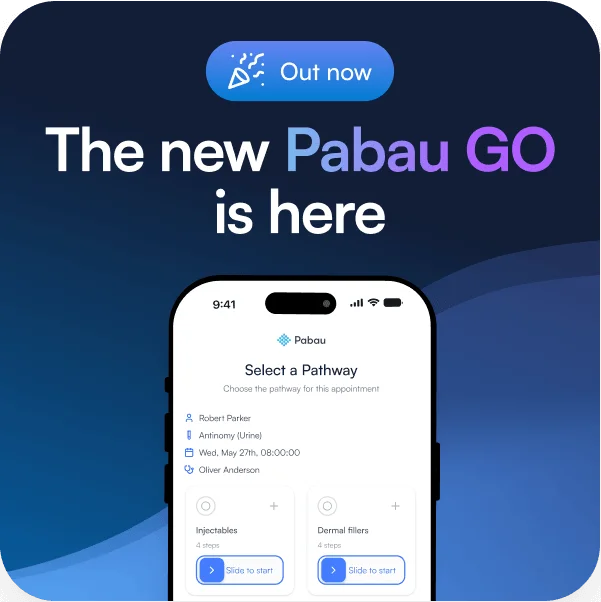

Pabau GO gives practitioners the day’s calendar, patient records and card payments on iPhone. Bookings, notes and payments stay in one system rather than three.

The right medical appointment scheduling app depends on who needs it in their hand. If your patients want to self-serve from an app, SimplePractice is the only pick here that gives them one.
If your practitioners need the calendar, the record and the card reader between patients, Pabau is built for that. If you only book non-clinical calls, Calendly is cheaper and entirely adequate.
Check the HIPAA line before the feature list. Three of these nine publish a business associate agreement without a paid upgrade. One forbids patient health information altogether.
Our pricing sits on our own page rather than behind a sales call. Book a demo to see how Pabau runs scheduling, records and payments for your practice from one app.

Comparing scheduling software rather than apps? Medical practice scheduling software reviews the desktop systems practices run alongside these apps.
Want patients booking themselves? Patient self-scheduling software covers the tools that hand booking over to the patient.
Worried about patient data? HIPAA compliant scheduling software explains what a business associate agreement covers.
Fixing the booking workflow first? Patient scheduling and appointment management walks through the front desk process behind the software.
Already on Acuity? Acuity Scheduling alternatives compares the platforms practices move to next.
Setmore, Acuity Scheduling and Square Appointments are widely used by wellness businesses, and all three run on iOS and Android. Pabau suits wellness practices that also keep clinical records, because the calendar, notes and payments sit in one app.
Setmore’s free plan is the most generous, covering up to four users with unlimited appointments and card payments. Calendly and Zoho Bookings are free for a single user. Square Appointments is free per location, with processing fees on top.
Start with mobile access for staff, a business associate agreement for HIPAA, integration with your record system, automated reminders and waitlist backfill. Published pricing matters too, since two of the nine apps compared here quote only on request.
Staff rarely sit at one desk, so a scheduler that only works on a practice computer creates delays. An app that runs on a phone lets a practitioner move an appointment between patients rather than at the end of the day.
Bookings taken in a separate app never reach the patient chart, so staff retype them and mistakes follow. NexHealth solves this by syncing with around 75 EHR and practice management systems. Pabau, SimplePractice and Tebra avoid it by being the record system themselves.
In most cases no. Eight of the nine apps compared here send patients to a browser booking page, so there is no app to install. SimplePractice is the exception, with a patient app on both iOS and Android.