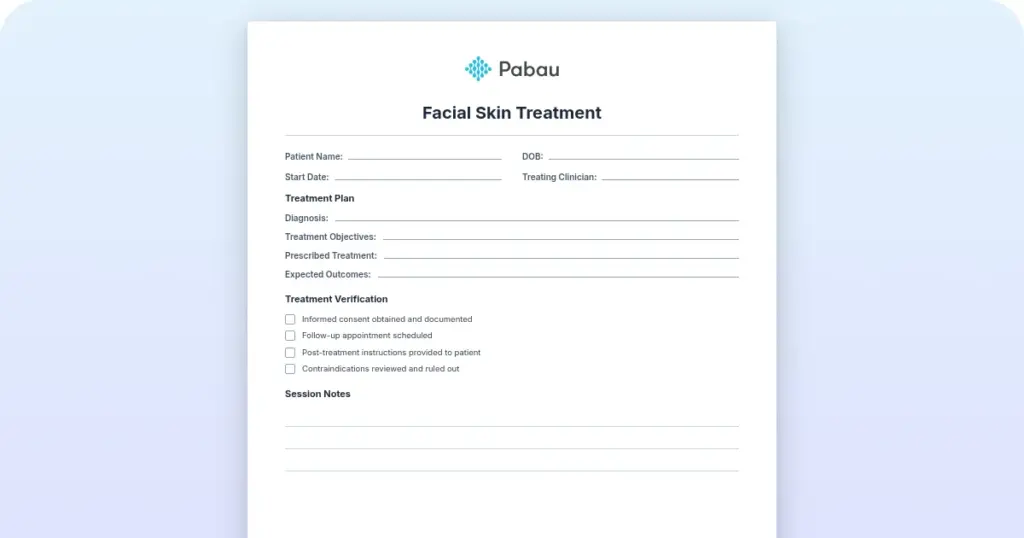
Facial skin treatment consent form template: Microneedling and phi-ion
A facial skin treatment consent form is the signed proof that a patient was scre...

3
Last Updated: Oct 21, 2026

Starting an aesthetics business in the US comes down to three gates most people underestimate: who can legally perform your treatments, whether you need a medical director, and how you structure the company.
Budget realistically. A lean, injectables-only practice can open for under $30,000, while a full medical spa with laser devices commonly runs $70,000 to $250,000 or more.
Estheticians can offer facials, peels, and skincare, but injectables and medical lasers require a licensed medical provider and, in most states, physician oversight.
Settle your business plan, legal entity, and insurance before you sign a lease or buy a single syringe.
Work the launch checklist at the end in order, so your licensing and medical director are in place before you open the doors.
To start an aesthetics business in the US, you need a licensed provider for the treatments you plan to offer, a legal entity and, for medical-grade services, a supervising physician, plus enough capital to cover roughly $30,000 to $250,000 in setup costs before your first client books. The order you tackle these in matters more than the tasks themselves. New and solo practices get their own pick in our roundup of the top software for med spas.
This guide walks the startup in eight steps, from choosing your model to landing your first patients. It includes the three things none of the top-ranking guides give you: a real US startup-cost breakdown, a table of who can legally perform each treatment, and a launch checklist you can work through in sequence.
It is written for the practitioner or investor actually opening the doors, not for someone still deciding whether aesthetics is worth getting into.
Your model decides everything downstream, from your licensing and medical director requirement to your startup budget, so pick it before anything else. Three models cover most new practices:
If capital is tight, the leanest aesthetics business ideas need little equipment to launch: a solo injector renting a room by the day, a mobile skin clinic, or a membership-based skincare studio. You can add services and devices once the calendar is full.
A medical spa business plan has one job: to prove the practice can cover its costs and turn a profit within its first 12 to 18 months. Lenders and investors want to see one, but the real value is that it forces you to put numbers against demand before you spend anything.
Even a one-page aesthetics business plan works, as long as it covers these:
Opening an aesthetic business typically costs between $30,000 and $250,000, depending mainly on whether you offer injectables only or add laser devices and build out a clinical space. The table below breaks down the line items into typical US ranges.
| Cost item | Typical US range | Notes |
|---|---|---|
| Lease deposit and build-out | $10,000 – $70,000 | Much lower if you rent a room in an existing clinic |
| Energy-based devices (laser, IPL) | $20,000 – $150,000 | Only if you offer laser treatments; injectables-only practices skip this |
| Opening injectable inventory | $3,000 – $10,000 | Neurotoxin and filler, subject to manufacturer minimum orders |
| Practice management software and EMR | $300 – $1,500 | Setup plus the first months |
| Malpractice and general liability insurance | $3,000 – $8,000 / year | Higher in CA, NY, and FL |
| Medical director retainer | $1,000 – $5,000 / month | If your services require physician oversight |
| Entity formation, licenses, and permits | $500 – $3,000 | Varies by state |
| Launch marketing | $2,000 – $10,000 | Website, branding, and first campaigns |
Treat these as ranges, not quotes, because costs swing widely by state, city, and model. A solo injector renting a room can open for a few thousand dollars, while a multi-room med spa running two lasers can pass $250,000 before the first appointment.
In most states you cannot simply register a company and start injecting. The treatments you offer dictate who must own the business and who must supervise the clinical work.
A standard LLC is fine for a skincare-only esthetics studio, but medical-grade services usually require a physician-owned professional corporation (PC), often paired with a management services organization (MSO) that handles the business side. This is the corporate practice of medicine doctrine, and it applies in many states.
Scope of practice is set state by state, so the table below is a general guide. Confirm the specifics with your state medical and nursing boards before you finalize your service menu. UK readers follow a different route entirely, from training tiers to prescriber rules, when becoming an aesthetic practitioner in the UK.
| Role | Typical scope | Oversight |
|---|---|---|
| Physician (MD/DO) | Any treatment; can serve as medical director and owner | None |
| Nurse practitioner (NP) | Injectables and lasers; can operate more independently in full-practice-authority states | Collaborative agreement in some states |
| Physician assistant (PA) | Injectables and lasers | Physician supervision |
| Registered nurse (RN) | Injectables and lasers after a qualifying provider exam | Physician or NP delegation; usually cannot own the medical entity |
| Esthetician | Facials, superficial peels, microdermabrasion, waxing | State esthetics license; cannot inject or use medical lasers |
Yes, if you offer any medical-grade treatment (injectables, prescription skincare, or medical lasers) and you are not a physician yourself, nearly every state requires a supervising physician as your medical director. They set treatment protocols, oversee the good-faith exam each patient needs before treatment, and delegate procedures to qualified staff, usually for a monthly retainer.
Before you treat anyone, you need professional liability (malpractice) and general liability insurance, plus a compliant way to store patient records, consent forms, and before-and-after photos. Compliance is where new practices most often cut corners and get burned.
For every regulated treatment, your records should tie the signed consent, the batch number of what was injected, before-and-after photos, and the practitioner notes to one patient timeline. Keeping photos on a personal phone or consents in a filing cabinet is both a HIPAA risk and a daily time sink.
Choose a location for visibility and easy parking, but keep the build-out lean. Most new practices over-spend on space and under-spend on the devices and inventory that actually generate revenue.
The systems you choose here decide how much of your week goes to admin instead of treating patients, so set them up before you open rather than once you are drowning. This is the step the top-ranking guides skip entirely.
Get four things working together: online booking so clients book themselves without a stream of DMs and calls, client records that hold treatment history, consent, and photos in one place, card payments with deposits on high-value treatments to cut no-shows, and automated reminders. When these are connected, your front desk stops rekeying the same information into four different tools.
Hire for the licenses your service menu requires first, then for front-of-house. A great injector with no receptionist still ends up doing admin between patients, which is the most expensive way to answer a phone.
For an injectables clinic or med spa, your medical director is effectively your first hire, followed by injectors (nurses, NPs, or PAs), an esthetician for skincare services, and a front-desk lead. Retention comes down to fair pay, a workable rota, and paying for continuing education so your team keeps their certifications current.
Your first clients come from three places: your existing network, local visibility, and a social feed that shows real results. Start there before spending on paid ads.
Retention is where the money is. Among the highest-return aesthetics business ideas is a simple membership that bundles regular treatments, because predictable monthly revenue smooths out the quiet weeks every new practice has.
Most new owners underestimate how much of running an aesthetics business is business rather than treatment, which is why aesthetic business support and structured training pay for themselves quickly.
Beyond your clinical certification, aesthetic clinic owner training covers the parts injectables courses leave out: pricing, compliance, staffing, and marketing. Industry associations, accredited academies, and continuing-education providers all run owner-focused programs, and many states require ongoing CE to keep your license active.
A specialist aesthetic business consultant, or a peer mentor who has already opened a practice, can shortcut months of trial and error, particularly around pricing and negotiating your medical director agreement.
Work this aesthetic business checklist from top to bottom, because the order matters. Your entity, medical director, and licensing all need to be settled before you spend money on a lease or devices.
When you open, the temptation is to stitch together free tools: a booking app, a spreadsheet for inventory, consent PDFs, and a card reader that talks to nothing. Practice management software like Pabau replaces that patchwork with one system, so a booking, a patient record, a consent form, a photo, and an invoice all live in the same place.
For a new practice, that means online booking that fills your calendar without DMs, digital consent and before-and-after photos tied to each patient record for compliance, deposits that cut no-shows on high-value treatments, and built-in marketing to bring first clients back. You set it up once during onboarding instead of untangling disconnected tools a year in.
Your instinct at the start of creating a business is to try and pull back on costs and things like IT software, but actually that is quite shortsighted. By investing in something like that, it frees up your time to focus on those more important things.
Dr Jordan Faulkner, Founder and Lead Injector, Allo Aesthetics


Pabau brings booking, patient records, consent, payments, and marketing into one platform, so your new aesthetics practice runs from a single dashboard instead of a pile of disconnected tools.

Starting an aesthetics business is less about the treatments and more about the order of operations. Get the model, the legal structure, and the medical director right first, and the lease, devices, and marketing become execution rather than gambles.
The owners who struggle are usually the ones who signed a lease before confirming who could legally perform their treatments, or bought a laser before they had a plan to fill the calendar. Working the checklist in sequence avoids both.
Once the doors are open, the gap between a smooth week and a chaotic one is how well your systems talk to each other. Book a demo to see how Pabau runs booking, records, and payments for a new aesthetics practice from one place.

Worried about where your revenue is leaking? Medical spa accounting software compares options for practices juggling packages, retail, and payroll across separate systems.
Want checkout to feel as good as the treatment? Payment processing tools for med spas compares tools built for a smooth, pain-free checkout experience.
Need quotes that win client trust? Professional service quotes guide walks through practical steps for building trust and closing more bookings.
No. An esthetician can run a skincare-only studio, and nurses, NPs, and PAs can perform injectables under the supervision their state requires. But if you offer medical-grade treatments and are not a physician, most states require a physician medical director, and the medical entity itself often has to be physician-owned.
A lean injectables-only or skincare practice can open for under $30,000, while a full medical spa with laser devices commonly runs $70,000 to $250,000 or more. The biggest swing factors are your build-out and whether you buy energy-based devices.
In nearly every state, yes, if you offer injectables, medical lasers, or prescription skincare and you are not a physician. The medical director sets treatment protocols, oversees the good-faith exam each patient needs, and delegates procedures to qualified staff, usually for a monthly retainer.
In most states an RN can perform injectables after a qualifying provider exam, but cannot own the medical entity because of corporate practice of medicine rules. A common workaround is a physician-owned professional corporation paired with a management company owned by the RN or an investor.
Margins on treatments like neurotoxins and fillers are high, since a treatment priced at several hundred dollars can cost the practice well under half that in product. Profitability depends less on that margin and more on keeping the calendar full and controlling fixed costs like rent and your medical director retainer.