









Key takeaways
ICD-10 Code S06.315S describes contusion and laceration of the right cerebrum with loss of consciousness greater than 24 hours. The patient must have returned to their pre-existing conscious level.
The 6th character 5 is what carries the greater-than-24-hour bracket. Do not confuse it with S06.313 (1 hour to 5 hours 59 minutes) or S06.314 (6 to 24 hours).
S06.316 is the closest trap. It covers the same duration, but the surviving patient never returned to their pre-existing conscious level.
The 7th character S designates a sequela visit. Coders must also report a separate code for the specific sequela manifestation, such as post-concussion syndrome or cognitive deficits.
A common coding error is using the initial encounter code S06.315A at a follow-up sequela visit, which can trigger claim denials and compliance audits.
Practice management software like Pabau helps neurology and rehabilitation teams organize TBI sequela documentation and submit paired diagnosis codes cleanly.
ICD-10 Code S06.315S: Definition and clinical description
ICD-10 Code S06.315S is a billable ICD-10-CM diagnosis code for contusion and laceration of the right cerebrum. It applies when loss of consciousness lasted more than 24 hours and the patient returned to their pre-existing conscious level. The 7th character S reports the visit as a sequela encounter.
Practices that see TBI patients in follow-up, rehabilitation, or long-term neurology settings meet this code often. The most common failure is treating the 6th character as a duration-only choice. S06.315 also requires a documented return to the patient’s baseline level of consciousness.
Two documents decide the code. The acute care record supplies the loss of consciousness duration and the return to baseline. The current visit note supplies the sequela manifestation being treated.
S06.315S code description and clinical meaning
Each element of the code description carries a distinct clinical and coding requirement. Understanding what each component means prevents miscoding at the point of claim submission.
Contusion vs. laceration of the cerebrum
A cerebral contusion is a bruising of brain tissue caused by impact, typically without tearing the brain surface. A cerebral laceration involves an actual tear of brain tissue. ICD-10-CM Code S06.315S covers both injury types in a single code, since they frequently co-occur in moderate-to-severe TBI. Documentation should specify which injury type is present, though the code applies when either or both appear alongside the other qualifying elements.
Right cerebrum laterality
The S06.31x subcategory specifies injury to the right cerebrum. Laterality is a required documentation element for this code family. If the provider’s note does not specify right or left hemisphere, coders must query the provider. Without confirmed laterality, use S06.30xS for unspecified focal traumatic brain injury rather than assuming a side. Coders cannot select laterality from imaging reports alone, without physician confirmation.
Loss of consciousness greater than 24 hours, with return to baseline
The 6th character 5 carries two separate requirements. Documented loss of consciousness must exceed 24 hours. The record must also show that the patient came back to their pre-existing conscious level. If the patient survived but never returned to baseline, the correct code is S06.316-.
Patient care management after a TBI often spans months. Code selection still refers to the loss of consciousness recorded at the time of the original injury, not the follow-up episode. Newer coders confuse the two often, so make the rule explicit in training.
Understanding the 7th character S in TBI coding
The three 7th character options for the S06.315 subcategory determine when the code is appropriate. Each maps to a distinct phase of care, and choosing the wrong one is a frequent source of denials.
For S06.315S specifically, the sequela visit means the original TBI is no longer the active condition being treated. The coder reports the sequela manifestation code first, such as F07.81 post-concussion syndrome or R41.3 other amnesia. S06.315S then follows as the cause of that sequela.
Both codes have to reach the claim together. Practices that build the sequela pair into their claims management workflow are less likely to submit S06.315S alone.
S06.315S code hierarchy and parent codes
Knowing where S06.315S sits in the ICD-10-CM hierarchy helps coders navigate to adjacent codes quickly and understand which chapter-level guidelines apply.
Per the CMS ICD-10 coding guidance, the S06 category covers all intracranial injuries. Coders should consult the official ICD-10-CM Tabular List and the FY2026 Official Guidelines when uncertain which subcategory applies. That matters most when distinguishing focal TBI (S06.3) from diffuse TBI (S06.2).
Related ICD-10 codes for cerebral contusion and laceration
The S06.31x family covers contusion and laceration of the right cerebrum across every LOC bracket and all three encounter types. Reading the full sibling set is the fastest way to confirm you have the right 6th character.
For left cerebrum injuries, the parallel codes sit under S06.32x. Diffuse traumatic brain injury sits in its own family under S06.2x, where S06.2X9D covers a subsequent encounter. Neuropsychology and cognitive rehabilitation teams often work alongside mental health EMR workflows for the same patients.
How S06.315S differs from adjacent LOC duration codes
Most S06.31x errors start here. The 6th character axis runs from no LOC through to death before regaining consciousness, and two of its steps share the same 24-hour threshold. Documentation that describes consciousness loosely makes the choice harder.
- S06.315S vs S06.316S: Both need LOC beyond 24 hours. S06.315S requires a documented return to the patient’s pre-existing conscious level. S06.316S applies when the surviving patient never regained that level.
- S06.315S vs S06.314S: S06.314S stops at 24 hours. A record showing the patient roused on day two supports S06.315S, provided the note confirms a return to baseline.
- S06.315S vs S06.313S: S06.313S carries the 1 hour to 5 hours 59 minutes bracket. The two codes sit one digit apart and are easy to transpose, so check the 6th character against the timed duration.
- LOC described as prolonged or as several days: Too vague to code. Query the provider for a timed duration and for the patient’s conscious level on recovery.
- Return to baseline not addressed: Query the provider before choosing between S06.315S and S06.316S. Never infer recovery of consciousness from a discharge summary alone.
- LOC duration not documented at all: Use S06.319S. Where the record does not establish whether LOC occurred, use S06.31AS instead.
NCHS and CMS guidance is clear that coders cannot estimate or infer LOC duration without explicit provider documentation. The same rule covers the return-to-baseline element that separates S06.315S from S06.316S.
When S06.315S is reported as the cause of a sequela, the duration referenced is still the original injury’s. A sequela visit note describing the patient’s current alertness does not change the 6th character.
Pro Tip
Build one question into your TBI provider-query template. Ask whether the patient returned to their pre-existing conscious level. That answer decides between S06.315 and S06.316, and acute records leave it out often.
Clinical documentation requirements for S06.315S
Four elements must be present in the medical record before a coder can assign ICD-10 Code S06.315S. Missing any one of them produces a claim that is either incorrect or auditable.
- Laterality confirmation: The provider must document right cerebrum (or right cerebral hemisphere) explicitly. Imaging reports showing right-sided injury support the documentation, but the physician’s note must contain the laterality statement.
- LOC beyond 24 hours, with return to baseline: The acute care record must show a timed duration longer than 24 hours. It must also state that the patient returned to their pre-existing conscious level. The sequela visit note alone cannot establish either element.
- Encounter type determination as sequela: The current visit note must establish that the original TBI has stabilized. It must also show that the patient presents for a residual condition caused by the prior injury. Language such as «presenting for management of cognitive deficits following right-sided TBI» supports the sequela classification.
- Sequela manifestation code documented: The specific late effect being treated must be identified in the current visit. Common sequela manifestations include post-concussion syndrome (F07.81), memory impairment (R41.3), headache (R51.9), or mood disorders attributable to TBI (F06.30). The structured clinical records system should capture these companion diagnoses at every sequela encounter.
Maintaining HIPAA-compliant clinical documentation standards across all four elements reduces the risk of a payer audit. Practices should also consult the AAPC ICD-10-CM code lookup when verifying companion diagnosis compatibility with S06.315S.
Neurological rehabilitation practices face the same task at every session. Physical therapy EMR workflows that build diagnosis capture into the session note make it easier to attach the manifestation code and S06.315S together.
Common coding errors and how to avoid them
TBI sequela claims are among the most frequently returned for correction in neurological and rehabilitation billing. The denial codes on a returned claim usually name the element the payer questioned. These five errors account for the majority of S06.315S-related denials.
- Using S06.315A for a sequela visit: The initial encounter code signals to the payer that the patient is in active treatment for the acute injury. Using it at a sequela visit misrepresents the encounter type, which may trigger a claim-integrity review. Once the original injury has stabilized, all subsequent visits for residual conditions must use 7th character S.
- Omitting the sequela manifestation code: S06.315S is the causal code. Per the ICD-10-CM Official Guidelines, the manifestation code for the residual condition is listed first, followed by S06.315S. Submitting S06.315S as a standalone diagnosis is a coding error that payers frequently flag.
- Assigning the wrong LOC bracket: S06.315 sits above the 6 to 24 hour bracket in S06.314, at the top of the duration axis. Coders sometimes reach for it whenever LOC was long, or transpose it with S06.313. Match the 6th character to the timed duration in the acute record, and query anything ambiguous. The 7th character S behaves the same way in other injury categories, as it does in S72.455S.
- Ignoring the return-to-baseline requirement: Reporting S06.315S for a surviving patient who never regained their prior conscious level is a factual error. That case belongs to S06.316S, and the two codes are not interchangeable.
- Incorrect laterality assignment: Coding right cerebrum (S06.31xS) when the documentation says left, which would require S06.32xS, is a factual error. Always confirm laterality against the physician note, not just the radiology report.
Auditing TBI sequela claims before submission catches most of these errors early. A checklist held inside your HIPAA compliance software keeps that review consistent. A scheduled medical chart audit then samples the claims that already went out.
Pro Tip
Run a monthly audit of all claims submitted with 7th character S codes. Cross-check that every sequela claim carries both the manifestation code, listed first, and the causal injury code S06.315S, listed second. Correct any claim missing its companion code before secondary submission.
ICD-10-CM excludes and coding notes for S06
The S06 category carries several Excludes1 and Excludes2 notes that affect how S06.315S may be reported alongside other codes. Coders must review these notes before adding companion diagnoses to a TBI sequela claim.
- Excludes1 (cannot be reported together): Head injury NOS (S09.90). When a more specific intracranial injury such as S06.315S is documented, the head injury NOS code must not appear on the same claim.
- Excludes2 (reportable separately when appropriate): The note at S06.3 excludes any condition classifiable to S06.4-S06.6. It also excludes focal cerebral edema (S06.1). An Excludes2 note means those codes may be reported alongside S06.315S when the record supports each condition separately.
- Use additional code instruction: The Tabular List carries a note at S06 itself. Add a code for mild neurocognitive disorders due to a known physiological condition (F06.7-), if applicable. At S06.3 and S06.31, which govern S06.315S, the list also instructs a code for traumatic brain compression or herniation (S06.A-).
For the current Excludes notes and coding instructions, verify against the CDC/NCHS ICD-10-CM tabular list for FY2026. Excludes designations can change between annual releases. Practices using digital intake forms that capture prior injury history can flag potential excluded conditions before a claim goes out.
Managing TBI sequela claims in Pabau
Most rehabilitation and neurology teams track sequela claims across three places. The acute record holds the LOC duration, the current note holds the manifestation, and the billing sheet holds the code pair. Anything that falls between them surfaces later as a returned claim.
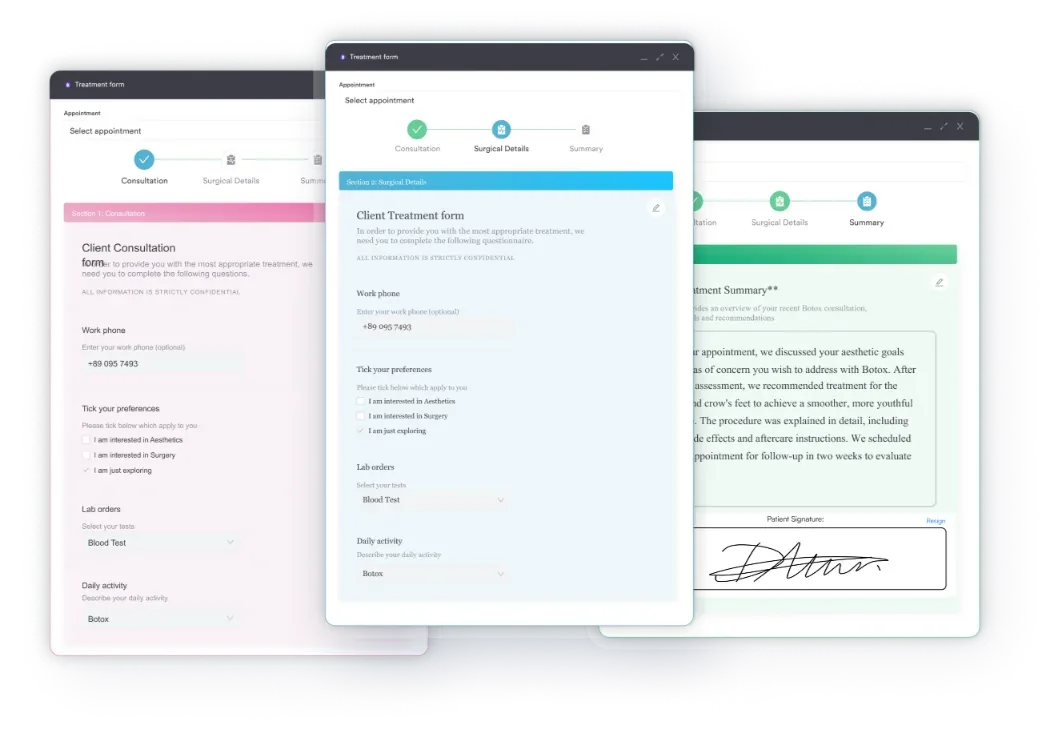
Pabau keeps all three in one patient record. Structured clinical notes carry the injury history and the sequela manifestation forward to every visit. Claims management then submits and tracks the claim from that same record.
Coding teams stop rebuilding context at each encounter, which is where the return-to-baseline detail usually goes missing. Every Pabau subscription includes the clinical records and claims tools, so nothing here sits behind a higher tier.

Keep TBI sequela documentation and claims in one system
Pabau keeps the injury history, the sequela manifestation, and the claim in one patient record. Neurology and rehabilitation teams submit and track TBI sequela claims without rebuilding context.

Conclusion
Sequela TBI claims are among the most documentation-intensive in neurological billing. An accurate S06.315S submission rests on four documented elements. Those are laterality, the LOC duration with its return to baseline, the sequela encounter type, and the manifestation code. An error in any one of them creates an avoidable denial.
The bracket itself is worth one last check. S06.315 means loss of consciousness beyond 24 hours with a return to baseline, and S06.313 is the one-to-six-hour code most often mistaken for it. To see how Pabau supports complex multi-diagnosis claim workflows, book a demo with the team.

Continue your research
Working returned TBI sequela claims? Denial management in healthcare sets out how to track, appeal, and prevent repeat denials.
Want the claim accepted first time? What is a clean claim in medical billing? explains the fields a payer checks before it accepts a claim.
Building a billing compliance program? Medical billing compliance covers the governing laws, the common violations, and a downloadable checklist.
Coding a different sequela injury? S66.399S applies the same 7th character S rules to an extensor tendon injury of the finger.
Frequently asked questions
What is ICD-10 Code S06.315S?
ICD-10 Code S06.315S is a billable ICD-10-CM diagnosis code for contusion and laceration of the right cerebrum. It applies when loss of consciousness lasted more than 24 hours and the patient returned to their pre-existing conscious level. The 7th character S reports the encounter as a sequela. The code is valid for HIPAA billing transactions in FY2026.
Is S06.315S a billable ICD-10-CM code?
Yes, S06.315S is a billable and specific ICD-10-CM code, valid for HIPAA-compliant electronic claim submission. It is confirmed as billable in the FY2026 ICD-10-CM release effective October 1, 2025. Non-billable codes in the same family include parent codes S06.315 and S06.31, which lack the required 7th character.
What is the 7th character S in ICD-10 traumatic brain injury codes?
The 7th character S designates a sequela encounter. The original TBI has resolved or stabilized, and the patient is being treated for a residual condition caused by it. The three options are A for the initial encounter, D for the subsequent encounter, and S for sequela.
What is the difference between S06.315A, S06.315D, and S06.315S?
All three codes describe the same injury, and they differ only in encounter type. S06.315A applies to the initial active treatment visit. S06.315D applies to routine follow-up during the healing phase. S06.315S applies once the original injury has healed and the visit addresses a residual condition caused by that TBI.
How long must loss of consciousness last to use S06.315?
Loss of consciousness must have lasted more than 24 hours, and the patient must have returned to their pre-existing conscious level. Shorter durations map to other codes in the family. Six to 24 hours is S06.314, and 1 hour to 5 hours 59 minutes is S06.313.
What is the difference between S06.315S and S06.316S?
Both codes cover loss of consciousness lasting more than 24 hours. S06.315S applies when the patient returned to their pre-existing conscious level. S06.316S applies when a surviving patient never returned to that level. The provider must document which of the two happened.
Is S06.315S the code for loss of consciousness of 1 to 5 hours?
No. That bracket belongs to S06.313, so the matching sequela code is S06.313S. S06.315 sits higher on the axis and needs loss of consciousness beyond 24 hours with a return to baseline. The two codes differ by a single digit, which is why they are often transposed.
What codes are reported alongside S06.315S at a sequela visit?
At a sequela visit, the sequela manifestation code is listed first, followed by S06.315S as the causal code. Common companion codes include F07.81 (post-concussion syndrome), R41.3 (other amnesia), R51.9 (headache, unspecified), and F06.30 (mood disorder due to known physiological condition, unspecified). The manifestation code sequence is required by the ICD-10-CM Official Guidelines.