ICD-10 code S61.201A: Open wound of left index finger without nail damage
ICD-10 code S61.201A covers a left index finger wound of unstated type ICD-10 co...

Last Updated: Oct 16, 2026
Billable Code Specific Code
S92.311B is the billable ICD-10-CM code for displaced fracture of first metatarsal bone, right foot, initial encounter for open fracture.
The code is valid for FY2026 under CMS ICD-10-CM guidelines, the annual update running from October 1, 2025 through September 30, 2026. Payers expect the record to support the displacement and the open wound separately, not as one finding.
S92.311B is a billable, specific code, so it can go on a HIPAA-covered electronic transaction without a more detailed child code. Coders should confirm current-year applicability in the CDC/NCHS ICD-10-CM web tool each October, when CMS releases its annual update.
Let Pabau's smart automation suggest the right codes, reduce claim denials, and keep your practice compliant—effortlessly.
Automate repetitive tasks and focus on what matters most—your patients.
Reduce coding errors and ensure compliance with the latest regulations.
Clean claims, fewer denials, and faster reimbursements.
Powerful insights and reporting to help your practice thrive.
HIPAA compliant SOC 2 certified GDPR-compliant Trusted by 4,000+ clinics worldwide

ICD-10 code S92.311B covers a displaced, open fracture of the first metatarsal bone in the right foot at an initial encounter. It is billable and valid through September 30, 2026.
The 7th character B marks an initial encounter for an open fracture. S92.311A is the same fracture with the skin intact.
Displacement and laterality share the sixth character, so a nondisplaced right-foot fracture is S92.314B rather than a variation on S92.311.
Documentation must capture five specifics: right foot, displaced, first metatarsal, open wound, and initial encounter. Missing any one can trigger a denial.
Practice management software like Pabau pairs ICD-10 code lookup with structured note templates. That helps podiatric and orthopedic practices submit clean claims for codes like S92.311B.
Where S92.311B sits in the ICD-10-CM tree affects sequencing decisions and DRG assignment. The table below traces it from chapter down to the 7th character.
Injury codes across the S00-T88 chapter share the same 7th character extension rules. For a displaced first metatarsal fracture, laterality is carried in the sixth character. A 1 means right foot, a 2 means left foot, and a 3 means unspecified foot.
The familiar “9 means unspecified” pattern belongs to the unspecified-bone codes in S92.30, such as S92.309. It does not apply to this bone-specific family. Choosing the wrong laterality character is a common denial trigger on podiatric and orthopedic claims.
The 7th character is not optional on S92.311 codes. Without it, the claim rejects as an invalid code. The character B tells payers this is an initial encounter for an open fracture, where bone communicates with the external environment through a wound.
CMS ICD-10-CM guidelines define “initial encounter” by treatment, not by visit count. It applies for as long as the patient is receiving active treatment for the fracture. A patient transferred to a specialist for surgical management still takes the A or B character, even on a third visit.
Use 7th character B for any visit where the patient is actively receiving care for an open metatarsal fracture. Surgery, irrigation, debridement, and wound management all count as active treatment. Switch to D, G, K, or P only once the patient reaches the aftercare or healing phase.
S92.311A and S92.311B describe the same injury at the same stage. Both cover a displaced first metatarsal fracture of the right foot at an initial encounter. Wound status is the only difference between them.
If the notes describe a wound near the fracture site without stating “open fracture” or “bone exposure,” query the provider before assigning S92.311B. Coding an open fracture without documented wound-to-bone communication is a common audit flag.
S92.311B sits inside a larger family of metatarsal fracture codes. Coders working with podiatric or orthopedic practices need the whole set to handle laterality switches, nondisplaced variants, and the other metatarsals. AAPC’s ICD-10-CM code lookup is a quick way to confirm a description anywhere in the S92.3 family.
Avoid S92.313B unless laterality genuinely cannot be determined from the documentation. Payers flag unspecified laterality for extra review, and it often prompts a request for records. Knowing which denial codes map to laterality and specificity errors makes those claims easier to scrub before submission.
Five documentation elements must all appear in the record to support S92.311B. Each one sets a different character of the code, as the breakdown below shows. Missing any one can produce a payer query or a denial.
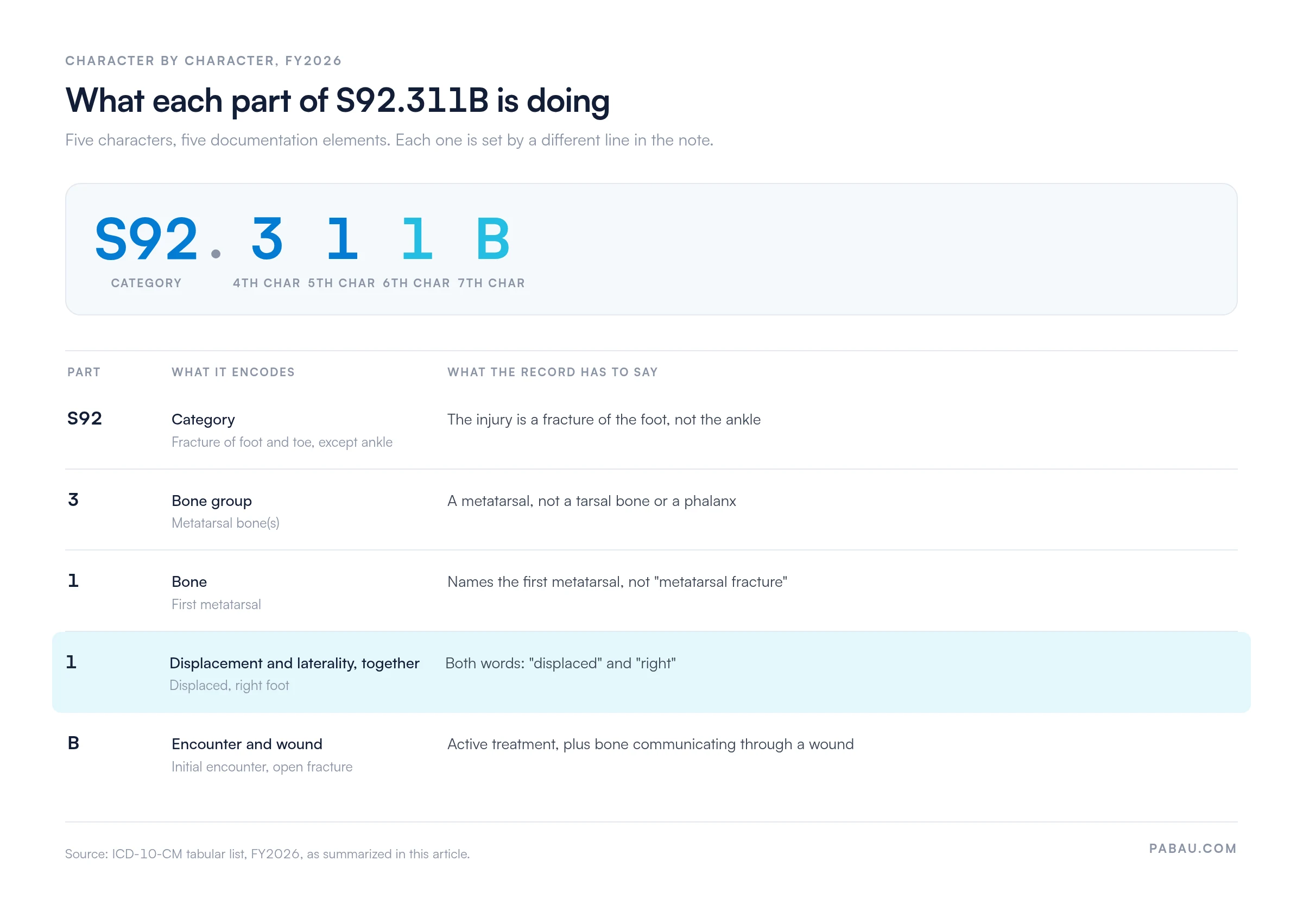
Injury records read best as standalone clinical documents that an auditor can follow without calling the provider. For an open fracture, include the mechanism of injury, such as a crush, penetrating trauma, or high-energy impact. Payers use it to assess whether the open designation is clinically plausible.
Build a note template for open metatarsal fractures that asks for five fields before the note is signed. They are laterality, fracture type, bone name, wound description, and the treatment given today. Completing all five at the point of care removes the most common documentation denials on S92.311B.
S92.311B is valid for HIPAA-covered electronic transactions. Outpatient claims carry it on a CMS-1500 form, and inpatient stays carry it on the UB-04. Reimbursement varies by payer, plan type, and locality, so verify current fee schedule values rather than last year’s.
CPT codes often paired with S92.311B for surgical management include 28485, open treatment of a metatarsal fracture, and 28476, percutaneous skeletal fixation. Treat both as examples, and confirm current AMA CPT descriptors and payer coverage policy before using them. Medicare values for either code sit in the CMS Physician Fee Schedule lookup tool.
Practices submitting these claims electronically benefit from a clearinghouse that checks the ICD-10 and CPT pairing before the claim leaves the office. Practice management software like Pabau runs that check inside its medical claims management module. A code mismatch then surfaces at the front desk instead of in a remittance advice.
Inpatient hospital claims for S92.311B require a Present on Admission indicator. A traumatic open metatarsal fracture is almost always present on admission, so the indicator is usually “Y”. If the fracture happens during a hospitalization for another condition, the indicator changes to “N”. Outpatient and ED claims do not need one.
Confirm the POA assignment with the attending physician before submission rather than after a query. Coverage is worth checking too, because a plan that excludes surgical open fracture management will deny the claim after the care is delivered.
Where rejections repeat, a clean claim checklist covering POA verification, ICD-10 specificity, and CPT pairing cuts most of the rework. Tracking which S92.311B claims deny, and for what reason, shows whether the problem sits in coding or in documentation.
Podiatric and orthopedic practices handling fracture cases make a specificity decision on every claim. Laterality, displacement, encounter type, and wound classification each change the code that goes out. Pabau keeps that decision next to the clinical note instead of in a separate coding step.
The result is fewer round trips between the chart and the claim. Coders see the documentation that supports each character of the code. Claims then go out electronically through Claim.MD to more than 4,000 US payers.

Pabau’s built-in ICD-10 code lookup and claims management module helps podiatric and orthopedic practices assign accurate codes and submit electronically through Claim.MD. See how it works for your practice.

The character that decides this claim is the sixth one, not the seventh. Displacement and laterality travel together in S92.311. A note that reads “metatarsal fracture, right foot” leaves the coder guessing at the part payers scrutinize hardest.
The fix lives in the note rather than in the code book. When the clinician records displacement, bone, wound, and treatment at the point of care, the coder has no judgment call left to make.
Book a demo to see how Pabau prompts for those five fields during the encounter and validates the code pairing before a claim goes out.

Need guidance on medical billing compliance for injury codes? Medical billing compliance covers the frameworks and workflows practices use to stay audit-ready.
Want to understand how claims get submitted electronically? 837 file guide explains the 837P transaction format used for professional claims including fracture treatment.
Handling denials on fracture claims? Denial management in healthcare outlines structured approaches to tracking, appealing, and preventing ICD-10 related claim denials.
ICD-10 code S92.311B is a billable ICD-10-CM diagnosis code for a displaced fracture of the first metatarsal bone of the right foot. It is coded at an initial encounter for an open fracture, where the bone communicates with the external environment through a wound. The code is valid for HIPAA-covered transactions in FY2026.
S92.311A codes an initial encounter for a closed fracture, with the skin intact over the fracture site. S92.311B codes an initial encounter for an open fracture, with bone exposed through a wound. Both describe the same displaced first metatarsal fracture of the right foot, so only the wound status differs.
Yes. S92.311B is a billable and specific ICD-10-CM code, valid for direct submission on HIPAA-covered electronic transactions. It does not require a more detailed child code to be complete and submittable.
The 7th character B designates an initial encounter for an open fracture. It means the patient is receiving active treatment and the fracture site communicates with the external environment through a wound. Per CMS guidelines, an initial encounter runs through the whole active treatment phase, not just the first visit.
A displaced fracture of the first metatarsal bone means the fracture fragments have shifted out of their normal anatomical alignment. The first metatarsal connects the midfoot to the base of the great toe and carries a significant share of load. Displacement usually requires reduction, closed or open, to restore alignment before healing can progress.
A displaced fracture means the bone fragments have moved out of alignment. A nondisplaced fracture means the bone has cracked but the fragments remain in their correct position. ICD-10-CM encodes the distinction in the sixth character. S92.311B covers displaced fractures, and S92.314B covers nondisplaced fractures of the same bone, foot, and encounter type.