

ICD-10 Code S42.444P: Medial epicondyle fracture, right humerus
ICD-10 Code S42.444P: full descriptor and code validity ICD-10 Code S42.444P car...

Last Updated: Oct 13, 2026
Billable Code Specific Code
S82.845D is the billable ICD-10-CM code for nondisplaced bimalleolar fracture of left lower leg, subsequent encounter for closed fracture with routine healing.
The code is current in the CMS ICD-10-CM code set for FY2026. One code carries five facts for the payer: bimalleolar, nondisplaced, left, closed, and a follow-up visit healing as expected.
The S82.84 series has one feature that catches coders out. Its 6th character sets displacement and side together, so 5 means nondisplaced and left at the same time. Coders who expect a separate laterality character go looking for one that does not exist.
Let Pabau's smart automation suggest the right codes, reduce claim denials, and keep your practice compliant—effortlessly.
Automate repetitive tasks and focus on what matters most—your patients.
Reduce coding errors and ensure compliance with the latest regulations.
Clean claims, fewer denials, and faster reimbursements.
Powerful insights and reporting to help your practice thrive.
HIPAA compliant SOC 2 certified GDPR-compliant Trusted by 4,000+ clinics worldwide

S82.845D is a billable ICD-10-CM code for a nondisplaced bimalleolar fracture of the left lower leg, subsequent encounter for closed fracture with routine healing.
Bimalleolar fractures live under S82.84, inside the S82.8 subcategory for other fractures of lower leg. They are not coded from S82.4 (shaft of fibula), S82.5, or S82.6.
In the S82.84 series the 6th character carries both displacement and side, so 5 means nondisplaced and left. There is no separate laterality character.
The 7th character D means a subsequent encounter for a closed fracture that is healing normally. E and F describe open fractures, so they never belong on a closed ankle fracture claim.
Practice management software like Pabau attaches ICD-10 codes to the patient record, so billing teams submit claims without manual re-entry.
Every character in ICD-10 Code S82.845D carries a specific meaning. A coder who can read the structure verifies a claim in seconds. A coder who cannot lands in a sibling code that flips the side, the displacement status, or the open versus closed status.
The 6th character is the one coders misread most. In the S82.84 series it encodes displacement and side together, so there is no separate laterality digit to check. All six combinations sit in one grid below. Submitting S82.845D for a right ankle therefore gets two facts wrong at once.
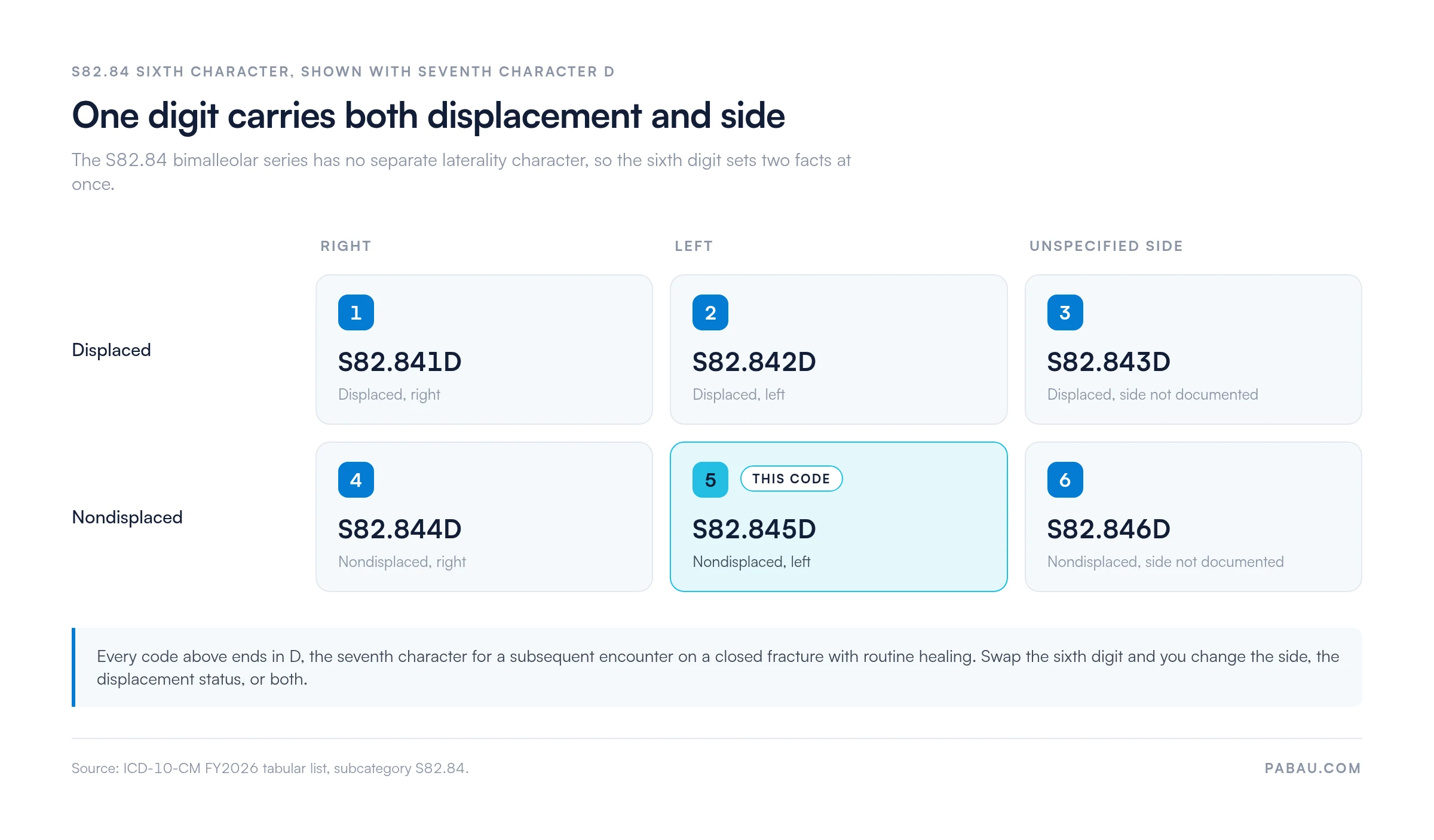
Every code in the S82.845 family needs a 7th character before it can be billed, and sixteen options exist. Each one describes a different combination of encounter type, open or closed status, and healing outcome. Pick the wrong one and the claim describes an encounter that never happened.
Character D means one thing only: the patient is back for follow-up, the fracture is closed, and it is healing as expected. The CDC/NCHS ICD-10-CM tool confirms the full extension list for this subcategory. D does not cover delayed healing, nonunion, or malunion, and it never covers an open fracture.
Read down the closed-fracture rows and the logic becomes easy to hold. Only A, D, G, K, and P belong on a closed ankle fracture. The remaining characters all describe an open wound communicating with the fracture site. The AAPC ICD-10-CM lookup gives year-specific validation for each code and its valid extensions.
Check the 7th character at every visit, not just the first one. A patient returning for a fracture check on a healing closed bimalleolar fracture needs D rather than A as the 7th character. Leaving A in place implies active initial treatment is still under way. That invites payer audits and records requests. Leaving E or F on the claim is worse, because both describe an open fracture the record does not support.
A bimalleolar fracture breaks both the medial malleolus and the lateral malleolus. The medial malleolus is the bony prominence on the inner ankle, formed by the distal tibia.
The lateral malleolus is the outer prominence, formed by the distal fibula. Together they hold the ankle mortise, so this pattern is treated as an unstable ankle injury even when the fragments have not moved.
That anatomy explains where the code lives. Because the injury spans two bones, ICD-10-CM does not file it under either bone. It sits in S82.8, the residual subcategory for other fractures of the lower leg, at S82.84.
Most bimalleolar coding errors happen before the 7th character is ever chosen. The coder searches the tabular list for “malleolus” or “fibula” and lands in a neighboring subcategory.
From there the result is a perfectly formed code for the wrong injury. The table below shows the S82 subcategories that get confused with S82.84 and what each one covers.
The S82.4 row is worth a second look, because it is the trap that catches the most coders. S82.4 codes carry the same 7th characters and the same nondisplaced wording as S82.84, so a mistyped code still validates cleanly. It just bills the wrong bone at the wrong level of the leg.
Knowing where ICD-10 Code S82.845D sits in the tree makes it easy to move sideways to other lateralities, displacement statuses, and encounter types. The hierarchy below runs from chapter level down to the fully specified billable code.
Every fracture code in Chapter 19 shares this shape. Reading the tree stops coders from submitting S82.845, which is not billable on its own. It also keeps the 7th character in view as a required element rather than an optional suffix. The same shape repeats across the wider ICD-10-CM code library, so the reading habit transfers to any chapter.
S82.845D sits in a tight family of near-identical codes. Picking the wrong sibling is the most common bimalleolar coding error after subcategory confusion. The table below maps the alternatives coders reach for most often, so the documentation can be cross-checked before submission.
Crosswalking between these siblings is a habit worth building. Before submission, read the code back against three lines in the note: which malleoli, which side, and how the fracture is healing. If any of the three is missing from the record, the sibling code is a guess.
The ICD-10-CM Official Guidelines for Coding and Reporting, Section I.C.19, govern every fracture coding decision. Five of its rules do most of the work on an S82.845D claim.
Orthopedic and sports medicine billing teams tend to keep fracture codes on a standing audit list. The 7th character rules give a claim sixteen ways to describe the same visit, and only one of them matches the note.
Getting ICD-10 Code S82.845D paid depends on three things. Pair it with the right procedure codes and document the encounter type clearly.
Then route the claim through a clearinghouse that screens format and eligibility first. Most fracture checks land on an office visit code such as 99213, so the diagnosis and the service have to describe the same visit.
Run a three-point pre-claim check on every fracture follow-up. Confirm that the 7th character matches the visit type in the note. Confirm that the side in the code matches the side in the documentation. Confirm that an external cause code is appended. Catching those three items before submission clears most S82 fracture denials before a payer ever sees the claim.
Fracture coding is not hard on any single visit. It gets hard across a treatment episode. The diagnosis has to change as the patient heals, while the side and the displacement status stay fixed.
Practice management software like Pabau keeps that episode in one record. The coder can see the initial encounter, every follow-up, and the imaging that supports the nondisplaced call.
Orthopedic and physical therapy teams get the same benefit from keeping the treatment plan next to the code. Keep the therapist’s note and the diagnosis in the same chart and the link between them is visible at the point of coding. Nobody has to reconstruct it at appeal.
Pabau submits electronic claims through Claim.MD, our US clearinghouse partner, which reaches thousands of US payers. The integration also supports real-time eligibility checks and 835 electronic remittance advice.
A billing team can submit an S82.845D claim, take the remittance back in, and reconcile a denied fracture encounter without leaving the platform. Pabau’s claims management without re-entry works from the same record that carries the clinical note.

Pabau connects your clinical documentation, ICD-10 code assignment, and claims submission through Claim.MD, so your billing team never reconciles codes by hand. See how it works for your practice.

ICD-10 Code S82.845D is straightforward once you read it in two halves. The first half, S82.845, fixes the injury: bimalleolar, nondisplaced, left. The second half, the character D, fixes the encounter: follow-up visit, closed fracture, healing normally. Get to S82.84 first and the rest follows.
The habit worth keeping is the re-read at every follow-up. Side and displacement stay fixed for the whole episode, but the 7th character moves. A claim carrying last visit’s character describes the wrong encounter. Book a demo to see how Pabau keeps the note, the code, and the claim on one record for every fracture follow-up.

Need to understand denial patterns for fracture billing? Denial management in healthcare covers the workflows that prevent and resolve common ICD-10 fracture claim rejections.
Want to understand how clean claims are built? Clean claim submission explains the pre-submission checks that keep ICD-10 coded claims out of the denial queue.
Looking for a revenue cycle overview? Revenue cycle management fundamentals gives billing teams the full picture of how ICD-10 codes connect to payment timelines.
S82.845D is a billable ICD-10-CM code for a nondisplaced bimalleolar fracture of the left lower leg, subsequent encounter for closed fracture with routine healing. The characters break down in stages. S82 is fracture of lower leg including ankle, 8 is other fractures of lower leg, and 4 is bimalleolar fracture. The 6th character 5 means nondisplaced and left. The 7th character D means a follow-up visit on a closed fracture that is healing normally.
Yes. S82.845D is a valid, billable ICD-10-CM code accepted by Medicare, Medicaid, and commercial payers, and it is current for FY2026. The parent code S82.845 is not billable on its own. Every code in the S82.845 family needs a 7th character before it can be claimed.
Bimalleolar fractures are coded from S82.84, Bimalleolar fracture of lower leg, which sits inside S82.8 for other fractures of lower leg. They do not belong in S82.4 for fracture of shaft of fibula, S82.5 for fracture of medial malleolus, or S82.6 for fracture of lateral malleolus. A trimalleolar fracture, which also involves the posterior malleolus, is coded from S82.85 instead.
The 7th character D means a subsequent encounter for a closed fracture with routine healing. It applies from the first follow-up visit onward, once initial treatment has started and the fracture is progressing as expected. It is distinct from G for delayed healing, K for nonunion, P for malunion, and S for sequela. It is also distinct from E and F, which describe open fractures healing routinely.
An initial encounter, marked A, B, or C, applies while the patient is receiving active treatment for the fracture. A subsequent encounter, marked D through R, applies at follow-up visits once that active treatment is under way. Cast changes, fracture checks, and physical therapy all count as subsequent encounters. The switch from A to D happens at the first follow-up visit, not after a set number of weeks.
S82.845D is reported as the primary diagnosis on claims for follow-up care where a closed left bimalleolar fracture is healing normally. It pairs with evaluation and management codes, physical therapy codes, or cast application and removal codes such as 29405 and 29700. The note must document both malleoli, nondisplaced status, the left side, a closed fracture, and routine healing to support the selection.
No. When both malleoli of the same ankle are fractured, report the single bimalleolar code from S82.84. Do not pair one code from S82.5 with another from S82.6. Reporting the two separately overstates the number of injuries and misrepresents the ankle as two isolated fractures instead of one unstable pattern.
ICD-10-CM guidelines recommend sequencing S82.845D first, then an external cause code that captures the mechanism. That is usually a W-code for a fall or a V-code for a vehicle accident. Some payers require external cause codes on musculoskeletal injury claims and others treat them as optional. Check the relevant Local Coverage Determination or payer policy to confirm which applies to your contract.




