ICD-10 code S61.201A: Open wound of left index finger without nail damage
ICD-10 code S61.201A covers a left index finger wound of unstated type ICD-10 co...

Last Updated: Oct 16, 2026
Billable Code Specific Code
S72.059P is the billable ICD-10-CM code for unspecified fracture of head of unspecified femur, subsequent encounter for closed fracture with malunion.
The official ICD-10-CM description for S72.059P is: Unspecified fracture of head of unspecified femur, subsequent encounter for closed fracture with malunion. Every segment of that description maps to a specific coding decision.
Read the site carefully, because that is where this code gets misused. S72.059P covers the femoral head only. The broader “head and neck of femur” wording sits one level up, at the S72.0 subcategory that groups head and neck fractures together.
S72.059P sits in the S72 femur fracture block of ICD-10-CM Chapter 19 (Injury, Poisoning, and Certain Other Consequences of External Causes). It has been valid since October 1, 2015, and the FY2026 edition carries it unchanged. Coders meet it on orthopedic follow-up, post-acute care, and rehabilitation claims for patients whose femoral head fracture healed out of alignment.
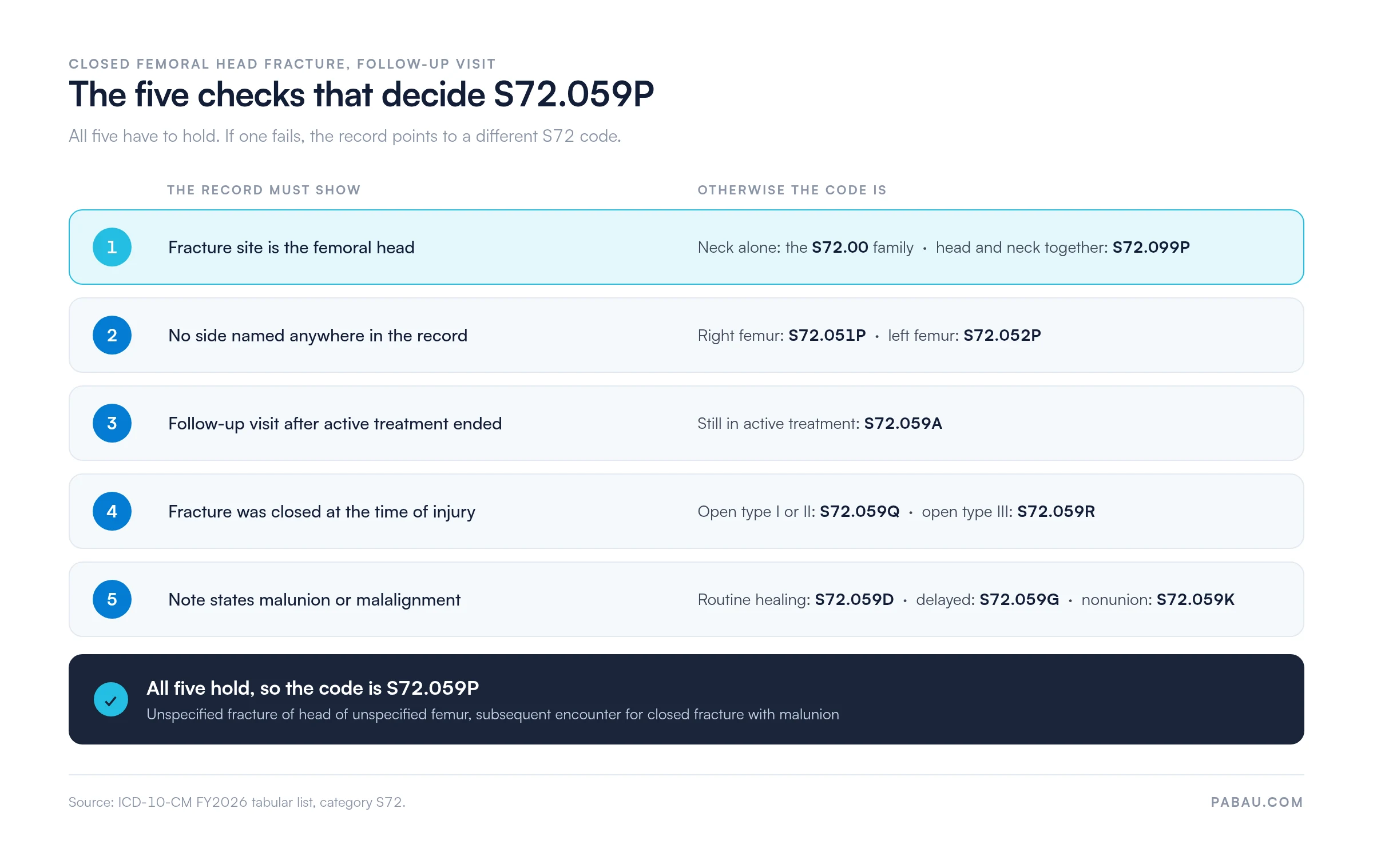
The code fits only when five conditions hold at once.
Let Pabau's smart automation suggest the right codes, reduce claim denials, and keep your practice compliant—effortlessly.
Automate repetitive tasks and focus on what matters most—your patients.
Reduce coding errors and ensure compliance with the latest regulations.
Clean claims, fewer denials, and faster reimbursements.
Powerful insights and reporting to help your practice thrive.
HIPAA compliant SOC 2 certified GDPR-compliant Trusted by 4,000+ clinics worldwide

S72.059P describes an unspecified fracture of the head of the femur, side not documented. The encounter is a follow-up after a closed fracture healed with malunion.
The site is the femoral head alone. The combined “head and neck” wording belongs to the parent subcategory S72.0, and to S72.09 for genuinely combined patterns.
This is a billable ICD-10-CM diagnosis code valid for FY2026, accepted on both UB-04 and CMS-1500 claim forms.
The 7th character P is the usual error point. It reports a subsequent encounter for a closed fracture with malunion, not nonunion (K) or delayed healing (G).
S72.059P sits on the CMS present-on-admission exempt list, so an inpatient claim carrying it needs no POA indicator.
Pabau’s claims management software submits ICD-10-CM codes through Claim.MD, so fracture follow-up claims go out with the coding already checked.
Yes. S72.059P is a fully billable ICD-10-CM diagnosis code for FY2026. Per the CMS ICD-10-CM code files, it is valid on UB-04 forms for institutional claims and CMS-1500 forms for professional claims. The parent codes S72, S72.0, S72.05, and S72.059 are not reportable on their own.
Submitting through a clearinghouse catches formatting errors before a payer ever weighs medical necessity. Practice management software like Pabau supports electronic claims submission via Claim.MD, routing diagnosis codes like S72.059P to thousands of payers on CMS-1500 and UB-04 forms. Built-in code catalogs flag structural errors before transmission.
The 837P electronic claim format reports the diagnosis code once, in the HI segment of Loop 2300. Each service line in Loop 2400 then carries a numeric pointer back to that code rather than the code itself. A pointer aimed at the wrong diagnosis produces a rejection that clearinghouse pre-validation would have caught.
S72.059P reports a fracture of the femoral head, and nothing else. The phrase “head and neck of femur” is the title of the S72.0 subcategory. That title works as a grouping label rather than a description of any one code beneath it.
That distinction decides which code belongs on the claim. Each child of S72.0 narrows the site, and two of them carry the combined wording while the rest do not.
S72.09 is the code that genuinely covers head and neck as one injury. If a note describes a fracture crossing both, S72.099P is the malunion follow-up code, not S72.059P. Reaching for S72.059P because the subcategory heading says “head and neck” changes the documented site on the claim.
The tabular list also gives S72.05 an Applicable To entry for fracture of head of femur NOS. NOS means the record confirms a femoral head fracture but does not classify it further. If the note calls the head fracture articular, S72.06 takes over.
The 7th character extension is where most S72.059P errors happen. Every code in category S72 needs one. The character reports three facts at once. It gives the encounter order, whether the fracture was open or closed, and how the bone is healing.
P applies to closed fractures only. If the skin was broken at the time of injury, the malunion character changes. Use Q for Gustilo types I and II, and R for types IIIA, IIIB, and IIIC. Assigning P to an open fracture fails payer edits.
One category note is easy to miss. A fracture that the record does not describe as open or closed is coded as closed. A fracture not described as displaced or nondisplaced is coded as displaced.
Malunion means the fracture healed in the wrong anatomical position. The bone ends united with angular, rotational, or translational deformity. That finding is what separates S72.059P from its siblings.
Malunion often justifies extra imaging, corrective osteotomy, or continued orthopedic management. Each of those needs the P character to establish the clinical rationale. Coding D when the chart documents malalignment understates the picture and invites medical necessity denials on the associated procedures.
For practices running high volumes of fracture follow-ups, medical billing workflow accuracy at the diagnosis level moves reimbursement timelines directly.
S72.059P is a seven-character code built from six nested levels. Knowing the path helps you step sideways to a sibling once laterality or fracture type turns up in the record.
Coders working femoral head fractures move between S72.059P and its neighbors constantly. The table below sets it against the codes it is most often confused with, at the laterality, healing, and site levels. The AAPC Codify ICD-10-CM lookup and the CDC and NCHS ICD-10-CM web tool let you browse the whole S72 family.
Laterality drives both claim accuracy and audit exposure. When an operative note, imaging report, or physician note names right or left, the code is S72.051P or S72.052P. S72.059P belongs to records that genuinely do not identify the side, not to a coder who has not checked.
The most frequent site error in this family is coding S72.059P for an intertrochanteric fracture. That injury lives in S72.14, outside the head and neck subcategory entirely. Anatomy drives the fifth and sixth characters, while the 7th character only reports encounter and healing status.
Some practices capture these codes on a superbill at the point of care. Generating a clean superbill with the correct site and laterality already attached cuts downstream query time.
Run a site and laterality query before you file any S72.059P claim. Pull the operative note, the radiology report, and the attending physician note. If the record names a side, use S72.051P or S72.052P instead. If it describes both head and neck, or the neck alone, the code moves to S72.099P or the S72.00 family. Unspecified codes draw orthopedic claim edits and delay payment even when the diagnosis itself is right.
The ICD-10-CM Official Guidelines for Coding and Reporting govern fracture coding in Section I.C.19.c, Coding of Traumatic Fractures. Three rules decide whether S72.059P survives review.
The characters D, G, K, and P all report a subsequent encounter, meaning routine care during healing or recovery. Physical therapy visits, orthopedic follow-ups, wound care, and cast adjustments all qualify once active treatment has ended.
The provider does not have to be the one who treated the original fracture. An outpatient follow-up with a different physician still counts as a subsequent encounter.
Guidelines permit unspecified laterality only when the record genuinely does not say which femur was fractured. Practices see this most often when a patient transfers care and the original operative report has not arrived.
In that situation a physician query comes first. Unspecified codes are not sanctioned as a shortcut when the documentation exists but nobody has retrieved it.
The P character needs malunion stated in the record. Radiology wording such as “healed with varus angulation”, “shortening deformity”, or “rotational malalignment” all support it.
A note that says only “the fracture has healed” points to character D, because it records no deformity. Where the wording is ambiguous, query the attending physician before assigning this code.
Practices managing medical billing compliance should keep a pre-submission checklist for malunion codes. Denial codes in medical billing for insufficient documentation usually cite specificity, and P-character claims without supporting imaging notes are a common trigger.
MS-DRG v43.0 applies to FY2026 inpatient claims. Under it, S72.059P groups to DRG 521 or 522 when a hip replacement is performed with a principal diagnosis of hip fracture. Without that procedure it falls to DRG 564, 565, or 566, the other musculoskeletal diagnoses group, split by complication level.
POA reporting works differently here than many coders expect. S72.059P is exempt from present-on-admission reporting, because a malunion coded at a follow-up encounter cannot describe a condition acquired during that stay. Check your payer companion guide on whether the field stays blank or takes an exempt value.
Denials on these claims cluster around two causes. One is the documented site, the other is the healing status. The electronic remittance advice returned after adjudication names which one it was. Reconciling those reason codes against the original claim surfaces the documentation problem behind repeat rejections.
Five mistakes account for most rejections on this code.
Each of those errors has a replacement code, and the five checks below name it.
ICD-10-CM publishes no approximate synonym list for S72.059P, so the code has to be built from the wording in the chart. These phrases point here, provided the side is absent and the fracture was closed.
Wording that names the femoral neck, the trochanters, or both head and neck sends you elsewhere in S72.
Confirm the descriptor in an official source before you appeal anything. The CDC and NCHS ICD-10-CM web tool carries the tabular list and alphabetic index for each edition. The CMS ICD-10-CM code files hold the annual addenda and the POA exempt list.
For legacy data, the 2026 general equivalence mappings convert S72.059P approximately to ICD-9-CM 733.81, malunion of fracture. That older code named neither the femur nor the encounter, which is worth remembering when you compare fracture volumes across the transition.
An S72 denial usually starts in the notes rather than on the billing screen. The imaging report records malunion and names the side, then the claim gets built somewhere else from a shorter summary. The detail that justifies the 7th character never makes the trip.
Pabau keeps the clinical record and the claim on the same patient file. Our claims management software builds each claim from the encounter itself. The treatment note, the attached imaging, and the visit history stay one click from the code.
Claims then go out electronically through our Claim.MD integration, and the remittance lands back on the same record. When a payer rejects an S72 code, your team sees the claim, the code, and the reason code together.
That turns a rejection into a documentation query instead of a hunt through the ledger, so fewer fracture follow-ups get billed twice.

Pabau integrates with Claim.MD to submit ICD-10-CM codes like S72.059P to thousands of payers. ICD-10 lookup, pre-validation, and electronic remittance advice keep orthopedic billing on one record.

S72.059P has one job. It tells a payer why the patient is back. A closed femoral head fracture, side not documented, healed out of alignment, and the patient returned for care. Read the site first, because the head and neck grouping above this code is a label, not a description of it.
Three checks keep the claim clean. Confirm the record names the femoral head, confirm the original fracture was closed, and confirm malunion appears in the imaging or physician note. Query the side before you settle for unspecified.
Pabau submits codes like S72.059P through Claim.MD to thousands of payers, then brings the remittance back onto the same patient record. Book a demo to see how orthopedic billing runs from encounter to payment.

Need a complete view of the medical billing process behind these claims? What is revenue cycle management walks through how diagnosis coding connects to claim submission and payment reconciliation.
Want to understand how clearinghouses process ICD-10-CM codes? How a medical claims clearinghouse works explains the pre-validation and routing steps between your practice and payers.
Tracking down denial patterns on fracture follow-up claims? What makes a clean claim outlines the documentation and coding requirements that prevent rejections before they happen.
S72.059P is a billable ICD-10-CM diagnosis code for an unspecified fracture of the head of the unspecified femur. It reports a subsequent encounter for a closed fracture that healed with malunion. The code is valid for FY2026 and accepted on UB-04 and CMS-1500 claim forms.
No. S72.059P covers the femoral head only. The wording “head and neck of femur” is the title of the parent subcategory S72.0, which groups several sites. A fracture involving head and neck together is reported with S72.099P, and a neck-only fracture falls in the S72.00 family.
Yes. S72.059P is fully billable for FY2026, and it has been valid since October 1, 2015. The parent codes S72, S72.0, S72.05, and S72.059 are not billable alone. Claims need the complete seven-character code.
S72.059A covers the initial encounter, while the patient is in active treatment for the fracture. S72.059P covers a follow-up visit after active treatment ended, specifically where the closed fracture healed with malunion.
P designates a subsequent encounter for a closed fracture with malunion, meaning the bone united in the wrong position. It differs from K, which reports nonunion, and from D, which reports routine healing at a follow-up visit.
Confirm the anatomical site and laterality in the record, confirm the fracture was closed, and confirm the note states malunion or malalignment. Then take the matching S72 code and add the 7th character P. Where a side is documented, use S72.051P for right or S72.052P for left.
No. S72.059P appears on the CMS present-on-admission exempt list, so inpatient claims carrying it do not need a POA indicator. Payer companion guides differ on whether the field is left blank, so check yours before submission.