EHR ROI: How to calculate and maximize your return
EHR ROI is the financial return a practice earns on its electronic health record...

Last Updated: Oct 15, 2026
A patient ledger is a chronological financial record that tracks every charge, payment, adjustment, and outstanding balance for an individual patient account. It is the per-patient layer of a practice’s medical billing workflow, and it settles every question about what someone owes. Without one, billing staff have no reliable way to reconcile insurance payments, track outstanding balances, or produce the audit trail regulators require.
This guide covers what a patient ledger contains, how it fits into the billing cycle, and how it differs from similar financial documents. It also walks one $175 office visit through all six billing steps, so you can see exactly when the running balance moves.

A patient ledger is the per-patient financial record showing every charge, payment, adjustment, and running balance in chronological order.
It differs from a patient statement, which is an external billing document, and from a practice ledger, which is practice-wide.
Every billing event, from charge entry through insurance posting to patient payment, creates a ledger entry and updates the running balance.
Inaccurate ledgers are a leading cause of A/R aging problems and insurance claim denials.
Practice management software posts ledger entries automatically and generates ledger reports, which cuts manual posting errors.
A patient ledger is the account record that documents every financial transaction between a practice and one patient. Think of it as a running bank statement for the patient’s account. Each row captures a date, a transaction type, the amount, and the updated balance after that transaction.
Historically this was a physical index card, one per patient, stored in a filing cabinet. Digital ledger modules largely replaced those paper cards from the 1990s onward. The core fields carry over: date, transaction type, amount, and running balance.
The ledger serves two purposes at once. For the billing team, it is the live source of truth on what a patient owes. For compliance, it is the audit trail showing every financial event on the account, when it happened, and who posted it.
Every patient ledger entry includes at least six data fields, regardless of whether the system is paper or digital.
Some systems also record the posting date, the name of the user who posted it, and the claim number tied to each insurance transaction. Those fields support the audit controls HIPAA expects of systems holding patient data. They also make billing disputes far easier to settle.
A patient statement is a document the practice sends to the patient. A patient ledger is the internal financial record the practice keeps. Both carry balance information, but they serve different audiences and different purposes.
A common mistake in small practices is treating the two interchangeably. The ledger is the source record, and the statement is a filtered output generated from it. If the ledger contains an uncorrected posting error, every statement generated from it will also be wrong.
A patient ledger tracks one patient’s transactions. A practice ledger aggregates financial activity across all patients, providers, and locations for the entire practice.
Billing staff work at the patient ledger level, posting charges, reconciling insurance EOBs, and resolving individual account balances. Practice managers and owners work at the practice ledger level, reviewing total receivables, monitoring collections, and producing financial statements.
Neither replaces the other. A practice can post a healthy practice ledger total and still hold dozens of patient ledgers with errors. Those errors age into bad debt.
Every billing event creates at least one ledger entry, from the moment a patient checks in to the moment the balance reaches zero. Understanding this sequence is how billing staff spot where errors originate.
Each of these six steps maps to a distinct entry type on the ledger. When a balance does not reconcile, trace back through the steps. That shows whether the error sits in the charge, the insurance posting, the adjustment, or the patient payment.
Two of those six steps post nothing to the ledger at all, which is easiest to see on a single $175 office visit.
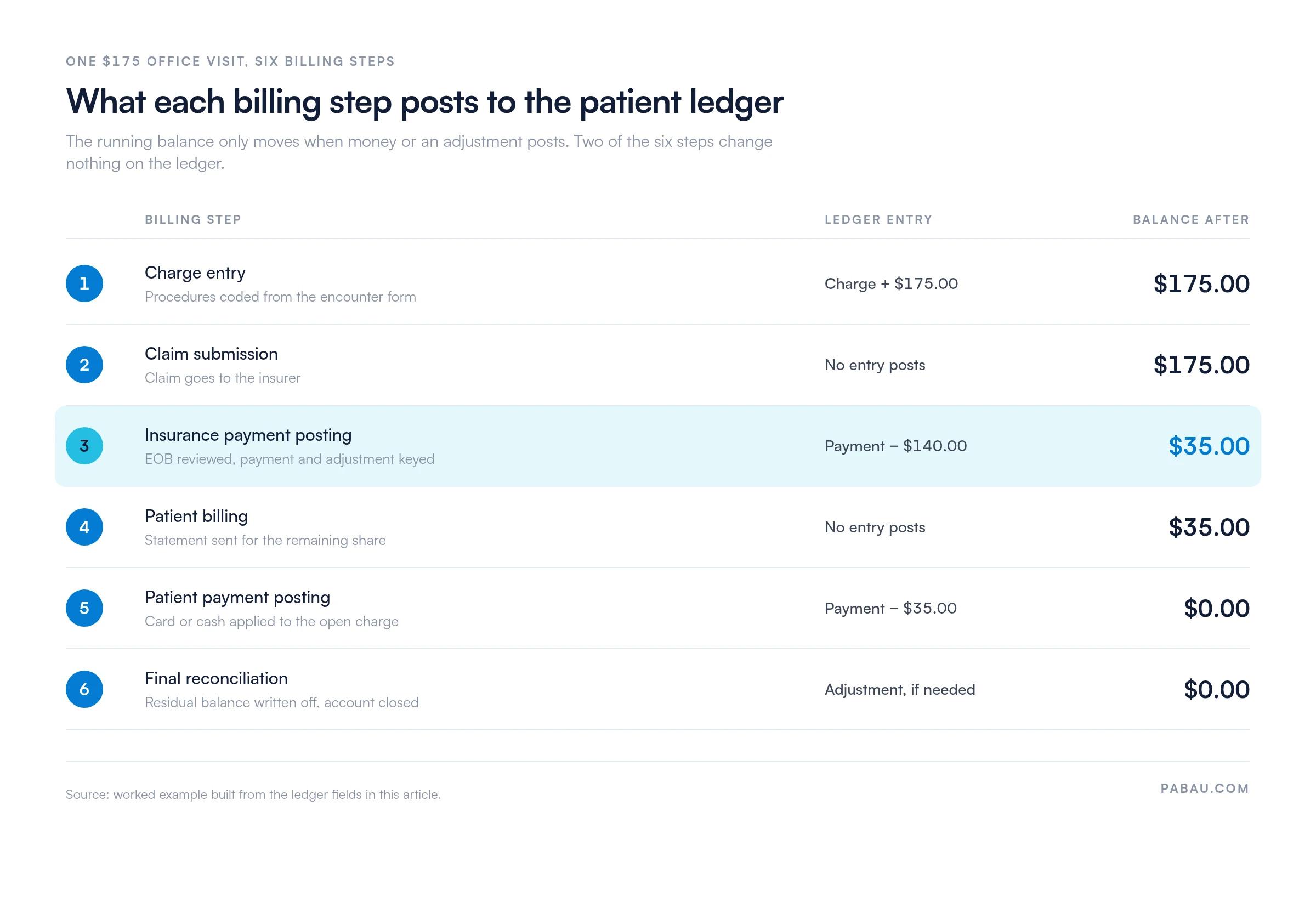
Adjustments are the entries that reduce or increase a balance without a direct cash payment. They are the most frequently misunderstood part of the patient ledger. Posting the wrong adjustment type is one of the most common billing errors auditors flag.
Medicare and Medicaid set their own rules on which adjustments are permissible and when. On a Medicare claim, the contracted rate comes from the relevant CMS fee schedule. The difference between that rate and the billed amount posts as a contractual adjustment. Practices that apply courtesy adjustments inconsistently risk breaching anti-kickback rules, so every adjustment type needs a documented policy.
Audit your adjustment codes quarterly. If your billing software allows free-text adjustment descriptions, you will find inconsistent labeling across billing staff. Standardizing to a fixed list of adjustment codes (contractual, bad debt, courtesy, credit) makes your ledger reports reliable and your OIG audit trail defensible.
A patient ledger report is an output generated from ledger data, typically filtered by date range, provider, or balance status. Billing managers use these reports to monitor accounts receivable and find where the revenue cycle is breaking down.
The three most useful patient ledger reports for most practices are:
Running these reports weekly or biweekly gives billing managers enough visibility to intervene before balances age past easy collection.
Every accounts receivable dollar starts as a ledger entry. The quality of a practice’s A/R management reflects how accurately and promptly those entries are made.
Billing errors that originate in the ledger compound quickly. A charge entered with the wrong procedure code generates a denied claim. The denial sits unresolved, the balance ages, and the account becomes a write-off candidate. All of that traces back to a single incorrect ledger entry. Accurate revenue cycle management depends on getting each entry right the first time.
The Office of Inspector General (OIG) conducts routine audits of medical billing records. A ledger that cannot produce a complete, timestamped audit trail for every transaction is a compliance risk on its own. HIPAA’s Security Rule requires audit controls and access safeguards on systems that hold electronic protected health information. Billing records tied to a patient sit inside that scope.
Ledger accuracy degrades over time as staff turn over, coding habits drift, and payer rules change. These five strategies address the most common sources of ledger error.
Ledger accuracy also depends on the system doing the posting. If manual entry is the bottleneck, our comparison of the best medical billing software for US practices covers what to look for.
Before practice management software, the patient ledger card was a physical card that served as the official financial record for each patient account. Practices filed them in a rotary or vertical cabinet. In multi-physician practices, a separate card was often kept per doctor, which made per-doctor accounts receivable figures possible.
Digital ledger modules largely replaced paper cards from the 1990s onward, as electronic practice management systems became standard. The core fields carry over: date, transaction type, amount, and running balance. What changed is the speed of entry, the automatic reporting, and the user-level access logs that create the audit trail.
Some practices running hybrid paper and digital systems still keep a physical card as a backup or for same-day reference. For anyone studying medical billing history, the card format explains why digital ledger fields are structured the way they are. They map directly to what used to be written by hand.
Practice management software posts the ledger entries that billing staff would otherwise key in by hand. When a clinician completes an encounter, the charge flows from the appointment record into the ledger.
For a practice running several practitioners or locations, volume is the problem. A four-provider practice seeing 80 appointments a day generates hundreds of potential ledger entries each week. Manual posting at that scale introduces errors faster than anyone can catch them.
Pabau, the practice management platform we build, keeps the per-patient financial record beside the clinical one. Insurer and policy details live on the patient record, so every invoice routes to the correct third party without re-keying. Our claims software for practices tracks each claim through its stages, and the payment is recorded against the right invoice from the same dashboard.
Billing staff see the clinical history, the outstanding invoices, and the payment history in one view. Nobody has to switch between a separate EHR and a billing system to answer a question about a balance.

Disconnected clinical and financial systems are where the most costly ledger errors start.

Pabau links charge entry, payment posting, and ledger reporting to the patient record, so your balances stay current without a separate billing system.

The patient ledger is where a practice’s revenue becomes visible one account at a time. Every charge, payment, and adjustment starts there, and most A/R problems trace back to an entry that was wrong, late, or missing. Those errors start at check-in and in the treatment room, which makes ledger accuracy an operational responsibility across the practice.
Start with the two steps that cost nothing. Verify eligibility before the visit, and post charges on the same day. The rest depends on whether your system posts the entries for you or leaves them to staff.
Pabau connects the clinical record and the financial record, so the charge follows the appointment and each payment posts against the correct account. Book a demo to see how that works in a practice like yours.

Want to understand the full billing cycle? What is medical billing covers how charges move from the clinical encounter through claims submission to final payment.
Looking for guidance on creating clean claims? Superbill documentation explains how the source billing document is structured and what it must contain.
Need a framework for measuring revenue cycle performance? Revenue cycle management covers the key metrics practices use to track collections and identify A/R bottlenecks.
Collecting balances without an insurer behind them? Self-pay patients covers how to quote, collect, and record balances that sit with the patient from day one.
A patient ledger is the chronological per-patient financial record of every charge, insurance payment, adjustment, and patient payment on an account. It shows the running balance after each transaction. Practices use it to track outstanding balances, reconcile insurance payments, and produce the audit trail compliance requires.
A patient ledger card is the paper version of the patient ledger. It was a physical index card filed per patient, and sometimes per treating physician, recording charges, payments, and the running balance by hand. Practice management software largely replaced the card from the 1990s onward, and the core fields carry over.
A patient ledger covers one patient’s transactions. A practice ledger aggregates financial activity across every patient, provider, and service in the practice. Billing staff work with individual patient ledgers, while practice managers use the practice ledger to monitor collections and produce financial statements.
At minimum: date of service, transaction type, procedure description or payment reference, billed amount, insurance share, patient share, and the running balance. Higher-specification systems also record the posting date, the posting user, and the claim number for each insurance transaction.
A ledger adjustment is an entry that changes a patient account balance without a direct cash payment. The four main types are contractual adjustments, bad debt write-offs, courtesy adjustments, and credit adjustments. Each type should be documented under its own adjustment code, which keeps the audit trail clean.
An insurer processes the claim and issues an Explanation of Benefits. The billing team then posts the insurance payment and the contractual adjustment to the ledger. Whatever balance remains after both postings is the patient responsibility. The ledger shows both figures on the relevant transaction row, so staff can confirm what the patient owes.