Patient ledger: What it is and how it works in medical billing
A patient ledger is a chronological financial record that tracks every charge, p...

Last Updated: Oct 15, 2026
EHR ROI is the financial return a practice earns on its electronic health record investment. The formula is (net benefit / total cost) x 100, and most practices turn positive between 12 and 36 months after go-live. The largest gains come from billing accuracy, fewer no-shows, and recovered clinician hours.
Adoption is no longer the hard part. About 95% of office-based physicians had adopted an EHR by 2024, according to the ONC. Earning a return from that system is a separate job. This guide covers the formula, the full cost stack, the benefit categories that matter most, and the steps that shorten the payback period.

EHR ROI is (net benefit / total cost) x 100, and most practices turn positive 12 to 36 months after go-live.
Hidden costs such as per-user fees, integration charges and onboarding downtime are the most common reason a return underperforms.
Billing accuracy, no-show reduction and recovered clinician time drive most of the measurable return, not the feature list.
Every Pabau subscription includes reporting on appointment volume, revenue and no-shows, so the inputs to your ROI calculation are already tracked.
EHR ROI measures the net financial and operational benefit a practice gets from its electronic health record, as a percentage of the total investment. The standard formula is (net benefit / total cost) x 100. The arithmetic is easy. Defining both sides of it is where practices go wrong.
Count the subscription fee as the cost and appointment volume as the benefit, and most of the sum never reaches the page. Honest EHR ROI accounting puts implementation labor, lost productivity during onboarding, training time, data migration and integration fees on the cost side. On the benefit side it puts billing error reduction, recovered no-show revenue and admin time freed.
Measurement is what turns that second list into money you can point at. A practice that never tracks its denial rate cannot tell whether the EHR moved it, and cannot argue for the retraining that would. The sections below put a number against each line.
The subscription line item is a fraction of the investment. Mapping the full cost stack is the prerequisite for any honest EHR ROI calculation.
Several cost categories appear only after the contract is signed. Per-user fee escalation is common, and a platform quoted at a flat monthly rate often charges separately for each clinician, receptionist or biller you add. Integration fees for scheduling, billing or lab systems can add hundreds of dollars a month, and they are rarely itemized in the first proposal.
Staff overtime during onboarding rarely appears in an ROI projection. A practice running 100 appointments a week that drops to 70 during a four-week implementation loses revenue, and that loss belongs on the cost side. For multi-system practices, the EHR data integration overhead of connecting billing and patient communication tools is the most underestimated line of all.
The EHR ROI formula is ROI (%) = ((total benefits – total costs) / total costs) x 100. A system that costs $24,000 a year all-in and delivers $36,000 in measurable benefits returns 50%. The work sits in quantifying the benefit inputs honestly.
Plug your own figures into the table below. These four benefit categories drive most of the measurable return in outpatient and aesthetic practices. The example column assumes a 10-clinician practice and is illustrative.
Add the rows that apply to your practice, then subtract total annual costs. That gives you net benefit, which feeds the ROI formula above.
Four benefit categories carry most of an EHR’s measurable return, and they are nowhere near equal in size. Recovered clinician documentation time is worth more than the other three put together.
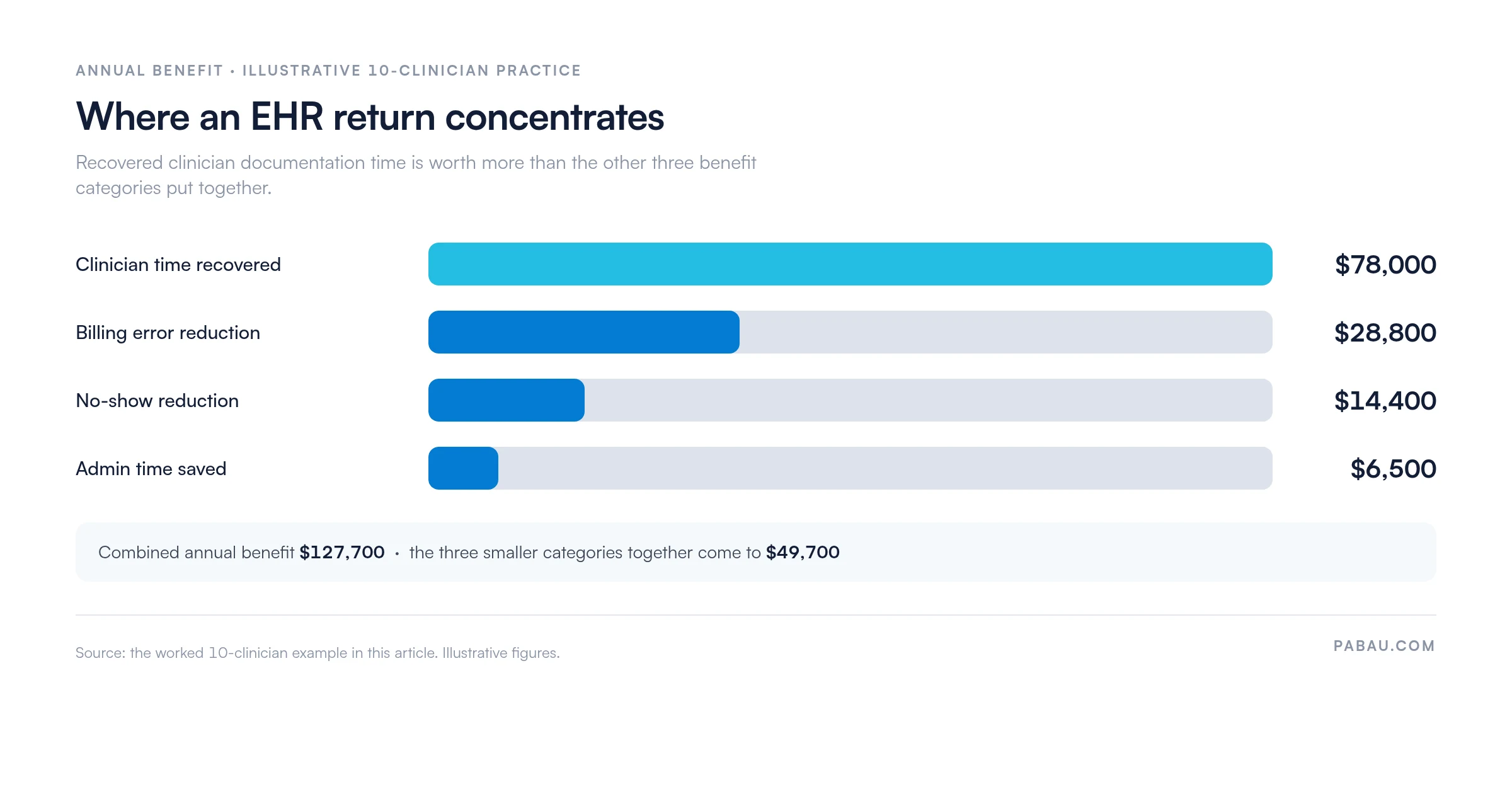
Denial rates fall when clinical notes feed billing codes directly, because the coding happens against the documentation rather than after it. If a practice submitting $80,000 a month in claims cuts its denial rate by three percentage points, it recovers $2,400 a month. That is $28,800 a year, before any other benefit is counted.
Revenue cycle management depends on that link between documentation and billing. When a note is missing the detail a payer wants, the denial costs twice. The practice waits longer for the money and pays staff time to rework the claim.
A missed slot often costs a practice $150 to $300 in lost revenue and unrecovered overhead. EHR systems with automated appointment workflows send SMS and email reminders a day or two ahead, which pulls the no-show rate down.
The financial model is simple, because the same physical capacity now produces more revenue. As an illustration, a practice recovering eight no-shows a month at $150 each generates $14,400 a year from this lever alone.
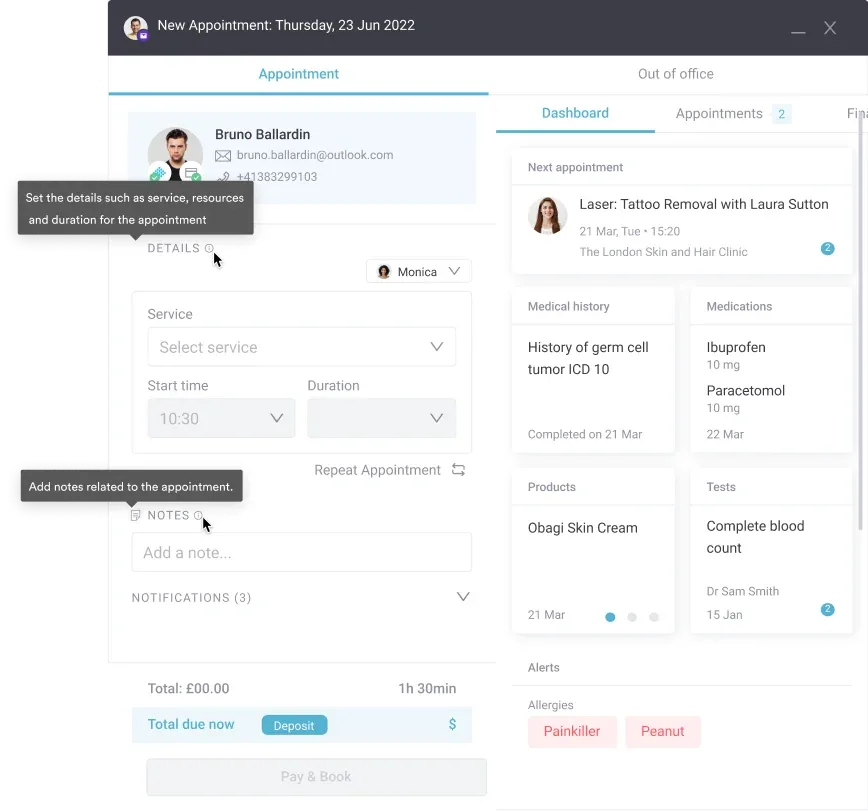
Administrative overhead is the largest time sink in most practice operations. Scheduling, intake forms, clinical notes and billing compound when they run through one practice management app instead of separate systems.
Save 15 minutes per consultation across 80 weekly consults and you free 20 hours a week. At $75 an hour that is $78,000 a year of clinician capacity, redirected to patient care or more appointments.
Not every EHR benefit shows up in the revenue column. Better care coordination cuts duplicate tests, and fuller documentation lowers malpractice exposure. HIPAA compliance and ONC interoperability standards are risk avoidance in their own right. One compliance incident can cost several times an EHR’s annual subscription.
Most EHR implementations follow a predictable curve. Productivity dips in months one through four, and breakeven usually lands between months six and twelve. Cumulative return turns positive somewhere between 12 and 36 months, and cloud deployments with faster onboarding tend to shorten every phase.
Every workflow change produces an implementation dip, so its appearance says little about the system you bought. What separates high-ROI deployments is how fast the practice climbs out. Onboarding quality, training depth and the EHR’s own usability all set the dip’s length.
Run a feature utilization audit at the six-month mark. Pull a report of which EHR modules your team uses and which ones were bought but sit idle. Idle features are paid-for capability that returns zero. Retrain on two or three high-value ones before month 12 to speed up the path to positive ROI.
A cost-benefit analysis goes one step past the ROI calculation. It weighs every quantifiable benefit against every identified cost, and assigns an estimated monetary value to the qualitative items. Use this four-step process to judge whether your current system is delivering.
Re-evaluation is where the all-in-one practice management platform model earns its keep. Bundled systems carry fewer integration points, and every integration point is somewhere net benefit leaks away.
Two practices running the same EHR at the same price can see very different returns. These five variables explain most of the variance.
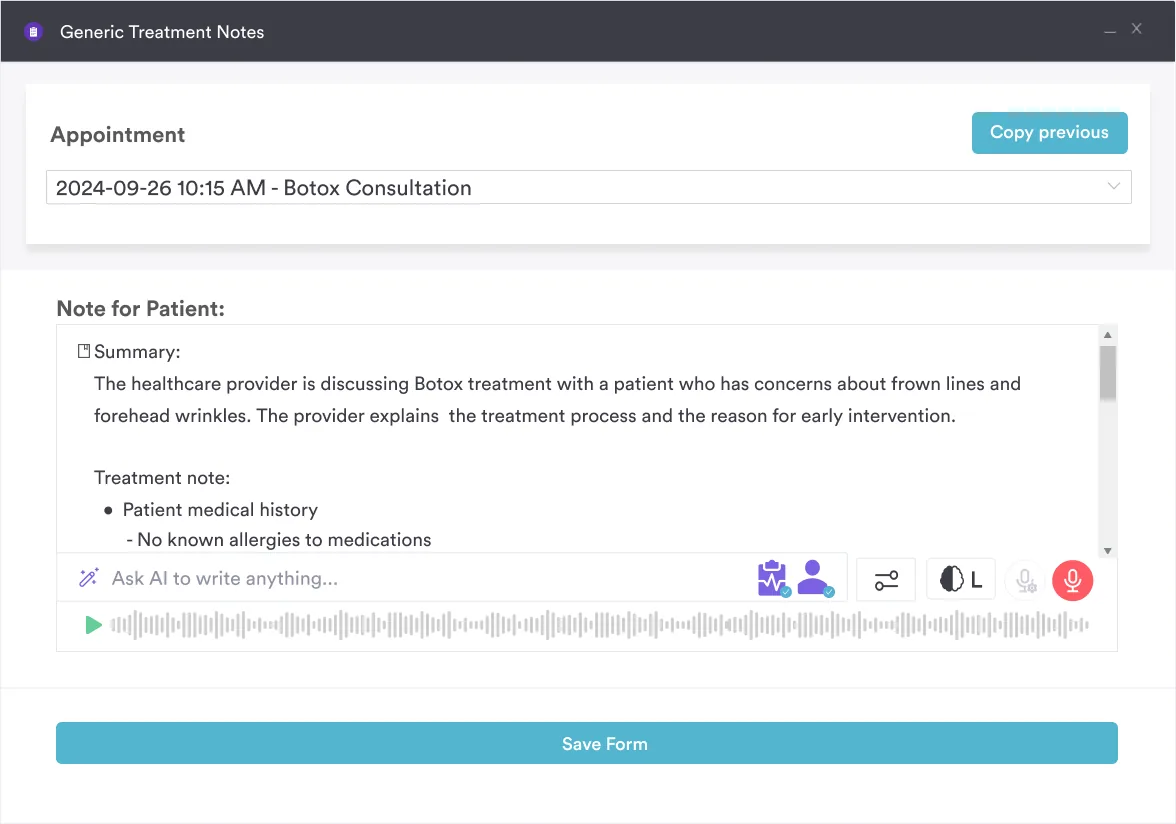
AI-assisted clinical documentation is the newest category of ROI driver. Vendors report that an ambient tool which transcribes and structures notes from the consultation saves 10 to 20 minutes per appointment. Across a 40-consultation week that is 6 to 13 hours of clinician time recovered, worth $450 to $975 at a $75 hourly rate.
Pabau, the practice management platform we build, includes Pabau Scribe, our AI scribe. It drafts the treatment note from the consultation and files it against the patient record, so the clinician reviews and signs instead of typing.
Cloud EHR platforms add to this by removing server maintenance, cutting IT overhead and allowing remote access. Those are cost categories an on-premise system carries for as long as it runs.
Underused capability is the cheapest return available, because you have already paid for it. These five steps go after it.
If the audit points at the system rather than at how your team uses it, price the alternatives before committing. Knowing the going EHR software cost for a practice your size keeps that comparison grounded.
Most practices rebuild these numbers by hand at quarter end. Someone exports appointments from one system and revenue from another, then counts no-shows off the calendar. By the time the spreadsheet is finished, the quarter it describes is over.
Every Pabau subscription includes reporting and analytics covering appointment volume, revenue and no-shows, with no add-on to buy. Scheduling, treatment notes, payments and patient communication run in the same system, so those reports read one record rather than three exports.
That turns the quarterly ROI review into a report you open rather than a project someone has to schedule. You see the denial trend and the no-show trend while there is still a quarter left to act on them.

Pabau brings scheduling, treatment notes, payments and patient communication into one system, and every subscription includes reporting on appointment volume, revenue and no-shows. Book a demo and we will show you the reports your practice would run.

EHR ROI is an accounting exercise before it is a software question. Put every cost on the page, including the onboarding dip and the integration fees nobody quoted you. Then put a number against each benefit you can observe.
What you find usually points at habits rather than at the system. Underused billing automation, reminders nobody switched on, and notes that never reach the biller account for more lost return than the subscription price does.
Fixing those costs a few hours of retraining. Replacing the system costs a year. Book a demo if you want to see how the arithmetic looks on Pabau for a practice your size.

Want more from the EHR you already pay for? EHR optimization walks through the workflow changes that lift utilization without a migration.
Thinking about changing EHR vendors? Switching EHR systems covers the transition plan, the data migration, and what the move costs in productivity.
Want the benefit side in more detail? EHR benefits sets out the clinical and operational returns that sit outside the revenue column.
EHR ROI is the net financial and operational return a practice gets from its electronic health record investment. It is expressed as a percentage of total costs, using (net benefit / total cost) x 100. The calculation covers measurable gains such as billing accuracy, admin time and no-show reduction, plus qualitative returns like lower compliance risk.
A positive return of 20% to 50% a year is a solid baseline for most outpatient and specialist practices. Practices that fully use billing automation, automated reminders and integrated documentation often pass 50% by year three. That happens faster where the EHR replaces several standalone tools with their own subscriptions.
Most practices reach cumulative positive EHR ROI between 12 and 36 months after go-live. Cloud deployments with faster onboarding can break even sooner. The implementation productivity dip, usually months one through four, is the main variable, and a shorter dip means an earlier return.
Yes. Larger practices spread fixed implementation costs over more appointments, so they reach positive ROI sooner in absolute terms. Smaller practices often see higher percentage gains from billing accuracy, because manual coding errors cost proportionally more at low volumes. The formula works at any scale, and only the inputs change.
List every quantifiable benefit, such as billing recovery, admin time saved and no-show revenue recovered. Add the qualitative benefits with conservative monetary estimates. Total your costs from invoices you have paid, not from vendor quotes. Then apply the ROI formula and run a re-evaluation checklist to see whether the current return reflects full feature use.