Patient financing: How to offer it and stay compliant
Patient financing lets patients spread the cost of treatment over weeks or month...

Last Updated: Oct 7, 2026
Healthcare workforce planning is the structured process of matching clinical capacity to patient demand before shortfalls become crises. It means analyzing the staff you have, forecasting the demand coming, and planning how to cover the difference. A sound plan runs across three horizons at once: the next quarter, the next 18 months, and the years after that.
According to the World Health Organization, the world faces a projected shortfall of about 11 million health workers by 2030. Low- and middle-income countries take the hardest hit. For owners, practice managers, and COOs in private healthcare, that global pressure lands as a local problem.
The wrong number of practitioners, in the wrong rooms, at the wrong times, costs you patients and revenue. This guide covers the five components of a sound workforce plan and the pressures that break one. It also runs through the tools that help and the six steps to build it.

Healthcare workforce planning matches clinical capacity to patient demand through structured analysis and forward planning.
WHO projects a shortfall of about 11 million health workers by 2030, which makes planning a financial priority.
A sound plan runs three horizons at once: the next quarter, the next 18 months, and beyond.
Most planning failures are reactive, because hiring starts only once the shifts are already uncovered.
Pabau, the practice management platform we build, already holds the scheduling and utilization data a plan needs.
Healthcare workforce planning is a structured way to put the right clinicians in front of patients at the right time. It covers numbers, skills, and availability together. Hiring reactively after a resignation is a different exercise altogether.
For a hospital system, planning means modeling physician supply against a regional population forecast. For a 10-room aesthetic practice or a multi-site physical therapy group, it is more concrete.
You need to know who covers the peak appointment blocks and which skills your team is short of. You also need to know what happens to revenue if your senior injector leaves.
Three planning horizons matter:
Most private practices work only in the first horizon. Workforce planning asks you to hold all three at once. The breakdown below shows which decisions belong where, and how far ahead each one has to start.
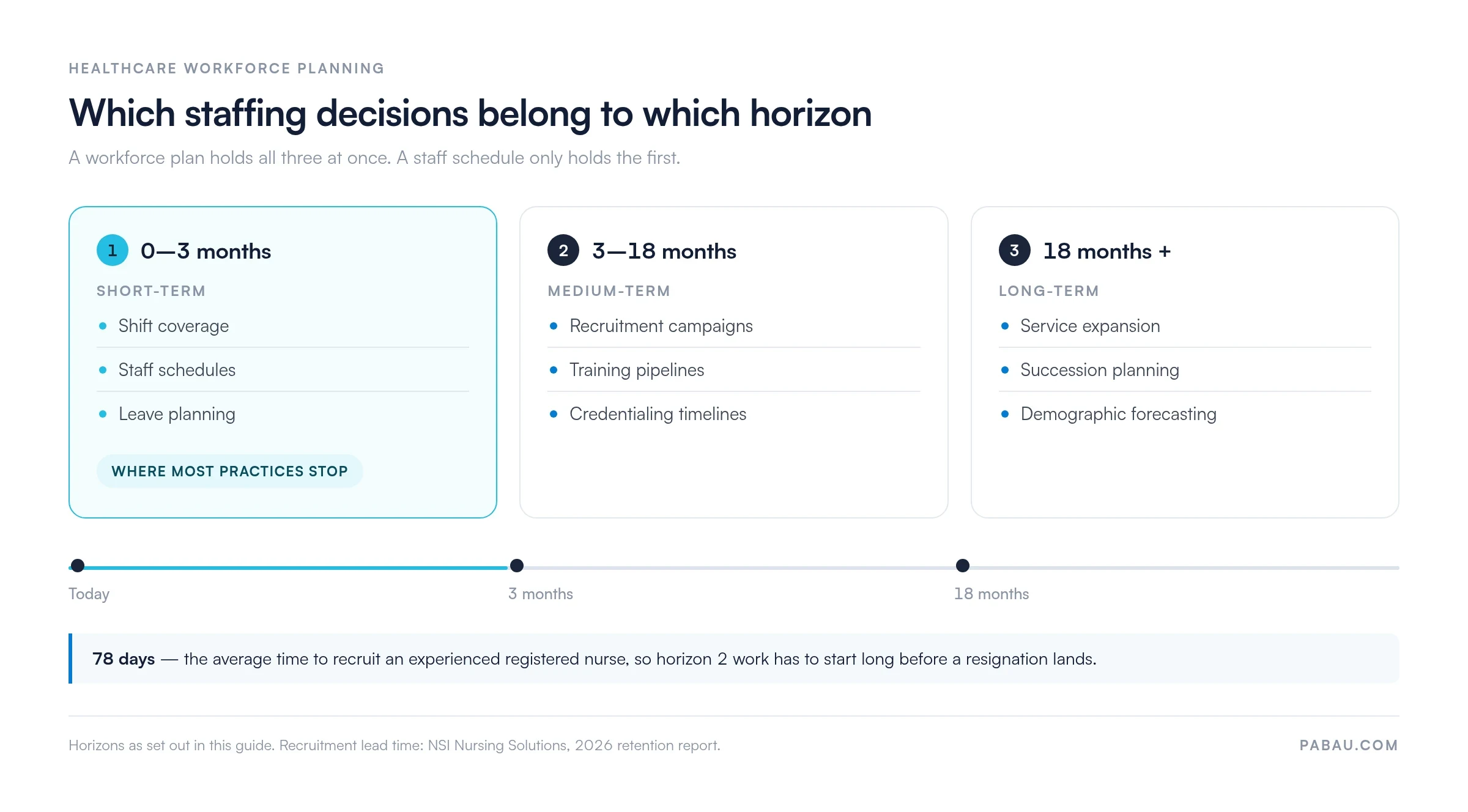
Lead times are what force the discipline. Hospitals took an average of 78 days to recruit an experienced registered nurse in NSI Nursing Solutions’ 2026 report. A practice that starts looking when a resignation lands is already two and a half months behind.
Understaffing is a financial problem as much as an HR one. Research published in BMC Health Services Research links inadequate nurse staffing to higher rates of patient adverse events, longer stays, and increased mortality in hospitals.
Private practice carries different stakes but the same signal. Uncovered clinical hours mean canceled appointments, longer waits, and patients who book somewhere else.
The math is direct. Take a practice billing $8,000 a week from one senior practitioner. If that practitioner leaves and the replacement takes three months to recruit, onboard, and credential, the practice loses roughly $96,000 from that role alone.
That figure ignores temporary cover and the margin lost while a junior practitioner builds up speed. Departures still happen with a plan in place. What a plan changes is the recovery time, because the shortlist, the budget, and the cover arrangement already exist.
Workforce plans fail in predictable ways. Knowing the pressure points is the first step to building one that holds.
The shortfall is structural, not a temporary dip. The Health Resources and Services Administration projects a shortage of 141,160 full-time physicians in the United States by 2038.
The distribution is the part that bites. HRSA puts that 2038 physician shortage at 58% in non-metro areas against 5% in metro areas. Rural and underserved markets are chasing the same candidates from a much weaker position.
For private practices, the candidate pool for skilled clinical roles is smaller than it was a decade ago. Hiring a credentialed aesthetics nurse, a dermatology-trained physician assistant, or an experienced physical therapist now takes months longer than most owners budget for. Treat extended lead times as your baseline assumption, not an exception.
Burnout is easing but still widespread. The American Medical Association reports that 41.9% of physicians had at least one symptom of burnout in 2025, down from 43.2% in 2024. Nursing figures follow a similar pattern.
For planning purposes, clinician burnout and attrition compound each other. Heavy workload drives burnout, burnout drives resignations, and each resignation adds workload to whoever stays. Breaking that cycle means building capacity before the warning signs show, not after.
Turnover carries a price you can put on a spreadsheet. NSI Nursing Solutions puts the average cost of a bedside registered nurse departure at about $60,000 in its 2026 retention report.
Figures for private aesthetics or allied health practices are lower, but the structure is the same. One senior clinician you keep, who would otherwise have left, is a planning dividend you can count.
A workforce plan is built from five connected components. Skip one and the plan looks complete on paper but fails under operating conditions.
Demand forecasting uses appointment data, patient volume trends, and seasonal patterns to estimate the clinical hours you will need by role. Run it over the same three horizons: 3, 18, and 24 months out.
A skin practice running 600 appointments in January may run 900 in September, on post-summer treatment demand. A physical therapy practice sees winter injury spikes. Smoothing those peaks is partly a forecasting job and partly a matter of scheduling patients effectively across the week.
Pull 24 months of appointment data, segment it by service line and practitioner, and look for both volume peaks and shifts in service mix. If laser treatments have grown from 15% to 30% of bookings in two years, you need more credentialed laser staff, not simply more staff.
A shortfall analysis compares your supply projection against your demand projection. The supply side is what your current team can deliver over the period, allowing for leave, turnover probability, and contracted hours.
Shortfalls come in three shapes: too few practitioners, the wrong mix of specializations, or the right people at the wrong hours. Each one calls for a different response.
A shortfall is not always a hiring signal. Rescheduling, a change to the service-delivery model, or a targeted upskilling program can often close it faster and cheaper than a new hire. The analysis has to be specific enough to tell those options apart.
Succession planning gets neglected until a key departure forces the conversation. In a private practice, that is usually a clinical director, a lead injector, or a senior physical therapist. Those people hold a large share of revenue or institutional knowledge.
A basic succession plan answers two questions. Who could step into each critical role, and what training or credentialing would they need to be ready within 12 months? It does not need a formal leadership program. It needs a deliberate conversation, written down once a year.
Run a revenue concentration audit before you build the succession plan. If a single practitioner accounts for more than 30% of monthly billings, their departure is a material business risk. That person needs a documented backup, a retention conversation, and a transition plan that gradually redistributes patient relationships.
The process is a repeatable six-step cycle. Each step feeds the next, and it should run at least annually with a lighter quarterly review.
The right stack depends on practice size and complexity. Large health systems buy dedicated workforce management platforms. Private practices are usually better served by tools already embedded in their operations.
WHO’s guidance for national health systems rests on three foundations. You need reliable workforce data, an analysis of supply against demand, and a route from that analysis into a decision. The same logic holds at practice scale.
Tools fall into three categories:
For most private practices, that last category is the one that matters. The scheduling and reporting modules inside practice management software already hold both sides of the equation, and you are paying for them.
Five habits separate practices with a resilient plan from those that react to each staffing crisis.
Those habits only work if someone owns the numbers. Day-to-day practice-level staff management is where turnover rate, average tenure, and fill time get recorded in the first place. Staff utilization, appointment fill rate, and revenue per clinical hour are the three figures that tell you each quarter whether the plan is working.
Most practices assemble the supply side by hand. Someone exports payroll, someone else pulls the staff schedule, and a third person reconciles both against the appointment book. By the time the spreadsheet is finished, the figures have moved.
Pabau holds all three in one place. Appointment scheduling and staff schedules give managers a live view of who is booked, at what utilization, and where capacity is sitting idle. That feeds both next week’s cover and next year’s demand forecast.
Reporting is included in every Pabau subscription, with pre-built reports across appointments and sales, built-in dashboards, and multi-location reporting. Practices that want more can add Insights Plus, our additional reporting product, which brings custom dashboards and a direct feed into tools like Power BI.
Either way, a manager reviewing revenue by practitioner and appointment volume each quarter has the raw material for a shortfall analysis. No separate reporting stack is needed to get there.
Staff management tools cover commissions, timesheets, and role-level access. For an annual workforce review, the supply-side picture is already structured. You can see who works, how many hours, and at what cost.

Pabau brings appointment utilization, revenue per practitioner, and staff scheduling into one platform. Your workforce decisions then rest on your own operating records rather than a spreadsheet estimate.

Workforce planning scales down as well as it scales up. Forecast demand, compare it against supply, plan for succession, and work from live data. Those steps apply to a three-room aesthetic practice with the same force as to a 300-bed hospital.
The difference is scale, not logic. What a small practice gains is time. A shortlist already drawn, a backup already trained, and a budget line already approved turn a resignation into an inconvenience rather than a crisis.
Start with the revenue concentration audit, because it tells you where the exposure sits before you spend a day on forecasting. Book a demo to see how your scheduling and reporting data can feed a workforce plan for your own practice.

Need to reduce clinician burnout before it becomes a retention problem? Burnout in healthcare covers the operational warning signs and the scheduling adjustments that help practices intervene before a resignation.
Want to know what practice management software actually covers? Practice management software features walks through the modules and how to judge them for a multi-practitioner practice.
Ready to get staff scheduling and reporting under one roof? Running a clinic with Pabau shows how integrated scheduling, team management, and reporting work together day to day.
Healthcare workforce planning is the structured process of forecasting clinical demand, analyzing current staff capacity, and planning how to cover the shortfall. It runs across three horizons: short-term shift coverage, medium-term recruitment, and long-term succession and service planning.
Strategic workforce planning affects patient access, clinical outcomes, and financial performance directly. Unplanned shortfalls lead to canceled appointments, heavier workload on the staff who remain, and compounding burnout. Practices with a structured plan recover faster from departures and hold revenue steady through demand cycles.
The candidate pool is shrinking, turnover driven by burnout stays high, and demand is hard to forecast across service lines. Staffing-ratio rules also vary by jurisdiction. For private practices, long credentialing and onboarding timelines stretch every shortfall further.
Options range from dedicated workforce management platforms used by large health systems to HRIS systems for employee records and leave tracking. Private practices usually get the most value from their practice management software, which already holds scheduling, utilization, and revenue-per-practitioner data.
Workforce planning looks forward. It forecasts future needs and builds strategies to meet them. Workforce management is operational, covering day-to-day scheduling, shift coverage, and schedule coordination. Both are necessary. Planning without management produces a strategy nobody acts on, and management without planning stays reactive.