



HCPCS code E0198: Water pressure pad billing guide
HCPCS code E0198 is a water pad for a standard mattress HCPCS code E0198 is the ...

Last Updated: Oct 13, 2026

CPT code 17271 reports destruction of one malignant lesion measuring 0.6 to 1.0 cm on the scalp, neck, hands, feet, or genitalia
The trunk, arm, and leg code for the same size band is 17261, and the face code is 17281. Specifically, site decides the series first, then size decides the tier
The 2026 non-facility allowable is $162.33 at the $33.4009 conversion factor, and the code carries a 10-day global period
Medicare caps 17271 at four units per date of service, and that cap is a clinical edit, so extra lesions can be appealed with documentation
A genital lesion has no C44 diagnosis code available, because ICD-10-CM excludes genital skin from C44 entirely
CPT code 17271 reports destruction of a single malignant skin lesion measuring 0.6 to 1.0 cm, sited on the scalp, neck, hands, feet, or genitalia. Specifically, two facts choose the code. First, where the lesion sits. Second, how wide it measures before any tissue is destroyed.
Get either fact wrong, and the claim goes out under a neighboring code. For example, a 0.8 cm lesion on the forearm is 17261, not 17271. Likewise, the same lesion on the nose is 17281. In both cases, the errors survive a clean clearinghouse pass and surface later as a recoding on audit.
Currently, the 17260 to 17286 range is maintained by the American Medical Association’s CPT Editorial Panel. Accordingly, this guide covers the official descriptor, the 2026 RVUs, and the Medicare rates.
It also covers the four-unit MUE cap, the modifiers, the ICD-10 pairings, and the NCCI edits that decide what you can bill alongside it. As such, it is written for the coders and billers who handle medical billing in a dermatology practice.
The full AMA descriptor for CPT code 17271 reads as follows. Destruction, malignant lesion (eg, laser surgery, electrosurgery, cryosurgery, chemosurgery, surgical curettement), scalp, neck, hands, feet, genitalia; lesion diameter 0.6 to 1.0 cm.
Notably, the site group is the part billers most often misread. Specifically, scalp, neck, hands, feet, and genitalia form the middle series of the malignant destruction family. By contrast, the trunk, arms, and legs sit in the 17260 to 17266 series, while the face and mucous membranes sit in 17280 to 17286.
Currently, every value above comes from the CMS January 2026 relative value file and the NCCI practitioner MUE table effective July 1, 2026. However, the parenthetical list of methods in the descriptor is illustrative rather than restrictive. In other words, any medically appropriate destruction technique reports under the same code, and the record still has to name which one was used.
Work in this order. Pick the site series first, then the size tier inside it. As a result, coders who reverse those two steps land on the right tier of the wrong series. In fact, that is the most common way a destruction claim gets recoded.
Overall, each series runs six size tiers, from 0.5 cm or less up to over 4.0 cm. For reference, the table below gives the whole range with the 2026 non-facility allowable at the $33.4009 conversion factor.
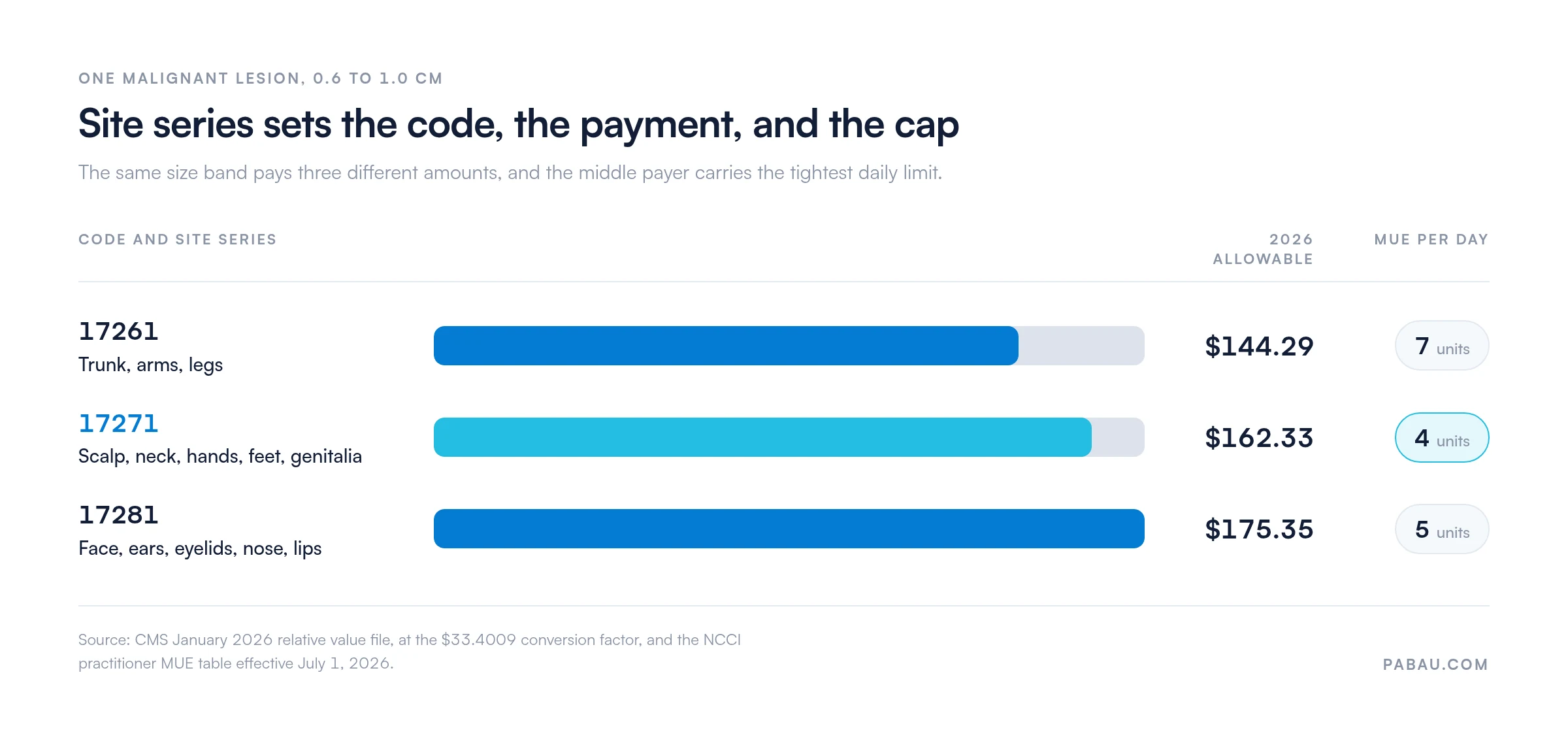
In particular, note the two codes that sit either side of 17271 in the size band. Specifically, at 0.6 to 1.0 cm the trunk, arm, and leg code is 17261, and the face code is 17281.
The three pay $144.29, $162.33, and $175.35 respectively, so a site error is a payment error as well as a coding error. Moreover, the daily unit caps diverge too, as the chart below shows.
First, measure the greatest clinical diameter of the lesion before you destroy any tissue. Then record it in centimeters in the procedure note. Unlike the excision codes, which add the narrowest surgical margins to the lesion diameter, destruction codes count the lesion only.
Indeed, that difference matters at the tier boundaries. A 0.9 cm lesion excised with 0.3 cm margins measures 1.5 cm for excision purposes, but the same lesion destroyed is still 0.9 cm. Therefore, do not carry a margin figure across from an excision template.
First, make the site field in your procedure template a picklist rather than free text, with the three CPT site series as the options. A note that says right hand routes to 17271, while a note that says right arm routes to 17261. Instead, free text produces right upper extremity, which routes to neither.
Notably, the descriptor names hands and feet, not the whole limb. So the boundary a coder needs is inside the arm and inside the leg, and the note has to be specific enough to find it.
For example, a 0.8 cm lesion on the dorsum of the hand is 17271. In contrast, the same lesion on the forearm is 17261. Similarly, the neck belongs to 17271, and the face belongs to 17281, which puts the jawline in play more often than most billers expect.
Genitalia sits in the 17270 to 17276 series too, and that site carries a diagnosis coding problem all of its own. The ICD-10 section below covers it, because the fix is on the diagnosis side rather than the procedure side.
Ultimately, the technique the surgeon used chooses the code, not the diagnosis. In practice, destroying the lesion reports 17271. Alternatively, cutting it out with margins reports an excision code. Finally, mapping it stage by stage under the microscope reports Mohs.
Notably, the excision route pays $66.13 more for the same lesion at the same size, which draws reviewers. Therefore, the record has to show that the lesion was cut out with margins, not burned, frozen, or curetted.
In short, relative value units set the Medicare allowable. First, total RVU multiplied by the conversion factor gives the national amount; then the Geographic Practice Cost Indices adjust it for your locality. Specifically, the figures below are the January 2026 values from the CMS relative value files.
Work RVU is identical in both columns, because the physician does the same job either way. Practice expense, however, is what moves. For instance, in the office the practice buys the cryogen, the tray, and the staff time. That is why the non-facility column carries 3.21 practice expense RVUs against 1.02 in a facility.
In fact, 2026 is the first year with two conversion factors. Specifically, clinicians who qualify as participants in an advanced alternative payment model are paid at $33.5675, while everyone else is paid at $33.4009. Still, both figures come from the same CMS relative value file.
Overall, these are national amounts before any geographic adjustment. Instead, your locality figure comes from the CMS Physician Fee Schedule lookup. Meanwhile, commercial contracts usually pay above Medicare, and each one needs checking on its own terms.
In short, reconciling what the payer sent is a separate job from estimating what it owes. For that reason, reading the electronic remittance advice line by line is how a practice catches a 17271 paid at the 17261 rate.
Currently, there is no national coverage determination for destruction of malignant skin lesions. Instead, coverage runs through Local Coverage Determinations, so the rules that bind you are your own MAC’s. For example, First Coast Service Options publishes LCD L33813 with billing article A57638. Specifically, it binds Florida, Puerto Rico, and the US Virgin Islands, though it is a useful model elsewhere.
A57638 asks for four elements in the record. First, the pages must be legible and identify the patient and the dates of service. Second, the note must carry the legible signature of the treating clinician. Third, the submitted record must support the ICD-10 code chosen and the CPT code billed.
Finally, the fourth is the substantive one. Specifically, the note must show removal of a malignant lesion, backed by either a matching pathology report or a clinical description consistent with a skin malignancy. It must also state the size and the location. Services outside the LCD are not simply lost, because the article names redetermination as the route to have them considered.
Modifiers explain circumstances the descriptor cannot. Specifically, two indicators on the fee schedule decide which ones are worth appending. 17271 carries multiple procedure indicator 2, so the standard surgical reduction applies to additional lesions. It also carries bilateral indicator 0, so modifier 50 adds no payment.
Overall, modifier 59 carries the most audit risk of the eight. Therefore, use it where the record shows a separate lesion, session, or site, and name which one. Alternatively, where a payer prefers the X series, XS is the specific one for a separate structure.
The diagnosis, therefore, has to name the same body area the procedure code does. First, pair 17271 with a malignancy of the scalp, neck, hand, foot, or genital skin. Then code the morphology and the side the pathology report gives you.
Notably, ICD-10-CM has no separate code for the skin of the hand or the foot. Instead, the hand rolls up into C44.6, upper limb including shoulder, and the foot into C44.7, lower limb including hip. That is why the diagnosis code cannot confirm the CPT site group on its own, and why the operative note has to.
Specifically, C44 carries an Excludes1 note for malignant neoplasm of skin of genital organs, pointing to C51 to C52, C60, and C63.2. In other words, Excludes1 means never code both. So a genital lesion destroyed under 17271 has no C44 code available to it, in any morphology.
In short, the knock-on effect is worth knowing before you bill. For instance, First Coast’s supporting-diagnosis list for 17260 to 17286 runs to 196 codes and contains no genital code at all. That holds even though 17270 to 17276 names genitalia as a covered site. As a result, a genital-site claim will meet the automated diagnosis-to-procedure edit, and redetermination is the stated route through it.
In fact, C44.6 and C44.7 do not follow the usual ICD-10 pattern. Typically, most of the code set uses 1 for right and 2 for left; instead, these two subcategories use 1 for unspecified, 2 for right, and 9 for left.
So C44.612 is basal cell carcinoma of the right upper limb and C44.619 is the left. In practice, read C44.619 as an unspecified rollup and you put the wrong side on the claim. Consequently, that is a mismatch against the operative note rather than a clean rejection.
Indeed, the unspecified codes are worse than merely vague here. C44.611, C44.621, C44.711, C44.721, and C44.40 are all absent from First Coast’s supporting list, while their right and left siblings are on it. Therefore, code the side, or the claim denies on the diagnosis edit. The CMS ICD-10 code files carry the current descriptors.
In short, in-situ disease has its own answer. Specifically, melanoma in situ codes to D03 and carcinoma in situ of skin to D04, never to C43 or C44. Both ranges, however, appear on the First Coast supporting list for this code family. Benign and premalignant lesions do not, because they belong to different CPT codes entirely.
In short, the National Correct Coding Initiative publishes procedure-to-procedure pairs that cannot be billed together without a modifier. Specifically, the list below comes from the practitioner PTP file for 2026, version 32.2, with 17271 as the column 1 code unless stated.
The modifier indicator is the number that matters. A 1 means a documented modifier can release the pair. In contrast, a 0 rules every modifier out, so appending 59 to a sedation line only adds an unbundling finding to the file. As a result, practices that check pairs before submission send a clean claim more often than those that work the denial afterwards.
There is also a useful absence in the file. No PTP edit pairs 17271 with 17270, 17272, or 17261, so lesions in different tiers or different series at one session are separately reportable. Instead, what limits them is the multiple procedure reduction and the MUE.
In short, Medically Unlikely Edits cap the units one provider can bill for one code on one date, and 17271 is capped at four. However, the cap is not uniform across the family, and it does not track lesion size in the way you might assume.
Notably, adjudication indicator 3 is the part worth knowing. Specifically, it marks a date-of-service edit set on clinical data rather than on a policy limit. Units above the cap can therefore be paid on appeal when the record supports them. For example, a dermatologist who destroyed six qualifying lesions has a route, and it runs through documentation.
Notably, compare that with 17110, which is capped at one unit under indicator 2. A policy edit leaves no appeal on the units, so the distinction changes what your team should do with the denial. Additionally, the current tables sit in the CMS MUE files and change quarterly.
In short, six elements carry a 17271 claim through review. If you miss one, the payer has grounds to downcode or deny, and the fix afterwards costs more than the capture would have. Therefore, consistent medical billing compliance habits are what keep the six in place.
Overall, one more habit pays for itself on multi-lesion days. Number the lesions in the note, then carry the numbers into the claim lines. A reviewer can then match four units of 17271 to four described lesions. Consequently, a medical chart audit is far quicker when the mapping is already there.
Typically, 17271 denials cluster into a handful of repeating shapes. Fortunately, each one is catchable before submission, which is cheaper than catching it in an appeal. Overall, a structured denial management process is what turns a pattern into a fix.
Overall, tracking denial reasons by CPT code is what surfaces a systemic documentation problem rather than a one-off. Relatedly, our reference on denial codes covers how payers word the rejection.
First, build a five-line pre-submission check for 17271. Diameter in centimeters, between 0.6 and 1.0. Site named specifically enough to choose the series. Diagnosis in C43, C44, C4A, D03, or D04, with a side. Method recorded. Units at four or fewer. In fact, four of the five come straight off the procedure note if the template asks for them.
These are the codes a dermatology coder reaches for next to 17271, with the reason each one comes up.
Typically, almost every problem on this page starts before anyone opens a claim. In practice, the clinician writes the note, and the coder works from a summary that has lost the measurement or blurred the site. Practice management software like Pabau, however, keeps both in one patient record, so the coder reads the clinician’s own note.
In short, the practical fix is a procedure template that will not close with a required field empty. Specifically, in Pabau’s skin clinic software the template asks for the site from a picklist, the diameter in centimeters, the method, and the indication. As a result, that turns the two facts 17271 depends on into a step nobody can skip.
In essence, Pabau’s role in a US practice is the record rather than the clearinghouse. Instead, your biller or billing service submits to Medicare, and what Pabau hands them is a complete, timestamped chart to code from. Alternatively, where a practice wants electronic submission, the Claim.MD integration sends the claim from the data already stored on the record.
Specifically, that matters most when a reviewer asks for support months later. In fact, the procedure note, the photographs, the diagnosis codes, and the audit trail come out of one system rather than three. In particular, for dermatology EMR software users, that consistency is what shortens the response.

Pabau keeps procedure notes, photographs, lesion sites, and measurements in one patient record. As a result, your coder never has to guess which destruction code a lesion belongs to. Book a demo to see how dermatology practices set this up.

In short, CPT code 17271 has two conditions and no others. Specifically, the lesion sits on the scalp, neck, hand, foot, or genitalia, and it measures 0.6 to 1.0 cm before destruction. From there, the rest of the claim follows from those two facts.
The traps are concentrated in three places. First, the site series decides whether you are in 17271, 17261, or 17281. Second, the diagnosis has to carry a side, because the unspecified limb codes are off the supporting list. Third, genital sites need a C51, C60, or C63.2 code, since C44 excludes genital skin outright.
Ultimately, get the note right and the coding follows almost mechanically. To see how Pabau keeps the site, the measurement, and the method on the record your coder reads, book a demo with the team.

Destroying a lesion on the face instead? CPT code 17284 covers the face series at the 3.1 to 4.0 cm tier, with its own allowable and unit cap.
Shaving the lesion rather than destroying it? CPT code 11311 covers shave removal on the face at the same 0.6 to 1.0 cm size band.
Cutting out a larger lesion on the same sites? CPT code 11622 is the excision code one tier up, at 1.1 to 2.0 cm.
Mapping the tumor stage by stage? CPT code 17312 covers each additional Mohs stage on the anatomic sites 17271 names.
Chasing the balance the payer left behind? Patient payment plans covers how to set one up, automate the reminders, and collect on schedule.
In short, CPT code 17271 covers destruction of one malignant skin lesion measuring 0.6 to 1.0 cm on the scalp, neck, hands, feet, or genitalia. Specifically, laser surgery, electrosurgery, cryosurgery, chemosurgery, and surgical curettement all report under it. However, the code does not apply to benign or premalignant lesions, which belong to 17110 and 17000.
No. Instead, trunk, arm, and leg lesions belong to the 17260 to 17266 series, and the 0.6 to 1.0 cm code there is 17261. By contrast, CPT 17271 covers the scalp, neck, hands, feet, and genitalia. Meanwhile, the face, ears, eyelids, nose, lips, and mucous membranes form a third series, 17280 to 17286, where the same size band is 17281.
Only the size band. In fact, both cover the scalp, neck, hands, feet, and genitalia. Specifically, 17270 applies to lesions of 0.5 cm or less, and 17271 to lesions of 0.6 to 1.0 cm. Accordingly, at the 2026 conversion factor of 33.4009 dollars, the non-facility allowables are 146.96 dollars and 162.33 dollars.
Specifically, the national non-facility allowable is 162.33 dollars at the 33.4009 dollar conversion factor. Alternatively, it is 163.14 dollars at the 33.5675 dollar factor, which applies to advanced alternative payment model participants. In a facility, however, the figures are 89.18 dollars and 89.62 dollars. Your locality rate then adjusts for geographic practice cost indices.
Four. Specifically, the practitioner MUE for 17271 is four units per date of service, with adjudication indicator 3. That indicator, in turn, marks a clinical edit rather than a policy limit. Therefore, units above four can be paid on appeal when the record describes each lesion separately.
Specifically, use a malignancy code for the scalp, neck, hand, foot, or genital skin, with the side documented. For example, common pairs are C44.41 and C44.42 for the scalp and neck. Similarly, for the right upper limb they are C44.612 and C44.622, and for the right lower limb C44.712 and C44.722. Genital lesions need C51.0, C60.0 to C60.2, or C63.2, because ICD-10-CM excludes genital skin from C44.
17271 carries a 010 global period, so routine follow-up related to the procedure is bundled for 10 days. However, an unrelated visit inside that window is billable with modifier 24, and a planned staged procedure takes modifier 58.



