ICD-10 Code S66.308A: Extensor muscle injury, other finger
ICD-10 Code S66.308A: Definition and code hierarchy ICD-10 Code S66.308A is the ...

Last Updated: Oct 14, 2026
Billable Code Specific Code
S42.256D is the billable ICD-10-CM code for nondisplaced fracture of greater tuberosity of unspecified humerus, subsequent encounter for fracture with routine healing.
It is billable in the FY2026 ICD-10-CM code set.
Most of the denial risk on this code sits in the fourth character. That digit decides whether you are coding the humerus or the clavicle, and the two branches read almost the same on screen. It is how the clavicle code S42.036D ends up on a shoulder claim.
So the work splits in two. Confirm the branch first, then let the visit and the imaging pick the 7th character.
Let Pabau's smart automation suggest the right codes, reduce claim denials, and keep your practice compliant—effortlessly.
Automate repetitive tasks and focus on what matters most—your patients.
Reduce coding errors and ensure compliance with the latest regulations.
Clean claims, fewer denials, and faster reimbursements.
Powerful insights and reporting to help your practice thrive.
HIPAA compliant SOC 2 certified GDPR-compliant Trusted by 4,000+ clinics worldwide

ICD-10 code S42.256D reports a nondisplaced greater tuberosity fracture of the unspecified humerus at a follow-up visit with routine healing.
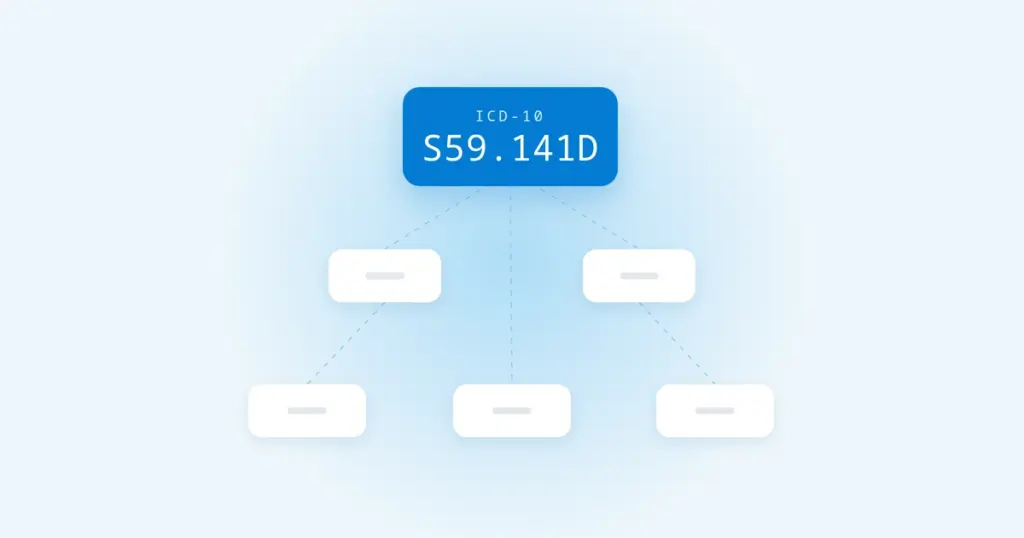
The chain runs S42 to S42.2 to S42.25 to S42.256, and the fourth character separates the humerus from the clavicle.
S42.036D reads almost the same but reports a clavicle fracture, so it never belongs on a greater tuberosity claim.
Code S42.254D for the right humerus and S42.255D for the left whenever the record names the side.
Only A, B, D, G, K, P, and S are valid 7th characters on S42 codes, which rules out Q and R.
S42.256D sits in subcategory S42.25, fracture of greater tuberosity of humerus. Four parts of its descriptor decide whether the code fits the visit in front of you.
Nondisplaced means the fragment stayed in place, or moved so little that a sling was treatment enough. Unspecified humerus means nobody wrote right or left in the record.
The D character belongs to the follow-up visit, not to the day of the injury. Routine healing means the provider found no delayed union, no nonunion, and no malunion at this visit.
The code is valid and billable in the FY2026 ICD-10-CM code set, per the CMS ICD-10 code files. It has been reportable since October 1, 2015. Most greater tuberosity fractures are managed without surgery, so aftercare visits produce most of the claims in this family. Coders in physical therapy and rehabilitation practices meet it more often than surgeons do.
The table below collects the facts that decide whether this code holds up on submission.
Treat the unspecified laterality as a flag rather than a default. If the note or the radiology report names a side, code that side instead. An unspecified shoulder code invites a request for records, because the side is nearly always documented somewhere in the chart.
Every character narrows the diagnosis, so reading the chain from the top is the fastest way to check your work.
The fourth character is where the two confusable branches split. S42.0 is the clavicle, S42.1 is the scapula, and S42.2 is the upper end of the humerus. The map below follows that split down to the billable code.
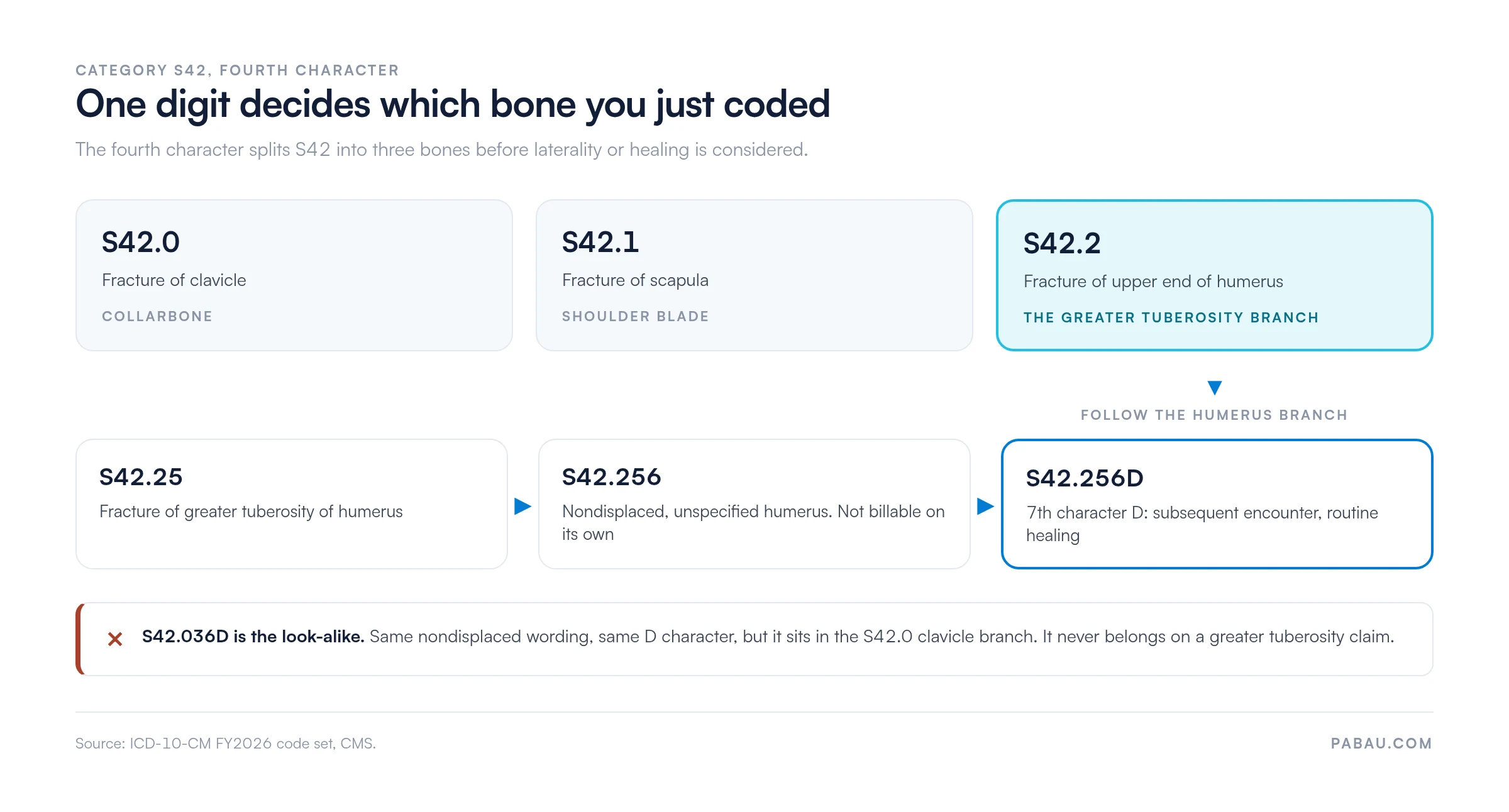
So S42.036D is not a shoulder-joint code at all. It reports a nondisplaced fracture of the lateral end of the unspecified clavicle at a routine-healing follow-up. Put it on a greater tuberosity claim and the diagnosis contradicts the imaging in the chart.
You can confirm the descriptor and the sibling codes in the CDC ICD-10-CM browser before submission. The AAPC index for S42 answers the same question in a different layout.
The 7th character tells the payer where this visit sits in the healing timeline. It is also one of the most audited details in fracture coding. Category S42 uses seven of them, and nothing else is valid on a shoulder or upper arm fracture code.
Characters Q and R are the common false friend. They belong to the Gustilo open fracture extensions, which appear on forearm, femur, and lower leg codes. No S42 code carries one, so an encoder offering Q on a greater tuberosity fracture has you in the wrong family.
The D character works the same way outside Chapter 19. ICD-10 code W56.32XD reports a follow-up visit after a marine mammal strike, with an X placeholder holding the sixth position.
D describes healing that is on track. Once the record says otherwise, the code moves with it.
Delayed healing, character G, means union is late but still coming. Nonunion, character K, means the fragments never joined. Malunion, character P, means they joined in the wrong position. At the greater tuberosity that often shows as a fragment healed above or behind the humeral head.
The change is driven by what the provider documents at that visit. A note that reads “fracture healing” without describing alignment or progress will not settle the question, and it will not survive an audit either.
Read the imaging report before you keep the D character on a later follow-up. Phrases such as callus formation visible or alignment maintained support routine healing. Phrases such as slower than expected or minimal bridging callus point to G instead. Query the provider rather than defaulting to D.
The greater tuberosity is the bony prominence on the outer proximal humerus, just below the humeral head.
Three rotator cuff muscles attach there: the supraspinatus, the infraspinatus, and the teres minor. That anatomy is why cuff involvement is so common, as the American Academy of Orthopaedic Surgeons (AAOS) describes.
Patients usually arrive after a fall onto an outstretched hand or a direct blow to the shoulder. An anterior shoulder dislocation can also pull the tuberosity away. What happens next depends on how far the fragment moved.
Practices that co-manage shoulder aftercare with an orthopedic surgeon carry a specific risk. The encounter character has to be re-checked at every visit, not set once at the first appointment and left alone.
These are the codes a greater tuberosity fracture moves through, from the injury to a late effect. The last row is the clavicle code that gets picked by mistake.
The pattern repeats across Chapter 19. Encounter characters behave the same way from one fracture category to the next, so the work is knowing which characters a category allows. Our ICD-10-CM code index carries the rest of the S42 family.
The ICD-10-CM Official Guidelines for Coding and Reporting, Section I.C.19, are direct about this. The 7th character reflects healing status at the current visit, not the status recorded at the first one. A patient at their fifth follow-up still codes to D if healing is routine that day.
Query the provider before you settle for unspecified laterality. Most orthopedic notes carry an imaging reference that names the right or left shoulder, even when the assessment line does not.
Workers’ compensation claims need one more layer. The documentation has to tie the fracture back to the original incident at work. State rules vary too, so check the payer’s requirements before you submit.
Practice management software like Pabau helps here. Its digital intake forms capture the injury mechanism, imaging findings, and range of motion at every visit. The audit trail then builds as you go, rather than after a denial arrives.
Diagnosis and procedure codes have to be clinically plausible together, because payers cross-check the pairing in their claim edits.
The codes below are the ones that show up around a greater tuberosity fracture, in the US CPT system. Always confirm payer coverage for a pairing before you submit it.
Codes 23620 and 23625 treat the acute fracture. They normally sit alongside an initial encounter character, not the D character. Where the fracture arrived with a dislocation, CPT code 23670 covers open treatment of both.
Shoulder slings and other immobilization devices bill on HCPCS Level II L codes, not CPT. The L series is organized by body region, so a cervical halo fixed into a body jacket takes HCPCS code L0820.
Global periods matter more on this code than on most. Fracture care codes commonly carry a 90-day global period that already covers routine follow-up. Billing an office visit inside that window is a frequent denial on S42.256D claims.
UK practices bill their procedures under OPCS codes, and their diagnosis coding differs too. NHS coders work from the WHO version of ICD-10, which carries no 7th character for routine healing.
The coding decision is only half the work. Below is the path a fracture aftercare claim takes, and where it tends to stop.
Three problems stall it most often. The side goes out unspecified when the radiology report named it. The visit falls inside the global period nobody checked. Or healing has moved on and the D character has not.
Claims travel electronically, so the HIPAA safeguards that cover the chart cover the transmission too. Reading the remittance line by line then tells you whether a denial came from the diagnosis, the encounter character, or the payer’s own policy.
The diagnosis on its own does not settle whether a follow-up service gets paid. Coverage turns on the payer, the therapy plan you documented, and sometimes an authorization you have to win first.
An authorization request lives or dies on the paperwork attached to it. Imaging findings, measured function, and a plan that explains what happens next carry more weight than the diagnosis code alone.
Put a laterality check in the pre-submission routine for every S42.256D claim. Search the encounter for the words right and left, including the radiology report. If either appears, the claim should carry S42.254D or S42.255D instead. This one check removes the most common denial on the code.
Fracture aftercare is one of the more demanding billing patterns in orthopedic and physical therapy work. The same patient returns five or six times, and the diagnosis character can change partway through.
Evidence for that change sits in a radiology report someone has to dig out. Most denials here are administrative rather than clinical.
Pabau keeps that evidence and the claim in one place. Imaging results, treatment notes, and consent forms attach to the patient record. The note behind a fracture code then sits one click from the visit it belongs to.
On the billing side, Pabau’s claim tracking is built for billing teams. It shows where every claim stands, from pending and submitted through to paid or error. It also checks that insurer-specific fields, such as membership and authorization numbers, are complete before the claim can go.
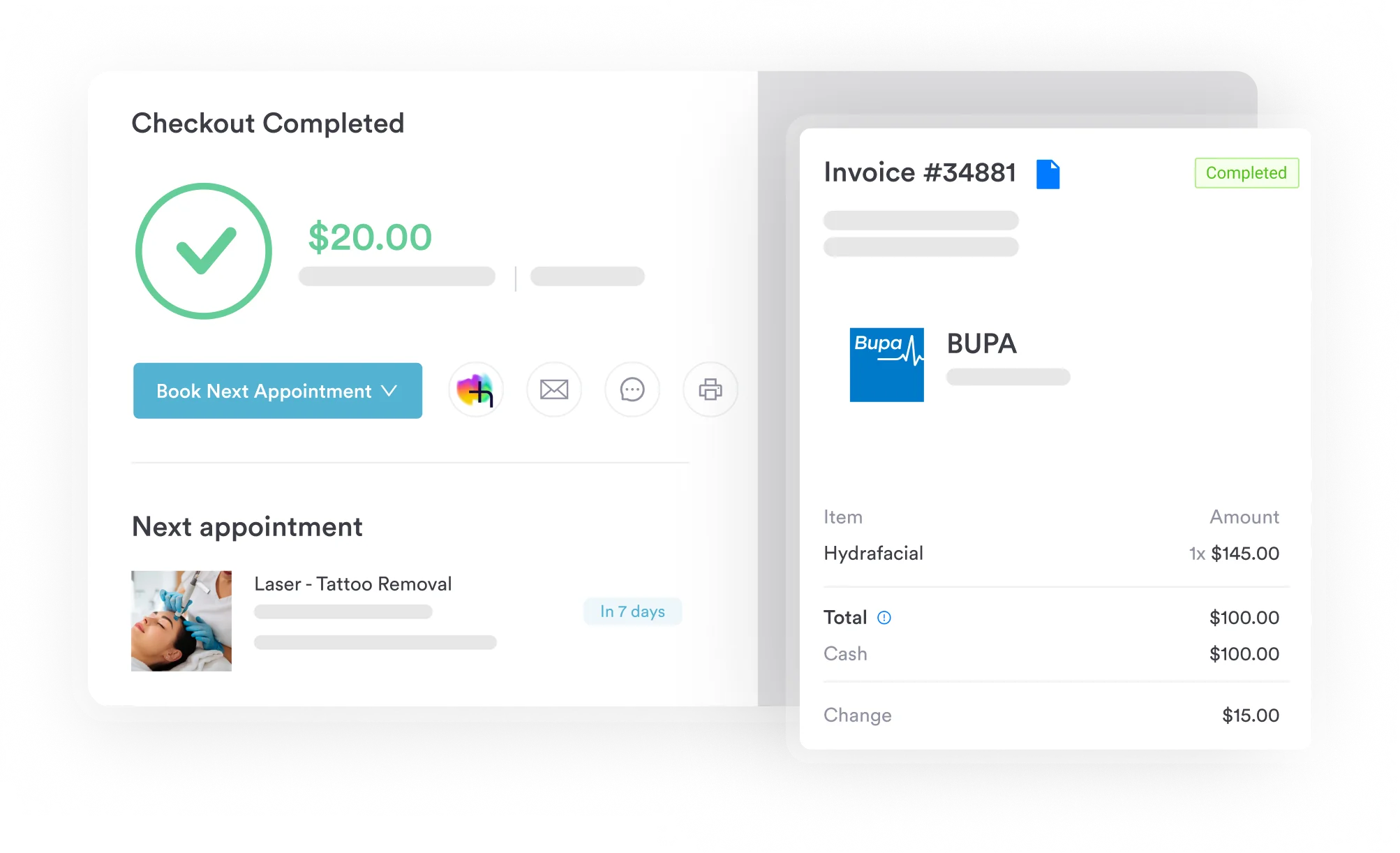
US practices submit through Claim.MD, our clearinghouse partner, which routes claims electronically and returns remittance advice and denial reason codes. Choosing the 7th character stays a coder’s judgment call. A failed claim, though, reaches you on the dashboard rather than in a month-old remittance.

Pabau keeps imaging reports, treatment notes, and claim status on one patient record. Multi-visit fracture billing stops depending on who remembers which follow-up needs a new code.

S42.256D is a narrow code, and that is the point of it. It says the greater tuberosity fracture is healing normally, at a follow-up visit, on a shoulder the record did not name.
Confirm the branch first, so the claim describes the humerus rather than the clavicle. Then check the side and the healing status at every visit, because both can change while the patient is still in your chair.
Book a demo to see how Pabau holds imaging reports, coded diagnoses, and claim status on one record through a full course of fracture aftercare.

Same fracture, healed crooked? S42.256P covers the malunion character on the same base code, and when to move off D.
Coding the displaced version instead? S42.253S walks through displaced greater tuberosity fractures at the sequela stage.
Lesser tuberosity rather than greater? S42.265D covers the neighboring S42.26 subcategory at routine healing.
Fracture arrived with a dislocation? CPT code 23670 covers open treatment of a shoulder dislocation with a greater tuberosity fracture.
Working through repeat denials? Denial management in healthcare shows how to trace a denial back to the code, the encounter, or the payer policy.
S42.256D is the billable ICD-10-CM code for a nondisplaced fracture of the greater tuberosity of the unspecified humerus, subsequent encounter for fracture with routine healing. It covers follow-up visits where the provider confirms the fracture is healing normally and the record does not name a side.
Yes. S42.256D carries all seven characters and is valid for claim submission in the FY2026 code set. The base code S42.256 is not billable on its own, because every S42 fracture code needs a 7th character.
S42.256A applies at the initial encounter, while the patient is receiving active treatment for a closed fracture. S42.256D applies at later visits, once treatment has been delivered and the fracture is healing as expected. The 7th character reflects the nature of the encounter, not the visit number.
Use them whenever the record names a side. S42.254D covers the right humerus and S42.255D covers the left. Reserve S42.256D for charts where neither the provider note nor the radiology report identifies the shoulder.
The chart needs the greater tuberosity named as the fracture site, plus a statement or imaging finding of nondisplacement. It also needs evidence that this visit is aftercare, and wording that supports routine healing. Phrases such as callus formation on imaging or alignment maintained satisfy the healing element.
Because S42.036D sits in the clavicle branch of S42. Its official descriptor is a nondisplaced fracture of the lateral end of the unspecified clavicle, subsequent encounter for fracture with routine healing. The greater tuberosity of the humerus falls under S42.25, so the correct routine-healing code is S42.256D.