

ICD-10 Code S42.444P: Medial epicondyle fracture, right humerus
ICD-10 Code S42.444P: full descriptor and code validity ICD-10 Code S42.444P car...

Last Updated: Oct 13, 2026
Billable Code Specific Code
S83.512D is the billable ICD-10-CM code for sprain of anterior cruciate ligament of left knee, subsequent encounter.
The suffix is where ACL claims go wrong, because coders often read subsequent as the patient's second visit.
S83.512D is confirmed billable in the CDC/NCHS ICD-10-CM official tool and the 2026 tabular list. The single code string carries laterality, the anatomical structure, the injury type, and the encounter phase. That combination satisfies payer specificity requirements on its own.
Let Pabau's smart automation suggest the right codes, reduce claim denials, and keep your practice compliant—effortlessly.
Automate repetitive tasks and focus on what matters most—your patients.
Reduce coding errors and ensure compliance with the latest regulations.
Clean claims, fewer denials, and faster reimbursements.
Powerful insights and reporting to help your practice thrive.
HIPAA compliant SOC 2 certified GDPR-compliant Trusted by 4,000+ clinics worldwide

ICD-10 Code S83.512D describes a sprain of the anterior cruciate ligament of the left knee at a subsequent encounter.
The 7th character D applies during follow-up, rehabilitation, and routine monitoring, once definitive treatment for the injury has ended.
Confusing S83.512D with S83.512A is one of the most common coding errors on ACL claims, and it often triggers denials.
Practice management software like Pabau links visit type to encounter suffix, so ACL claims carry the correct 7th character.
The 7th character is where most ACL coding errors start. ICD-10-CM appends it to traumatic injury codes to show which phase of care the encounter represents. Payers and auditors read that character as a clinical statement about the visit.
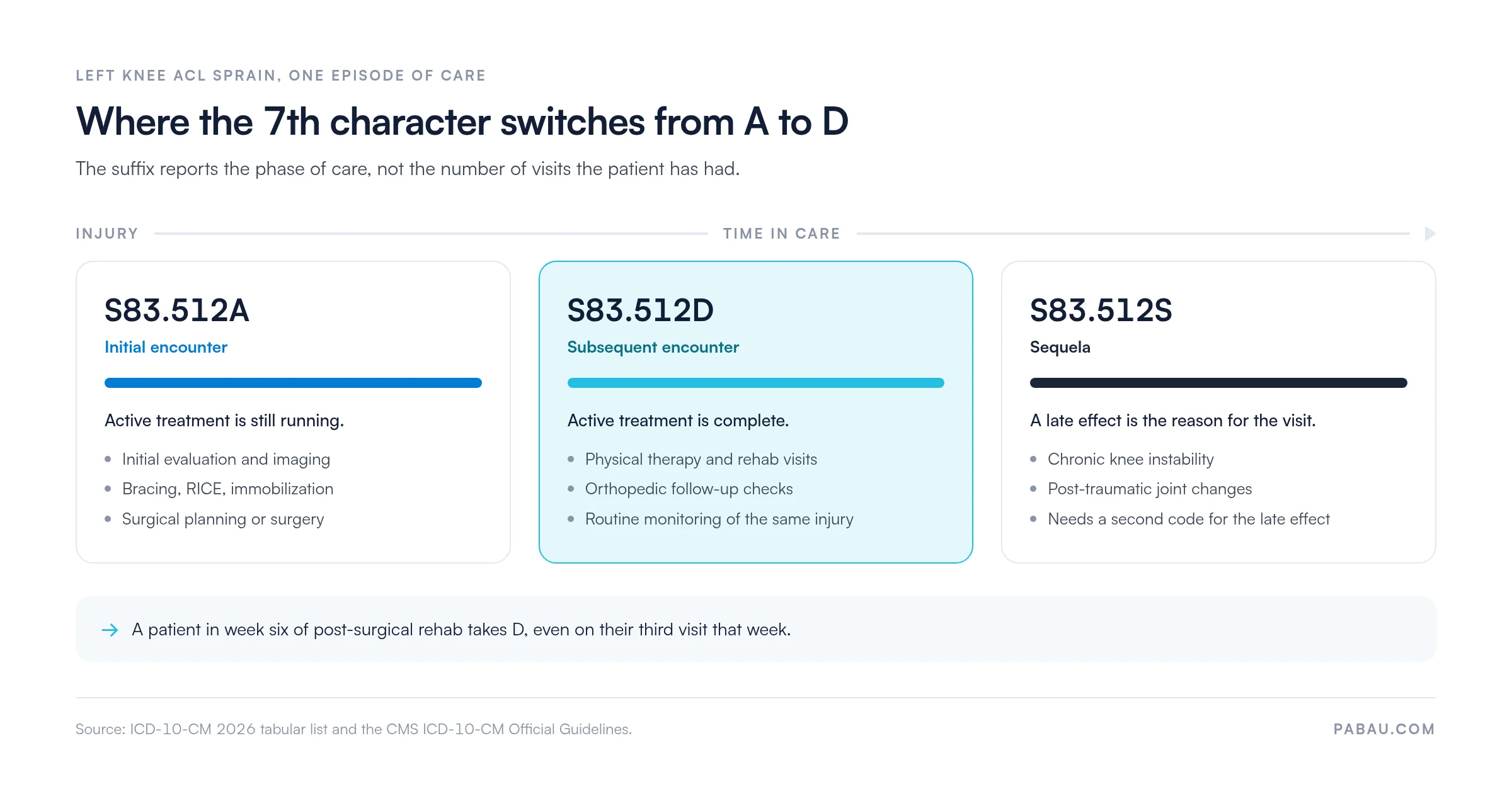
The CMS ICD-10-CM coding guidelines are specific on one point. Subsequent encounter does not mean the patient’s second visit. It means that active treatment has finished. A patient in week six of post-surgical ACL rehabilitation takes D on every visit that week.
Treatment phase decides the suffix, not visit count. While a clinician is still providing active treatment, A applies. That covers surgical recovery, bracing management, and the initial immobilization period.
Once the patient moves into monitored recovery or rehabilitation, D takes over. The diagram below marks where that switch falls in a single ACL episode.
The same phase test applies beyond the injury chapter. External cause codes carry a 7th character as well, so a sea lion bite follow-up is coded W56.11XD.
All three codes share the same anatomical base, a sprain of the anterior cruciate ligament of the left knee. The suffix is the only variable, and it changes what the claim says about the visit.
Sequela coding needs a second code for the sequela condition itself. If the documented late effect is chronic knee instability, the instability code accompanies S83.512S on the claim. The original injury code alone will not support a sequela claim.
S83.512D sits inside the S83.5 cruciate ligament sprain subcategory. Coders handling ACL injuries on both knees, or with undocumented laterality, need the full code family. Payers increasingly flag claims where the billed side does not match the operative or diagnostic report.
Use the unspecified laterality codes (S83.519x) only when the record genuinely does not document which knee is affected. In practice, any legible clinical note, imaging report, or operative record names the side. Billing S83.519D when the left knee is documented is a specificity failure under the ICD-10-CM Official Guidelines.
Every code in that table assumes the note documents ligament involvement. Documentation that shows only a surface wound on the left knee, with no ligament damage recorded, belongs to superficial injury code S80.912A instead. Its 7th character A covers the active treatment phase, so it applies at a different point in care than S83.512D.
The parent chain helps coders navigate the tabular list during an audit. It also confirms that exclusion notes higher up the tree do not affect S83.512D. The full hierarchy, per the WHO ICD-10 classification structure, runs like this:
No Type 1 Excludes note at the S83.5 level stops S83.512D from being billed alongside standard physical therapy evaluation or management codes. Check the S83 parent notes for Type 2 Excludes notes, which may call for an additional code such as an open wound code.
Thin documentation is the most common reason an S83.512D claim gets denied. The encounter note has to support every element the code carries. Payers run automated edits that flag ACL sprain claims where the documented visit type contradicts the suffix.
The clinical record needs these elements to substantiate S83.512D:
Structured intake forms capture laterality, injury mechanism, and treatment phase at the point of care. That puts the details a coder needs on file before the chart reaches billing.
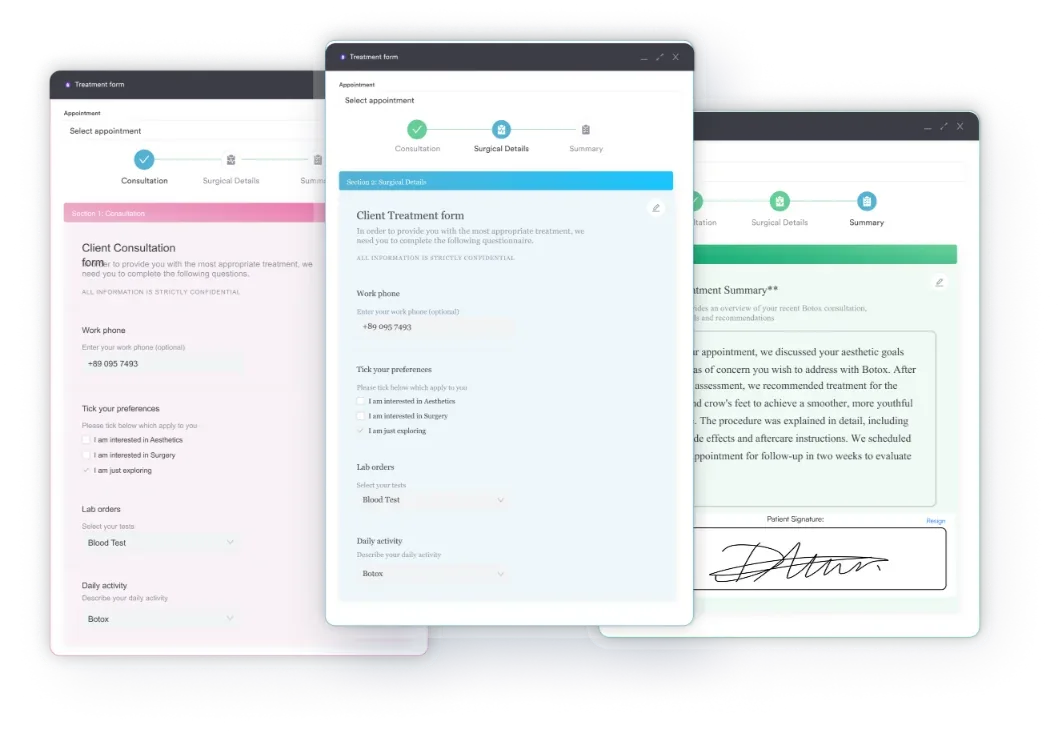
Flag the treatment phase transition in your EHR. When a patient moves from active ACL management to rehabilitation, update the encounter type field on that date. The record then answers the payer’s question about why the suffix changed from A to D.
S83.512D is a diagnosis code, so every claim pairs it with a CPT procedure code. The CPT code says what was done at the visit and S83.512D says why. 97110 is the code most often billed alongside it on physical therapy claims.
Payer bundling rules apply when several physical therapy codes are billed for the same session. Check the payer’s own policy before you submit a multi-code PT claim. Edit checking at the point of submission catches most bundling conflicts, which is the top denial type on ACL rehabilitation claims.
S83.512D denials cluster around four predictable mistakes. They show up on remittance advice from major payers, and a clear workflow prevents each one.
Encounter-suffix mismatches come back with specific denial codes, so tracking which ones recur tells you where the workflow breaks. Catching the pattern before submission beats correcting it after the denial arrives.
Build a crosswalk in your billing system that pairs S83.512A, S83.512D, and S83.512S with the visit types in your EHR. One rule tied to visit type catches most suffix errors before a coder sees the claim. Initial evaluation means A, and follow-up or PT means D.
The errors above share one cause. The encounter suffix gets picked manually at coding time, with no decision point recorded in the clinical workflow. The claim then rests on how a coder reads unstructured text in the note.
Practice management software like Pabau ties the visit type to the encounter suffix. The trigger then sits in the clinical record instead of a coder’s judgment.
Structured visit templates hold laterality and treatment phase as fields, so the billing team reads them in one place. Claims built from those templates run through error-checking claims management software before they reach the payer.
Pabau integrates with Claim.MD, a US clearinghouse supporting electronic submission to thousands of US payers. Claims carrying S83.512D pass through edit checking, eligibility verification, and electronic remittance advice processing before submission. Sports medicine and physical therapy practices run that alongside their clinical notes, instead of in separate billing software.

Pabau’s claims management software helps orthopedic and physical therapy practices submit accurate ICD-10 and CPT pairings. Built-in edit checking, eligibility verification, and Claim.MD submission catch errors before the payer does.

S83.512D is not hard to code once the suffix logic is clear. The harder part is making sure the person coding knows which phase of care the visit belongs to.
More coder training helps less than a change to the workflow. Write the treatment phase into the visit record on the day it changes, and the suffix follows on its own.
Practices that do this stop reworking ACL claims and start clearing them on the first pass. Book a demo to see how Pabau handles coding, documentation, and claim submission for musculoskeletal practices.

Want to know how clearinghouse submission cuts ACL denials? Claim.MD clearinghouse explains how electronic claim submission works and where denial prevention starts.
Aiming to get ACL claims paid on the first pass? Clean claim submission shows what a payer needs before the claim leaves your practice.
Denials already piling up on rehab claims? Denial management in healthcare covers how to work a denial queue and stop the repeat causes.
Need a billing compliance framework that covers every claim type? Medical billing compliance sets out the documentation, coding, and submission standards to work to.
S83.512D is a billable ICD-10-CM code for a sprain of the anterior cruciate ligament of the left knee. It applies at a subsequent encounter, once active treatment is complete and the patient is in follow-up or rehabilitation.
Yes. S83.512D is billable and specific, so it is valid for claim submission. It took effect October 1, 2025 as part of the 2026 ICD-10-CM edition, and the CDC/NCHS official tool confirms its billable status.
S83.512A applies while the patient is receiving active treatment for the left knee ACL sprain. S83.512D applies once that treatment has ended and the visit is follow-up, rehabilitation, or routine monitoring. The treatment phase triggers the change, not the visit count.
Use D once active or definitive treatment for the injury is complete. The visit is then follow-up care, rehabilitation, or ongoing monitoring. Under the CMS ICD-10-CM Official Guidelines, subsequent encounter describes the phase of care rather than the number of visits.
The common pairings are 99213 and 99214 for outpatient evaluation and management visits. On the therapy side they are 97110, 97140, 97012, and 97530. Payer bundling rules may apply when several therapy codes are billed in one session.
Yes. The ICD-10-CM index routes both sprain and tear of the anterior cruciate ligament to the S83.51x family. S83.512D covers a left knee ACL sprain, strain, or tear at a subsequent encounter, whatever word the note uses.
The record must name the left knee as the affected joint and describe an ACL sprain or ligament injury. It must also show that active treatment is finished and this visit is follow-up or rehabilitation. A link back to the original injury completes it.




