Intake note template
An intake note is the clinical record a therapist or counselor writes at the sta...

3
Last Updated: Oct 22, 2026
Before you can work out how to start a med spa, you need to know who is allowed to own one. A med spa is a medical practice that delivers aesthetic treatments like injectables and lasers. That’s why most states require a physician to own or oversee the clinical side. Keep our ranking of the best medical spa software for later, since it lists each platform’s pricing.
Settle ownership first, then budget $150,000 to $500,000 to open, with a cash reserve included. Get that order wrong and you could hold a signed lease and a financed laser with no legal way to treat patients.
The 10 steps below follow that order, and Step 3’s Med Spa Launch Ledger prices every line for your route.

Settle ownership first. Physicians can usually own a med spa outright, while RNs and non-clinical owners in most states use an MSO split with a physician-owned practice.
A lean to mid-size med spa costs $150,000 to $500,000 to open, including a cash reserve of three to six months of running costs.
The MSO route adds two line items. Expect MSO legal fees plus a medical director retainer of $1,500 to $5,000 a month, so price your route before your devices.
Breakeven is simple arithmetic. Divide fixed monthly costs by the average margin per treatment to get the visits you need each month.
Well-run med spas keep 15% to 30% of revenue as net profit, and average annual revenue sits near $1.4 million, according to AmSpa.
A medical spa needs more groundwork than a day spa, because the treatments are medical. Fillers, lasers, chemical peels, and body contouring bring healthcare rules with them in most states.
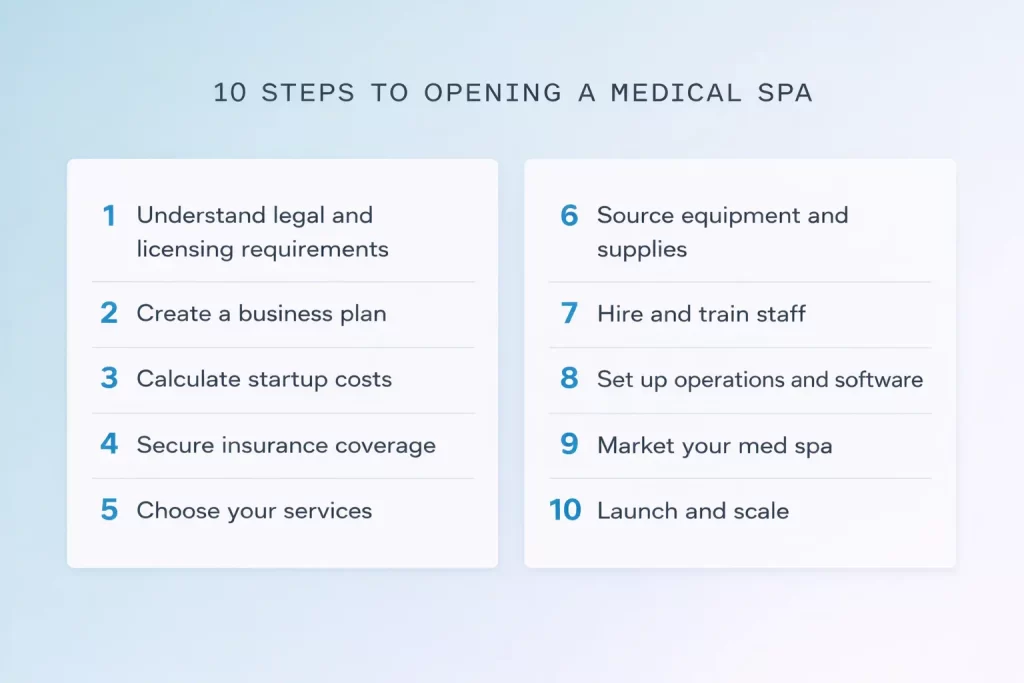
Each step below depends on the one before it, so work through them in order.
Your state’s corporate practice of medicine (CPOM) rules decide who can own a med spa, and most states reserve the medical practice itself for physicians.
The CPOM doctrine bars companies and unlicensed people from practicing medicine or employing physicians. It exists in some form in the majority of states. So your first meeting should be with a healthcare attorney, well before you tour a single retail unit.
The Med Spa Launch Ledger starts here, because each ownership path carries different costs:
The diagram below maps each license to the ownership path it opens and the costs that path adds to your ledger.
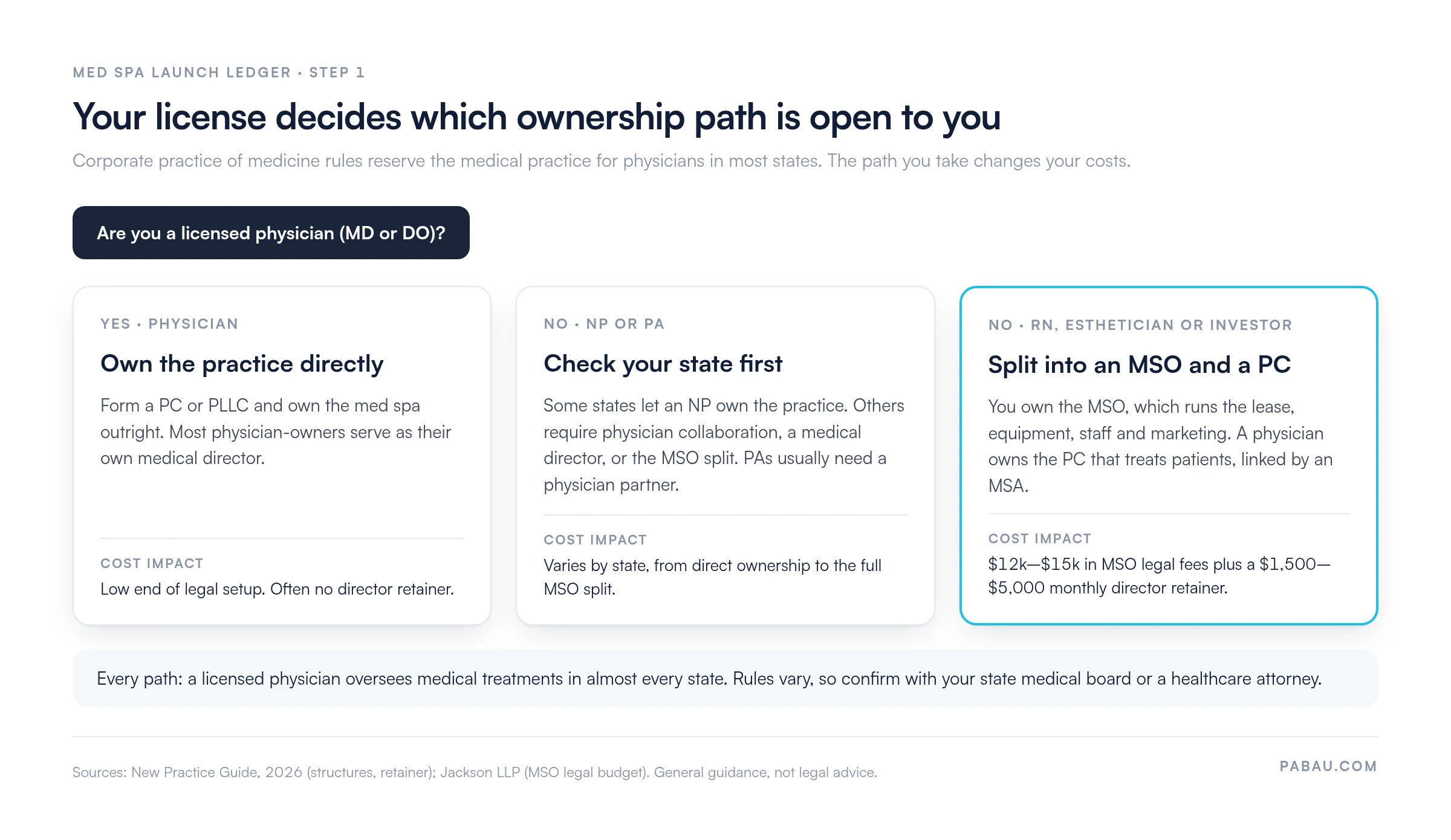
Which states let an RN or NP own a med spa? Your state board is the only reliable answer. Medical and nursing boards revise their rules often, so a 50-state list goes stale fast. California is one well-known strict example, where a medical corporation must be majority-owned by physicians.
What trips owners up: paying the medical director a percentage. Pay a fixed fee instead, never a share of revenue or a per-treatment cut. Revenue-linked pay can count as illegal fee-splitting in many states, and it undermines the MSO structure you paid to build.
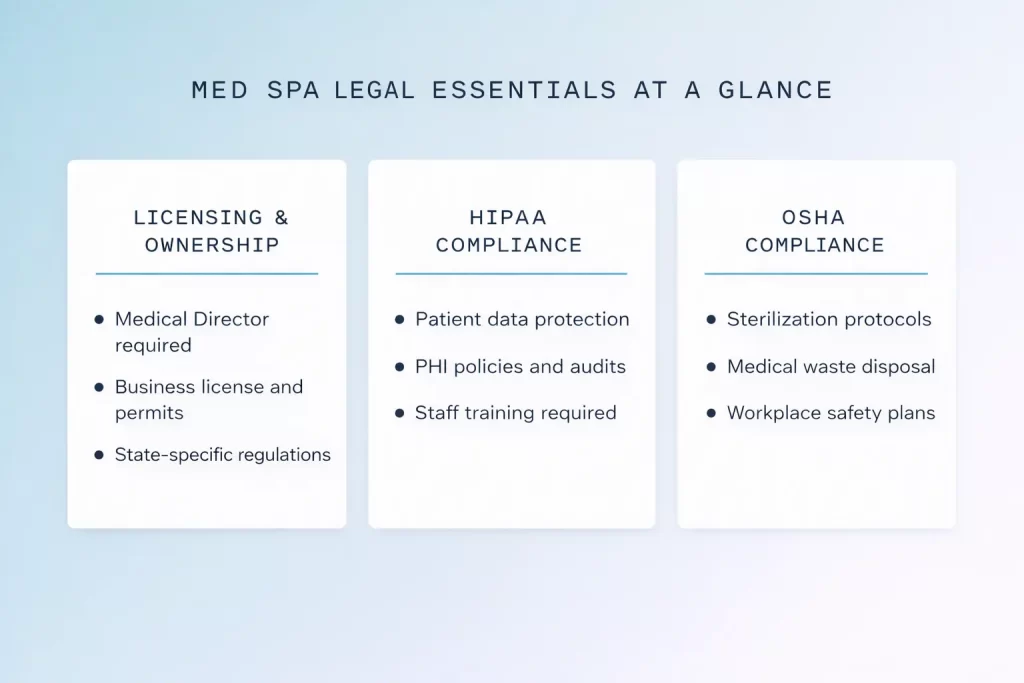
Once ownership is settled, four more items finish the licensing work:
Don’t rely on general online summaries for legal compliance. Consult a healthcare attorney who specializes in medical aesthetics in your state. Laws change frequently, and one oversight can lead to fines, lawsuits, or losing your medical licenses.
Your med spa will hold intake forms, informed consents, treatment histories, and before-and-after photos. That’s protected health information (PHI), and HIPAA, the Health Insurance Portability and Accountability Act, sets the rules for handling it.
Formal HIPAA coverage turns on whether you transmit health information electronically, such as for insurance claims. Build your systems to HIPAA standards either way, because state privacy laws and patient expectations apply regardless.
In day-to-day terms, that means four habits:
HIPAA fines run from roughly $141 to $71,162 per violation, under the penalty amounts HHS adjusted for inflation in August 2024. Repeat violations of the same provision are capped at $2,134,831 a year, and willful cases can bring criminal charges.
Your staff will handle bloodborne pathogens, sharps, and biohazardous waste during injectables and laser treatments. That puts your med spa under Occupational Safety and Health Administration (OSHA) oversight.
You’ll need documented protocols for:
Following an OSHA compliance checklist helps you stay ahead of inspections and avoid penalties.
A business plan for a med spa proves your ownership structure is legal, your costs are priced line by line, and your breakeven is reachable.
Lenders and investors read it in that order too. An SBA lender will also expect financial projections, with monthly or quarterly detail for the first year. A med spa business plan that holds up covers seven sections:
When we onboard new med spas, the smoothest launches are the ones whose plan named a qualified provider for every treatment on the menu. A menu item without a provider allowed to perform it is revenue the plan can’t deliver.
According to the AmSpa 2024 report, average annual med spa revenue reached nearly $1.4 million, up from $1.3 million the year prior.
A lean med spa costs $150,000 to $250,000 to open and a mid-size one $300,000 to $500,000, with the working-capital reserve included.
Those are the tiers in New Practice Guide’s 2026 cost breakdown, and full-service builds with several lasers run $500,000 to $1 million or more. What it costs to start a med spa in your case comes down to two choices. Your ownership route is the first, and your device list is the second.
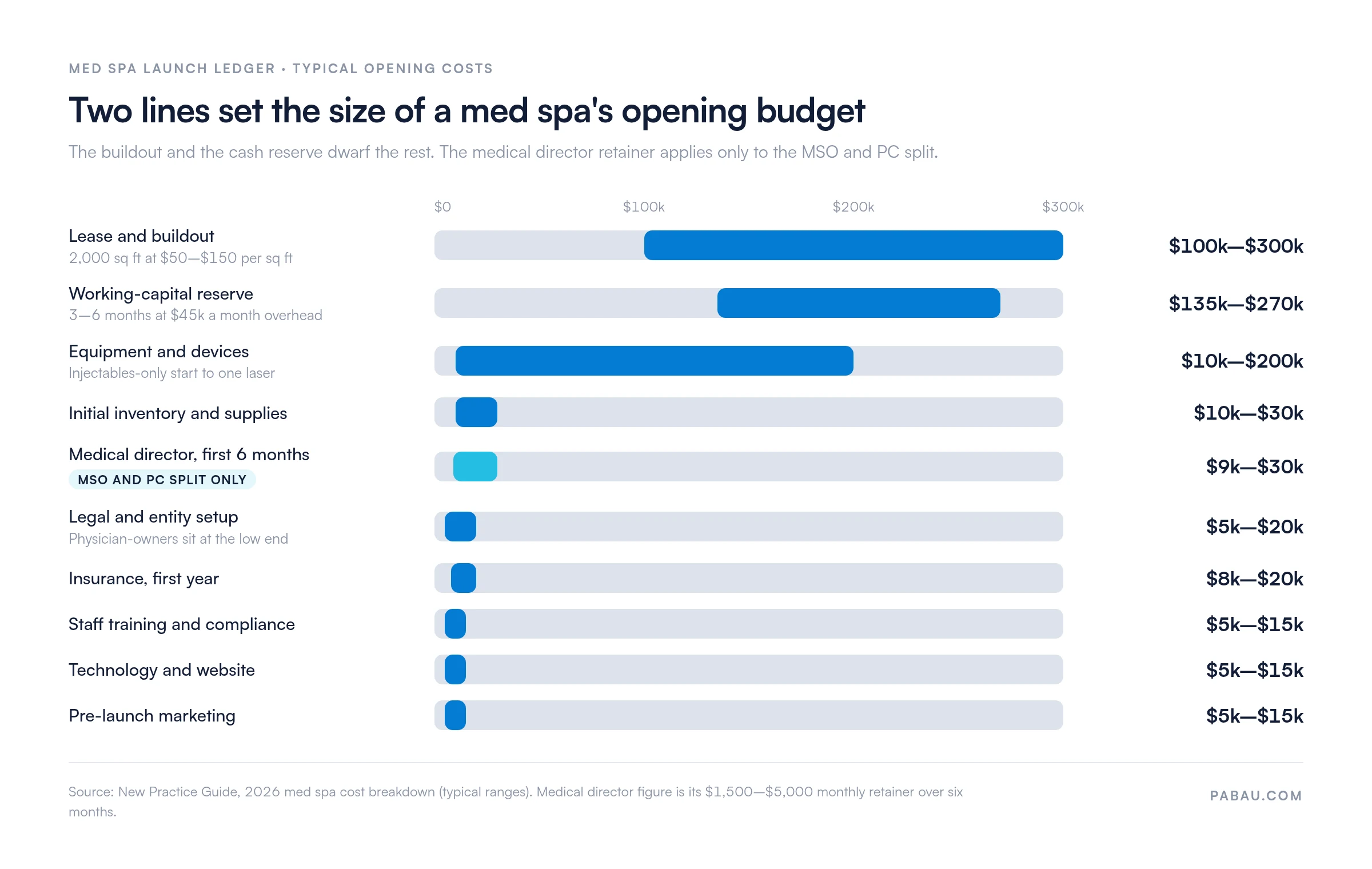
The ledger below prices each line for both ownership routes. Figures are typical ranges from the sources named under the table.
Sources: New Practice Guide’s 2026 cost breakdown for every range except the MSO legal fees, which come from Jackson LLP.
Two lines stand out once the ranges sit side by side. The buildout and the cash reserve set the size of your budget. Legal work and the medical director decide how the two ownership routes differ.
Once the ledger is priced, divide your fixed monthly costs by the average margin per treatment. The answer is the number of visits you need each month.
For example, say fixed costs are $45,000 a month and an average visit leaves $250 after product costs. You’d need 180 visits a month, or about nine a day across 20 working days. For more detail on leases and inventory, see our line-by-line guide to med spa startup costs.
A new med spa needs four core policies: general liability, professional liability (malpractice), workers’ compensation, and property insurance.
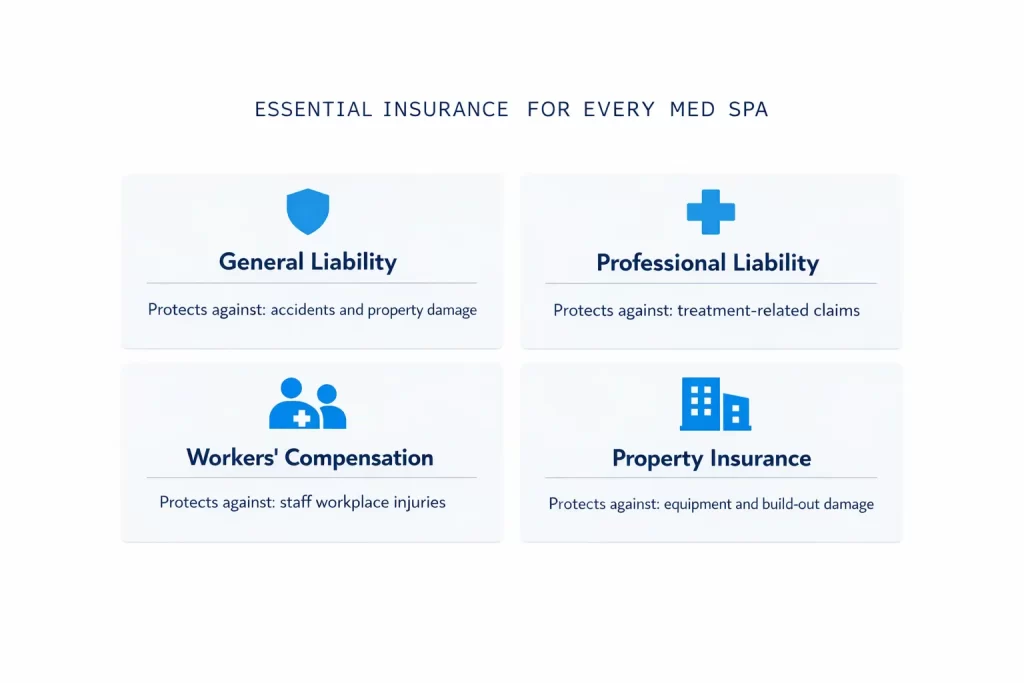
New Practice Guide puts total annual insurance for a mid-range med spa at $8,000 to $20,000. A common slip is a malpractice policy that doesn’t list your treatments. Ask your broker to name each procedure you offer, such as dermal fillers, chemical peels, and laser therapy.
Launch with a focused menu of treatments your team is licensed and trained to deliver, then add services once each one fills its room.
Your medical spa service menu decides your equipment spend, your staffing, and your revenue potential. Common starting services include:
An injectables-first menu keeps equipment spend near $10,000 to $20,000, which is why many new owners start there. Body contouring is worth a place on the roadmap. Market analysts valued those treatments at $1.46 billion in 2024, with $2.58 billion projected by 2029.
Buy or lease equipment only for the treatments on your launch menu, and choose FDA-cleared devices in every medical device category.
FDA clearance protects your patients and your liability position. Leasing is worth pricing too, since it cuts the upfront outlay by 50 to 70% in exchange for monthly payments. Essential equipment typically includes:
Buy from reputable manufacturers and negotiate maintenance contracts upfront. Downtime from broken equipment means lost revenue. Also, confirm that your treatment rooms meet the electrical and ventilation requirements for each device before installing it.
Hire in the order your ownership structure sets: the medical director first, then the licensed injectors they supervise, then estheticians and front desk.
Supervision rules from Step 1 decide who can do what, so match each hire to the treatments on your menu:
Verify every medical license and certification before the first shift, and keep copies on file. Ongoing training keeps your team current on treatment protocols, patient safety, and changing state regulations.
Set up one practice management system before launch, so bookings, patient records, consents, and payments run from the same place on day one.
A practice management system for a med spa should handle:
Practice management software like Pabau is purpose-built med spa software, so it covers each item on that list. Clinical documentation and marketing automation run from the same dashboard.
Market your med spa first on the channels local patients check before booking: your Google Business Profile, your website, and Instagram.
Each channel below does a different job, from getting found to getting rebooked:
Healthcare marketing comes with rules. Avoid making false claims, promising specific results, or using misleading language in your ads. Instead, focus on education, transparency, and documented results. That’s what builds patient trust.
Launch in two stages: a soft opening that tests your booking, consent, and payment flows, then a public grand opening that starts collecting reviews.
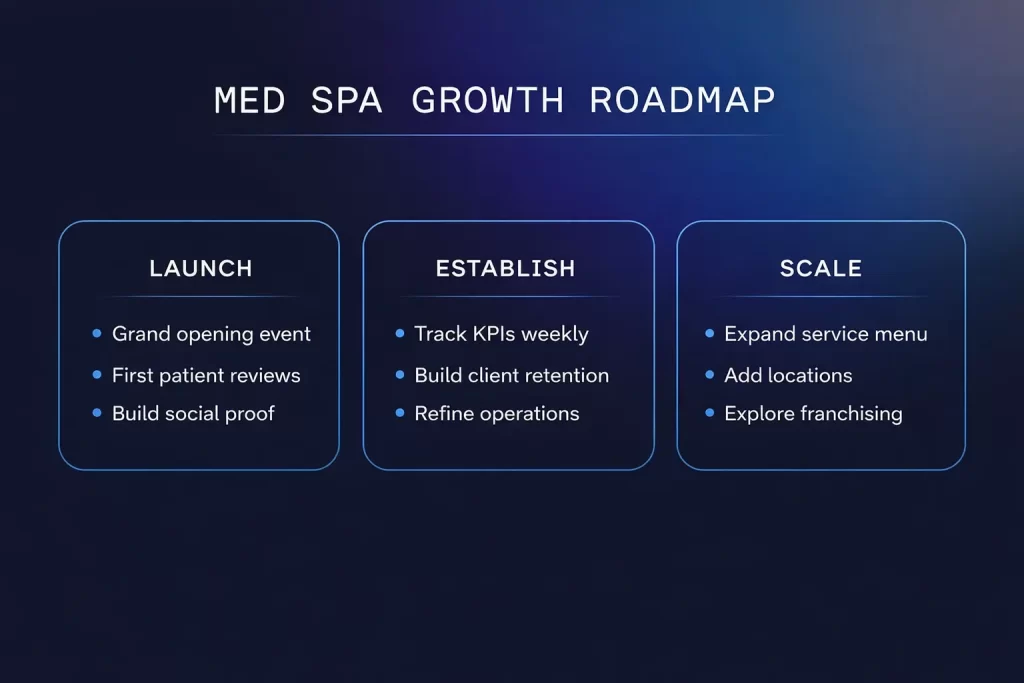
Plan the grand opening itself around a few proven moves:
Once you’re operational, shift your focus to scaling. Track revenue per treatment, patient retention, average spend per visit, and new patient acquisition cost every week.
As demand grows, consider expanding your service menu, adding treatment rooms, or opening a second location.
Clinical skill doesn’t protect you from business mistakes. These six show up again and again in new med spas:
A seventh mistake is harder to spot: a medical director who only signs paperwork. If your director never reviews charts or supervises protocols, your whole operation carries the legal risk.
Once the doors open, repeat business decides whether a med spa succeeds. That means patients who rebook, members who stay, and providers whose schedules stay full.
The five habits below keep those numbers moving in the right direction.
Keeping a patient costs less than finding a new one, and in medical aesthetics your reputation drives bookings. Build a patient experience that reaches past the treatment itself:
Patients who feel looked after come back, and they refer friends.
Your financial plan doesn’t stop at launch. Review these benchmarks monthly, because they separate profitable med spas from those that barely break even.
Pricing tips to keep in mind:
Cutting corners on safety leads to lawsuits and can cost your providers their medical licenses. Build these habits in from the first patient:
Don’t wait for an inspection to find out you’re non-compliant. Run internal audits quarterly and write up each one. If something does go wrong, that paper trail is what protects you.
Med spas that grow steadily run the same marketing routines every month. Invest in:
Weekly numbers flag a problem weeks before your bank balance does. Use your reporting tools to monitor:
Reporting built into your practice management software surfaces these numbers without spreadsheet work. The sooner you spot a trend, the sooner you can act on it.
Work through these five lists in order, because each one depends on the decisions above it.
Most new med spas open with a booking tool, a spreadsheet for inventory, a forms app for consents, and an inbox for patient questions. Each one needs its own login, and none of them share data.
Pabau replaces that stack with one record per patient. Bookings, consent forms, treatment notes, before-and-after photos, invoices, and campaign history all sit in the same file. A practitioner walking into a treatment room can see the history without asking the front desk.
That matters most in your first year, when you’re hiring, training, and covering reception yourself. Charting takes minutes instead of an evening, and rebooking runs on automated reminders. Under an MSO split, your medical director can log in to review treatment notes and consents without a site visit.

Pabau brings scheduling, HIPAA-compliant records, digital consent forms, payments, and inventory into a single platform. A new med spa can run its front desk and its charting without stitching four tools together.

Starting a med spa is a licensing exercise before it’s an aesthetics business. Settle your ownership route and your medical director first, because those two decisions shape your lease, your insurance, and your ledger.
Then protect the cash. Price the Med Spa Launch Ledger for your route and hold three to six months of running costs in reserve. Keep the menu narrow until each service fills its room.
If you aren’t a physician, budget the MSO legal work and the director retainer before you fall for a laser. Once the structure is in place, book a demo to see how Pabau sets up scheduling, records, and consent forms for your opening week.

Want to confirm you’re compliant before opening? The medical spa compliance checklist walks through the documentation an inspector will ask for.
Launching in California? California med spa licensing laws covers the state’s physician-ownership rules in detail.
Need the funding first? How to get a med spa business loan explains what lenders expect to see in your projections.
Wondering what you’ll take home? Med spa owner salary breaks down owner pay by practice size and license.
Not sure what to track after launch? The med spa KPI guide sets out the numbers worth reviewing every week.
Many owners plan for six to 12 months from forming the entity to treating the first patient. The buildout and state licensing usually set the pace. An MSO split can add a few weeks, because two entities and their agreements need drafting first.
Buying gets you patients, staff, and cash flow on day one, but the price includes that goodwill. Medical licenses stay with the people who hold them, so you’ll likely need a new medical director agreement. Have a healthcare attorney check the ownership structure before you close.
A franchise gives you a brand, an operating playbook, and group pricing on products. In return, you pay an upfront fee and ongoing royalties. Your state’s ownership rules still apply, so review the franchise disclosure document with a healthcare attorney.
Rarely. Most med spa treatments are cosmetic, so patients pay out of pocket. That’s why many med spas skip insurance billing and use memberships, packages, and financing instead. A few services for medical skin conditions may qualify with the right documentation.
A good-faith exam is an assessment by a licensed provider before a patient gets a prescription treatment like Botox or filler. It sets up the provider-patient relationship the treatment depends on. Depending on your state, a physician, NP, or PA performs it, sometimes by telehealth.