Facial skin treatment consent form template: Microneedling and phi-ion
A facial skin treatment consent form is the signed proof that a patient was scre...

2
Last Updated: Oct 21, 2026

NovaThreads are absorbable PDO sutures preloaded into syringes, injected into facial tissue to stimulate collagen and create a lifting effect without surgery.
A defensible consent form must disclose risks, screen contraindications, and state that results last 12-18 months rather than permanently.
Swelling and bruising peak at days 3-5 and settle by day 10, so aftercare must cover activity limits and wound care.
The threads themselves absorb within 4-6 months, and the collagen they trigger is what holds the lift afterward.
Pabau captures consent digitally, stores before-and-after photos, and sends aftercare messages on a schedule you set once.
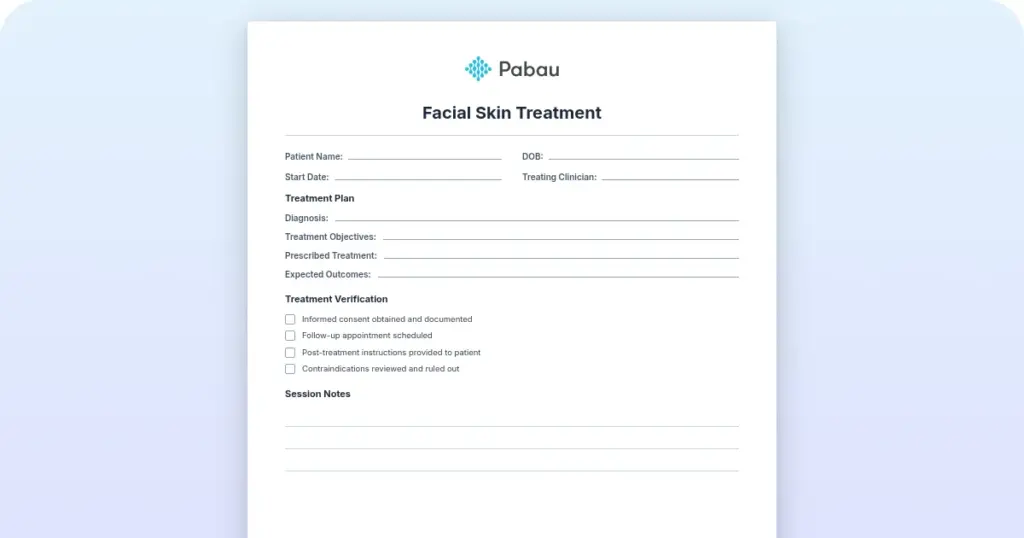
This file pairs a consent form covering risk disclosure and contraindication screening with aftercare instructions for wound care, activity limits, and warning signs. Hand it to the patient on the day, or send it digitally after treatment.
Download templateA NovaThreads consent form has two jobs. It has to prove the patient understood the risks, and it has to set expectations that a gradual, 12-18 month result can meet.
Timing is where expectation-setting usually breaks down. A patient who checks the mirror at day three sees swelling, not a lift. The consent form is what tells them to expect that.
This guide covers the sections your consent form needs, a day-by-day recovery framework, and what the aftercare sheet should say. Practice management software like Pabau handles the paperwork side, and its digital intake forms capture a signature before the patient reaches the treatment room.

NovaThreads are absorbable polydioxanone (PDO) sutures, preloaded into pre-threaded syringes for minimally invasive facial lifting. The practitioner places them in the subcutaneous layer at set points along the jawline, midface, cheeks, and temples.
The threads do two things at once. They give mechanical support straight away, and as they dissolve over 4-6 months they trigger neocollagenesis in the treated tissue. Visible change appears over 2-4 weeks as collagen deposition accelerates, then keeps improving to the 3-6 month mark.
That distinction matters for the consent conversation. By three months the threads have largely absorbed, so the lift the patient sees is held by their own collagen.
Threads can treat several facial regions, each with its own lifting and contouring goal.
The lips are not among those areas. Perioral threading uses PDO or PLLA threads placed toward the vermilion border, and a separate lip threading consent form covers that protocol.
Ideal candidates have mild to moderate skin laxity, are roughly 35 to 65, and hold realistic expectations about a non-surgical result.
Contraindications include active skin infection, immunosuppression, bleeding disorders, and metallic implants near the treatment area. Current anticoagulation therapy is a relative contraindication rather than an absolute one. Screening belongs in the consultation, which is also where you set the outcome expectations. Our guide to consultations that convert covers how to structure that conversation.
Most patients feel immediate tightness. Visible lifting arrives later, as collagen deposition does the work, and that lag is what the consent form has to name.
The full sequence runs from days to months, and it is worth walking a patient through it in order.
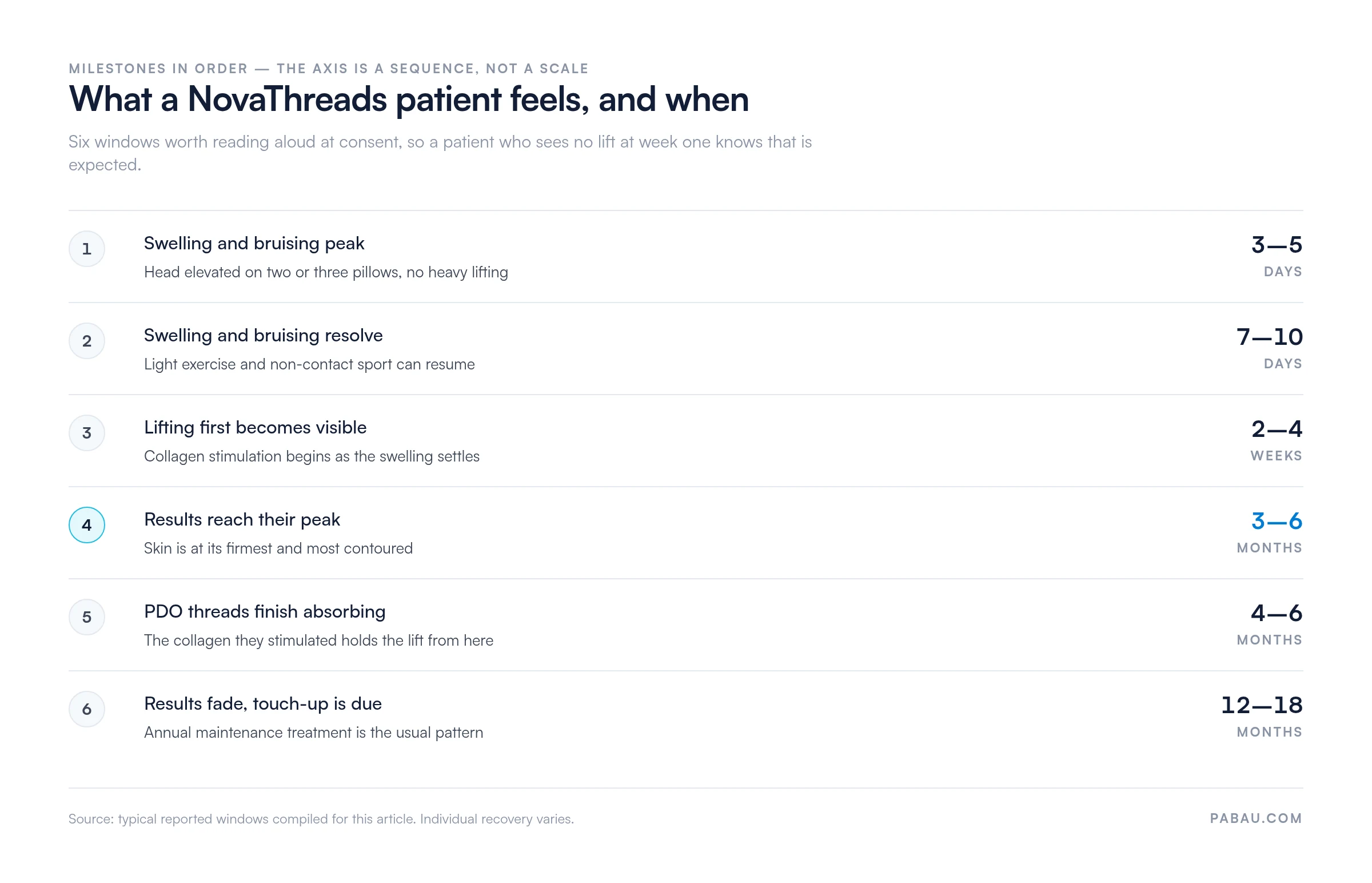
Results duration varies with patient age, skin quality, lifestyle, and sun exposure. Your consent form should state that results typically last 12-18 months, and that a touch-up may be wanted each year.
Recovery is far shorter than a surgical facelift. Patients still need explicit limits on activity and clear wound care instructions to keep complications down.
Tell patients to contact you straight away if any of these appear.
Put your practice’s direct number and after-hours protocol on the aftercare sheet, not just in the consent form.
Pricing moves with location, provider experience, thread count, and treatment scope. US sessions typically run $2,000 to $6,000, with most practices charging $200 to $400 per thread. UK pricing tends to sit between £2,000 and £4,500 per session.
Aftercare products such as arnica and specialist cleansers are usually sold as optional add-ons. Quote all of it in the consultation rather than on the day of treatment.
The consent form should also state your revision policy. Say plainly whether a touch-up is discounted inside the first 30 to 60 days if the patient is unhappy.
A defensible consent form covers informed consent, risk disclosure, contraindication screening, and written proof that the patient understood the limits.
Have a healthcare attorney in your state review the template before you use it. This file is a starting point, and it is not a finished legal document.
Structured instructions cut patient anxiety, lift compliance, and reduce complications. Give a copy at the time of treatment and send a second copy by email or text for reference at home.
A signed consent form documents that the patient understood the risks, the realistic outcome, the contraindications, and the alternatives. That record is what protects the practice when a complication or a disappointment turns into a complaint.
Detailed aftercare does the preventive half of the same job. Proper wound care and clear activity limits reduce infection risk, shorten swelling, and cut thread problems such as extrusion and migration.
Digital, trackable documentation also gives you an audit trail. Timestamped consent and delivery records answer a regulator or an insurer far faster than a filing cabinet does.
Most practices still print the consent form, scan the signed copy, and email the aftercare sheet by hand. Pabau is practice management software for med spas and aesthetic practices, and it takes that sequence off the front desk.
Digital forms capture a timestamped signature and file it straight into the patient’s clinical record. Pabau Scribe, our AI scribe, documents thread count, placement, and depth during the procedure, so the note is written before you leave the room.
Before-and-after photos store against the treatment date and body area, so the two-week, four-week, and twelve-week images sit in one comparison. Automated workflows then send the aftercare sheet two hours after treatment and check in on days 3 and 7. A four-week review invitation goes out on the same schedule.
The outcome is that consent, clinical note, photos, and aftercare all live against one patient record. Nobody has to remember to send the day-7 message, and nobody has to hunt for the signed form a year later.
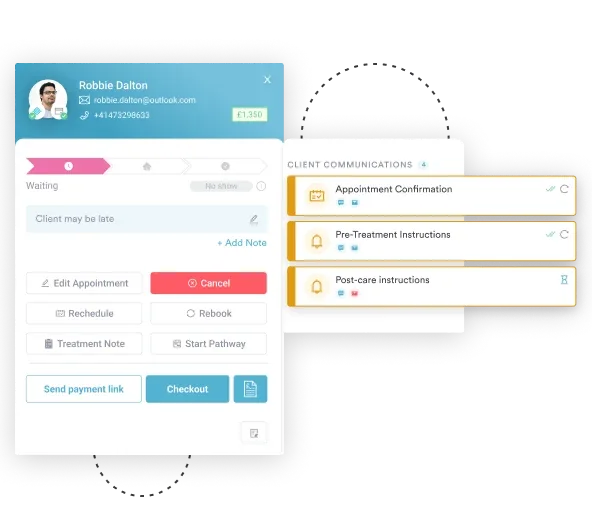

Pabau’s digital forms take the signature before treatment, and automated messaging delivers the aftercare sheet and the follow-up invitations. Your team stops chasing paperwork.

Customize the template with your practice details and your state’s requirements before you hand it to anyone. Two edits matter more than the rest. Name the 4-6 month absorption window, and name the 12-18 month result.
A patient who has read both numbers before treatment rarely reads day-five swelling as a failed procedure. That single expectation is what keeps the follow-up appointment friendly.
Practices lose more time on the paperwork than on the treatment. Book a demo to see how Pabau captures NovaThreads consent and delivers aftercare on a schedule.

Running a radiofrequency device as well? AccuTite aftercare instructions template covers the recovery guidance and warning signs for that treatment.
Need the RF microneedling equivalent? Morpheus8 aftercare instructions sets out the post-treatment care and healing timeline patients ask about.
Building your intake paperwork from scratch? A med spa consultation form template shows what to capture before any treatment decision.
Offering another skin-tightening treatment? JuVaShape aftercare instructions gives you a matching sheet for that device.
Want the consultation itself tightened up? Consultations in medi-aesthetics walks through screening, consent, and compliance.
NovaThreads are absorbable polydioxanone (PDO) sutures, preloaded into syringes and placed in facial tissue to lift and contour. As the threads dissolve over 4-6 months they stimulate collagen. That collagen response peaks at 3-6 months and holds results for 12-18 months on average.
Most patients return to normal activities within 7 to 10 days. Swelling and bruising peak around day 3 to 5, then resolve. Strenuous exercise and heavy lifting wait two weeks, and so do chemical peels and laser.
Results last 12 to 18 months on average, varying with patient age, skin quality, lifestyle, and sun exposure. They reach their peak at 3 to 6 months as collagen deposition continues. Many patients book an annual touch-up to hold the lift.
Common effects are temporary swelling and bruising through days 3 to 7, mild discomfort, and tenderness at the injection sites. Rarer complications include infection, thread extrusion, thread migration, asymmetry, and nerve injury where threads sit near facial nerves. Most are treatable, and infection needs prompt antibiotics or thread removal.
Absolute contraindications are active skin infection, severe immunosuppression, known PDO allergy, pregnancy or breastfeeding, and uncontrolled bleeding disorders. Current blood thinner use is a relative contraindication. A full medical history at consultation catches these before treatment.
Include patient demographics, the procedure description, expected results and timeline, risks and complications, contraindication screening, alternatives, practitioner credentials, aftercare acknowledgment, and dated signatures. Then have a healthcare attorney in your state review it against local informed consent and liability standards.