Kate Tarrant
Nursing care plan for aggressive behavior
A nursing care plan for aggressive behavior is a structured clinical document fo...

2
Last Updated: Oct 26, 2026
Free PDF Clinician-reviewed
Dermaheal is a Korean mesotherapy range, but many practitioners still document it on paper consent forms or generic templates. These generic forms rarely capture the screening detail and protocol structure this treatment requires. Without structured records of patient screening, batch numbers, and session-by-session protocols, practices lose the treatment traceability regulators expect.
This guide covers what Dermaheal is, the six product lines and their indications, and how to administer the treatment safely. You’ll also find contraindications to screen for and storage requirements. Plus, there’s a downloadable consent and treatment record template you can customize for your practice. Whether you’re introducing Dermaheal to your offerings or refining your existing protocols, this resource provides the clinical and governance framework modern practices need.
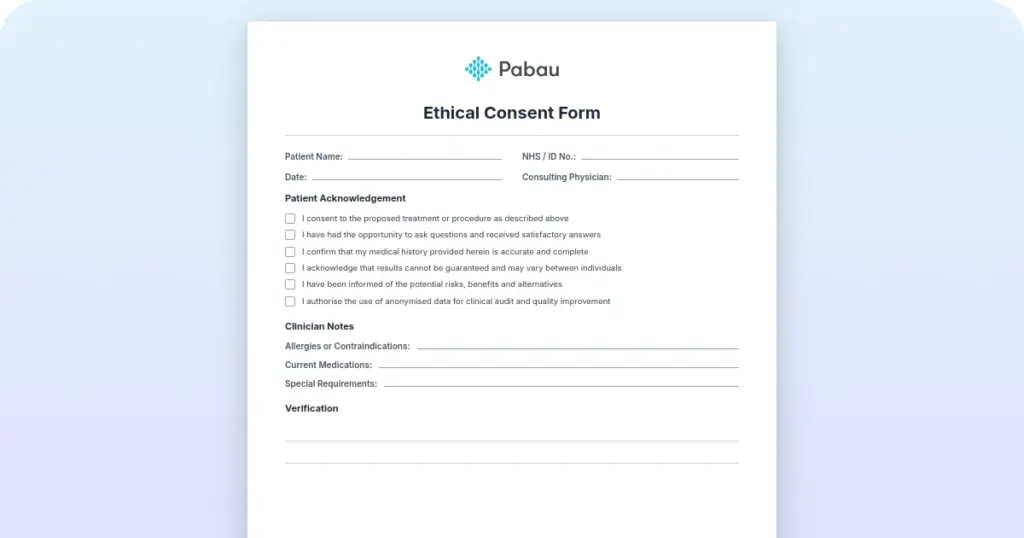
A ready-to-use professional template covering patient medical history, contraindication screening, informed consent declarations, treatment protocol, and per-session clinical governance records for Dermaheal mesotherapy procedures.
Upload this PDF, or any form you already use, and Pabau's AI Form rebuilds it with tick boxes, text fields and a signature. Attach it to the treatment once, and every patient gets it on time.
AI Form rebuilds the consent, history and aftercare forms you already use. You review each one, then publish.
Patients complete forms on their phone before they arrive, so the front desk stops retyping paper.
Every signed form is versioned and attached to the treatment record, ready when you need it.
Set how long a consent stays valid. Returning patients skip forms they have already signed.
Supports HIPAA and GDPR compliance AES-256 encryption 4.8 on G2 4.7 on Capterra Trusted by 4,000+ practices worldwide

Dermaheal is a Korean mesotherapy range by Caregen containing biomimetic peptides and growth factors for professional clinical use.
Six core product lines (HSR, SR, SB, HL, LL, Eye Bag) target distinct skin concerns via needle mesotherapy, microneedling, or electroporation.
Practitioners must screen for contraindications and obtain documented informed consent before each treatment session.
Practice management software like Pabau streamlines compliance documentation and treatment traceability with digital consent forms and per-session records.
Dermaheal is a range of professional-grade mesotherapy cocktails manufactured by Caregen Co., Ltd., a South Korean biotechnology company specializing in biomimetic peptide research. Each Dermaheal product is supplied as a sterile vial containing a proprietary blend of growth factors, biomimetic peptides, amino acids, vitamins, and minerals. The formulation supports subcutaneous injection, topical delivery via microneedling, or transdermal electroporation.
Unlike generic mesotherapy cocktails, Dermaheal formulations are indication-specific. Each product targets a distinct skin concern – anti-aging, rejuvenation, brightening, hair loss, eye bags, or body contouring – with a matched peptide complex. Practitioners administer Dermaheal within a digital consent framework that documents patient suitability, treatment expectations, and post-care instructions. This ensures clinical governance and informed consent standards are met before needle-to-skin contact.

Caregen’s research into biomimetic peptides and skin regeneration has been documented in the Journal of Cosmetic Dermatology, a peer-reviewed publication covering aesthetic treatment outcomes. The signature component of Dermaheal is its biomimetic peptides: synthetic peptides that mimic natural growth factors. They signal skin cells to stimulate collagen production, improve hydration, and reduce visible signs of aging and other skin concerns.
Dermaheal offers six core formulations, each with distinct indications and peptide profiles. Below is a quick reference comparing the product variants, their target concerns, and typical treatment frequency.
Each product is supplied in sterile glass vials and must be stored under cold-chain conditions. Treatment frequency and session count vary by product line and patient response; always consult the manufacturer’s Instructions for Use (IFU) for definitive protocol guidance.
Dermaheal formulations share a core set of ingredient classes, each serving a specific role in stimulating skin regeneration.
The exact peptide blend differs by product line. Consult the product datasheet or IFU for the complete ingredient list and concentration data relevant to your clinical protocols.
Dermaheal can be delivered via three distinct professional methods, each suited to different clinical scenarios and anatomical zones.
The choice of delivery method depends on patient preference, treatment area, skin sensitivity, and your practice’s equipment. Many practitioners combine methods within a single treatment course (e.g., injection for the face, microneedling for body areas).
Before administering any Dermaheal product, conduct a thorough pre-treatment consultation and document patient suitability in your digital consent form. The screening process protects both patient safety and your practice’s clinical governance.
Common indications (suitable candidates for Dermaheal):
Absolute contraindications (do not treat):
Relative contraindications (assess and document carefully):
For UK practitioners, the Save Face register offers evidence-based guidance on practitioner registration, accreditation, and safe aesthetic treatment protocols. This guidance aligns with informed consent best practices. Always consult the manufacturer’s IFU and your practice’s medical director before treating any patient with relative contraindications. Document your clinical reasoning in the patient record.
Dermaheal products are supplied as sterile vials and require strict cold-chain management to preserve peptide integrity and efficacy.
Implement a stock rotation system (FIFO – First In, First Out) and maintain temperature logs for your practice refrigerator to ensure compliance with cold-chain requirements. Poor storage compromises product efficacy and may invalidate your informed consent – document your storage procedures in your practice’s standard operating procedures.
Effective Dermaheal outcomes depend on consistent protocol adherence. The downloadable treatment record template (link in the card at the top) lets you document each session’s product, batch number, and vial volume. It also captures delivery method, anatomical site, post-treatment observations, and patient feedback, creating an auditable per-session record for clinical governance and safety traceability.
General protocol principles across all Dermaheal lines include an initial course of 4-6 weekly sessions. Maintenance sessions follow every 4-8 weeks, depending on patient response and product line. The exact frequency should be customized based on individual skin condition, patient tolerance, and clinical results. Always frame treatment timelines with patients during the consent conversation and adjust protocols based on observed outcomes.
Some patients run a Dermaheal course alongside a device treatment, so plan the calendar around both. An ultrasound facial protocol carries its own screening questions and signed consent, so document both treatments in the same patient record.
Within your practice’s client record system, link each treatment to the session record template, embedding the protocol, vial details, and aftercare instructions. This digital linkage ensures continuity and makes it easy to review historical treatments when assessing cumulative results or troubleshooting any adverse responses.

Post-treatment instructions are critical for patient satisfaction and safety. Provide written aftercare guidance within your digital consent framework so patients have a record they can reference at home.
Your practice’s aftercare instructions should align with NHS best practices for wound care and infection prevention to ensure patient safety standards are met. Any unusual reactions (prolonged erythema, infection signs, allergic response) should prompt immediate contact with the practice. Document all patient feedback and adverse events in the treatment record for continuous quality improvement.
Despite thorough screening, some patients will be unsuitable or develop complications requiring escalation. Know when to refer out.
Document all referrals and clinical decisions in the patient record. This creates a safety trail and supports your practice’s governance framework when audited by regulators (CQC, HIS, MHRA).
Most practices running Dermaheal protocols track consent on paper, then log batch numbers, vial volumes, and session notes in a separate spreadsheet. Those records rarely connect back to the specific product used, the practitioner who administered it, or the aftercare instructions the patient received.
Pabau’s digital consent forms capture the same screening and contraindication questions this template covers, then attach directly to the patient’s record. Each treatment note logs the product line, batch number, vial volume, delivery method, and practitioner, so every Dermaheal session has a documented, auditable trail.
Automated appointment reminders and aftercare messages go out without front-desk staff typing them by hand. Before-and-after photos attach to the same record as the consent form and treatment note. When a regulator asks for the full history behind one session, the practice pulls it from a single screen instead of three separate systems.

Manage patient consent, document treatment records, track batch numbers, schedule follow-ups, and store before-and-after photos in one integrated practice management platform.

Dermaheal mesotherapy is a sophisticated, indication-specific treatment that demands careful patient selection, precise documentation, and meticulous follow-up. The clinical and governance framework – screening, consent, per-session records, and post-care instructions – is as important as the product itself.
Using a structured digital consent form and treatment record template (like the downloadable templates linked above) keeps your practice compliant and ensures continuity of care. It also gives your team a single source of truth for each patient’s treatment history. Book a demo to see how practice management software can embed Dermaheal protocols, consent workflows, and treatment records into one system.

Need to document treatment outcomes? Before-and-after photo capture helps you and your patients track Dermaheal results over time.
Want to automate patient reminders? Email and SMS campaigns can send pre-treatment prep instructions and post-care reminders to your entire patient list.
Looking for a medical director or compliance partner? How to hire a medical director for your med spa covers governance best practices and staffing models.
Dermaheal is a range of professional mesotherapy products by South Korean company Caregen, each formulation containing biomimetic peptides, growth factors, amino acids, and vitamins. Products are administered by needle injection, microneedling, or electroporation and target specific skin concerns (anti-aging, rejuvenation, brightening, hair loss, eye bags, or body contouring).
A standard initial course is 4-6 weekly sessions, followed by maintenance sessions every 4-8 weeks depending on the product line and individual response. Exact frequency should be customized based on patient skin condition and results observed during the treatment course.
Yes. Dermaheal can complement other treatments such as laser, radiofrequency, or chemical peels. Allow at least 2 weeks between Botox or filler injections and Dermaheal treatment in adjacent areas. Always document combined treatments in your patient record for continuity.
Dermaheal is generally suitable for all skin types, but practitioners must screen for contraindications (pregnancy, active infection, immunosuppression, bleeding disorders) during consultation. Patients with sensitive skin or active dermatological conditions should be assessed individually before treatment.
Mild erythema and swelling typically appear post-injection and resolve within 24-48 hours. Patients should avoid vigorous exercise, extreme temperatures, and active skincare products for 24-48 hours. Sun protection (SPF 30+) and hydration support optimal healing and results.
Dermaheal vials must be stored at 2-8°C (refrigerated) in the original packaging, protected from direct sunlight. Shelf life is typically 24-36 months from manufacture; check individual vials for expiry dates. Once opened, use within 24 hours if from a multi-dose vial, or immediately if a single-use vial.