Alex Koch
Exilis patient treatment record: Free PDF for RF sessions
An Exilis patient treatment record is the session log for BTL’s radiofrequ...

3
Last Updated: Oct 23, 2026
Free PDF Clinician-reviewed
A Botox reminder email works on five dates: 48 hours before the appointment, day 2, day 14, month 3 and month 4. A sixth goes out the same day a patient no-shows.
Those dates are not a marketing calendar. They come from the drug’s own label. Muscle movement starts to drop off one to two days after injection, and keeps dropping through the first week. The effect on frown lines lasts roughly three to four months.
So an appointment reminder email that only confirms the slot is doing one job out of six. The other five keep the result on track and bring the patient back before their frown lines fully return. Every template below is free to copy, and the whole sequence sits in one table you can set once.
The file holds six complete templates with subject lines, one for each send point in the cadence. You also get the timing table, a merge-field list, a before-you-send checklist, and a subject-line swap file.
Upload this PDF, or any form you already use, and Pabau's AI Form rebuilds it with tick boxes, text fields and a signature. Attach it to the treatment once, and every patient gets it on time.
AI Form rebuilds the consent, history and aftercare forms you already use. You review each one, then publish.
Patients complete forms on their phone before they arrive, so the front desk stops retyping paper.
Every signed form is versioned and attached to the treatment record, ready when you need it.
Set how long a consent stays valid. Returning patients skip forms they have already signed.
Supports HIPAA and GDPR compliance AES-256 encryption 4.8 on G2 4.7 on Capterra Trusted by 4,000+ practices worldwide

Six Botox reminder emails cover the cycle: 48 hours before, day 2, day 14, month 3, month 4, and after a no-show.
The send points follow the drug’s own label figures, not a generic marketing calendar.
Month three is the earliest rebooking point the label supports, because more frequent dosing has not been clinically evaluated.
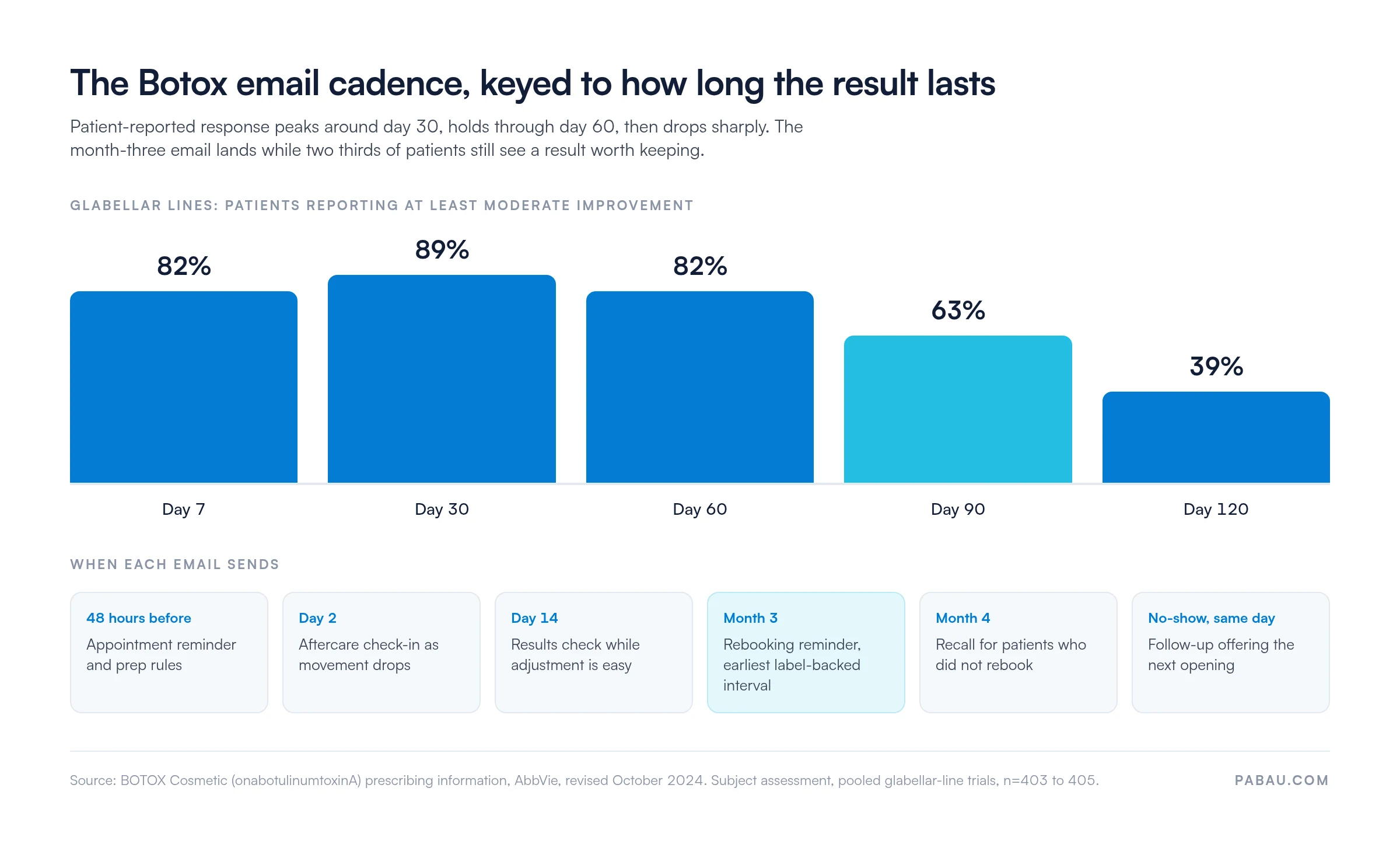
Patient-reported response falls from 82% on day 60 to 39% on day 120, which is what the month-four recall catches.
All six templates, a merge-field list, and a subject-line swap file sit in the free download below.
A Botox reminder email is a short, scheduled message tied to one date in the treatment cycle. It either protects an appointment that is already booked, or brings the patient back for the next one. A promotion or a newsletter belongs in med spa email marketing, not in this stream.
Whichever date it lands on, an appointment reminder email needs the same six parts.
The pre-appointment sends and the recall sends also need separate consent, which is covered further down.
Send at 48 hours before, day 2, day 14, month 3 and month 4, plus a same-day email after a no-show. Each date does a different job, because the patient is experiencing something different at each one.
| Send point | What the patient is experiencing | What the email does | Channel |
|---|---|---|---|
| 48 hours before | Booked, and probably unaware of the prep rules | Confirms the slot and sets out the 24-hour prep | Email plus text |
| Day 2 | Movement in the treated area is starting to drop | Repeats aftercare and opens a reply channel | |
| Day 14 | The result has settled and is fully visible | Invites a review while an adjustment is still easy | |
| Month 3 | Movement is returning and lines are reappearing | Offers the next appointment with a booking link | Email plus text |
| Month 4 | The effect has largely worn off | Recalls a patient who never rebooked | |
| Same day as a no-show | Missed the slot and expects a lecture | Offers the next opening, and the fee if you charge one | Email plus text |
Those dates come from the manufacturer’s own labeling. The BOTOX Cosmetic prescribing information puts the standard glabellar dose at 20 units, four units into each of five sites.
The same document says movement drops one to two days after injection, then keeps dropping through the first week. It gives the duration of effect for frown lines as roughly three to four months.
The trial data gives the recall its shape. In the pooled glabellar studies, patient-reported response ran at 82% on day 7 and peaked at 89% on day 30. It held at 82% on day 60, fell to 63% by day 90, then dropped to 39% by day 120.
Patients often call the month-three send a top-up reminder, and three months is the earliest point the label supports. The channel matters here too, because a text gets read faster but an email carries the booking link and the record detail.
Send this one 48 hours out, so a patient who needs to move has time to pick another slot. It carries the prep rules, which a generic reminder template leaves out.
Subject line: Your appointment with [PRACTITIONER], [DAY] at [TIME]
Hi [FIRST NAME],
You’re booked with [PRACTITIONER] on [DATE] at [TIME] at [PRACTICE NAME].
Two things before you come in. Skip alcohol and anti-inflammatories like ibuprofen for 24 hours. Arrive with the treatment area free of makeup.
Confirm your slot here: [CONFIRM LINK]
Need a different time? Move it here: [BOOKING LINK]
Changes inside 24 hours forfeit the deposit, so tell us today if the slot no longer works.
[PRACTICE NAME]
The 48-hour window is doing specific work. Inside 24 hours, a patient who can’t make it can only cancel, because there is rarely another slot left to move into. At 48 hours the reschedule link still has options, so the appointment moves and the slot goes back on the calendar.
Only include the deposit line if your written cancellation policy says the same thing. Quoting two different windows is how a card dispute starts.
Keep the confirmation and the reschedule as two separate links. Merging them into one “manage booking” page adds a step, and the patient who was going to confirm in three seconds stops bothering.
The day-2 email repeats aftercare while the patient can still act on it. The day-14 email asks how the result looks, at the point where an adjustment is still simple.
Day 2. Subject line: Checking in after your visit
Hi [FIRST NAME],
You should be noticing less movement in the treated area by now. That is expected, and it will keep settling over the next week.
Until then, no facials, no saunas and no heavy exercise.
If you have a headache, a droop, or a symptom that worries you, reply to this email. [PRACTITIONER] reads these.
[PRACTICE NAME]
Day 14. Subject line: Two weeks in, how does it look?
Hi [FIRST NAME],
Your result should be fully settled now. Have a look in the mirror at rest, then while frowning.
If one side is moving more than the other, or a line has not softened, tell us this week. Book a review here: [REVIEW BOOKING LINK]
Happy with it? No reply needed. We will be in touch when you are due.
[PRACTICE NAME]
Day 14 is the one send with a hard cut-off. Catch an asymmetry inside the same treatment cycle and it is a five-minute review. Leave it until month three and you are correcting it on top of a fresh dose, which muddles both the record and the unit count.
Send the Botox rebooking reminder at three months, because that is the earliest interval the label supports. Dosing more frequently than every three months has not been clinically evaluated. A nudge at week 10 asks for an appointment the evidence does not back.
Month three is also where the patient is most likely to act. At day 90, 63% of patients in the glabellar trials still reported at least moderate improvement. The result is visibly going but not gone, which is exactly when someone books to protect it.
Subject line: Time to book your next appointment, [FIRST NAME]
Hi [FIRST NAME],
It has been three months since your appointment with [PRACTITIONER] on [LAST TREATMENT DATE].
Most people find movement returning around now. Treating at this point keeps the result even, rather than starting again from scratch.
Book your slot here: [BOOKING LINK]
Last time we used [UNITS] units across [AREAS]. We will hold the same plan unless you want to change it.
[PRACTICE NAME]
That last line is the one worth copying. Naming the units and areas from the record turns a marketing email into a continuation of a clinical conversation. It also tells the patient you didn’t have to look them up.
Those figures come off your Botox treatment note, so the merge fields have something to read from. A record that never captured the units cannot fill that line in. A printable Botox face chart gives the practitioner a chairside sheet for logging units against each zone. The recall email then has figures to merge.
Month four is a recall, not a reminder, and the tone changes with it. By day 120 only 39% of patients still reported at least moderate improvement, down from 82% on day 60. The result is gone, so there is no fading benefit to protect and no urgency to borrow.
Subject line: Ready for your next round?
Hi [FIRST NAME],
You are four months on from your last appointment, so the effect has likely worn off by now.
If booking has been on your list and it slipped, here is the link: [BOOKING LINK]
Would you rather we stopped emailing about this? [UNSUBSCRIBE LINK] takes you off recall and leaves your appointment reminders alone.
[PRACTICE NAME]
A patient who drifts past month four rarely rebooks unprompted. They book with whichever practice emails them first, and that loss shows up in next quarter’s numbers rather than this month’s.
Three shorter reminder email templates cover what is left. None of them needs more than a subject line and a few lines of copy. The consultation follow-up works off what you agreed in the room. A structured Botox consultation gives you the units, areas and price to merge in.
These three travel well. A dental practice or a specialty practice can lift all of them as they are, because none depends on how long a neurotoxin lasts. Only the day-2, day-14 and month-three sends are tied to the drug’s own timing.
Keep the treatment name out of the subject line and out of the preview text, because both appear on a locked phone. Under the Health Insurance Portability and Accountability Act, known as HIPAA, the fact that someone is having a treatment is protected health information, or PHI.
That is why none of the templates above names Botox in the subject line. “Your appointment with [PRACTITIONER]” tells the patient what they need and tells a shoulder-surfer nothing. Save the clinical detail for the body of the email.
Treat reminders and recall as two separate consents. A patient who books has agreed to be contacted about that appointment. That does not extend to a promotional email about a filler offer three months later. Run the two streams with their own opt-outs, so a marketing unsubscribe never switches off the 48-hour reminder.
Send from an inbox somebody reads. Patients reply to the day-2 email with photographs of a droopy eyelid, and a no-reply address turns a clinical question into a complaint. Where a reply needs clinical detail, move it to a secure portal link instead of answering in plain email.
Six emails on five dates is a list somebody has to keep, and on a busy Friday that somebody forgets. Practice management software like Pabau attaches the sequence to the treatment instead, so the dates look after themselves.
You set the notifications once, per appointment type. A Botox booking then carries its own reminder, its own confirmation and its own precare email, each with its own channel and send time. The month-three recall runs off the treatment date in the client record, not off a spreadsheet someone updates on Fridays.
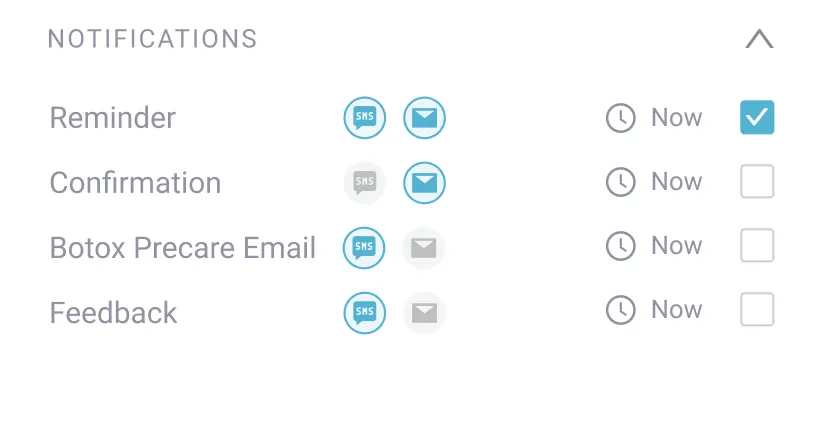
Merge fields pull the first name, the appointment time, the practitioner and the last treatment date out of the record, so nobody retypes them. The booking link points at your own online booking, which means a patient who wants a different slot moves it without calling reception.
The result is a front desk that stops calling patients to confirm, and a month-three nudge that goes out whether or not anyone remembered. Every subscription to our medical spa software includes the full marketing and communications suite, and the sequence gets built with you during structured onboarding.

Pabau attaches reminders, aftercare emails and the three-month recall to the treatment itself, so each one sends on time without anyone keeping a list. Your front desk stops calling patients to confirm.

The copy is the easy part. Rewrite every line above in your own voice and the templates will still work. What you cannot improvise is the calendar.
Month three is not a convenient round number. It is the first interval the label backs, and it lands while most patients can still see what they are about to lose. Send at week 10 and you are ahead of the evidence. Send at month five and you are competing with whoever emailed them in month four.
Set the six dates once, against the treatment rather than against a marketing calendar. The sequence then stops depending on who is on the front desk that week. Book a demo to see how Pabau runs the whole Botox recall sequence off the treatment date.

Building out the rest of your email program? Med spa email marketing templates covers the campaigns that sit beyond reminders and recall.
Need to fill the slot a cancellation leaves? Waitlist management for med spas shows how to offer that opening the same day.
Writing the policy your deposit line quotes? Med spa cancellation policy guide sets the windows, the fees and the wording.
Want the consultation these emails run off? How to do a Botox consultation walks through the assessment, the units and the plan.
Still mapping units to each area of the face? Botox face mapping covers the sites and the dosing behind the treatment plan.
The 48-hour template above is one you can copy as it stands. It is a general-purpose appointment reminder email with two Botox-specific lines added. Those are the alcohol and anti-inflammatory rule, and the no-makeup rule.
Yes, for the pre-appointment send only. A doctor’s version confirms a slot, which is exactly what the 48-hour email does. It carries no day-2 check-in and no Botox rebooking reminder, so the recall half of the cycle goes missing.
At day 2 it repeats aftercare and invites a reply about side effects. At day 14 it asks the patient to look at the settled result. An asymmetry caught then is a quick review, not a correction on top of the next full dose.
48 hours, not 24. Inside 24 hours a patient who cannot make it can only cancel, because there is rarely another slot left to move into. At 48 hours the reschedule link still has options, so the appointment moves instead of disappearing.
Both, split by job. Email carries the prep rules, the aftercare detail and the booking link, because there is room to say it properly. Text carries the two sends that need to be seen within the hour, the 48-hour reminder and the same-day no-show follow-up.