How to ask patients for reviews: Timing, channels and scripts
Knowing how to ask patients for reviews comes down to four habits. Ask every pat...

Last Updated: Oct 8, 2026
An aesthetic clinic deposit policy is the written rule for what a patient pays at the moment they book. The policy also states when that money is refunded, and when the practice keeps it. Almost every aesthetic practice should have one in writing. The payment tools that collect a deposit at booking are part of what our ranking of medical spa systems compares.
Choosing the amount is harder than deciding to charge one. Set it by what an empty slot costs you, not by one house rate applied to every treatment. That rule is the Deposit Ladder, and it runs from a flat consultation deposit up to payment in full.
Below you get the four rungs and the clauses your policy needs. You also get a paragraph to copy into your booking confirmation, plus a rollout sequence for existing patients.

An aesthetic clinic deposit policy states the amount, the point you take it, and when the patient gets it back.
The Deposit Ladder sets the amount by what an empty slot costs you, from a flat consultation fee up to payment in full.
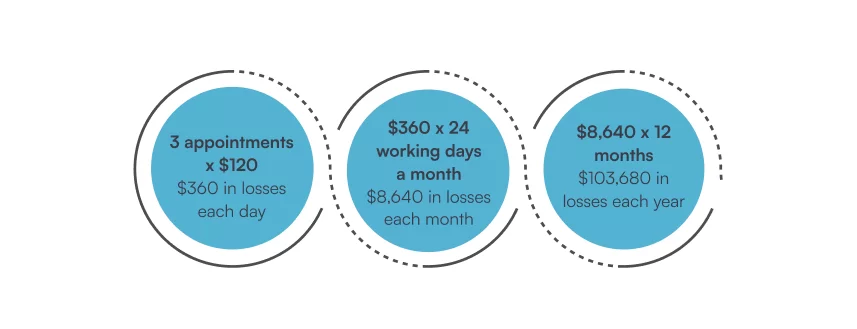
Three practitioners losing one appointment each per day costs a $120-average practice $103,680 a year.
A deposit holds the slot, a cancellation fee charges for late notice, and a no-show fee charges for silence.
Announce the policy, apply it to new bookings first, and give your front desk one sentence to say.
A deposit is a part-payment taken at the time of booking that holds the appointment slot and comes off the treatment price on the day.
Three words get used for the same transaction, and they are not identical. A deposit is a portion of the price, paid to secure the booking. A prepayment is the whole price, paid before the visit. A part-payment is any installment against a treatment plan, and it need not hold a slot at all.
Whichever word you use on your booking page, patients read it as money they have already handed over. So the wording that matters more is refundable or non-refundable. A deposit can be either, and the patient has to know which one applies before they pay it.
Yes, if an empty slot costs you money you cannot recover that day, which covers almost every treatment an aesthetic practice books.
Missed appointments are not rare enough to treat as noise. Published rates put nonattendance at 28% in Medicaid and 15.3% in Medicare. In dermatology, the reported range runs from 17% to 31%. Aesthetics sits alongside dermatology on booking behavior, so plan for a rate in that band rather than hoping for the bottom of it.
Now put that on your own numbers. Take a practice with three practitioners, 15 appointments each per day, at an average of $120. One no-show each per day is three lost appointments, so $360 walks out the door daily. Across 24 working days that is $8,640 a month. Over a year it reaches $103,680.
A deposit does not recover all of that loss. Deposits recover the part you can defend, and they change who books. Taking deposits for appointments filters the schedule before it fills up. Patients who were never sure they would attend tend to stop at the payment screen. Losing those bookings there leaves the slot free for someone who will show up.
There is a second effect that owners notice faster than the revenue. Staff stop working through a call list each morning to confirm who is coming. The confirmation already happened when the card cleared. Providers on med spa commission structures gain as well, because a slot that holds is a slot they get paid for.
Set the deposit by what an empty slot costs the practice, not by one flat rate applied to every treatment on the list.
The Deposit Ladder does exactly that. Its four rungs are ordered by how much the practice has already spent before the patient arrives. A consultation costs you a room and an hour. A treatment that opens a single-use product costs you the product whether the patient shows or not.
| Rung | Treatment type | What to charge | Why that amount |
|---|---|---|---|
| 1 | Consultation | A low flat deposit, redeemed against treatment. In this article’s worked example, $30. | You are protecting time and a room, not stock. A small figure screens out casual bookings without deterring a nervous first-timer. |
| 2 | Standard treatment | A set share of the treatment price, applied the same way every time. | The cost of the empty slot scales with the price of the slot, so the deposit should scale too. |
| 3 | Consumable-backed treatment | The cost of the product opened for that patient. A $50 serum means a $50 deposit. | Once the vial or ampoule is opened, the money is spent. The deposit makes the patient, not the practice, carry that risk. |
| 4 | High-value or long slot | Payment in full at booking. | A three-hour slot cannot be backfilled at short notice. Only payment in full covers a slot that size. |
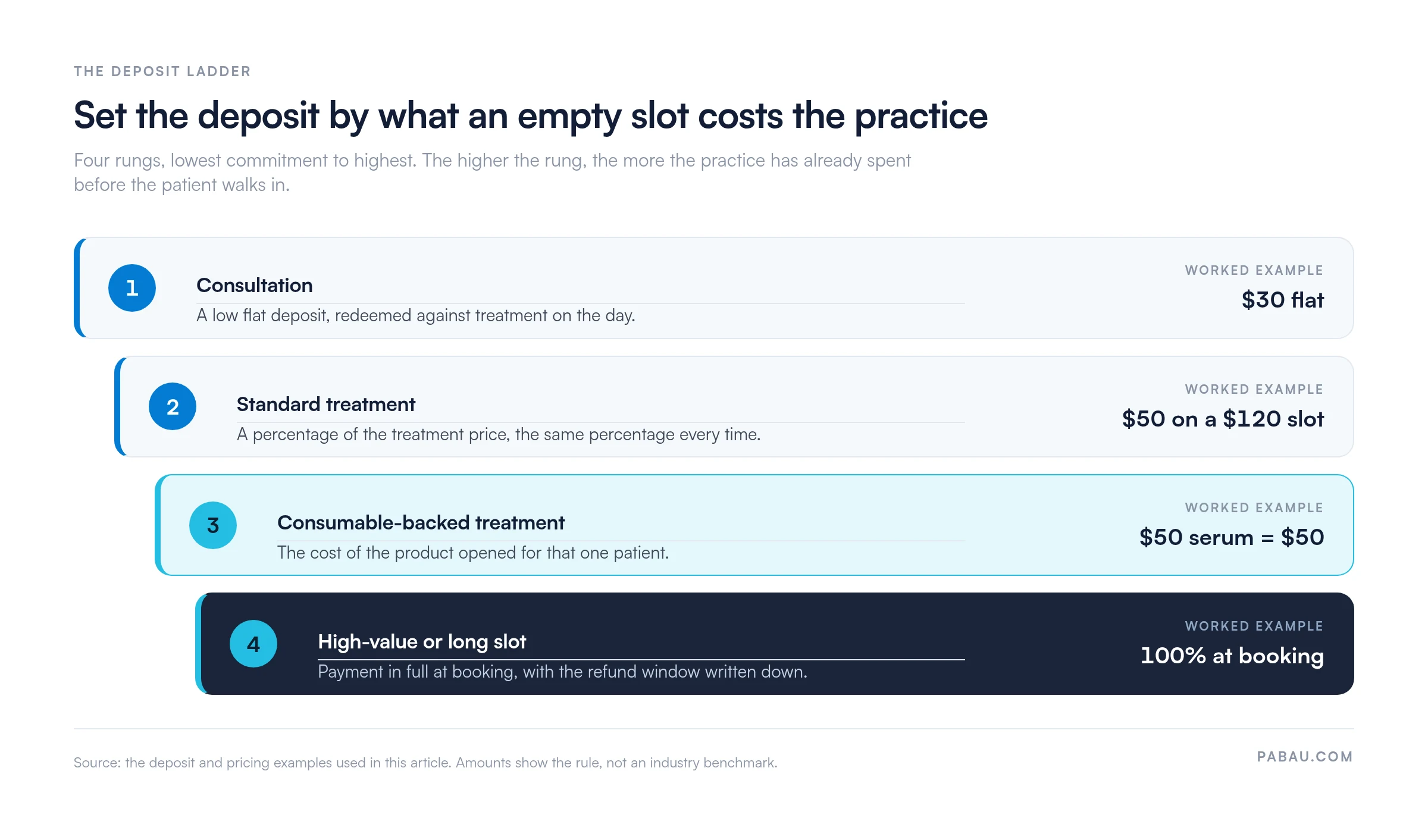
Rung one, consultations. A flat $30 works because the number is small enough to agree to without thinking. Redeem it against treatment on the day and the patient is no worse off for turning up. Charge zero and the consultation schedule fills with people who never intended to come.
Rung two, standard treatments. Pick one share of the price and hold it across the whole menu. On the $120 average used above, a $50 deposit is roughly 40% of the slot. Whatever share you choose, keep it identical everywhere, because a patient who compares two prices and finds two different rules stops trusting both. Where you set that share depends on your med spa pricing strategy.
Rung three, consumable-backed treatments. This rung is the one deposits for aesthetics were invented for. If a patient needs a specific serum that costs you $50, the deposit is $50. The rule explains itself to the patient in a single sentence, which is why it rarely gets argued with.
Rung four, high-value or long slots. Take the whole amount at booking. There is no follow-up payment to chase afterward, and the patient arrives knowing the treatment is already settled.
Every appointment deposit policy must state the amount, the point at which you take it, and the notice window for a refund.
A policy that covers those three points fits in a short paragraph. A longer one usually means you are writing terms for a dispute you have not had yet. Here are the clauses worth including:
Here is a version you can copy into your booking confirmation and your website, swapping the figures for your own:
A deposit of [amount] is taken when you book, and it comes off the price of your treatment on the day. Reschedule or cancel with at least 48 hours’ notice and your deposit moves to the new appointment. With less than 48 hours’ notice, or if the appointment is missed, the deposit is retained. Illness and emergencies are looked at case by case, so please call us.
Storing a card on file makes the late-cancellation charge easy to take. Card on file also makes a dispute easy to start. A cardholder can ask their bank to reverse a charge they did not expect.
What protects the practice is evidence that the patient agreed to the rule before paying. That means a policy shown at the point of booking, a checkbox recording the agreement, and a timestamp you can produce later. Keep that record against the patient file rather than in a staff member’s inbox.
Treat that as a practical precaution rather than legal advice. Deposit and refund obligations vary by state, so have a local attorney read your wording once before it goes live.
State rules shape more than refunds. Texas med spa regulations split oversight across three agencies, and Massachusetts cosmetology license requirements decide which staff may perform which treatments.
A deposit holds the slot, a cancellation fee charges for late notice, and a no-show fee charges for an appointment nobody attended.
| Charge | When it is taken | What it is for | Typically refundable? |
|---|---|---|---|
| Deposit | At the moment of booking | Securing the slot and covering stock bought for that patient | Yes, inside the notice window. The deposit is redeemed against treatment if the patient attends. |
| Cancellation fee | After a cancellation inside the notice window | Compensating for a slot given up too late to refill | No, that is the point of it |
| No-show fee | After a missed appointment with no contact | Compensating for a slot that stayed empty | No |
Most aesthetic practices only need the first row. A deposit you already hold does the job of a no-show fee without the awkward conversation. The money is with you before the appointment, not chased after it.
A booking deposit policy enforces itself when the payment sits inside the booking flow, so the slot is only confirmed once the deposit clears. Every version that depends on a staff member remembering to ask will decay within a month.
Practice management software like Pabau handles the rule at the point of booking. So your written policy and your booking page have to match. Purpose-built medical spa software also lets you vary the rule by service rather than forcing one rate across the menu.
Patients book outside opening hours, which is the main reason an online booking system earns its place. The booking screen is also the one moment where taking a deposit costs nobody any effort.
The patient picks a treatment and sees the deposit and the policy on the same screen. Payment goes through the processor before the slot is held. Nobody at the front desk has to raise the subject, and no card details pass over the phone.
Service-specific deposits are how the Deposit Ladder stops being a diagram and starts being a setting. Charge $30 on an online consultation and $50 on an in-person treatment, because the two slots cost the practice different amounts.
Booking systems that support this usually offer three shapes: a flat amount, a percentage of the price or payment in full. Map each treatment on your menu to one of them once, and the rule applies itself from then on. Check scope before a treatment reaches that menu, because a Nevada cosmetology license does not cover injectables or most medical lasers.
A small number of patients miss appointments again and again, and a standard deposit does not change their behavior. Tag those records and raise the deposit for that patient specifically.
Handle it as a quiet setting rather than an announcement. The patient sees a higher figure the next time they book, and the slot is covered either way. Nobody has a difficult conversation at reception.
Give existing patients notice, start with the treatments where an empty slot costs most, and tell them what the deposit buys them.
Switching an established patient base onto deposits is mostly a communication job. In practices we onboard, the pushback arrives in the first two weeks and then stops. That is worth knowing before you soften the rule on day three. Run it in this order:
Expect a handful of regulars to grumble and almost none of them to leave. The deposit changes the relationship less than owners fear, and the practices that struggle are usually the ones that apply it inconsistently. Framing it as part of the booking experience, rather than as a new charge, also protects patient engagement through the change.
Deposits for aesthetics cost you something too, and the honest version of this decision names the price. Four factors are worth weighing before you switch the setting on.
Local norms. If no other practice within a few miles asks for money upfront, you will be the first. Some patients read that as a lack of trust. That is survivable, but it is easier if your booking page explains the rule rather than just displaying it.
Card processing fees. Every deposit carries a processing charge, and a refunded deposit sometimes carries it twice. On rung one, that fee is a meaningful share of a $30 payment. Check what your processor does with refunds before you set the figure.
The ethical line on consultations. A patient who is still deciding whether to have a treatment should not feel financially committed to going through with it. Keeping rung one low and clearly redeemable is what stops a consultation deposit from turning into pressure.
Refund handling. Somebody has to process refunds inside the notice window, and a slow refund does more damage than the deposit ever earned. Decide who owns that job and how quickly they do it before the first cancellation lands.
Pabau sets the deposit on the service, not on the booking. Each treatment on your menu carries its own rule. The choices are a flat amount, a percentage of the price, payment in full, an optional deposit or none. That is the Deposit Ladder expressed as four settings.
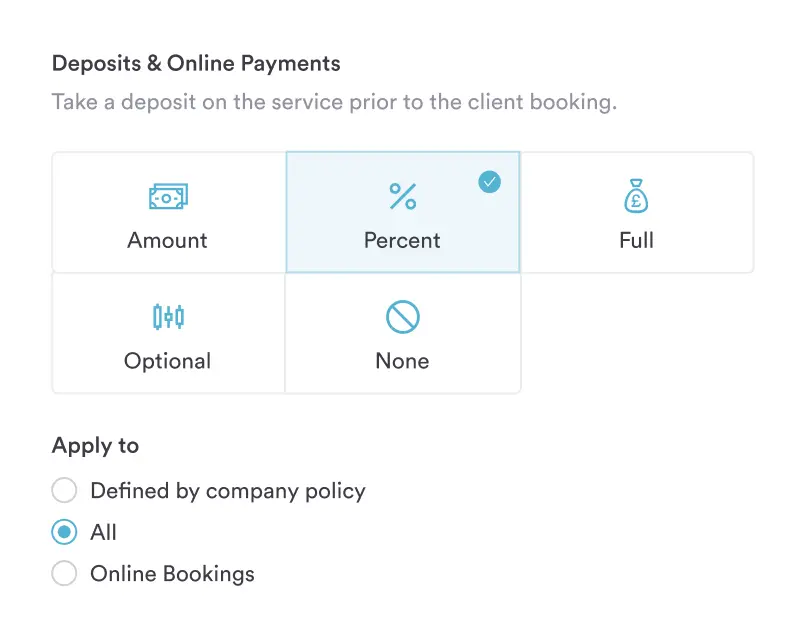
You also choose where the rule bites. Apply the deposit to every booking, or only to bookings made online. Restricting it to online bookings phases the policy in without changing how regulars book by phone.
Scheduling, deposits and reminders sit in the same system, and that matters more than any one of them alone. The calendar holds the slot, the deposit secures it, and automated reminders go out on your schedule before the appointment. When a patient does cancel inside the window, the record already shows what was paid and what your policy says about it. Every Pabau subscription includes each of those, so none of it depends on a higher tier.

Pabau sets a deposit rule on every service, collects it at online booking, and sends automated reminders from the same calendar. Your front desk stops chasing payments and confirming appointments by phone.

The question worth settling is whether your deposit amounts were chosen or inherited. One house rate across the whole menu is the inherited version. That rate under-charges the treatments that hurt most to lose, and over-charges a consultation that costs you an hour.
Walk your treatment menu once and put every service on a rung. Write the three-sentence policy. Then leave it alone for a month, because the practices that abandon deposits are almost always the ones that renegotiated them in week one.
The trade-off is honest. You will lose a few bookings you would rather have kept, and you will stop losing the slots that cost most. Book a demo to see how Pabau sets a deposit rule per treatment and collects it at the point of booking.

Wondering what an empty slot costs you? Aesthetic clinic profit margin breaks down where the money in a treatment goes.
Consultations not converting? Converting consultations into surgical bookings covers the follow-up that turns a paid consultation into a treatment.
Choosing how to take the money? Best integrated payment processing tools compares the processors that sit behind a deposit at booking.
Setting your treatment prices? Med spa charm pricing explains how the number on the price list changes what patients book.
Need the booking side sorted first? Best medical spa scheduling software reviews the systems that can hold a deposit rule per service.
Taking the deposit at the point of booking means the patient commits money before the slot is held. A missed appointment then costs the patient money, and the practice keeps part of the value of that slot.
Yes. Service-specific deposits let you charge $30 on an online consultation and the full product cost on a treatment that opens a consumable. The Deposit Ladder above decides which rung each treatment on your menu sits on.
Three practitioners losing one appointment each per day, at a $120 average, is $360 a day. Across 24 working days that reaches $8,640 a month, or $103,680 a year.
Yes, and rung four of the Deposit Ladder recommends exactly that for high-value or long slots. Booking systems that handle deposits normally offer a flat amount, a percentage of the price or payment in full.
A deposit is a part-payment the patient makes when they book. Taking deposits for appointments holds the slot, and the money comes off the treatment price on the day.
Charge what the empty slot costs you. Deposits for aesthetics work best as a small flat fee on consultations and a set share of the price on standard treatments. Where a consumable gets opened, charge the product cost.