











Key takeaways
S72.431R covers a displaced medial condyle fracture of the right femur at a subsequent encounter, for an open type III fracture with malunion.
The 7th character R means open fracture type IIIA, IIIB, or IIIC with malunion, so it never applies to a closed fracture.
Closed fracture malunion at the same site takes 7th character P, and open type I or II malunion takes Q.
The 6th character carries displacement and laterality together, so 1 through 3 are displaced and 4 through 6 are nondisplaced.
Pabau’s claims management tools attach ICD-10 codes inside the patient record, so the code on the claim matches the clinical note.
ICD-10 Code S72.431R is a billable ICD-10-CM diagnosis code for a displaced fracture of the medial condyle of the right femur. In short, it applies at a subsequent encounter, once an open fracture of type IIIA, IIIB, or IIIC has healed with malunion.
In fact, the open fracture requirement is where this code is most often misapplied. In practice, coders reach for R whenever the record says malunion, but closed fracture malunion belongs to character P instead. So this guide covers the code hierarchy, the full 7th character set, sibling codes, documentation requirements, and the ICD-9 crosswalk.
ICD-10 Code S72.431R: definition, billable status, and 2026 validity
Specifically, ICD-10 Code S72.431R is a billable and specific ICD-10-CM diagnosis code. Indeed, the CDC/NCHS ICD-10-CM web tool confirms it is valid for the 2026 code set, starting October 1, 2025. As a result, it maps to one well-defined clinical scenario, so payers accept it directly on claims.
Also, the CMS ICD-10-CM/PCS code files maintain the tabular list and coding rules for this code family. So, confirm the code is still valid before applying it to a claim, because additions and revisions land with each October update.
Code hierarchy: parent codes for S72.431R
Overall, S72.431R sits at the bottom of a four-level hierarchy within the fracture of lower end of femur classification. Therefore, the parent chain matters for correct specificity, and for choosing among sibling codes when laterality or fracture type differs.
In fact, the S72 category covers every femur fracture, from femoral neck injuries at the proximal end to the distal condylar fractures in S72.4. Specifically, that subcategory groups the medial condyle, the lateral condyle, and the supracondylar regions. In turn, S72.43 narrows to the medial condyle alone.
The 6th character then carries displacement and laterality together. Namely, characters 1, 2, and 3 are displaced right, left, and unspecified femur. Likewise, characters 4, 5, and 6 are the nondisplaced versions. For example, sibling code S72.451K shows the same pattern applied to the supracondylar region.
Understanding the 7th character R: open fracture type III with malunion
First, the 7th character is where most S72 coding errors start. In fact, it shows the encounter type, whether open or closed, and how it healed, so all three must be noted before you use S72.431R.
Malunion vs. nonunion: Specifically, malunion means the bone healed out of line—bent, twisted, or shortened. In contrast, nonunion means it never healed at all. Specifically, for an open type III injury, malunion takes the R character and nonunion takes N. Likewise, S52.262K covers the same split in the forearm.
So, swapping these characters is a coding error that can trigger an audit—check what healing outcome the provider recorded before you pick one.
Clinical meaning: displaced fracture of the medial condyle of the right femur
In short, the medial condyle is the rounded bony prominence on the inner aspect of the distal femur, forming part of the knee joint. For example, fractures here often follow high-energy trauma such as motor vehicle collisions or falls from height. As a result, orthopedic surgeons and sports medicine clinicians see this pattern most often.
- Displaced: Specifically, the fracture fragments have moved out of normal anatomical position. Displacement and laterality share the 6th character, so 1 is displaced right and 4 is nondisplaced right. So, displaced condylar fractures often need surgery.
- Medial condyle: Namely, the site on the inner side of the distal femur. Meanwhile, lateral condyle fractures are coded under S72.42x, and unspecified condyle fractures under S72.41x.
- Right femur: Specifically, right is S72.431, left is S72.432, and unspecified is S72.433. Indeed, in every case, laterality must come from the provider, not from the coder.
- Open type IIIA, IIIB, or IIIC: The first injury broke the skin and carried extensive soft tissue damage under the Gustilo-Anderson classification. By contrast, type I and type II open fractures use different 7th characters.
- Subsequent encounter: Specifically, the patient is in follow-up care after active treatment of the acute fracture. Previously, the active treatment phase for this injury uses 7th character C.
Related ICD-10 codes for medial condyle femur fractures
Overall, patients move through several sibling codes across an episode of care, as the encounter type and healing status change. Specifically, the table below lists the codes most often confused with S72.431R. First, the initial encounter code S72.431C is where the same episode usually starts.
Specifically, use S72.433R for an unspecified femur only when the record genuinely does not state a side. Indeed, laterality must come from the provider’s documentation rather than the coder’s assumption. Otherwise, coding «unspecified» when the provider documented right or left is a specificity error that can trigger a claim edit.
Documentation requirements for ICD-10 Code S72.431R
Indeed, applying this code correctly requires the medical record to support six clinical facts. Otherwise, if any one of them is absent, a different code or a provider query is warranted. In addition, a structured patient record system with encounter-type and fracture-status fields keeps those details in one place.
- Fracture site confirmed: Specifically, the documentation names the medial condyle of the femur. Otherwise, if the record says only «condylar fracture» without stating medial or lateral, query the provider.
- Right side specified: Notably, the provider clearly notes the right femur. Otherwise, if only «femur» appears, use S72.433R and consider a query for clarification.
- Displaced fracture type: Specifically, the provider notes displacement. By contrast, nondisplaced fractures of the same condyle use S72.434, S72.435, and S72.436 instead.
- Open type III confirmed: Specifically, the 7th character R applies only to open fractures graded IIIA, IIIB, or IIIC. Meanwhile, a closed fracture takes P, and an open type I or II fracture takes Q.
- Subsequent encounter status: Specifically, the visit is follow-up care after active treatment, not the initial emergency or surgical encounter.
- Malunion clinically established: Notably, the provider notes malunion, ideally with imaging that shows angular, rotational, or shortening deformity. Indeed, digital clinical documentation forms with a healing-status field help teams capture this consistently.
Pro Tip
First, audit your S72 subsequent encounter codes each quarter. Then, pull every claim where a routine-healing character was billed more than six months after the initial encounter date. Indeed, by that point, the record should describe the fracture as healed, malunited, or nonunited. So, routine-healing claims past the expected window are a common audit trigger.
ICD-9-CM to ICD-10-CM crosswalk: S72.431R and code 733.81
For instance, practices holding legacy billing data or answering audits on historical claims will find the ICD-9-CM match for S72.431R is 733.81. However, the mapping is approximate. Meanwhile, the AAPC’s ICD-10-CM code lookup and the General Equivalence Mappings from CMS and NCHS are the trusted references.
In fact, ICD-9-CM 733.81 was a broad malunion code that maps to many S72 malunion codes in ICD-10-CM. That one-to-many relationship means it does not convert cleanly to a single successor, so translating legacy data needs the original clinical record, not just the forward-mapping file.
Notably, the site, laterality, and open fracture grade all have to come from somewhere. For that reason, always check crosswalk results against the GEM files rather than commercial conversion tables.
Coding guidelines and common errors when using ICD-10 Code S72.431R
Reference sites list the code but rarely explain where billers go wrong. Specifically, the errors below come up most often in orthopedic coding audits for this family, per WHO and CMS rules.
- Treating R as the closed fracture malunion code: Notably, this is the most frequent error on S72.431R claims. R is reserved for open type IIIA, IIIB, and IIIC injuries; instead, closed fracture malunion takes P.
- Skipping the Gustilo grade: Specifically, open type I and II injuries take Q, not R. So, check the grade in the surgery or ER record before you pick the encounter character.
- Confusing initial and subsequent encounters: Notably, using C at a follow-up visit is common. Once active treatment ends, use an F, J, N, R, or S character instead.
- Confusing malunion with nonunion: Specifically, N means the fracture never healed, while R means it healed out of line. Also, each needs a different CPT code, so a mismatch means diagnosis and procedure disagree.
- Laterality left unspecified: Notably, choosing S72.433R when the record notes a side is not specific enough. It may still get paid but can fail an audit.
- Omitting the cause-of-injury code: S72.431R shows the site and healing status, not how the injury happened, so add an external cause code from the V00-Y99 range where payer rules call for it.
So, most errors happen when the note is written, not when the claim is sent. As a result, an EHR that carries the code removes that step.

Pro Tip
First, record the Gustilo-Anderson grade at the initial encounter. Then, if a patient transfers mid-treatment and the grade is unclear, ask for the surgery or ER records, since it drives every later encounter character.
How Pabau supports ICD-10 coding and claim accuracy
Today the coder looks S72.431R up on a reference site, then retypes it into a separate billing system. Consequently, that handoff is where a 7th character quietly turns into the wrong one, and where the claim stops matching the note behind it.
By contrast, practice management software like Pabau removes the retyping step. Instead, staff search for and attach the diagnosis code inside the patient record at the point of care. The code then flows into the claim unchanged, so laterality and 7th character errors have nowhere to enter.
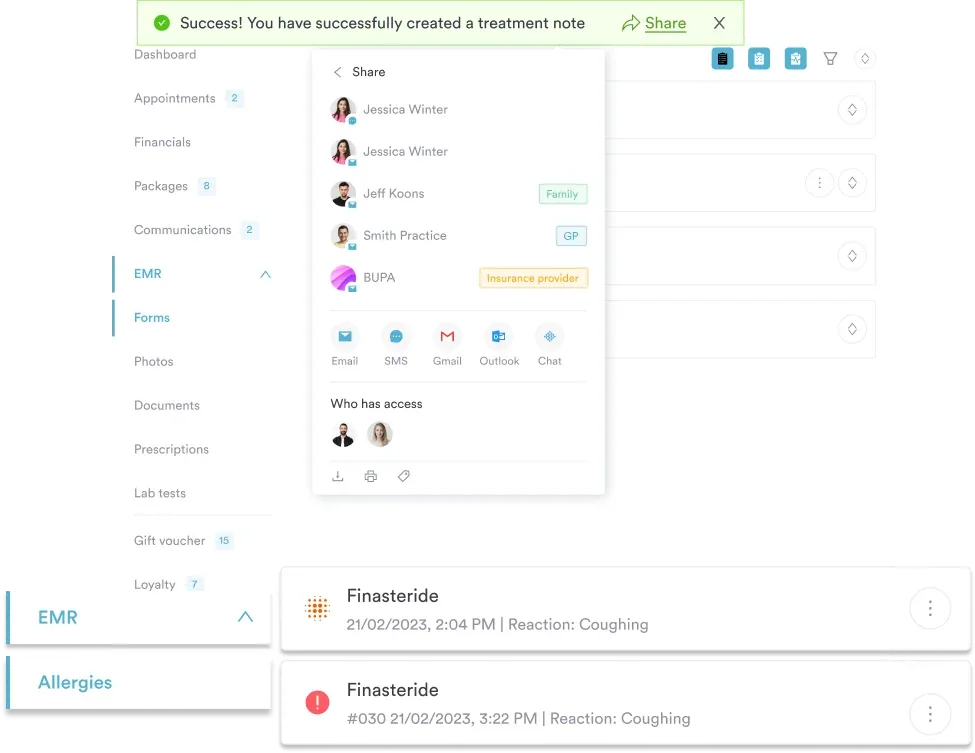
Notably, orthopedic, sports medicine, and rehabilitation teams often track fracture cases across many encounters. Similarly, for them, physical therapy EMR software keeps the episode record consistent from the initial encounter through discharge. Pabau’s claims management tools then surface the attached code next to the clinical note, so you can confirm it matches what the provider documented.

Keep ICD-10 codes and clinical notes in step
Pabau attaches diagnosis codes inside the patient record and carries them through to claim submission without re-keying. That keeps encounter type, laterality, and healing status consistent across every visit in a fracture episode.

Conclusion
Ultimately, S72.431R rewards one habit above all others: reading the 7th character definition in full before you assign it. However, the letter only looks like a generic malunion marker; it is not. In fact, it commits the claim to an open type III injury that the original operative record has to support.
Indeed, practices that capture the Gustilo grade, the side, and the healing status at the point of care rarely have to revisit this code. By contrast, those that treat coding as a step after documentation end up choosing between P, Q, and R from an incomplete note. In the end, the correction costs far more than the original query would have.
An integrated practice management platform keeps that decision inside the clinical record instead of a separate lookup. So, book a demo to see how Pabau keeps fracture coding accurate across every encounter in an episode.

Continue your research
Coding another subsequent encounter injury? S21.439D walks through the same 7th character logic for a thoracic puncture wound.
Billing the surgical side of fracture care? CPT code 20938 covers structural autograft documentation and the modifiers that go with it.
Documenting ligament findings alongside a fracture? Eversion stress test explains how to perform the maneuver and record the findings defensibly.
Assessing limb length after malunion? Supine to long sit test shows how clinicians screen for apparent leg length discrepancy.
Frequently asked questions
What does ICD-10 Code S72.431R mean?
Put simply, ICD-10 Code S72.431R is a billable ICD-10-CM code for a displaced fracture of the medial condyle of the right femur. Specifically, it applies at a later encounter, once an open type IIIA, IIIB, or IIIC fracture has healed with malunion, out of its normal position.
Is S72.431R a billable ICD-10-CM code?
Yes. S72.431R is a billable, specific ICD-10-CM code for the 2026 code set, so payers accept it as-is on claims.
Does S72.431R apply to a closed fracture?
No. Specifically, the 7th character R is only for open fractures graded IIIA, IIIB, or IIIC. Instead, a closed fracture with malunion takes P, while an open type I or II fracture with malunion takes Q. So, using R on a closed fracture is the most common error on this code.
What is the difference between S72.431C, S72.431F, and S72.431R?
Notably, all three describe a displaced open type III fracture of the medial condyle of the right femur, and only the 7th character is different. Specifically, C is the initial encounter, F is a subsequent encounter with routine healing, and R is a subsequent encounter with malunion.
What does malunion mean in fracture coding?
Malunion means the bone healed out of line, bent, twisted, or shortened, instead of straight. In contrast, nonunion means the bone never healed at all. So, malunion takes P, Q, or R depending on the fracture grade, while nonunion takes K, M, or N.
What documentation is required to use ICD-10 Code S72.431R?
Specifically, the record must show a displaced fracture at the medial condyle of the right femur, graded as an open type IIIA, IIIB, or IIIC injury, at a later encounter with malunion noted by the provider. If anything is missing, ask the provider first.