

HCPCS code E0198: Water pressure pad billing guide
HCPCS code E0198 is a water pad for a standard mattress HCPCS code E0198 is the ...

Last Updated: Oct 13, 2026
Billable Code Specific Code
S72.451K is the billable ICD-10-CM code for displaced supracondylar fracture without intracondylar extension of lower end of right femur, subsequent encounter for closed fracture with nonunion.
Let Pabau's smart automation suggest the right codes, reduce claim denials, and keep your practice compliant—effortlessly.
Automate repetitive tasks and focus on what matters most—your patients.
Reduce coding errors and ensure compliance with the latest regulations.
Clean claims, fewer denials, and faster reimbursements.
Powerful insights and reporting to help your practice thrive.
HIPAA compliant SOC 2 certified GDPR-compliant Trusted by 4,000+ clinics worldwide

In short, S72.451K is a billable ICD-10-CM code for a displaced supracondylar fracture of the lower right femur. That is, it applies at subsequent encounters when nonunion is noted.
In fact, the 7th character K marks a follow-up encounter for a closed fracture that has failed to heal. As such, it keeps this code apart from D for routine healing and S for sequela.
Put simply, without intracondylar extension means the fracture line does not cross the joint surface into the condyles. So, that puts the code in the S72.451 family rather than the condylar families.
In practice, Pabau, an all-in-one practice management system, submits orthopedic claims online, runs real-time coverage checks, and tracks each claim through to a payer outcome.
In short, ICD-10 Code S72.451K is a billable code for a displaced supracondylar fracture of the right distal femur. That is, it applies at a follow-up encounter where the closed fracture has been noted as a nonunion. In turn, the 7th character K is what carries the nonunion status, and it keeps this code apart from S72.451D and S72.451P.
Broadly, this reference covers the full code description, the complete 7th-character set, nearby codes, and documentation needs. Last, it closes with the coding errors that most often send these claims back.
In fact, every word in the full description of ICD-10 Code S72.451K carries coding weight. Indeed, misread any part and you land on another code. Here is what each part means:
First, a coder working from an operative or clinic note needs all seven of these details noted to support S72.451K. If any one of them is missing, mainly laterality or the nonunion status, payers will question the code. Even so, practice management software like Pabau submits the finished claim online and reports its status back. As a result, an incomplete record shows up as a payer reply you can act on.
In practice, how supracondylar differs from intracondylar is something coders and clinicians often mix up. Still, knowing the anatomy makes the coding choice simple.
So, the distal femur widens as it approaches the knee and splits into two rounded parts: the medial and lateral condyles. The spot just above this split, where the femoral shaft turns into the condylar flare, is the supracondylar zone. As a result, a fracture here stays close to the joint surface.
Indeed, supracondylar fractures without intracondylar extension are common in high-energy trauma and in older patients with osteoporosis. In these cases, orthopedic teams use physical therapy practice software to track rehab across post-op visits. This detail also matters for surgery planning, since a fracture that enters the joint needs a different operation. As a result, a medial condyle fracture coded as S72.431C sits in its own family.
In fact, the 7th character in ICD-10-CM fracture codes does the heaviest lifting. That is, for any S72.451x code, it tells the payer just where the patient is in their fracture care journey. As a result, getting this wrong is the most common reason these claims are denied.
Indeed, fracture codes are more complex than most ICD-10-CM code groups because S72.451 takes 16 different 7th characters. Of these, six cover closed fractures and sequela, while the other ten cover open fractures, split by Gustilo type. Likewise, open-fracture nonunion is coded with M or N rather than K, in the same way S72.431R handles an open malunion. The full table appears in the next section.
In fact, ICD-10-CM Official Guidelines set no fixed timeline for nonunion. Instead, the call rests with the treating doctor, backed by imaging. Note it clearly, and the K character is supported; without that note, though, payers will question the code.
First, flag the change from D to K in your EHR workflow. As soon as the doctor notes nonunion for the first time, the coder should update the encounter type right away, not at the next billing cycle. If not, a single mismatched D code on a nonunion visit can trigger a payer audit of the entire case.
In short, S72.451 is the 6-character parent for displaced supracondylar fractures without intracondylar extension of the lower end of the right femur. Beyond that, the 7th character sets the complete, billable code. All 16 valid characters are listed below, plus the open-fracture characters that many coding guides leave out.
Per the CMS ICD-10-CM coding guidelines, the 7th character reflects the status of the fracture at the time of the encounter, not how far along treatment is. For instance, a new injury seen in the emergency department always takes the A character, and that holds even at the hospital that treated the patient’s previous fracture.
Put simply, nonunion means the fracture has not healed and is unlikely to heal on its own. As such, it is a clinical diagnosis, confirmed by imaging, and it changes both the treatment plan and the coding approach.
On imaging, nonunion often shows a lasting fracture gap, sclerosis of the fracture ends, or the formation of a pseudarthrosis (a false joint). Clinically, meanwhile, the patient often reports ongoing pain at the fracture site and, in weight-bearing bones like the femur, trouble walking.
Nonunion coding follows the same pattern in other long bones, which is why S52.262K reads almost the same way for the radius. Given this pattern, practices that manage hard orthopedic cases gain from structured HIPAA-compliant documentation workflows. In turn, those workflows keep nonunion recorded every time across visits, not only in the surgeon’s operative note.
In fact, S72.451K sits within a large family of distal femur fracture codes. As such, knowing the nearby codes helps coders check laterality, displacement status, and encounter type at a glance. Sports medicine practices that manage these injuries, for instance, record diagnoses and billing detail in one place with sports medicine practice software.
In practice, operative reports, radiology reads, and clinic notes rarely use the precise ICD-10-CM language. Still, these other phrasings all map to ICD-10 Code S72.451K in the alphabetic index.
When reading radiology reports, look for phrases such as “fracture gap persists,” “no bridging callus,” or “pseudarthrosis formation.” These support the nonunion label, but the doctor still has to confirm it in the clinical check. Indeed, per the AAPC ICD-10-CM code reference, coders follow the doctor’s stated judgment, not imaging findings alone.
In fact, a missing laterality note is one of the most common triggers for orthopedic fracture claim rejections. So, for ICD-10 Code S72.451K, seven documentation items must appear in the clinical note or operative report before a coder can safely assign this code.
Indeed, practices running orthopedic follow-up programs gain from structured patient record management that tracks visit type, fracture status, and imaging findings over the course of care. As a result, a steady record structure makes each of these seven items easy to find at billing time.
Payer-specific rules vary; for instance, some payers require imaging reports along with the clinical note to support nonunion. So, check the payer’s documentation policy before a revision surgery, since duties go beyond the fracture code to the whole span of care.
In fact, S72.451K rarely appears on a claim without a procedure code. After all, nonunion care needs active treatment, and each treatment step has a matching CPT code. So, the table below covers the most often paired codes based on standard orthopedic nonunion treatment paths.
Indeed, prior auth rules for nonunion surgery vary by payer and plan. So, check the individual plan’s current coverage policy rather than assuming a payer waives or requires it. Also, where the graft is taken through a second cut, the autograft rules that govern CPT 20938 are worth reading along with 27472. Note, per the CDC ICD-10-CM web tool, S72.451K is valid for filing FY2026 claims.
In fact, three coding mistakes account for most of the denials on S72.451K claims. Still, each one is easy to prevent with the right workflow.
In practice, a structured pre-submission check of orthopedic claims, sorted by S72.4x codes, usually reveals a pattern in encounter-type errors. So, practices that route these claims through a set review step see fewer denial cycles for this code family. Once the coder signs off, Pabau submits the claim online and reports its status back, so a denial then shows up in days rather than at month-end review. For context, the WHO ICD-10 browser holds the international framework behind the US version. An out-of-network claim rests on the paperwork the practice hands over, so what a superbill includes matters. Revenue cycle management treats coding, submission and collection as one process rather than three handoffs.
In most orthopedic practices, a nonunion claim passes through three disconnected systems. First, the doctor’s note lives in the record, and the coder works from a printout or their own summary. Next, the claim goes out through a clearinghouse portal that nobody logs into daily. As a result, denials show up weeks later, at review time.
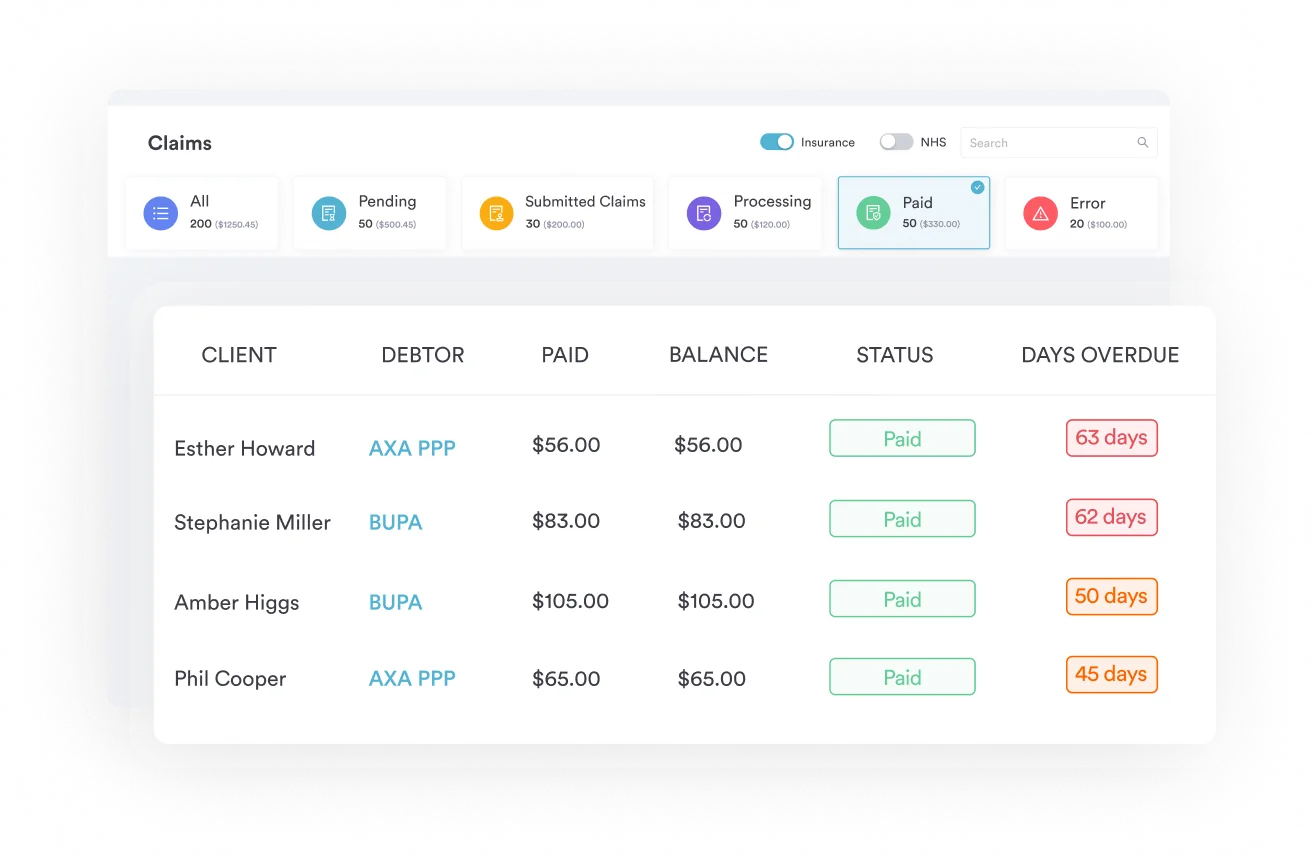
In short, Pabau keeps those steps in one place: the clinical note, the imaging finding, and the coded claim sit against the same patient record. Also, coverage is checked in real time before the visit. Our claims management software then submits the claim and reports its status back as the payer works on it.
Indeed, the coder still owns the code choice; what changes is the feedback loop. As a result, a rejected S72.451K claim shows up in days, while the encounter is still fresh enough to fix. For more detail, our comparison of claims management software sets out how that filing path differs from a standalone clearinghouse.

In practice, Pabau submits your claims online, checks patient coverage in real time, and tracks every claim through to a payer outcome. Your billing team sees where each S72.451K claim stands without leaving the patient record.

In short, the 7th character is the part of S72.451K worth defending. Indeed, K is never a default value, and it holds only where the doctor has written nonunion into the note. So, if the note is silent on healing status, the safe move is to ask, not to guess between D and K.
Practices that build the healing-status check into their standard follow-up template stop making this error for good, because the coder never has to guess at it. In exchange, the trade-off is one extra field on every orthopedic follow-up note. Practice management software can carry that field and the claim it feeds. To see how Pabau handles orthopedic claim filing and tracking, book a demo.

Coding the orthosis supplied after fixation? L0458 sets out the documentation a spinal orthosis claim needs.
Adding the external cause code? W49.09XD shows how the subsequent-encounter character works on the injury cause side.
Coding a late effect of the original accident? V86.54XS covers the sequela character on transport-related injuries.
Drawing blood from an implanted port? Implanted port blood draw billing covers the code for collecting blood from a fully implanted venous access device such as a Porta-Cath.
Billing an unlisted vascular procedure? Unlisted vascular procedure billing explains why these claims get denied more often and land with a human reviewer instead of automated processing.
In short, ICD-10 Code S72.451K is a billable ICD-10-CM diagnosis code for a displaced supracondylar fracture of the right distal femur. That is, the fracture does not extend into the condyles. Rather, the code applies at a subsequent encounter, where the closed fracture is noted as a nonunion. In short, it is valid for filing FY2026 claims on HIPAA-covered transactions, effective October 1, 2025.
In short, S72.451D is used at a subsequent encounter when the fracture is healing as expected. By contrast, S72.451K is used once the doctor has noted nonunion, meaning the bone has failed to heal. So, the moment the clinical note records nonunion, D should be replaced with K for all subsequent encounters related to that injury.
Put simply, without intracondylar extension means the fracture line does not cross into the femoral condyles or the knee joint surface. Instead, the fracture stays in the supracondylar zone, above the condyles. This matters for coding because fractures with intracondylar extension belong to another family, S72.441 and related codes. As a result, those fractures usually need harder surgery and other CPT pairings.
Simply, S72.452K is the direct match for the left femur. That is, it carries the same description, with the left side in place of the right. That is, the laterality changes at the 5th character spot (1 = right, 2 = left, 9 = unspecified). So, never use S72.451K for a left-sided fracture.



