ICD-10 Code Y76.0: Diagnostic obstetric and gynecological devices
ICD-10 Code Y76.0: Definition and billable status ICD-10 Code Y76.0 is a valid, ...

Last Updated: Oct 23, 2026
Billable Code Specific Code
S82.032Q is the billable ICD-10-CM code for displaced transverse fracture of left patella, subsequent encounter for open fracture type I or II with malunion.
Three codes in this family describe the same misaligned bone, so the grade recorded at the initial encounter is the only difference between them. That grade usually sits in a trauma note from months earlier, which is where the wrong character creeps in.
Let Pabau's smart automation suggest the right codes, reduce claim denials, and keep your practice compliant—effortlessly.
Automate repetitive tasks and focus on what matters most—your patients.
Reduce coding errors and ensure compliance with the latest regulations.
Clean claims, fewer denials, and faster reimbursements.
Powerful insights and reporting to help your practice thrive.
HIPAA compliant SOC 2 certified GDPR-compliant Trusted by 4,000+ clinics worldwide

ICD-10 code S82.032Q is a displaced transverse fracture of the left patella, subsequent encounter for open fracture type I or II with malunion.
The 7th character Q means the original fracture was open and graded Gustilo type I or II. It has since united in a malaligned position.
Malunion after a closed fracture of the same bone is S82.032P, and after a Gustilo type III wound it is S82.032R.
An open fracture documented without a Gustilo grade still takes the type I or II characters, so Q is the default open-fracture malunion code.
The note must confirm a subsequent encounter, an open wound, left laterality, and imaging evidence of malunion.
S82.032Q is a billable ICD-10-CM code. Its full descriptor is displaced transverse fracture of left patella, subsequent encounter for open fracture type I or II with malunion.
Three codes describe that same malunited fracture, and the wound at the time of injury is what separates them.
That detail is easy to lose by the time the patient returns for aftercare. The wound has usually closed months earlier, and the current progress note may never mention it.
ICD-10-CM still expects the 7th character to reflect how the fracture was first classified.
Because it is billable and specific, S82.032Q can stand alone on a claim without a more granular subcategory. It is also not a new code.
The S82.032 family carried the same 16 seventh-character extensions in earlier ICD-10-CM editions, and the current descriptors are published in the CMS ICD-10 code files.
Coverage and payment still follow individual payer policy, so treat what follows as coding guidance rather than a payment promise.
S82.032Q lives under S82, the lower-leg fracture category, because ICD-10-CM files patellar fractures with the lower leg rather than the knee joint. That surprises coders who expect to find the kneecap somewhere in the S83 range.
The hierarchy matters when documentation is thin and you have to fall back on a parent code. Each level adds one piece of specificity. Body region comes first, then the bone, then the fracture pattern, then the side, then the encounter and healing status.
One row is worth pausing over. S82.03 is titled “Transverse fracture of patella”, and it covers both the displaced codes (S82.031 to S82.033) and the nondisplaced codes (S82.034 to S82.036). So the group name alone will not tell you whether the fragments moved.
Laterality is mandatory once the chart names a side. S82.031Q covers the right patella and S82.033Q covers an unspecified patella, and there is no S82.039.
The right-side code also shifts with the encounter. For a closed displaced transverse fracture of the right patella in active treatment, the code is S82.031A.
The CDC ICD-10-CM web tool walks the same hierarchy by code year, so you can confirm which extensions a parent accepts.
Every code in category S82 needs a 7th character, and S82 uses the full 16-letter set. Each letter states whether the encounter is initial or subsequent, whether the fracture was closed or open, and how the bone healed.
Get one of those three wrong and the whole code is wrong.
The set skips I, L and O, because those letters read too easily as digits. That is why the sequence jumps from H to J and from K to M.
Every description in the third column follows the stem “Displaced transverse fracture of left patella”.
ICD-10-CM collapses the five Gustilo grades into two coding paths. Types I and II share one set of characters, and types IIIA through IIIC share another. The S82 category note points to that classification, which grades the wound and the soft-tissue injury rather than the bone.
So five clinical grades become two coding decisions. S82.032Q is correct only when the surgeon graded the original wound as type I or type II. A type III grade anywhere in the record moves the malunion code to S82.032R.
The same type III split applies long before any malunion is known. A displaced transverse patella fracture with a type III wound and no documented side is S82.033C at the initial encounter.
There is a useful default here, and it works in Q’s favor. The ICD-10-CM Official Guidelines instruct coders to assign the type I or II characters when an open fracture is documented without a Gustilo grade. An ungraded open fracture that healed in malalignment therefore lands on Q, not R.
A second default points the other way, which is where coders get caught. The S82 note says a fracture not documented as open or closed is coded to closed. Silence about the wound sends the malunion to P, while an ungraded open wound sends it to Q instead. With no side documented either, that closed malunion takes ICD-10 code S82.033P.
Those two defaults pull in opposite directions, so the four documentation routes below land on only three codes.
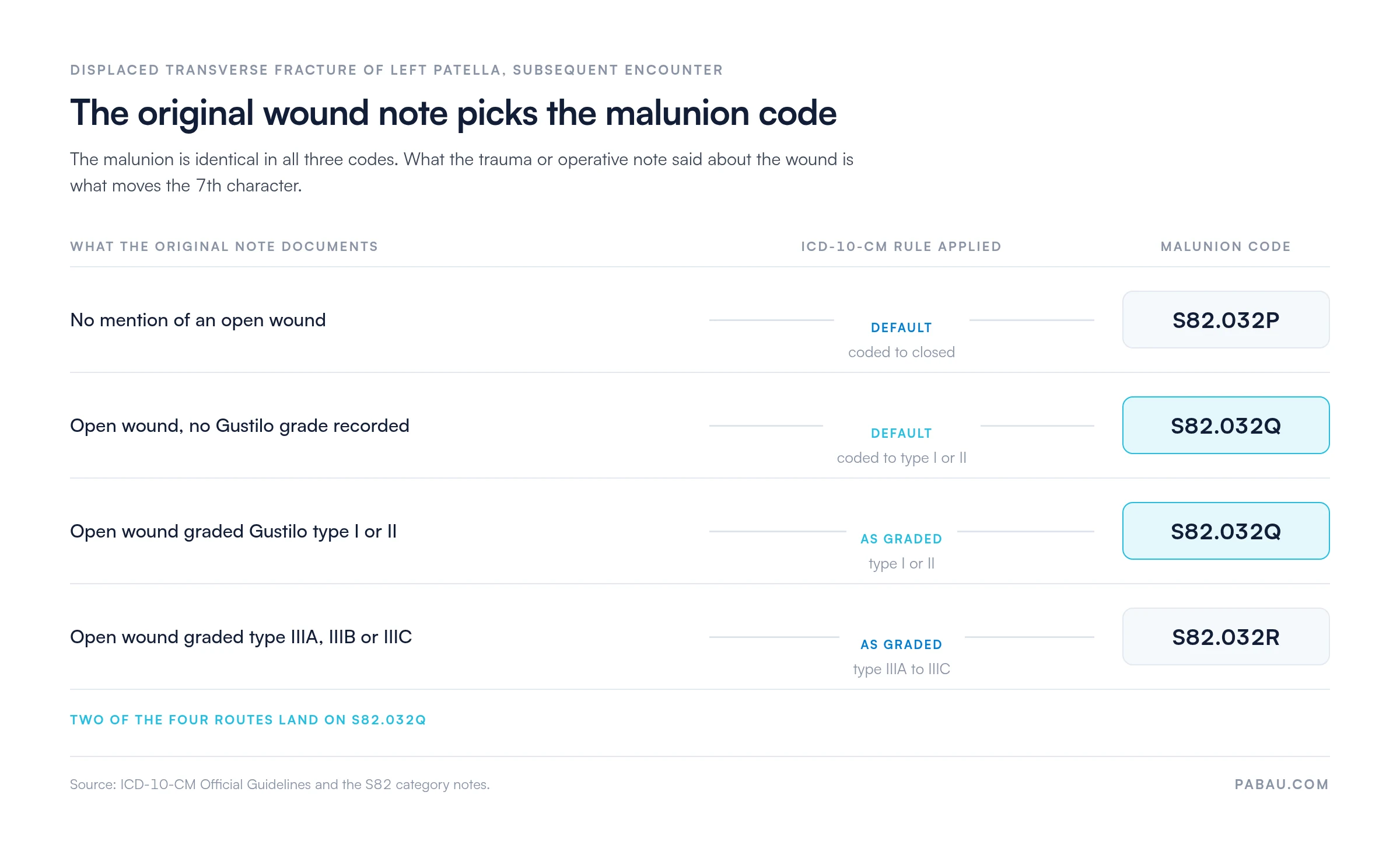
Before you submit S82.032Q, pull the original trauma or operative note rather than just today’s progress note. The 7th character has to reflect the fracture as it was first classified. If that note grades the wound type III, the malunion code is S82.032R. If it never describes an open wound at all, ICD-10-CM defaults to closed and the code is S82.032P.
A transverse patellar fracture runs horizontally across the kneecap, and “displaced” means the fragments have pulled out of position.
The quadriceps tendon draws the upper fragment upward, so the gap tends to widen rather than settle. Most of these injuries follow a direct blow to the front of the knee, a violent quadriceps contraction, or both.
An open version of the same injury is less common but more consequential. The patella sits directly under thin skin, so a laceration over it reaches bone quickly.
Orthopedic practices see the aftermath at follow-up, and physical therapy teams see it again through rehabilitation.
Malunion is the same finding in S82.032P and S82.032Q. What differs is how the bone got there. Care for an open fracture starts with irrigation, debridement and antibiotics, and wound coverage comes first. Definitive fixation is sometimes staged days later, or held back until the soft tissue settles.
That sequence is where alignment gets lost. Contamination, periosteal stripping and a delay to fixation all work against an anatomic reduction. Repeat debridement can also cost bone stock at the fracture edges, and the extensor mechanism keeps pulling the fragments apart in the meantime.
The result matters clinically, not only on the claim. A malunited patella changes the length and the contact pattern of the extensor mechanism. Patients present with extension weakness, anterior knee pain, and a higher risk of patellofemoral arthritis later on.
Infection is the other legacy of an open fracture, and it is coded separately. The 7th character Q reports healing status only. If the visit is also treating osteomyelitis or a wound infection, that condition needs its own code.
The CMS ICD-10-CM Official Guidelines govern fracture coding across categories S52 to S82.
Five confirmations have to clear before S82.032Q goes out. Good compliance habits put that check before submission rather than after a denial.
The tabular notes at the S82 category level bind every code beneath it, S82.032Q included. Four of them affect this code directly.
Two more habits keep these claims clean. Do not add a separate S81.- open wound code for the wound that the 7th character already describes. Do add an external cause code from V00-Y99 where the mechanism matters, which it usually does for workers’ compensation and liability claims.
Most S82.032Q denials trace back to a note that supports four of the five code components. Run this checklist before the claim goes out:
Knowing the code is one job. Getting it paid is another, and it helps to picture the route the claim takes.
Stage two is where most of the trouble starts. If the trauma note lives in a hospital system the practice cannot search, the coder either queries the provider or guesses. Guessing usually means defaulting to closed, and the claim goes out as S82.032P.
The diagnosis is also only half the claim. The visit carries a procedure or evaluation code too, and the CPT code library lists the patellar revision options that pair with a malunion.
Durable medical equipment bills on a separate line. A custom-fabricated knee-ankle-foot orthosis supplied for knee stability is billed under HCPCS code L2036.
These five come up again and again on S82.032 malunion claims. Each one has a fix that takes less time than an appeal.
Each code below is a malunion version of the same injury, so only the wound grade, the side or the fracture pattern changes. Every one of them differs from S82.032Q by a single character.
Cross-check any of them in the AAPC ICD-10-CM lookup.
Reading down the third column shows how independently the parts move. The pattern digit, the laterality digit and the 7th character each control one fact, and each one can be wrong on its own.
All that specificity is recent. Legacy systems and older registries that still reach back to ICD-9-CM lose most of it. An open patellar fracture mapped to 822.1, and malunion of a fracture mapped to 733.81. Aftercare for a healing traumatic fracture of the lower leg sat at V54.16.
None of those codes recorded the side, the Gustilo grade or the fracture pattern. That is the practical reason S82.032Q reads the way it does. It is also why auditors expect the note to support each part of it separately.
Malunion claims draw attention because the 7th character is easy to get wrong and hard to defend afterwards. Running the claim through a clearinghouse catches the mechanical problems first. Formatting errors and incomplete code combinations get flagged before the payer ever sees them.
The rest is documentation. Practices with orthopedic volume gain more from a clean first pass than from appealing later. Tracking reason codes across a quarter also tells you more than any single appeal, which is where denial management earns its keep.
Check the relevant MAC local coverage determinations too, since some name the diagnosis codes that support medical necessity for fracture aftercare.
Coding an open-fracture malunion means reading two notes at once. The 7th character depends on a trauma or operative report that may be months old, while the malunion finding sits in today’s imaging. When those records live in separate systems, coders spend their time hunting instead of coding.
Practice management software like Pabau keeps them in one patient record. Pabau’s medical claims management puts ICD-10-CM entry inside the clinical workflow, so the coder and the clinician work from the same chart.
Diagnoses entered at the point of care carry through to billing without re-entry, which is where 7th character mismatches usually creep in.
Submission runs through the Claim.MD clearinghouse to thousands of US payers, with real-time eligibility checks and remittance processing built in. Billing teams can see where a claim stands without chasing it. A rejected 7th character then surfaces in days, not at the end of the month.
For a practice running fracture aftercare alongside everyday billing, one system holds the note, the diagnosis and the claim. That removes the handoffs that produce 7th character mismatches.

Pabau connects ICD-10-CM entry, clinical notes and claims submission in one record, so fracture aftercare codes reach the payer with the documentation behind them. See how it works for orthopedic and physical therapy practices.

S82.032Q rests on three confirmations. The encounter is subsequent, the original fracture was open and graded type I or II, and the bone united in a malaligned position. Change the wound status and the code changes with it, to S82.032P for a closed fracture or S82.032R for a type III wound.
The safeguard is unglamorous and it works. Read the original trauma note before you assign the 7th character, and make sure today’s note states the malunion in plain words. Do that and the claim carries its own defense into an audit.
Most of the work here is keeping two notes within reach of one coder. Book a demo to see how Pabau holds the trauma note, the diagnosis and the claim in a single record.

Need guidance on ICD-10-CM coding compliance for your practice? Medical billing compliance covers documentation standards, audit readiness, and how to avoid common claim errors.
Want to see how clearinghouse submission reduces fracture coding denials? Claim.MD clearinghouse integration explains how electronic claims validation works before the claim reaches the payer.
Looking for a complete overview of medical billing workflows? What is medical billing breaks down every stage of the billing cycle from diagnosis coding to payment posting.
ICD-10-CM sets no time limit. The 7th character follows the phase of care, not the calendar. Once definitive treatment ends, later visits for healing or malunion stay in the subsequent range.
The treating surgeon, usually at the initial debridement. Coders read the grade from that note and never assign one themselves. If it is missing, query the provider instead of guessing.
Yes. When the malunion is the reason for the visit, S82.032Q can be first-listed. Code any related condition, such as post-traumatic knee osteoarthritis, as a secondary diagnosis.
Use S82.032S once you are treating a lasting effect rather than the fracture itself. List the residual condition first, then S82.032S. A malunion still under management keeps Q.
Not usually with the claim itself. The report still has to be in the record, since an auditor reviewing the 7th character will ask for it.
That depends on the visit. Revision surgery for a patellar malunion is often reported with 27524 or 27350. Open fracture debridement codes 11010 to 11012 belong to the initial encounter.