HCPCS code J3471: Hyaluronidase ovine injection billing guide
HCPCS code J3471: Descriptor, code type, and quick-reference data HCPCS code J34...

Last Updated: Oct 14, 2026
Billable Code Specific Code
S42.494G is the billable ICD-10-CM code for other nondisplaced fracture of lower end of right humerus, subsequent encounter for fracture with delayed healing.
Let Pabau's smart automation suggest the right codes, reduce claim denials, and keep your practice compliant—effortlessly.
Automate repetitive tasks and focus on what matters most—your patients.
Reduce coding errors and ensure compliance with the latest regulations.
Clean claims, fewer denials, and faster reimbursements.
Powerful insights and reporting to help your practice thrive.
HIPAA compliant SOC 2 certified GDPR-compliant Trusted by 4,000+ clinics worldwide

S42.494G describes other nondisplaced fracture of the lower end of the right humerus, subsequent encounter for fracture with delayed healing.
The 7th character G signals delayed healing, which is distinct from nonunion (K) and malunion (P). Each finding calls for different clinical documentation.
This is a fully billable ICD-10-CM code, valid for HIPAA-covered transactions in the current fiscal year. The parent 6-character code S42.494 is not billable on its own.
Practice management software like Pabau submits S42.494G claims through its Claim.MD clearinghouse integration and tracks the status of each one.
The table below gives coders the core facts about ICD-10 Code S42.494G at a glance, mirroring the format used by the CDC/NCHS ICD-10-CM web tool.
The 7th character carries two facts on a fracture code. It records the phase of care, and on a subsequent encounter it records how the fracture is healing. Per the CMS ICD-10-CM official guidance, it is required on every code in this family.
Laterality is not part of that job. The 6th character already fixes the side, which is why every S42.494 code describes the right humerus. Picking the wrong 7th character means submitting the correct 6-character code for the wrong clinical scenario.
Seven 7th characters are valid for S42.494, and the table below lists all of them. Which one applies depends on what the treating clinician documents at the encounter.
S42.494G is a fully billable, 7-character ICD-10-CM diagnosis code. It is valid for HIPAA-covered electronic transactions in the FY 2026 code set.
Practice management software like Pabau connects orthopedic and physical therapy practices to the Claim.MD clearinghouse integration. Claim.MD runs payer edits on a claim before it reaches the insurer, which catches format and eligibility problems early.
Inside Pabau, the orthopedic claims management workflow pulls the codes already sitting on the patient record into a pre-filled claim. The coder still chooses the 7th character, and the clearinghouse edits then run before the claim is filed.

Two points coders should note before submitting:
The parent code path shows coders which related diagnoses sit nearby. That helps when several injury codes land on the same claim, as the ICD-10 code hierarchy for trauma diagnoses shows. The full hierarchy for S42.494G is:
The distal humerus is the lower third of the upper arm bone. It meets the radius and ulna to form the elbow joint. A nondisplaced fracture means the bone has cracked but the fragments have not shifted out of alignment.
Displacement is its own coding axis. Displaced and nondisplaced fractures at the same site carry different codes, so the treating clinician has to state the displacement status in the note.
Common mechanisms include direct impact to the elbow, outstretched-arm falls (FOOSH injuries), and sports contact. Older patients with lower bone density are overrepresented in nondisplaced distal humerus presentations.
The usual physical therapy documentation requirements apply once therapy joins the follow-up care plan. Those encounters generate their own CPT codes, billed alongside S42.494G.
Document the specific fracture location within the distal humerus (medial epicondyle, lateral condyle, articular surface, etc.) in the clinical note. The “other” qualifier in S42.494G exists because some distal humerus fracture subtypes have their own dedicated codes. Vague anatomical descriptions may prompt a payer query or audit request.
Delayed healing (G), nonunion (K), and malunion (P) are three separate clinical findings. All three appear as 7th character options for a subsequent fracture encounter. Using the wrong one puts the claim at odds with the medical record, which is an audit trigger.
Patient compliance in fracture aftercare often shapes the clinician’s view of why healing is behind. Weight-bearing restrictions, splint use, and follow-up attendance all belong in the record. The choice itself comes down to a single question about the note, and it maps onto three codes.
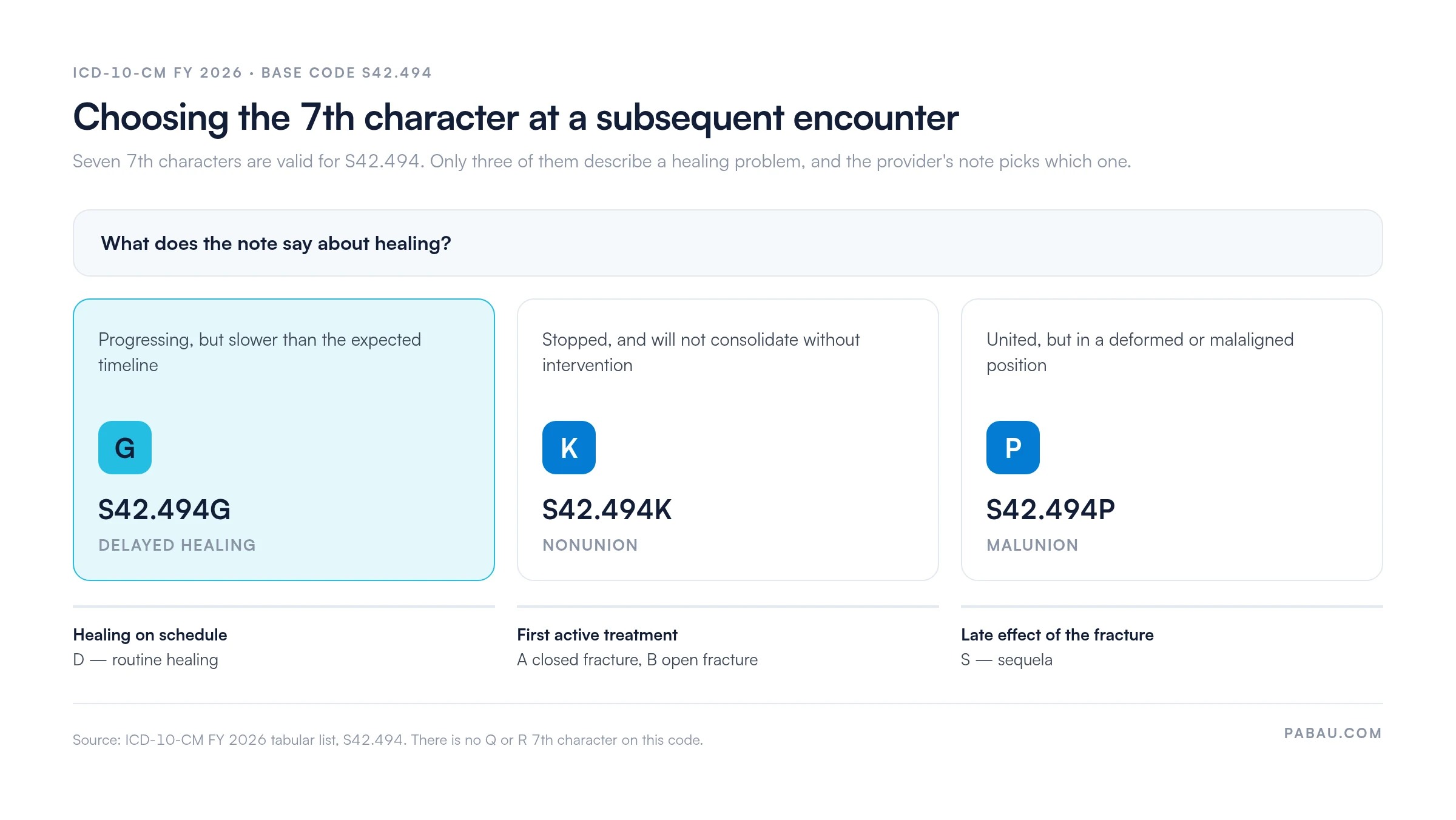
The distinction between G and K is biological potential. With delayed healing, the fracture could still consolidate under continued treatment. With nonunion, that potential is gone without surgical or other procedural intervention.
Coders cannot make that call. It has to come from the treating surgeon’s or physician’s documentation, so query the provider whenever the record is ambiguous. Submitting G where the record describes nonunion is a coding error, and it can surface in a denial management review.
The S42.494 family and its neighbors are the codes coders look up alongside S42.494G. The AAPC Codify ICD-10-CM lookup and ICD List both offer sibling navigation for the full S42.4 block.
The table below covers laterality, encounter type, and displacement status for this fracture site. As with any ICD-10-CM diagnosis code reference, confirm laterality and displacement from the operative note or the imaging report. Never take them from the referral.
The ICD-10-CM Official Guidelines for Coding and Reporting govern how subsequent fracture encounter codes are applied. They are maintained by the Centers for Medicare and Medicaid Services (CMS) and the NCHS. The ICD-10-CM coding guidelines on encounter type apply across every trauma code, not just S42.494G.
The most common submission error on this code is a simple one. Someone applies the initial-encounter suffix (A) to a follow-up visit. A grounding in medical billing fundamentals is usually enough to stop it.
Key rules for S42.494G specifically:
The codes below are the CPT procedures that most often accompany a subsequent encounter for a nondisplaced distal humerus fracture with delayed healing. The American Medical Association (AMA) maintains the CPT code set and updates it every year. Check the current AMA code set and the CMS Physician Fee Schedule for reimbursement values before you submit.
Practices running physical therapy practice management software should also check that therapy CPT codes are tied to the correct ICD-10 diagnosis at the claim level.
Standard modifier rules still apply when an E/M code goes out with a procedure code for the same encounter. Modifier 25 marks a separately identifiable E/M performed on the same day as a procedure. Practices billing therapy codes should check that their medical claims clearinghouse supports paired ICD-10 and CPT edits at the claim line level.
Pabau’s Claim.MD integration posts electronic remittance advice (ERA/835) files back into the practice. You can see which line items a payer adjusted or denied without reconciling remittances by hand.
When you bill an E/M code alongside imaging (73060) at a delayed-healing follow-up, attach Modifier 25 to the E/M line. It marks the visit as a significant, separately identifiable service. Without it, payers may bundle the office visit into the radiology payment and deny the E/M line.
In most orthopedic and physical therapy practices, the note and the claim live in different places. A coder reads the follow-up note, picks the 7th character, then retypes the encounter into a payer portal or a separate billing tool. Claim status then sits somewhere else again.
Pabau keeps the appointment, the treatment note, and the codes already on the patient record in one place. Its Claim.MD integration pulls that record data into a pre-filled claim, submits it, and tracks what the payer does next. The coder still decides whether the note supports G rather than D or K.
The outcome is fewer rekeyed claims and a shorter wait to find out where one stands. When a fracture line is adjusted or denied, the ERA lands against the same record the claim came from. You can correct and resubmit without hunting for the original note.

Pabau’s claims management module connects to the Claim.MD clearinghouse, so fracture claims go out from the same record that holds the note. Track claim status and post ERA remittances without switching systems.

Coding delayed healing well comes down to one habit. Match the 7th character G to what the provider actually wrote, rather than inferring healing status from elapsed time or visit frequency. S42.494G has a narrow clinical definition, and swapping G for D or K is both avoidable and auditable.
Pabau’s claims management software sends fracture claims to the clearinghouse from the same record that holds the note, then tracks what comes back. That cuts the rework a rejected follow-up claim usually creates. Book a demo to see claim tracking and ERA posting on an orthopedic workflow.

Need to understand how clearinghouses validate ICD-10 codes before submission? How Claim.MD clearinghouse works with Pabau explains the real-time payer edit and eligibility verification process.
Dealing with denied fracture claims? Denial codes in medical billing breaks down the most common CARC denial reasons and how to respond to each one.
Billing for physical therapy services alongside fracture follow-up? What is revenue cycle management covers how to structure the billing workflow from encounter to ERA reconciliation.
S42.494G is a billable ICD-10-CM diagnosis code. It covers other nondisplaced fracture of the lower end of the right humerus, subsequent encounter with delayed healing. Use it at a follow-up visit when the fracture is healing more slowly than expected, per the provider note and imaging.
Yes. S42.494G is a fully billable, 7-character ICD-10-CM diagnosis code valid for HIPAA-covered electronic transactions in FY 2026. The parent 6-character code S42.494 is not billable on its own and cannot be submitted on a claim.
A nondisplaced fracture of the lower (distal) end of the humerus means the bone has cracked but the fragments stay in alignment. The lower end of the humerus forms the elbow joint with the radius and ulna. Fractures here usually follow a fall, a direct blow to the elbow, or a high-energy sports injury.
Yes. S42.494G is valid for both outpatient and inpatient billing, wherever ICD-10-CM diagnosis codes are submitted on a claim. It shows up most often on orthopedic follow-up visits, physical therapy encounters, and imaging facility claims. The note has to document delayed healing of the nondisplaced right distal humerus fracture.