

CCSD code G5100: Bypass of duodenum billing guide
CCSD code G5100 bills a bypass that leaves the duodenum in place CCSD code G5100...

Last Updated: Oct 16, 2026
L0641 is the HCPCS Level II code for lumbar orthosis, sagittal control, with rigid posterior panel(s), posterior extends from l-1 to below l-5 vertebra, produces intracavitary pressure to reduce load on the intervertebral discs, includes straps, closures, may include padding, stays, shoulder straps, pendulous abdomen design, prefabricated, off-the-shelf.
HCPCS code L0641 bills a prefabricated, off-the-shelf lumbar orthosis with one rigid posterior panel running from L-1 to below L-5. Coders often treat it and L0642 as the firm and soft versions of one brace. Both descriptors are rigid, and only the panel count separates them.
That misreading is expensive, because the two codes are priced more than five times apart. It also covers the modifiers and the file a DME MAC will ask for on audit.
Let Pabau's smart automation suggest the right codes, reduce claim denials, and keep your practice compliant—effortlessly.
Automate repetitive tasks and focus on what matters most—your patients.
Reduce coding errors and ensure compliance with the latest regulations.
Clean claims, fewer denials, and faster reimbursements.
Powerful insights and reporting to help your practice thrive.
HIPAA compliant SOC 2 certified GDPR-compliant Trusted by 4,000+ clinics worldwide

HCPCS code L0641 covers a prefabricated, off-the-shelf lumbar orthosis with one rigid posterior panel running from L-1 to below L-5.
The mechanism in the descriptor is intracavitary pressure that reduces load on the intervertebral discs, not a block on flexion and extension.
L0641 and L0642 differ by panel count and nothing else. L0641 has one rigid posterior panel, and L0642 adds a rigid anterior panel.
That one panel carries the money. On the July 2026 DMEPOS fee schedule, L0642 pays 5.27 times L0641 in every jurisdiction.
Medicare pays L0641 under LCD L33790, and the KX modifier is what tells the MAC that the coverage criteria are met.
L0641 is a Healthcare Common Procedure Coding System (HCPCS) Level II alphanumeric code maintained by the Centers for Medicare and Medicaid Services. It pays for a stock-size lumbar brace with a single rigid panel at the back.
Its official long descriptor is set out below, clause by clause.
Read the mechanism clause closely, because it is the part people paraphrase wrongly. The descriptor never says the brace blocks flexion or extension. It says the device produces intracavitary pressure, meaning the closures compress the abdomen and shift load off the lumbar discs.
Sagittal control names the plane the rigid panel works in. The pressure clause names how the brace does its job.
Off-the-shelf is about who fits the brace, not how the brace is built. An off-the-shelf orthosis needs no more than minimal self-adjustment by the patient at delivery. Nobody with orthotic expertise trims, bends, molds, or assembles it to that individual.
Once a fitter customizes the device, it leaves the off-the-shelf range entirely. A one-panel lumbar orthosis that a qualified fitter adapts to the patient is L0626, not L0641. Setting a strap length or attaching a pad the manufacturer supplied does not count as customization.
All four elements have to be present at once. A brace that satisfies three of them is a different code, not a close-enough L0641. A reviewer reads the product specification, not the order.
The same four elements say what L0641 excludes. Custom-fitted and custom-fabricated lumbar orthoses are out, along with flexible supports that carry no rigid panel. So are lumbar-sacral orthoses and any brace with a rigid anterior panel.
L0641 has one rigid panel and L0642 has two. That is the entire difference. Every other clause in the two descriptors matches. Both name sagittal control, a posterior panel from L-1 to below L-5, and intracavitary pressure on the discs. Both are prefabricated and off-the-shelf.
Neither descriptor contains the words semi-rigid or flexible. A lumbar orthosis with no rigid panel at all is coded from the flexible descriptor, L0625. So a spec sheet that calls the panel semi-rigid does not point you to L0642. Reading L0642 as the softer sibling of L0641 gets the claim wrong in both directions.
The panel count is also where the money sits. On the July 2026 DMEPOS fee schedule, L0642 pays 5.27 times L0641, and that ratio holds in all 53 jurisdictions. Miscounting a single panel moves the allowed amount by $258.78 in the 18 states at the top tier.
The ladder below sets both codes against their custom-fitted and flexible neighbors.
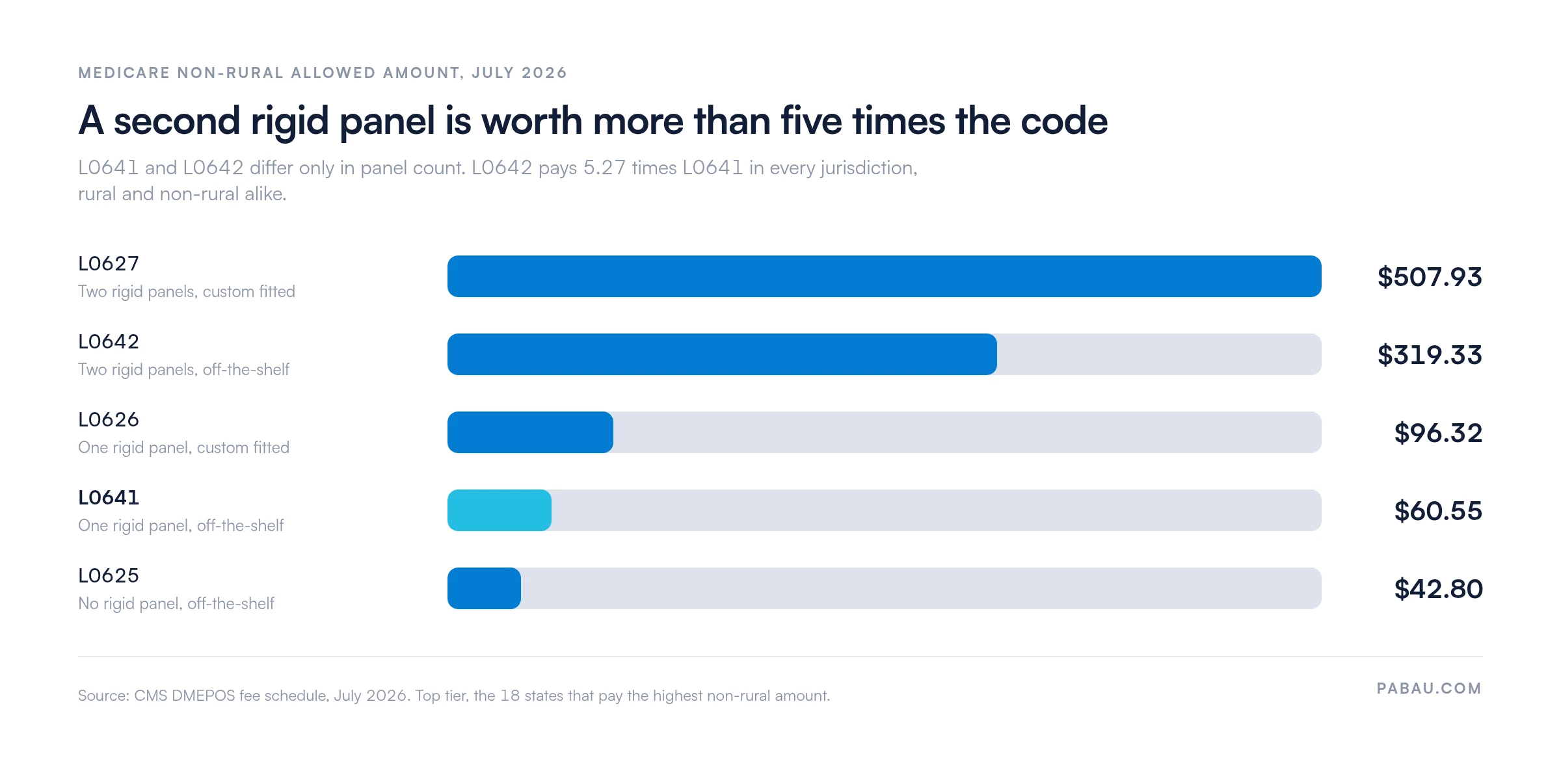
Count the rigid panels on the manufacturer’s spec sheet before you pick the code. One rigid panel at the back is L0641. A rigid panel at the back plus one at the front is L0642. The words rigid and semi-rigid do not separate these two codes, because both descriptors are rigid. Keep the spec sheet in the claim file.
L0641 sits on a grid with two axes. One axis is panel construction, running from no rigid panel to two rigid panels. The other is fabrication, running from off-the-shelf through custom fitted to custom fabricated. Knowing both axes prevents upcoding and stops staff reaching for an adjacent code out of habit.
Two patterns run through the whole family. Every rigid code names the panels it contains, and every code names its fabrication method. Read those two clauses first and the rest of the descriptor usually confirms what you already decided.
Coronal control opens a third axis on the same grid. Add rigid lateral panels to the LSO span and the off-the-shelf code moves from L0643 to L0649.
The same fabrication clause splits the cervical codes, where HCPCS code L0113 is the prefabricated torticollis orthosis and L0112 is the custom-fabricated one.
Medicare pays L0641 from the quarterly DMEPOS fee schedule, and the amount follows the state where the beneficiary lives rather than where the supplier sits. Two features of the pricing catch billers out.
First, L0641 carries separate rural and non-rural amounts, because its fees were adjusted using competitive bidding information. Second, the rural amount beats the non-rural amount in every state, often by a wide margin. The figures below come from the July 2026 DMEPOS public use file published by CMS.
Across the 49 contiguous jurisdictions the non-rural amount takes one of seven values, from $26.67 to $60.55. The median is $59.36, because 25 of those jurisdictions pay that amount or more. The four Pacific-region states sit at the bottom of the range, at less than half the median.
Medicare pays 80% of the lesser of your charge or the fee amount, once the deductible is met. On the median that works out at $47.49 from the program and $11.87 from the patient. Quote the patient from the amount for their own state, not a national figure.
Rural amounts run from $77.02 to $78.79, so a rural delivery pays more than any non-rural rate in the 49 contiguous jurisdictions. The non-continental areas sit outside the ceiling and floor calculation, which is why Puerto Rico is priced at $93.77. Check the current quarter before you bill, because CMS refreshes these amounts in January, April, July and October.
Competitive bidding is the reason the rural column exists, but no contract applies to L0641 today. Round 2021 covered the off-the-shelf back brace codes L0648 and L0650 along with off-the-shelf knee braces. Those contracts expired on December 31, 2023, and CMS has run a temporary bidding pause since January 1, 2024.
Medicare covers L0641 when the record shows the brace was ordered for one of four purposes named in LCD L33790. Coverage turns on the purpose, not on the diagnosis alone.
The order has to name one of those purposes and the clinical notes have to back it up. A qualifying diagnosis with no stated purpose is a common denial. The LCD pays for what the brace does, not for what the patient has. Verifying the patient’s benefits before delivery also heads off rejections tied to plan exclusions.
Suppliers need active Medicare enrollment plus DMEPOS accreditation from a CMS-approved organization to bill L0641. Billing while accreditation has lapsed denies automatically, and no amount of clinical documentation rescues that claim.
The claim needs a covered ICD-10-CM code that matches the ordered purpose. The diagnoses below commonly support lumbar orthosis claims, though your MAC’s own list governs. Verify against the current policy article before you submit.
One retired code still shows up on these claims. M54.5 was deleted on October 1, 2021, so any line carrying it for a later date of service will deny. Use M54.50, M54.51 or M54.59 instead, and pick the one the notes support.
Keep a crosswalk between your usual diagnoses and the codes your MAC accepts. A clinically accurate diagnosis that is off the covered list still denies. Our ICD-10-CM code reference carries the full descriptor behind each of these diagnoses.
Incomplete documentation is the second biggest source of L0641 denials, behind panel miscounting. Five items belong in the file before the claim goes out.
CMS discontinued Certificates of Medical Necessity and DME Information Forms for dates of service from January 1, 2023. Claims that arrive with one attached are rejected and returned. The standard written order and the medical record now carry what a certificate used to. Do not build a workflow around chasing one.
A complete, organized file is also what keeps post-payment review manageable. Spinal orthoses draw Comprehensive Error Rate Testing attention, and the findings are usually about paperwork rather than clinical judgment. Capturing every element at the point of delivery cuts the recoupment risk.
Modifiers tell the DME MAC about device status, upgrades, and your medical necessity attestation. KX does the most work here, and leaving it off is a routine reason an otherwise clean L0641 claim denies.
Most initial claims go out as L0641 with KX and NU. RT and LT never apply, because a spinal orthosis is not a paired item. The competitive bidding modifiers KV, J4 and J5 are also out of scope, since no bidding contract has been in force since January 1, 2024.
Spinal orthoses are one of Medicare’s weaker DMEPOS categories on error rate, and L0641 denials cluster around six causes. Preventing them costs far less than appealing them.
L0641 is not on CMS’s required prior authorization list. On the spinal side that list holds two codes, L0648 and L0650, phased in during 2022 and national from October 10, 2022. Mandatory PDAC coding verification follows the same two codes, so an L0641 product does not need it.
You can still request a voluntary coding verification, and it is worth doing where a product’s construction reads ambiguously. A PDAC decision on file is the cleanest answer to an auditor asking why you called the panel rigid.
Audit last month’s L0641 and L0642 lines against the product spec on file for each one. If L0641 lines are carrying two-panel braces, you are giving away $258.78 per claim in the top-tier states. If L0642 lines are carrying one-panel braces, you are sitting on a recoupment. Either way the fix belongs at the point of dispensing, not in the billing queue.
For a clean claim on L0641, include the NPI for both the ordering practitioner and the supplier. Add the patient’s Medicare Beneficiary Identifier, the delivery date as the date of service, and the right place of service code. Software that validates those fields before transmission catches most of it in advance.
In most supplier workflows the pieces of an L0641 claim live in four places. The order sits in a referring practitioner’s portal and the delivery signature is on paper. The product specification is a PDF in a shared drive, and the claim itself sits in a billing tool.
When a MAC asks for the file two years later, somebody spends a morning reassembling it.
Practice management software like Pabau keeps those pieces in one client record. The signed order, the LCD purpose note, the delivery confirmation and the product specification all attach to one record. The claim then goes out from that same record. No one has to match the pieces up later, because they were never separated.
An audit request then turns into a lookup rather than a search. A coder can also open the specification in the moment they choose between L0641 and L0642. That is the point where counting the panels is still free.
Pabau’s tools for cleaner claims management also flag missing fields before submission. The KX attestation and the delivery date get checked while the claim is still yours to fix.

Pabau helps DME suppliers and orthotists validate HCPCS codes, document medical necessity, and submit cleaner claims with fewer denials. See how it works for your billing team.

L0641 is a one-panel code. It covers one rigid panel at the back and none at the front. The posterior span runs from L-1 to below L-5, and the fit is off-the-shelf.
Add a rigid anterior panel and the claim belongs on L0642 at 5.27 times the money. Neither code has a semi-rigid version, so the panel count on the specification sheet settles it.
The rest is documentation discipline. Get the signed order first, put the LCD purpose in the notes, and add KX to the line. Then file the delivery proof where you can find it.
Pabau holds all of it against one client record. To see how that works on your own HCPCS volume, book a demo with the team.

Need to understand why HCPCS claims deny? Denial management in healthcare walks through the most common denial reason codes and how to build a systematic appeals process.
Want to clean up your claim submission rate? Submitting a clean claim covers the required elements that reduce first-pass rejection rates across DME and procedural billing.
Looking to strengthen your revenue cycle? Revenue cycle management explained provides a practical overview of the billing lifecycle from eligibility verification through payment posting.
L0641 bills a prefabricated, off-the-shelf lumbar orthosis with one rigid posterior panel. The panel runs from L-1 to below L-5, and the brace produces intracavitary pressure that reduces load on the intervertebral discs. DME suppliers, orthotists and physical therapy practices use it when they dispense that brace.
Panel count, and nothing else. L0641 has one rigid posterior panel. L0642 has rigid anterior and posterior panels. Both are prefabricated, off-the-shelf lumbar orthoses with sagittal control from L-1 to below L-5, and both work by intracavitary pressure. Neither code describes a semi-rigid or flexible panel, so rigidity is not the differentiator.
On the July 2026 DMEPOS fee schedule the non-rural amount runs from $26.67 to $60.55 across the 49 contiguous jurisdictions. The median is $59.36 and rural amounts run from $77.02 to $78.79. Medicare pays 80% of the lesser of your charge or the fee amount, and the patient owes the rest.
Traditional Medicare does not require prior authorization for L0641. The two spinal orthosis codes on the required list are L0648 and L0650, national since October 10, 2022. Medicare Advantage plans and commercial payers often do require authorization, so check the plan before you dispense.
Yes, whenever the record meets the coverage criteria in LCD L33790. KX tells the DME MAC that the medical necessity documentation is on file. A claim that meets the criteria but leaves KX off denies automatically, and the remedy is a corrected claim.
L0641 is prefabricated and off-the-shelf. The brace is dispensed in a stock size and needs no more than minimal self-adjustment by the patient at delivery. A one-panel lumbar orthosis that a qualified fitter customizes is L0626 instead.
You need a standard written order signed before you bill. The clinical notes must tie the brace to one of the four purposes in LCD L33790. You also need proof of delivery and the manufacturer specification showing one rigid posterior panel. Certificates of Medical Necessity were discontinued from January 1, 2023.



