

HCPCS code E0198: Water pressure pad billing guide
HCPCS code E0198 is a water pad for a standard mattress HCPCS code E0198 is the ...

Last Updated: Oct 13, 2026
C1825 is the HCPCS Level II code for generator, neurostimulator (implantable), non-rechargeable with carotid sinus baroreceptor stimulation lead(s).
Let Pabau's smart automation suggest the right codes, reduce claim denials, and keep your practice compliant—effortlessly.
Automate repetitive tasks and focus on what matters most—your patients.
Reduce coding errors and ensure compliance with the latest regulations.
Clean claims, fewer denials, and faster reimbursements.
Powerful insights and reporting to help your practice thrive.
HIPAA compliant SOC 2 certified GDPR-compliant Trusted by 4,000+ clinics worldwide

HCPCS Code C1825 describes an implantable, non-rechargeable neurostimulator generator with carotid sinus baroreceptor stimulation lead(s), used for Barostim baroreflex activation therapy.
C1825 is billed only in hospital outpatient settings, where Medicare packages the generator cost into New Technology APC 1580.
From January 1, 2026, Barostim procedures use Category I CPT codes 64654 to 64659, plus 93145 and 93146 for device interrogation.
The old Category III codes 0266T through 0273T are deleted, so they reject on any 2026 date of service.
Coverage still turns on the applicable MAC local coverage determination, and several commercial payers class baroreflex activation therapy as investigational.
Practice management software like Pabau keeps claims tracking in one place, so outpatient billing teams can flag missing device documentation before submission.
HCPCS Code C1825 describes a generator, neurostimulator (implantable), non-rechargeable with carotid sinus baroreceptor stimulation lead(s). In practice, hospitals report it on the outpatient claim when a Barostim system goes in. As a result, the generator cost is packaged into the procedure payment.
C1825 is an HCPCS Level II C-code, a category reserved for hospital outpatient billing under Medicare’s Outpatient Prospective Payment System (OPPS). As a result, C-codes do not appear on physician fee schedules. In turn, they cannot be billed in a physician office or a freestanding ambulatory surgical center without specific payer authorization.
Per the CMS HCPCS Level II system, C-codes are temporary codes for hospital outpatient departments. Also, they support data collection and payment for new devices and services.
Billers should confirm each year that C1825 is still active and has not become a permanent code. For that reason, that annual check is part of how medical billing works across the HCPCS categories.
HCPCS Code C1825 exists for one specific device: the Barostim system from CVRx. In other words, knowing what Barostim does clinically is what lets a billing team pair the right CPT and ICD-10 codes with it.
Baroreflex activation therapy (BAT) treats heart failure with reduced ejection fraction (HFrEF) by electrically stimulating the carotid sinus baroreceptors. In fact, these receptors regulate blood pressure and autonomic nervous system tone. In patients with HFrEF, this stimulation reduces sympathetic nervous activity and increases parasympathetic tone. As a result, cardiac function improves without the mechanical approach that older cardiac resynchronization therapy (CRT) devices take.
The FDA approved Barostim for HFrEF in August 2019. In fact, patients who qualify for BAT often have New York Heart Association (NYHA) Class III heart failure.
They also have a left ventricular ejection fraction (LVEF) at or below 35% and a poor response to guideline-directed medical therapy. In turn, those rules drive the ICD-10 diagnosis codes Medicare expects on the claim.
C1825 is paid under Medicare’s OPPS. That means payment is determined by Ambulatory Payment Classification (APC) assignment, not a physician fee schedule RVU. Also, CMS publishes the authoritative payment rates in OPPS Addendum B each year. Even so, payment varies by geographic area wage index, and the figures below are national 2026 rates.
C1825 carries no separate OPPS payment of its own. In fact, its device pass-through status ended on December 31, 2023. As a result, the generator cost now sits inside the payment for the implant procedure.
CMS assigns that procedure to New Technology APC 1580, and proposed keeping it there for 2026 at roughly $45,000. For that reason, hospital teams calculating net revenue per case should work from the procedure payment rather than the device acquisition cost.
Billing teams should check CMS OPPS Addendum B each year for the current APC assignment and payment rate. Otherwise, relying on prior-year rates for a high-cost device code is a common source of payment shortfalls.
Medicare covers baroreflex activation therapy devices under OPPS when specific clinical rules are met. In fact, coverage is governed by local coverage determinations (LCDs) issued by Medicare Administrative Contractors (MACs). Even so, the specific rules may vary by jurisdiction. For that reason, billers must confirm that the correct MAC LCD is current. They must also confirm that the patient’s documentation satisfies every coverage requirement before submission.
Checking patient eligibility and coverage before the implantation date reduces post-service denials. As a result, a structured insurance eligibility verification workflow keeps the hospital and the referring GP practice working from the same coverage answer. In turn, neither one ends up appealing a denial on a claim that should have been pre-authorized.
The 837I electronic transaction format is required for Medicare OPPS claims. For that reason, billing staff unfamiliar with the hospital’s claim format should review the 837 file structure before submitting C1825 claims online. That way, they avoid format-related rejections.
Clean claims for HCPCS Code C1825 require documentation that satisfies both the MAC LCD and the hospital’s own compliance standards. In fact, one missing element triggers a medical necessity denial. For example, that could be the ejection fraction measurement, or the documented failure of guideline-directed medical therapy.
Building a pre-submission documentation checklist specific to C1825 reduces denial rates and speeds up the appeals process when denials do occur. To begin with, the clean claim framework is the right starting point. In practice, every field is populated, and every supporting document is attached. Every coverage criterion is addressed before the claim leaves the department.
Teams managing recurring denials for device claims benefit from a structured denial management process. That process categorizes root causes and tracks appeal outcomes by code. Otherwise, the same documentation errors repeat across cases. Also, consistent documentation standards for device codes reduce audit exposure under Medicare’s Targeted Probe and Educate program.
Before you submit a C1825 claim, run a three-point pre-flight check. Confirm the prior authorization number is on file. Verify the LVEF measurement date falls inside the payer’s required window. Check that the UB-04 revenue code matches the device category. Those three items clear most initial denials on high-cost cardiac device claims.
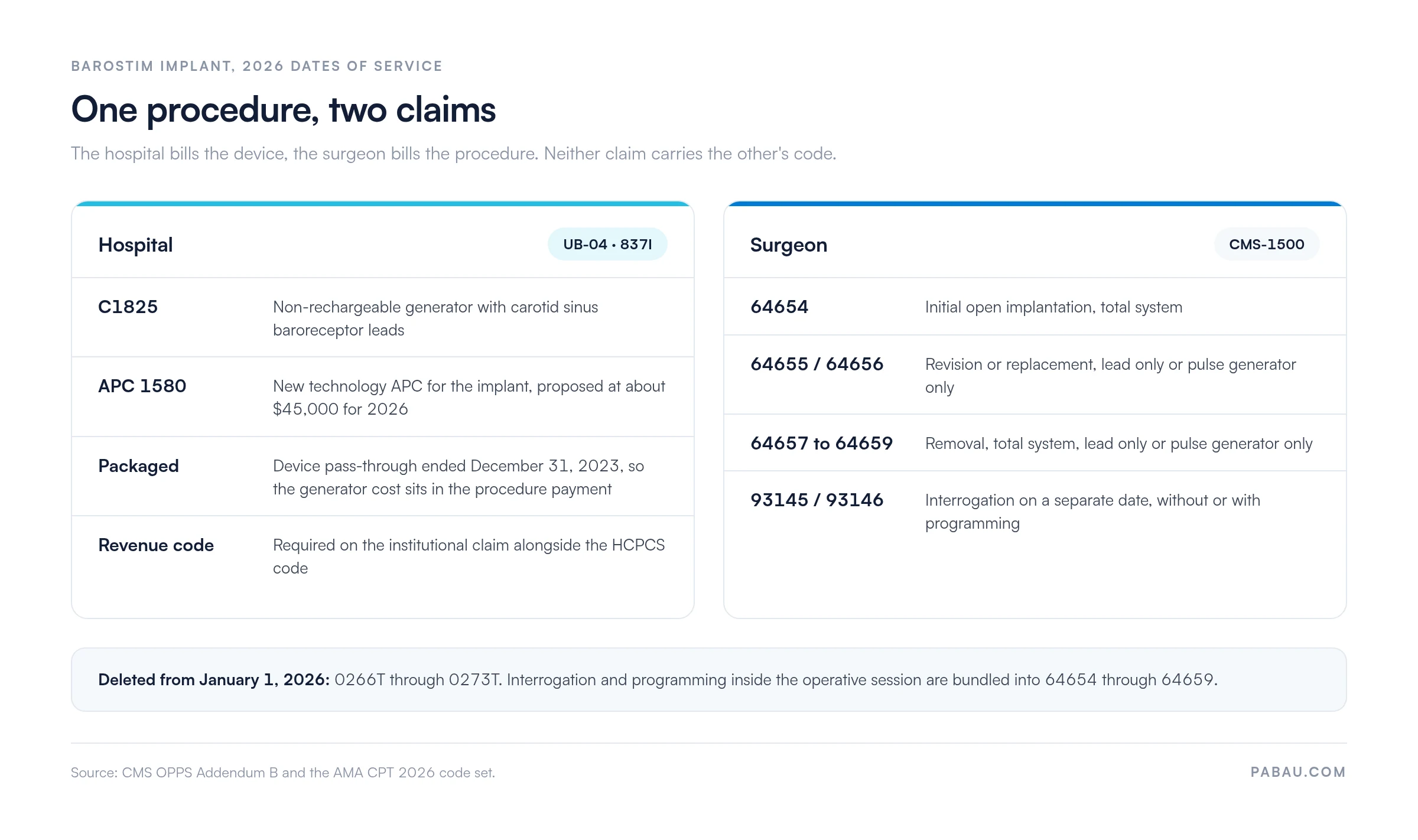
HCPCS Code C1825 covers the generator only. In short, the surgery, the revisions, the removals, and the device interrogations are reported separately. Those codes changed on January 1, 2026. That is, the AMA deleted the Category III family 0266T through 0273T. In its place, the AMA added Category I codes 64654 through 64659, 93145, and 93146.
That shift matters for more than tidiness. Category I codes carry published RVUs and sit inside the standard claim edits. As a result, payers process them without the manual review that Category III codes attracted. So, a 0266T submitted on a 2026 date of service now rejects as an invalid code.
One bundling rule governs the surgical codes. Interrogation and programming performed during an implantation, revision, replacement, or removal are included in 64654 through 64659. In other words, report 93145 or 93146 only when the interrogation happens on a separate date.
The split between the two claims has not changed. The hospital bills C1825 for the generator on its UB-04 claim, alongside the facility charge for the procedure. Meanwhile, the implanting surgeon bills the matching CPT code on the CMS-1500, the surgeon’s claim. In short, neither claim ever carries the other’s code, which is easier to hold as one view.
Claims with a date of service on or before December 31, 2025 still use the old Category III codes. In fact, appeals, corrected claims, and audit responses on those dates need the descriptors that were in force at the time. For that reason, they are listed below.
Two of these pairings are easy to reverse. For example, 0268T was the pulse generator implant or replacement, not a lead revision. Similarly, 0270T was a lead revision or removal, not a programming code. Check any legacy appeal packet against the descriptors above before you file it. Either way, confirm current numbers against the AMA CPT code set or the CVRx crosswalk.
Medical necessity for HCPCS Code C1825 must be supported by ICD-10-CM diagnosis codes that reflect the clinical indication for baroreflex activation therapy. In short, the accepted diagnosis codes are tied to heart failure with reduced ejection fraction. For that reason, billers should confirm the specific codes accepted by the correct MAC LCD. That’s because the covered diagnosis list may differ slightly between jurisdictions.
Always code to the highest level of detail the documentation supports. For instance, I50.22 is the most often accepted code for elective Barostim implantation.
I50.9 is often rejected because it does not specify systolic dysfunction, the qualifying criterion for BAT. In practice, a charge capture form often drives coding. Keep its diagnosis options aligned with the LCD list rather than generic heart failure descriptors.
Medicare is the most common payer for Barostim procedures, since most patients have HFrEF. Even so, commercial payer coverage is a separate and more variable question. In fact, several major payers have published medical policies that address baroreflex stimulation devices directly, and the coverage position varies widely.
An investigational status is a serious payment risk for programs billing C1825 to non-Medicare patients. For that reason, run the prior authorization process in writing before the implantation is scheduled. At the same time, request the payer’s current policy document, so the file holds a contemporaneous record.
A denial on a claim this size is rarely fixed by a resubmission. Instead, the appeal is built from the file the team assembled before the procedure. That’s the argument for collecting it early.
C1825 is specific to the non-rechargeable generator with carotid sinus baroreceptor leads. As a result, billers often need to distinguish it from related neurostimulator codes for other device types and applications. Using the wrong code is a common accuracy error. It usually happens because of a description mismatch on rechargeable versus non-rechargeable or carotid versus spinal cord placement.
The defining attribute of C1825 is the pairing of a non-rechargeable generator with carotid sinus baroreceptor leads. In fact, no other active HCPCS code carries that descriptor. For that reason, check the implanted device description against the manufacturer’s label before you pick the code.
Other cardiac device C-codes follow the same OPPS logic, with the device cost packaged into the procedure payment. For example, two that reach the same billing desks are C1893 and C1895.
A medical billing platform that holds the device record next to the charge entry makes that cross-check quick. It happens before a claim is generated. For example, Pabau’s claims management software keeps the encounter record, the attached documents, and the submitted claim in one view. As a result, a mismatch surfaces while there is still time to fix it.
Audit any claim period where both C1823 and C1825 were billed. Both describe a non-rechargeable generator, which is why they get swapped. In short, the difference is the lead: C1825 takes carotid sinus baroreceptor stimulation leads, and C1823 takes transvenous sensing and stimulation leads. For that reason, a device-label check at charge entry catches the swap before the payer does.
C1825 took effect on January 1, 2021 and stays active for the 2026 billing year. In practice, CMS maintains C-codes through the annual OPPS rulemaking cycle. It publishes the final rule each November for a January 1 start. For that reason, check the descriptor and the status each year against the annual CMS HCPCS Level II release.
The dates matter most on older claims. A 2025 date of service pairs C1825 with a 0266T-series CPT code. By contrast, a 2026 date of service pairs it with the 64654 series. As a result, filing the wrong pair for the year is a straightforward rejection.
Outpatient billing teams usually track device codes like C1825 in a spreadsheet. Even so, that holds up until volume rises, a code set changes mid-cycle, or the person who knew the C1825 rules moves on.
Practice management software like Pabau keeps the claim, the encounter record, and the supporting documents together. For example, a physical therapy practice billing a routine visit works from the same pre-submission view as a team billing a device claim.
As a result, billing staff can see whether the operative report and the device details are attached before the claim goes out. They never have to open the chart to check.
For US practices, Pabau submits and tracks claims through our Claim.MD integration. As a result, submission status and remittance detail come back into the same record. In other words, coding decisions stay with the coder, and the software carries the data behind them.
In sum, the payoff is fewer denials caused by missing implant documentation. It also means a shorter run from the procedure date to a paid claim.

Pabau’s claims management software helps outpatient billing teams track HCPCS device codes and flag missing documentation before submission. See how it handles high-cost implant claims.

All told, C1825 is a narrow code attached to an expensive device. The generator’s cost sits inside the procedure payment, so the margin on each case rests on the paperwork behind it.
Three habits separate a paid claim from an avoidable denial. First, get the prior authorization in writing. Second, pair the ICD-10 codes to the MAC LCD rules. Third, submit a clean UB-04 with complete operative documentation.
The 2026 code change is the nearer risk, because a 0266T on a current date of service rejects outright. For that reason, check the CPT pairing on every open Barostim claim before the next batch goes out. Book a demo to see how Pabau tracks device claims and denials in one place.

Billing another cardiac device C-code? C1895 covers the endocardial dual coil defibrillator lead on a hospital outpatient claim.
Need the electrophysiology introducer sheath code? C1893 sets out its OPPS packaging and the documentation a MAC expects.
Facing a patient balance after an investigational denial? Patient payment plans shows how to set one up, automate it, and collect.
HCPCS Code C1825 is an HCPCS Level II C-code for an implantable, non-rechargeable neurostimulator generator with carotid sinus baroreceptor stimulation lead(s). In practice, hospitals bill it in the outpatient setting under Medicare’s OPPS. In short, the device is the Barostim system from CVRx. It’s used for baroreflex activation therapy in heart failure with reduced ejection fraction.
Three ICD-10-CM codes carry most C1825 claims: I50.22, I50.21, and I50.23. In fact, they cover chronic systolic, acute systolic, and acute on chronic systolic heart failure. Notably, I50.22 is the most often used code for elective Barostim implantation. Avoid I50.9 (unspecified heart failure), as it often lacks the detail payers want for device medical necessity.
As of January 1, 2026, the AMA replaced the Category III codes 0266T through 0273T with Category I codes. Specifically, implantation of the total system is 64654. Revision or replacement is 64655 for the lead and 64656 for the pulse generator. Also, removal is 64657 for the total system, 64658 for the lead, and 64659 for the pulse generator. Interrogation on a separate date is 93145 without programming or 93146 with programming. In sum, the hospital bills C1825 on the UB-04, and the surgeon bills the CPT code on a CMS-1500.
Yes, C1825 is billable under Medicare’s Outpatient Prospective Payment System (OPPS) when the correct MAC LCD rules are met. In fact, coverage requires documented HFrEF with LVEF at or below 35% and NYHA Class III symptoms. It also requires a full prior trial of guideline-directed medical therapy. Also, prior authorization is required by most MACs before implantation.
Billing C1825 takes five documents. First, a recent echocardiogram must confirm LVEF at or below 35%. Second, the physician must document the NYHA functional class. Third, the record must show a full trial of guideline-directed medical therapy. Fourth, the operative report must name the device serial number and model. Finally, a payer-issued prior authorization letter must be on file. As a result, claims missing any of these are routinely denied for medical necessity.
C1825 is defined by its carotid sinus baroreceptor stimulation leads. By contrast, C1823 covers a non-rechargeable generator with transvenous sensing and stimulation leads. That is a different device family, used for phrenic nerve stimulation in central sleep apnea. For that reason, cross-check the device label against the code descriptor before you submit the claim.
No. The AMA deleted 0266T through 0273T effective January 1, 2026, so those codes now reject on current dates of service. Instead, use 64654 for the initial total system implant. Use the matching code from 64655 through 64659 for a revision, replacement, or removal. The old codes apply only to dates of service on or before December 31, 2025.



