

CCSD code G5100: Bypass of duodenum billing guide
CCSD code G5100 bills a bypass that leaves the duodenum in place CCSD code G5100...

Last Updated: Oct 16, 2026
L2126 is the HCPCS Level II code for knee ankle foot orthosis, fracture orthosis, femoral fracture cast orthosis, thermoplastic type casting material, custom fabricated.
That is a custom thermoplastic cast brace for a healing femur fracture. It is not a stance-control walking brace, and it is not an off-the-shelf item.
The distinction matters at the claim line. A supplier who reads L2126 as a prefabricated stance-control KAFO will pick the wrong code, build the wrong file, and lose the claim. Orthotic coding starts with reading the descriptor word by word.
Let Pabau's smart automation suggest the right codes, reduce claim denials, and keep your practice compliant—effortlessly.
Automate repetitive tasks and focus on what matters most—your patients.
Reduce coding errors and ensure compliance with the latest regulations.
Clean claims, fewer denials, and faster reimbursements.
Powerful insights and reporting to help your practice thrive.
HIPAA compliant SOC 2 certified GDPR-compliant Trusted by 4,000+ clinics worldwide

HCPCS code L2126 describes a custom-fabricated femoral fracture cast orthosis built from thermoplastic casting material for a healing femur fracture.
L2126 is not the stance-control KAFO. That device is L2005, or L2006 when a microprocessor controls the swing and stance phases.
Medicare covers L2126 under LCD L33686 when the basic KAFO criteria and one of five custom-fabrication criteria are both documented.
Neither the LCD nor policy article A52457 publishes a covered ICD-10 list for L2126, so the clinical record carries the justification.
Practice management software like Pabau helps orthotic and DMEPOS teams assemble the L2126 documentation file before the claim goes out.
L2126 is a HCPCS Level II L-code maintained by the Centers for Medicare and Medicaid Services (CMS). L-codes cover orthotic procedures and devices. Orthoses of this kind are paid under the Medicare braces benefit at Social Security Act §1861(s)(9), not under the general durable medical equipment benefit.
Read the descriptor in four parts. “Fracture orthosis” sets the clinical purpose. “Femoral fracture cast orthosis” fixes the anatomy at the thigh. “Thermoplastic type casting material” names what the shell is made of. “Custom-fabricated” rules out any prefabricated or off-the-shelf device. All four have to be true of the item you dispensed.
A femoral fracture cast orthosis is a functional cast brace for a healing thigh bone. It is molded to the patient and holds the femur in alignment through the soft tissue around it. A hinge at the knee lets the joint move while the fracture consolidates. The device then continues down to control the ankle and foot.
The clinical intent is fracture management, not permanent gait support. The brace protects a healing bone for weeks or months and comes off once union is achieved. That is a different job from a KAFO worn indefinitely for neuromuscular weakness.
Because the shell is molded over a model of the patient’s limb, L2126 is a custom-fabricated item by definition. Policy article A52457 defines a custom-fabricated orthosis as one individually made for a specific patient, which no other patient could use. It is built from castings, tracings, measurements or images of the body part. The work involves cutting, bending, molding and finishing basic sheet materials before the device is fitted.
A large amount of published coding guidance describes L2126 as a double-upright, stance-control KAFO with a swing phase lock. That description belongs to a different code entirely. Getting this wrong sends the claim, the device and the documentation file in three different directions.
The stance-control device is L2005. A52457 describes it as a custom-fabricated single or double upright KAFO with an automatic lock and swing phase release knee joint. When a microprocessor controls resistance through both swing and stance, the code is L2006 instead. Neither code accepts add-on codes.
There is one more reason the confusion sticks. A52457 gives written coding-guideline definitions for dozens of AFO and KAFO codes, including L2005 and L2006. It gives none for L2126 or any other code in the fracture orthosis family. The long descriptor is the only definition you have to code against, so it has to be read literally.
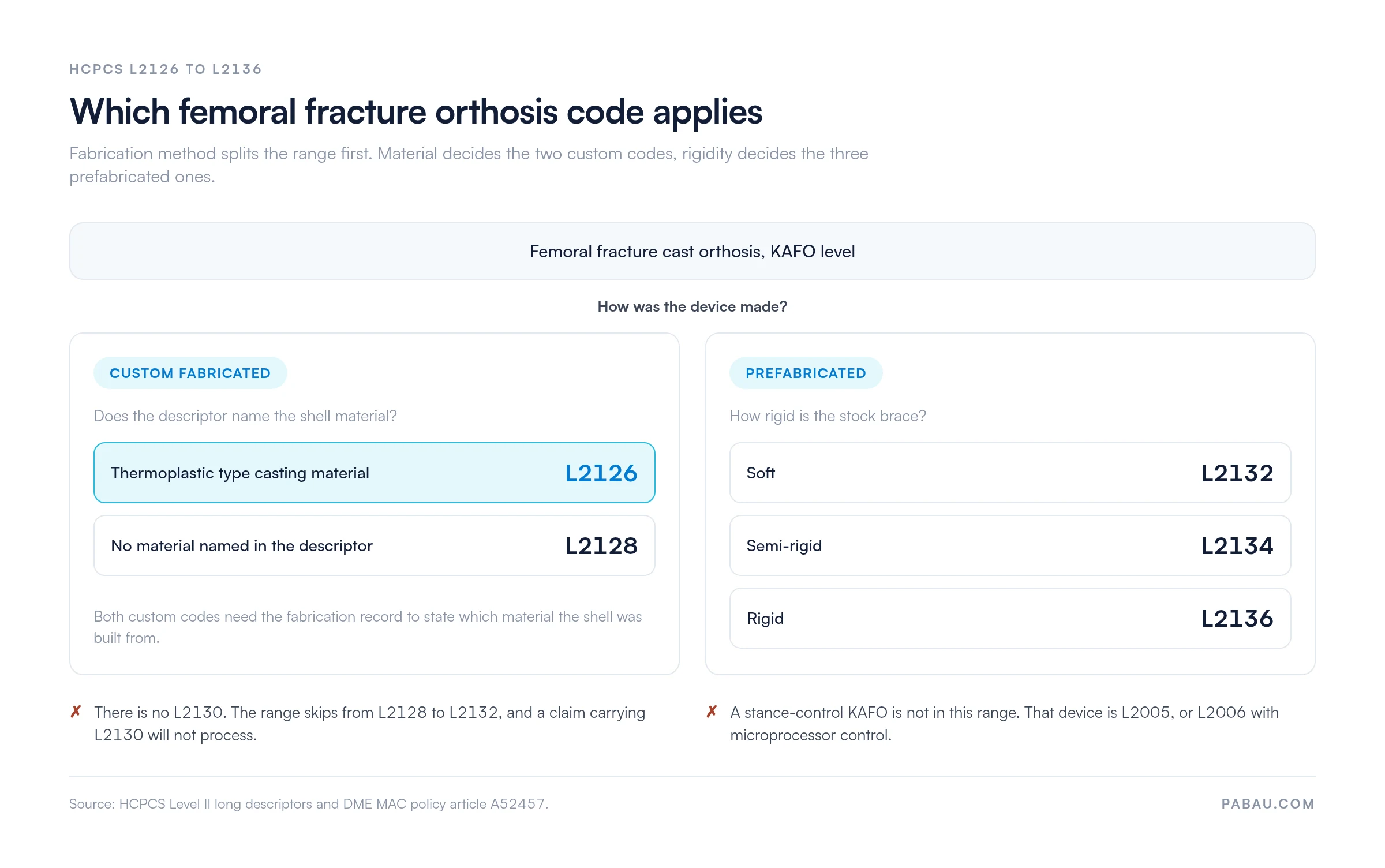
L2126 opens the L2126-L2136 KAFO code range. Every code in it is a femoral fracture cast orthosis. What separates them is fabrication method and, for the prefabricated versions, how rigid the device is.
Two points about this table are worth holding on to. There is no L2130. The range runs L2126, L2128, L2132, L2134 and L2136, and a claim submitted with L2130 will not process.
The second point is the split at L2128. L2126 applies when the custom shell is made from thermoplastic casting material. L2128 is the custom-fabricated femoral fracture cast orthosis whose descriptor names no material at all.
Both are custom, so the fabrication file has to show which material was used. The diagram below runs through that choice in the order a coder makes it.
The same five-code pattern exists for the lower leg, one anatomical level down. Those are ankle-foot orthoses, so they carry AFO codes rather than KAFO codes. Picking a tibial code for a femoral brace is a descriptor mismatch that a DME MAC will catch.
L2106 is the tibial counterpart of L2126, custom-fabricated from the same thermoplastic casting material. A rigid, prefabricated tibial brace is billed as HCPCS code L2116 instead.
Medicare covers L2126 under LCD L33686, Ankle-Foot/Knee-Ankle-Foot Orthosis, which the four DME MACs administer. L2126 is named in the LCD’s list of KAFOs covered for ambulatory beneficiaries.
Running insurance eligibility verification before you fabricate protects against a late coverage surprise on an item you cannot restock.
Coverage runs through two gates, and L2126 has to clear both. Missing the second gate is the more common failure, because it is the one that applies specifically to custom-fabricated devices.
The LCD covers KAFOs, including L2126, for ambulatory beneficiaries who meet all three of the following conditions.
If those basic criteria are not met, the LCD denies the orthosis as not reasonable and necessary. That denial lands before anyone looks at the fabrication method.
A custom-fabricated AFO or KAFO is covered only when the basic criteria are met and at least one of five further criteria applies. The LCD lists them as follows.
The fifth criterion is the natural fit for L2126, and it should be the one your record addresses head on. Say what the fracture is, and say why the limb cannot be braced with a stock device. If a custom orthosis is supplied and none of the five criteria is documented, the LCD denies it as not reasonable and necessary.
The stock alternative is a prefabricated brace from the same range, billed by rigidity as L2132, L2134 or L2136. Naming the stock code you ruled out makes that justification specific.
There is no Medicare list of covered diagnoses for L2126. Policy article A52457 publishes supporting ICD-10 codes for only two small groups. Group one covers L4392, L4396 and L4397. Group two covers L4631. The article then states plainly that for all other HCPCS codes, diagnoses are not specified.
That changes how you approach the claim. There is no covered-code list to match against, so the diagnosis has to be clinically correct and the record has to carry the coverage argument.
The codes below are the ones a femoral fracture cast orthosis is usually paired with, chosen for the fracture itself. Check the one you pick against the ICD-10-CM code index before it goes on the claim.
Two habits keep this section clean. Code the fracture to the highest specificity the record supports, because an unspecified code invites a records request. Then make sure the seventh character matches the encounter, since an initial-encounter code on a brace supplied months into healing contradicts your own notes.
Incomplete documentation is the leading cause of L2126 denials and post-payment recoupment. A DMEPOS claim carries its own file, separate from the clinical chart. Assemble it before you submit, not after an audit letter arrives.
L2126 is not on the CMS list of items requiring a face-to-face encounter and a written order prior to delivery. It does not require prior authorization either. That is a smaller upfront burden than some L-codes carry. It also means nothing external forces the file into shape, so the discipline has to come from your own process.
Build these six items into a checklist that runs before the claim is generated. A claim that pays on the first pass costs far less than an appeal.
Before you code, write one line in the chart naming the fracture, the shell material, and why a stock brace was ruled out. That line decides between L2126, L2128 and the prefabricated codes L2132 to L2136. It is also your evidence for the custom-fabrication criterion if the file is reviewed.
L2126 is paid under the Medicare DMEPOS fee schedule. Allowed amounts are jurisdiction-specific and change every year, so treat the table below as structure rather than a dollar figure. Verify the current allowable in the CMS DMEPOS fee schedule for your MAC and calendar year.
Additions are denied when the base orthosis is not reasonable and necessary, or when the addition itself is not. Pricing an L2126 build accurately means pricing the base and its additions as one decision. Revenue cycle management for orthotic lines depends on that arithmetic being right before the device is fabricated.
Other L-range additions follow a harder version of the same rule. Bill L1070 without its base scoliosis orthosis code and the line is denied as an invalid claim.
A52457 names five modifiers for AFO and KAFO codes. Two of the rules below are rejection-level, meaning the claim never reaches a medical necessity review at all.
A claim line billed without KX, GA or GZ is rejected as missing information. A claim billed without RT or LT is rejected as incorrect coding. So is a line carrying RTLT together with two units of service.
For bilateral devices on the same date of service, bill two lines. Put one unit of service on each, one with RT and one with LT. Rental and used-equipment modifiers have no role here, because an orthosis under the braces benefit is a purchase.
L2126 denials follow a short list of patterns. Grouping them by cause lets a billing team fix the process instead of reworking claims one at a time.
The CARC and RARC codes on the remittance map each denial back to the specific failure above. Sustained billing compliance across orthotic lines comes from pre-submission review rather than post-denial reaction.
LCD L33686 sets the Medicare baseline. Commercial payers publish their own ankle-foot and knee-ankle-foot orthosis policies, and several align loosely with the Medicare criteria while adding requirements of their own. Confirm the following four points with each plan before you fabricate.
Call the plan’s provider line rather than relying on a published policy page. Plan-level requirements change more often than the documents describing them.
A custom-fabricated orthosis produces a heavier record trail than most outpatient claims. The written order, the practitioner’s justification and the orthotist’s functional evaluation all have to be at hand. So do the fabrication notes and the proof of delivery. A file spread across paper folders and disconnected systems takes days to reassemble when a reviewer asks for it.
Practice management software like Pabau brings that file into one patient record. Our audit-ready claims management lets orthotic practices and DMEPOS suppliers track L-codes, attach the supporting records, and follow claim status across payers. Staff can flag a claim that is missing a document before it leaves the building.
The result is fewer corrections and a shorter path to payment. When a records request does arrive, the order, the evaluation, the fabrication notes and the delivery confirmation are already attached to the claim you sent.

Pabau’s claims management software gives orthotists and DMEPOS suppliers a structured way to track documentation requirements, run eligibility checks, and submit clean claims. See how it works for your practice.

L2126 rewards suppliers who read the descriptor before they pick the code. It is a custom-fabricated femoral fracture cast orthosis in thermoplastic casting material. It is not a stance-control KAFO, and it is not an off-the-shelf brace.
Once the code is right, the claim turns on three things. Document both coverage gates. Code the femur fracture to the specificity the record supports. Put KX, GA or GZ alongside RT or LT on every line. Each of those is fixable before submission and none of them is fixable afterward.
Pabau’s claims management software helps orthotic and DMEPOS teams build the documentation workflow that heads off those failures. To see how it fits your billing process, book a demo.

Need a deeper look at denial patterns across DME billing? Denial management in healthcare covers root-cause analysis frameworks and resolution workflows for claim rejections.
Want the pre-submission checks that keep orthotic claims clean? Submitting a clean claim explains what determines whether a claim pays on the first pass.
Looking for the broader billing compliance picture for DME and specialty practices? Medical billing compliance outlines the audit safeguards and documentation standards that protect practices during payer reviews.
Want to see where an orthotic claim sits in the wider revenue cycle? Revenue cycle management traces the money from eligibility check to posted payment.
L2126 describes a knee ankle foot orthosis (KAFO) used as a fracture orthosis. Specifically, it is a femoral fracture cast orthosis in thermoplastic type casting material, custom-fabricated. It is a molded cast brace that protects a healing femur fracture while allowing knee motion. It is billed under the Medicare braces benefit.
No. The stance-control KAFO with an automatic lock and swing phase release is L2005, and the microprocessor-controlled version is L2006. Both are custom fabricated and both are for gait support rather than fracture management. Coding guidance that describes L2126 as a prefabricated stance-control brace is describing the wrong device.
Yes. LCD L33686 names L2126 among the KAFOs covered for ambulatory beneficiaries who need additional knee stability and for whom an ankle-foot orthosis would be covered. Because L2126 is custom fabricated, one of five further criteria must also be documented. A healing fracture lacking normal anatomical integrity is the criterion that usually applies.
Medicare does not publish a covered diagnosis list for L2126. Policy article A52457 lists supporting ICD-10 codes only for L4392, L4396, L4397 and L4631, and states that diagnoses are not specified for other codes. In practice, code the femur fracture itself, using S72 codes at the highest specificity the record supports.
Both are custom-fabricated femoral fracture cast orthoses. L2126 is the version built from thermoplastic type casting material, which the descriptor names explicitly. L2128 is the custom-fabricated femoral fracture cast orthosis without that material restriction. Your fabrication record should state which material was used, because that is what separates the two codes.
Every line needs KX, GA or GZ. Use KX when all LCD criteria are met and the records are on file. Use GA when they are not met but a valid ABN was signed. Use GZ when no ABN exists. RT or LT is also required. A line missing either group is rejected before clinical review.
No. The femoral fracture cast orthosis range runs L2126, L2128, L2132, L2134 and L2136. There is no L2130, and a claim submitted with it will not process. The gap trips up coders who assume the L-code series increments evenly across the range.



