CPT code 21011: Excision of soft tissue tumor of the face
CPT code 21011: Official descriptor and procedure overview CPT code 21011, as pu...

Last Updated: Oct 8, 2026
Q4170 is the HCPCS Level II code for cygnus, per square centimeter (add-on, list separately in addition to primary procedure).
Medicare no longer prices it on Average Sales Price. Since January 1, 2026, CMS pays skin substitute products as incident-to supplies at a flat per-square-centimeter rate. That comes to roughly $127.28 under the physician fee schedule and $127.14 under the OPPS, where Cygnus sits in APC 6002.
Let Pabau's smart automation suggest the right codes, reduce claim denials, and keep your practice compliant—effortlessly.
Automate repetitive tasks and focus on what matters most—your patients.
Reduce coding errors and ensure compliance with the latest regulations.
Clean claims, fewer denials, and faster reimbursements.
Powerful insights and reporting to help your practice thrive.
HIPAA compliant SOC 2 certified GDPR-compliant Trusted by 4,000+ clinics worldwide

HCPCS code Q4170 describes Cygnus from Vivex Biologics, an amniotic membrane skin substitute billed per square centimeter of wound area
From January 1, 2026, CMS pays Q4170 as an incident-to supply at a flat rate rather than on Average Sales Price
The 2026 rate runs to roughly $127.28 per cm² under the physician fee schedule and $127.14 per cm² under the OPPS
Cygnus is regulated as a Section 361 HCT/P, so it lands in APC 6002 and keeps no ASP-based pricing
No national LCD covers skin substitutes. Novitas applies LCD L35041, First Coast applies L36377, and CGS applies L36690
Pair Q4170 with a CPT application code from 15271 to 15278. Pabau’s claims management software flags a missing one before submission
HCPCS code Q4170 is the Healthcare Common Procedure Coding System Level II code for Cygnus skin substitute, billed per square centimeter of treated wound area. Cygnus is a human amniotic membrane product manufactured by Vivex Biologics. It is applied to chronic, non-healing wounds, most often diabetic foot ulcers and venous leg ulcers.
The “Q” prefix marks it as a temporary HCPCS code assigned by the Centers for Medicare and Medicaid Services (CMS). Q4170 remains active for 2026. CMS now treats these product codes as add-on codes reported alongside the application procedure, rather than as standalone biologicals.
The unit of measure decides the payment. Billers calculate the wound surface area in square centimeters, length multiplied by width, and report that figure as the unit quantity. Under the 2026 flat rate, that number is the only variable left in the price.
Cygnus is a dehydrated human amnion membrane allograft from Vivex Biologics. Knowing the product matters for billing, because its FDA regulatory category now sets its payment group. Cygnus is regulated under Section 361 of the PHS Act, which places it in APC 6002 for 2026.
Wound care practices that stock several skin substitutes need inventory tracked by lot number against the patient record. When product usage is logged against the encounter, the lot on the chart matches the lot on the claim.
Medicare no longer pays Q4170 on Average Sales Price. Since January 1, 2026, CMS treats skin substitute products as incident-to supplies furnished with a covered application procedure. Payment runs through the physician fee schedule in the non-facility setting and through the OPPS in hospital outpatient departments.
The rate is site-neutral and product-neutral. CMS set roughly $127.28 per square centimeter under the physician fee schedule, and that figure is geographically adjusted. The OPPS rate is $127.14 per square centimeter, with no geographic adjustment applied.
Cygnus no longer carries a product-specific price. Every product in the same FDA category is paid the same amount per square centimeter, whatever the invoice says. Wastage is not separately payable, so discarded product cannot be billed with a JW modifier.
Place of service still decides which system pays. A physician office bills Q4170 under the physician fee schedule. A hospital outpatient department bills under the OPPS. The two rates sit close together, but the wrong place-of-service code remains an audit trigger.
Check the current figure before you bill, since CMS issues technical corrections during the year. The CMS Physician Fee Schedule lookup tool returns the rate for your MAC jurisdiction and place-of-service indicator. Building a quarterly rate check into your billing calendar keeps fee estimates honest.
Through December 31, 2025, Q4170 was priced from the manufacturer’s Average Sales Price and sorted into a high-cost or low-cost OPPS tier.
The CY2026 OPPS final rule removed both. CMS also deleted codes C5271 through C5278 on December 31, 2025. The old and new rules differ on every line a biller touches.
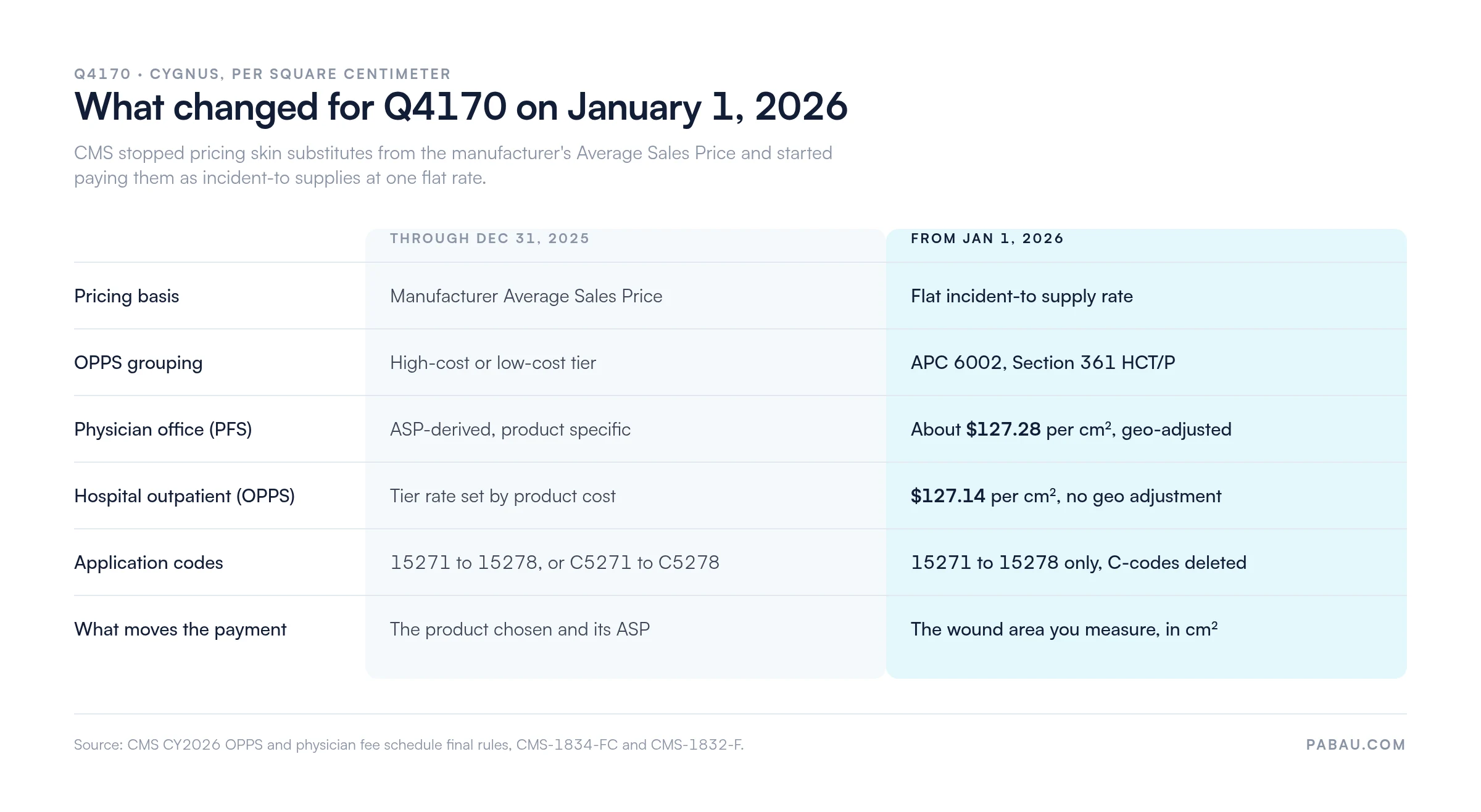
Products are now grouped by FDA pathway instead of by cost. CMS created three new APCs, each carrying status indicator S1, and set one payment rate across all three for the first year.
CMS took the highest weighted ASP across the three groups, found in APC 6002, and applied that single rate to all of them. Only biologics licensed under Section 351 of the PHS Act kept ASP methodology. Cygnus is a 361 HCT/P, so it does not qualify for that exception.
Sheet-form products stay unpackaged and separately paid under the OPPS. Q4170 therefore lands in APC 6002 rather than being folded into payment for the application procedure. The CY2026 OPPS final rule sets out this grouping.
Place of service (POS) determines which payment system governs the claim, and which bill type and revenue codes apply. Under the 2026 rules the choice no longer changes the price very much, but it still changes the paperwork. Billing POS 11 for a procedure performed in a hospital outpatient department is an overpayment risk.
In a hospital outpatient department the facility bills the product and the physician bills only the professional component. Confirm with the facility billing team how that split is handled, so the product is not reported twice.
Where a course of treatment spans several sessions, each date of service needs its own claim with the POS that applied that day.
Q4170 is a product code and cannot stand alone on a claim. In the Novitas jurisdictions the controlling policy is billing article A54117. Its full title is Billing and Coding: Application of Bioengineered Skin Substitutes to Lower Extremity Chronic Non-Healing Wounds.
The article requires a companion CPT application code from the 15271-15278 series, and the First Coast and CGS articles say the same. Submitting the product without that code is the most common denial here.
Codes 15273, 15274, 15277 and 15278 are not pediatric codes. They apply to any patient whose total wound surface area reaches 100 sq cm or more. The body-percentage wording in the descriptor is an alternate measure for infants and children, not an age restriction.
Pairing rules like this one are not unique to wound care. On a scoliosis orthosis claim, L1050 is an addition code that Medicare denies unless base code L1000 or L1001 appears alongside it.
Every Q4170 claim needs at least one covered ICD-10-CM diagnosis code. Covered lists are jurisdictional rather than national. Each MAC’s billing article carries its own list of ICD-10-CM codes that support a skin substitute application. Check the patient’s diagnosis against the applicable list before the product is opened.
Most L97 and L98 codes require a laterality and severity qualifier. The code selected has to match the wound’s documented location and current clinical status. Reaching for an unspecified code when a specific one exists raises denial risk and invites review. The AAPC HCPCS code lookup is a useful cross-reference for Q-code and diagnosis pairings.
No national coverage determination governs skin substitutes, so coverage depends on your Medicare Administrative Contractor. Novitas applies LCD L35041 with billing article A54117. First Coast Service Options applies LCD L36377 with article A57680, and CGS applies LCD L36690 with article A56696.
Palmetto GBA, NGS, WPS and Noridian carry no skin substitute LCD and review these claims case by case. A harmonized set of DFU and VLU policies was withdrawn on December 24, 2025, before it took effect. Confirm your own jurisdiction’s position before the product goes on the wound, and verify the patient’s benefits first.
Where one of those LCDs applies, the criteria below generally have to be met before Q4170 is billed:
Commercial payers run their own skin substitute policies. Those often differ from the MAC policies on covered diagnoses and on the number of applications allowed per wound episode. Prior authorization is payer-specific too. Some MACs and commercial plans require it, others do not.
Medicare also limits applications per wound episode. Going past that limit without documented healing progress is one of the most reliable ways to trigger a denial. Check the payer’s current policy before each application episode rather than at the end of it.
Thin documentation is the main reason skin substitute claims fail on post-payment audit. Each MAC’s billing article sets out what the record needs before and at the time of each application. Compliance requirements for these Q-codes run tighter than for most supply codes, because payers watch this category closely.
Under the 2026 flat rate the wound measurement is the payment. Q4170 units are multiplied by a fixed per-square-centimeter figure, so a loosely recorded measurement moves the money directly. Photograph the wound and record length by width at every visit, not only at application. A 30-day trend showing no progress under standard care is also the strongest medical necessity evidence you can put in front of a payer.
Billing Q4170 correctly comes down to six steps, from wound measurement through claim submission. A mistake at any one of them produces a denial, an underpayment, or an audit finding. Most of the manual arithmetic disappears in error-checking claims software that understands HCPCS Q-code workflows.
Verify the claim before transmission. Missing fields, mismatched dates and absent modifiers cause most technical rejections. A pre-submission check catches them earlier than any appeal.
The skin substitute landscape tightened steadily from 2023, then changed shape entirely in January 2026. Medicare Part B spending on these products rose sharply between 2022 and 2024.
CMS responded first with documentation scrutiny, then with a new payment method. A practice working from 2022 assumptions is now wrong on both coverage and price.
The CY2026 rules rewrote skin substitute payment rather than adjusting it. CMS finalized the change in the CY2026 physician fee schedule and OPPS final rules, CMS-1832-F and CMS-1834-FC. The operating instructions arrived in MLN change request MM14361. All of it took effect on January 1, 2026.
The practical effect is that the invoice price of Cygnus no longer drives the reimbursement. Practices that bought on acquisition cost and billed on ASP need to rebuild their margin assumptions from the flat rate up.
Q4170 sits inside a large family of skin substitute Q-codes, all listed in the HCPCS code index. Each code names a specific product from a specific manufacturer. Billing the wrong Q-code is a compliance problem rather than a clerical one, and the 2026 flat rate removes any pricing advantage from doing it.
Confirm the Q-code from the product label and lot number in the clinical record. If a different product is substituted at the time of application, the claim has to name the product that went on the wound. Never swap one Q-code for another to reach a better rate, since that is upcoding and creates false claims exposure.
Q4170 denies more often than most HCPCS codes, because payers audit this category closely. Good denial management starts by preventing the patterns below rather than appealing them afterward.
Read the remittance advice adjustment reason code before choosing between an appeal and a corrected claim. Many skin substitute denials clear with additional documentation, which is the fastest route when the records were complete from the start.
Build a Q4170 pre-submission checklist your billing team runs before every claim. Confirm the product code, the companion application code, and a place of service that matches the setting. Then confirm the diagnosis sits on your MAC’s covered list, the wound area in sq cm matches the units, and prior treatment failure is documented. The check takes about two minutes and clears the largest denial categories before the claim leaves the practice.
A wound care practice applying skin substitutes has to keep measurements, companion codes, product lot numbers and prior treatment notes connected across weeks of visits. Under the 2026 flat rate, the measurement in the chart is the number that gets paid. Any drift between the note and the claim costs money.
Practice management software like Pabau holds those pieces in one patient record. Pabau’s claims management tools track what a Q4170 claim needs, from the wound measurement through to submission. Because the treatment note feeds the charge, a missing application code gets caught before the claim goes out.
Inventory tracked by lot number sits beside the encounter, so the product on the chart is the product on the claim. Your team spends its time on wounds instead of reconciling two systems at month end.

Pabau’s claims management tools support HCPCS Q-code workflows, superbill generation, and payer-specific billing rules. Your wound care practice spends less time fixing claims and more time treating patients.

The 2026 rules moved the risk on a Q4170 claim from pricing to measurement. When every square centimeter pays the same fixed amount, the figure in the wound note becomes the figure on the remittance. Tightening measurement discipline pays back faster than any appeal your team writes.
Coverage deserves the same caution. Pricing went national in January 2026, but coverage did not. Until CMS replaces the withdrawn DFU and VLU policies, your own MAC decides whether the application is payable at all.
Get those two right and most of the rework this code generates disappears. Book a demo to see how Pabau keeps wound measurements, companion codes and claim submission in one workflow.

Need to understand how clean claims reduce skin substitute denials? Clean claim best practices covers the documentation elements that decide first-pass claim acceptance.
Want to see how the revenue cycle connects to skin substitute reimbursement? Revenue cycle management explained covers the process from eligibility through payment posting.
HCPCS code Q4170 is used to bill for Cygnus, a dehydrated human amniotic membrane skin substitute from Vivex Biologics, per square centimeter of wound area. It is applied to chronic lower extremity wounds, mainly diabetic foot ulcers and venous leg ulcers that have not closed under standard care. A companion CPT application code from 15271 to 15278 belongs on the same claim.
Medicare pays Q4170 at a single flat rate per square centimeter, effective January 1, 2026. That rate is roughly $127.28 per cm² under the physician fee schedule, where geographic adjustment applies. Under the OPPS it is $127.14 per cm², with no geographic adjustment. Confirm the current figure in the CY2026 fee schedule files before billing, since CMS issues technical corrections.
No. Product-specific ASP pricing for Q4170 ended on December 31, 2025. From January 1, 2026, CMS pays skin substitute products as incident-to supplies at a flat per-square-centimeter rate. Only biologics licensed under Section 351 of the PHS Act kept ASP methodology. Cygnus is a Section 361 HCT/P, so it does not qualify for that exception.
Q4170 falls under APC 6002 with status indicator S1. CMS created three APCs based on FDA regulatory category. APC 6000 covers premarket approval products, APC 6001 covers 510(k) products, and APC 6002 covers Section 361 HCT/Ps. Cygnus is regulated as a 361 HCT/P, which places it in APC 6002. All three APCs pay $127.14 per cm² for CY2026.
Commonly paired codes include E11.621 and E10.621 for diabetes with foot ulcer. Coders also use the I83.0 series for varicose veins with ulceration and the L97 series for chronic lower extremity ulcers. Covered lists are jurisdictional rather than national, so each MAC’s billing article carries its own set. Always select the most specific code available, since an unspecified code raises denial risk.
CPT codes 15271 through 15278 are the application codes billed alongside Q4170. The correct one depends on body region and total wound surface area. Codes 15271, 15272, 15275 and 15276 work in 25 sq cm increments. Codes 15273, 15274, 15277 and 15278 apply once total wound area reaches 100 sq cm, at any age. Omitting the application code is the most common denial on this code.
Q4170 is billed per square centimeter. The unit quantity equals the wound surface area in sq cm, measured as length by width at the time of application. Bill only the product actually applied. If a 10 sq cm sheet is trimmed onto a 7 sq cm wound, bill 7 units. Wastage is not separately payable in 2026, so the trimmed material cannot be billed.
The record needs wound measurements in cm² that match the units billed, plus the wound type and how long it has been present. Add at least 30 days of prior standard wound care with documented failure to respond. Include a signed physician order, a medical necessity narrative, and the product label with its lot number. Pre- and post-application photographs are required by several MACs.
No national LCD covers skin substitutes, so the answer depends on your MAC. Novitas applies LCD L35041 with billing article A54117. First Coast applies LCD L36377 with article A57680, and CGS applies LCD L36690 with article A56696. Palmetto GBA, NGS, WPS and Noridian carry no skin substitute LCD and review these claims case by case.