CCSD code G5100: Bypass of duodenum billing guide
CCSD code G5100 bills a bypass that leaves the duodenum in place CCSD code G5100...

Last Updated: Oct 16, 2026
Billable Code Specific Code
T31.70 is the billable ICD-10-CM code for burns involving 70-79% of body surface with 0% to 9% third degree burns.
Three documented facts decide the code. They are the burn mechanism, the total TBSA, and the share of that area burned to full thickness.
Let Pabau's smart automation suggest the right codes, reduce claim denials, and keep your practice compliant—effortlessly.
Automate repetitive tasks and focus on what matters most—your patients.
Reduce coding errors and ensure compliance with the latest regulations.
Clean claims, fewer denials, and faster reimbursements.
Powerful insights and reporting to help your practice thrive.
HIPAA compliant SOC 2 certified GDPR-compliant Trusted by 4,000+ clinics worldwide

ICD-10 Code T31.70 covers burns on 70-79% of total body surface area, with third-degree burns under 10% of that area.
T31.70 became effective October 1, 2025 under the 2026 ICD-10-CM edition and is valid for reimbursement.
T31.70 leads the claim only when the burn site is unspecified, otherwise it supports the site codes in T20-T25.
The Rule of Nines estimates TBSA in adults, while pediatric cases use the Lund-Browder chart instead.
Practice management software like Pabau supports ICD-10 coding workflows, so fewer burn claims are denied for incomplete documentation.
T31.70 is a specific, billable ICD-10-CM diagnosis code. It describes burns involving 70 to 79 percent of the total body surface area. Third-degree burns account for less than 10 percent of that total. It also covers cases where the third-degree extent is unspecified.
The code became effective October 1, 2025, as part of the 2026 ICD-10-CM edition maintained by CMS. It is valid for reimbursement across US payer types, including Medicare, Medicaid, and commercial insurers. The T31 category has carried no major restructuring across recent ICD-10-CM editions.
Burns covering 70 to 79 percent of total body surface area are classified as massive burns. Patients in this range face high risks of systemic complications. Those include sepsis, respiratory failure, multi-organ dysfunction, and the fluid and electrolyte imbalances that drive aggressive resuscitation.
For coding, the TBSA extent and the depth of the deepest burns are documented separately. T31.70 captures cases where the third-degree component sits at 0-9% of TBSA. Most of the injury is then first- and second-degree tissue damage.
That distinction shapes the rest of the case. Treatment complexity, skin grafting requirements, and expected length of stay all differ between 5% third-degree burns and 30%.
When third-degree burns account for less than 10% of a 70-79% TBSA injury, the damage is mostly superficial and partial thickness. Document burn depth at each anatomical site so the third-degree percentage can be assigned from the record rather than estimated.
The Rule of Nines is the standard clinical estimation method for total body surface area in adult burn patients. It divides the body into regions, each assigned a percentage of total surface area.
Anterior and posterior trunk together account for 36%, and both lower extremities add another 36%. Those regions alone reach 72% of TBSA, which already sits inside the T31.7 band. Adding an upper extremity or the head pushes the estimate past 79% and into T31.8.
Documenting which regions are burned, and to what depth, drives both the clinical plan and the code selection.
Important: The Rule of Nines applies to adults. Pediatric patients use the Lund-Browder chart instead, because children have proportionally larger heads and smaller legs.
Applying adult percentages to a pediatric case produces an inaccurate TBSA estimate and the wrong code. The CDC/NCHS ICD-10-CM coding tool carries the official tabular guidance by TBSA range.
T31.7 is the non-billable parent code for burns involving 70-79% of total body surface area. It requires a fifth digit to become a specific, billable code. That fifth digit states the percentage of the total burned area that is third-degree, or full-thickness.
T31.70 fits when the third-degree component is documented below 10% of TBSA, or when the physician notes burn depth without giving a third-degree percentage. Where the record documents third-degree burns of 10% or more, the code moves to T31.71 or higher. A documented third-degree share of 50% to 59%, for example, lands on T31.75.
Using T31.70 when the documentation supports T31.72 or T31.73 is a common audit target. Confirm the documented percentage against the operative note or the burn chart before you commit to a subcode.
T31 is the ICD-10-CM category for burns classified by total body surface area involved. It sits within the injury chapter (S00-T88) under the burn and corrosion block (T30-T32). The T20-T25 codes classify burns by anatomical site, while T31 codes handle the extent of body surface involvement.
Each T31 category code represents a TBSA range. T31.0 covers 0-9%, T31.1 covers 10-19%, and so on through T31.9 (90-99%). T31.7 covers the 70-79% range.
The WHO ICD-10 classification provides the international framework that US ICD-10-CM builds on. The fifth-digit specificity for burn depth belongs to the clinical modification rather than the WHO original. You can also walk the full T31 hierarchy through the AAPC ICD-10-CM code lookup.
When a burn case spans both T20-T25 (anatomical site) and T31 (TBSA extent), ICD-10-CM guidelines permit using both code sets together. T31.70 may be assigned alongside site codes such as T22 (burn of shoulder and upper limb) where the documentation supports both levels of detail. Where the site is documented, the T20-T25 code leads and T31.70 supports it.
Accurate use of T31.70 rests on three facts that have to appear in the medical record.
A coder cannot infer any of the three, so a record missing one of them goes back to the physician as a query. The checks also run in a fixed order, because the first one decides which category the case belongs to at all.
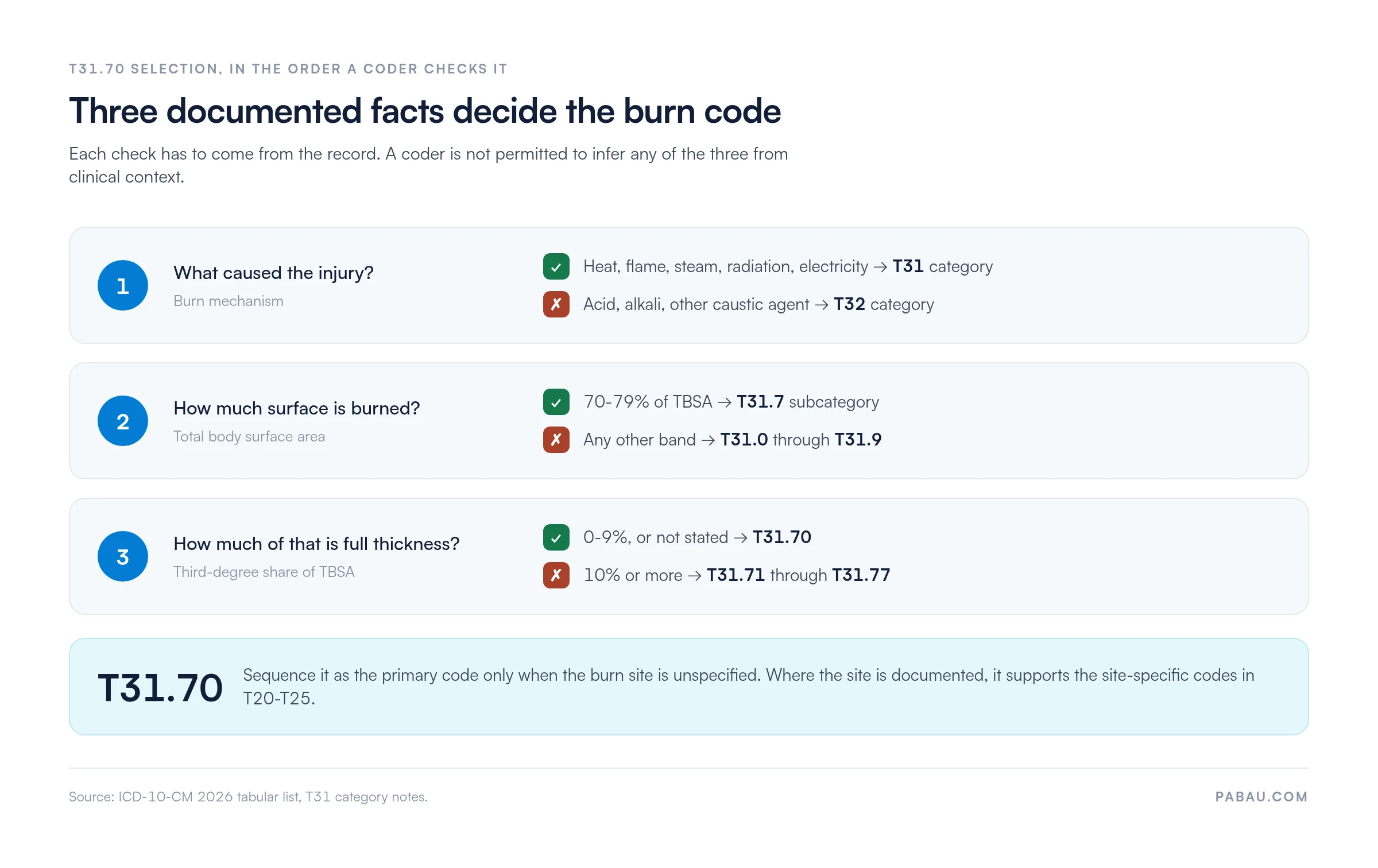
The T31 category carries an Excludes2 note for burns and corrosions classified by body region (T20-T25). An Excludes2 note is not a prohibition. T31.70 and a site-specific burn code may appear on the same claim when the record supports both.
Sequencing follows from the record. T31.70 leads only where the burn site is unspecified. Where the site is documented, the T20-T25 code leads and T31.70 reports the extent behind it.
What T31 does exclude is corrosion coding. Corrosions, meaning chemical burns, are classified under T32. If a caustic or corrosive substance caused the injury rather than a heat source, the correct category is T32.7x rather than T31.7x.
Using T31.70 for a chemical corrosion misrepresents the mechanism in the patient record. It also tends to surface later as a rejection, so the medical billing denial codes payers return on burn claims are worth knowing early.
ICD-10-CM instructs coders to use additional codes when documenting the full clinical picture of a major burn injury. The most common supplementary codes alongside T31.70 include:
Major burn cases often trigger payer-side eligibility and prior authorization checks before reimbursement is processed. Verify both early, because a 70-79% TBSA admission generates charges faster than a benefits query gets resolved.
The burn versus corrosion distinction decides which ICD-10-CM category the case belongs in. A mechanism error moves the claim out of T31 entirely, and no amount of TBSA detail corrects it.
Thermal burns (T31 category) result from contact with heat sources: open flames, scalding liquids, steam, hot objects, radiation, electricity, or lightning. T31.70 applies here.
Corrosions (T32 category) result from chemical substances such as acids, alkalis, and other caustic agents. A patient with 70-79% TBSA involvement from a chemical plant exposure is coded under T32.7x, not T31.7x.
The two categories run in parallel. T32.70 mirrors T31.70 in both the TBSA range and the third-degree structure. Only the mechanism differs.
The treating physician should document the mechanism explicitly. Where the note is ambiguous, as in “extensive chemical and thermal exposure”, query the provider before assigning T31.70.
Coding guidelines prohibit coders from inferring burn mechanism from clinical context alone. A wrong mechanism then follows the record into every downstream report the case appears in.
ICD-10-CM carries several accepted synonyms for T31.70 in clinical documentation and coding lookups. Recognizing them helps coders reach the correct code when a note uses non-standard terminology.
These descriptions turn up in clinical notes, discharge summaries, and operative reports. Map any of them to T31.70, provided the third-degree component is confirmed below 10%.
The pattern holds across the trauma categories. Quantified extent drives the classification whenever the record states it, which is why the TBSA figure is the first number a burn coder looks for.
The most common error in the T31.7 subcategory is selecting T31.70 when the documentation supports a higher subcode. The only difference between T31.70 and its siblings is the documented third-degree burn percentage. The TBSA range of 70-79% is identical across all T31.7x codes.
One documentation pattern comes up repeatedly. The physician records “extensive full-thickness burns” without stating a percentage. T31.70 is the correct default there, because the third-degree extent is unspecified.
Do not step up to T31.71 or higher without an explicit percentage in the record. A query to the physician costs less than a denied claim on an extended burn admission.
Major burn cases generate complex claims. Multiple providers, multiple procedure codes, and extended inpatient stays all land on the same institutional claim. Whether T31.70 leads the claim or supports a site code depends on how the burn site was documented.
Submitting through claims management software that validates ICD-10 codes at the point of submission cuts preventable technical denials. Claim.MD, which Pabau integrates with, handles electronic claims submission and real-time eligibility checking with over 400 payers.
For T31.70 specifically, three submission errors account for most rejections:
Reading the electronic remittance advice on a denied burn claim tells you which documentation the payer actually wanted. On T31.7x denials the reason codes most often point at burn depth or TBSA. Fixing that at coding review beats fixing it after the denial.

Read the electronic remittance advice on any denied T31.7x claim before you resubmit. Payers frequently return burn claims with a CO-16 adjustment code, which means the claim is missing information the payer needs. On T31.7x claims that is usually the TBSA figure or the third-degree percentage, so the fix is a documentation query rather than a resubmission.
Standardized templates for burn documentation reduce the variability that drives coding queries. Prompt for the TBSA percentage, the depth by region, and the burn mechanism on every burn admission. The coder then never has to chase all three.
Burn documentation for a T31.70 admission arrives from several places. The TBSA estimate sits in the trauma note, the depth by region in the operative record, and the mechanism in the intake history. A coder assembles all three by hand before the claim leaves the building.
Pabau is an all-in-one practice management system, so the diagnosis code, the supporting documentation, and the claim sit on one record. Coding fields live on the encounter rather than in a separate billing file. The TBSA percentage and the third-degree share stay attached to the note that recorded them.
Claims go out through the Claim.MD integration with codes validated at submission, and the remittance comes back against the same claim. When a payer returns CO-16 on a T31.7x claim, your billing team can see which field it wanted without reopening the chart.

Pabau’s claims management tools help billing teams submit clean claims the first time and track ICD-10 codes accurately. That means fewer denials on complex burn cases.

The difficulty with T31.70 sits in the documentation rather than the code lookup. The three facts that select it live in three different parts of the record, and a coder is not allowed to infer any of them.
So the work that pays off happens before submission. Build the TBSA percentage, the depth by region, and the burn mechanism into the burn documentation template. The subcode then follows from the record instead of from a query.
The trade-off worth remembering is that T31.70 is the safe default only when the third-degree extent is genuinely unstated. Book a demo to see how Pabau moves a burn admission from documentation to a paid claim.

Need guidance on clean claim submission? Clean claim best practices covers the documentation and coding standards that prevent technical rejections before claims leave your system.
Struggling with burn claim denials? Denial management in healthcare explains how to build a systematic response process for high-value trauma claim rejections.
Want to understand how clearinghouses process ICD-10 claims? Medical claims clearinghouse guide walks through how electronic claim routing and validation work across US payers.
ICD-10 Code T31.70 is a billable ICD-10-CM diagnosis code for burns involving 70 to 79 percent of the total body surface area. It applies where third-degree burns account for less than 10 percent of the burned area, or where the third-degree extent is unspecified. The code became effective October 1, 2025 under the 2026 ICD-10-CM edition.
Yes, T31.70 is a specific, billable ICD-10-CM code valid for diagnosis reporting and reimbursement. Its parent code, T31.7, is non-billable and needs the fifth digit to become specific. T31.70 is the correct billable code when third-degree burns are below 10% or unspecified within the 70-79% TBSA range.
T31.70 applies when third-degree burns account for 0-9% of TBSA, or when the third-degree percentage is unspecified. T31.71 applies when third-degree burns are documented at 10-19% of TBSA. Both cover the same 70-79% overall TBSA range. The only distinction is the fifth digit, which states how much of the burned area is full thickness.
The Rule of Nines divides the adult body into regions. Head and neck take 9%, each arm 9%, anterior trunk 18%, posterior trunk 18%, each leg 18%, and perineum 1%. Clinicians add the affected regions to estimate total TBSA burned. Pediatric patients use the Lund-Browder chart instead, because their body proportions differ from those of adults.
T31.70 excludes corrosions caused by chemical substances, which are coded under T32.70 instead. The T31 category covers thermal burns only. T31 codes are also distinct from the site-specific burn codes in T20-T25. Both code sets may appear on the same claim where the documentation supports the extent and the site.
T31.70 is sequenced as the primary code only when the burn site is unspecified. Where the record documents the site, the T20-T25 site code leads and T31.70 reports the extent behind it. Check the ICD-10-CM Official Guidelines for Coding and Reporting for the sequencing rules that apply to your case.
T31.70 became effective October 1, 2025 as part of the annual ICD-10-CM update cycle. That edition is referred to as the 2026 ICD-10-CM edition. The code has been valid across several preceding editions with no structural change. Verify currency each year using the CDC/NCHS ICD-10-CM coding tool.