

HCPCS code E0198: Water pressure pad billing guide
HCPCS code E0198 is a water pad for a standard mattress HCPCS code E0198 is the ...

Last Updated: Oct 13, 2026
C1893 is the HCPCS Level II code for introducer/sheath, guiding, intracardiac electrophysiological, fixed-curve, other than peel-away.
The code sits inside the facility medical billing rules that decide where and how it may be reported. It also covers the C1892 distinction, applicable modifiers, and the related C-series codes coders work with.
Let Pabau's smart automation suggest the right codes, reduce claim denials, and keep your practice compliant—effortlessly.
Automate repetitive tasks and focus on what matters most—your patients.
Reduce coding errors and ensure compliance with the latest regulations.
Clean claims, fewer denials, and faster reimbursements.
Powerful insights and reporting to help your practice thrive.
HIPAA compliant SOC 2 certified GDPR-compliant Trusted by 4,000+ clinics worldwide

HCPCS Code C1893 is the CMS-maintained Level II code for a guiding introducer sheath, fixed-curve, other than peel-away.
C1893 is billed only by hospital outpatient departments, paid under OPPS, and ambulatory surgical centers, paid under the ASC payment system.
C1892 and C1893 both describe fixed-curve sheaths, so the only difference is peel-away versus other than peel-away.
The 2026 payment rate, APC assignment, and status indicator for C1893 all come from the CMS OPPS Addendum B file.
Pabau submits and tracks the codes your coders enter, including C-series device lines on outpatient facility claims.
HCPCS Code C1893 carries the official descriptor: Introducer/sheath, guiding, intracardiac electrophysiological, fixed-curve, other than peel-away. The Centers for Medicare and Medicaid Services (CMS) maintains this code within the HCPCS Level II C-series. That group of codes was built for the Outpatient Prospective Payment System (OPPS). CPT codes are maintained by the American Medical Association (AMA). HCPCS Level II codes are created and updated by CMS instead, for items, supplies, and devices that CPT does not capture.
C-series HCPCS codes identify medical devices used in outpatient procedures that qualify for separate Medicare reimbursement. C1893 sits in this category because the introducer sheath is a discrete, separately billable device rather than a supply bundled into the procedure payment.
An introducer sheath is the access route for the whole EP procedure, because catheters cannot reach the cardiac chambers without one. During EP studies and ablation procedures, electrophysiologists insert one or more sheaths through the femoral or subclavian vein. The sheath then holds a stable channel open for mapping and ablation catheters.
The sheath coded under C1893 has a fixed curve, so the tip sits at a manufactured deflection rather than being steerable. C1893 then covers the version that is not designed to peel away as it comes out.
Because the sheath is placed before the procedure begins and removed after, it is a distinct device from the ablation or diagnostic catheter coded elsewhere. CMS designates it as separately reportable in the HOPD and ASC settings for that reason. The procedure CPT code covers the physician work, while C1893 covers the device cost the facility carries.
C1893 is reported per device unit used, not per procedure. If two fixed-curve sheaths are placed during a single session, two units of C1893 are appropriate. Payer policy on multiple units and modifier requirements still applies.
C-series HCPCS codes were built for outpatient facility billing. C1893 belongs on a facility claim from a hospital outpatient department or an ambulatory surgical center. HOPD claims price under OPPS, while ASC claims price under the separate ASC payment system. Physician office billing does not apply at all.
Non-OPPS payers, including Medicaid managed care plans and commercial insurers, may or may not recognize C1893 independently. Verify the specific payer fee schedule before assuming coverage. Running insurance eligibility verification before the procedure date catches coverage limits early. It also confirms the facility is contracted with that payer for cardiac device codes.
Device pass-through payment status is an important variable. CMS gives some device categories a transitional pass-through period, during which the device earns payment above the APC base rate. Check pass-through status for C1893 against the current CMS OPPS Addendum B for the calendar year you are billing. Pass-through status is temporary by design and expires after two to three years.
The 2026 Medicare rate for HCPCS Code C1893 is published in CMS OPPS Addendum B, the annual reference for outpatient device payment. Rates move every calendar year with the OPPS final rule, published in the Federal Register each November. This article does not hard-code a rate, because the number can change between publication and your billing date. Download the current file from the CMS OPPS Addendum B files page and read the C1893 line. ASC facility rates for the same code live in ASC Addendum AA, not in the physician fee schedule.
Four fields in that entry decide how the line pays: the APC assignment, the status indicator, the coinsurance percentage, and any pass-through adjustment in force. Status indicator N means the item is packaged into the APC payment. Pass-through device categories carry status indicator H, which is what separately payable pass-through status looks like on the file. Indicator K covers nonpass-through drugs, biologicals, and radiopharmaceuticals, so it never describes a device like C1893. Reading these values correctly is part of solid revenue cycle management for outpatient cardiology.
The coinsurance percentage lands on the patient side of the bill, and a device-heavy EP claim leaves a larger balance to collect. Offering patient payment plans keeps those balances from aging into write-offs while the facility waits on the payer.
Pull C1893 rates from the CMS OPPS Addendum B file released each January, not from third-party lookup tools that lag behind the official update. Filter column A for the code, then read the status indicator, APC assignment, and payment rate. Set a calendar reminder each November, when the next year of rates arrives with the OPPS final rule.
This code pair is where most EP device denials start. Both descriptors read fixed-curve, so the curve itself decides nothing. The official descriptor for C1892 ends in peel-away, and C1893 ends in other than peel-away. Payers that run claim edits on the pair will deny the code that contradicts the operative report.
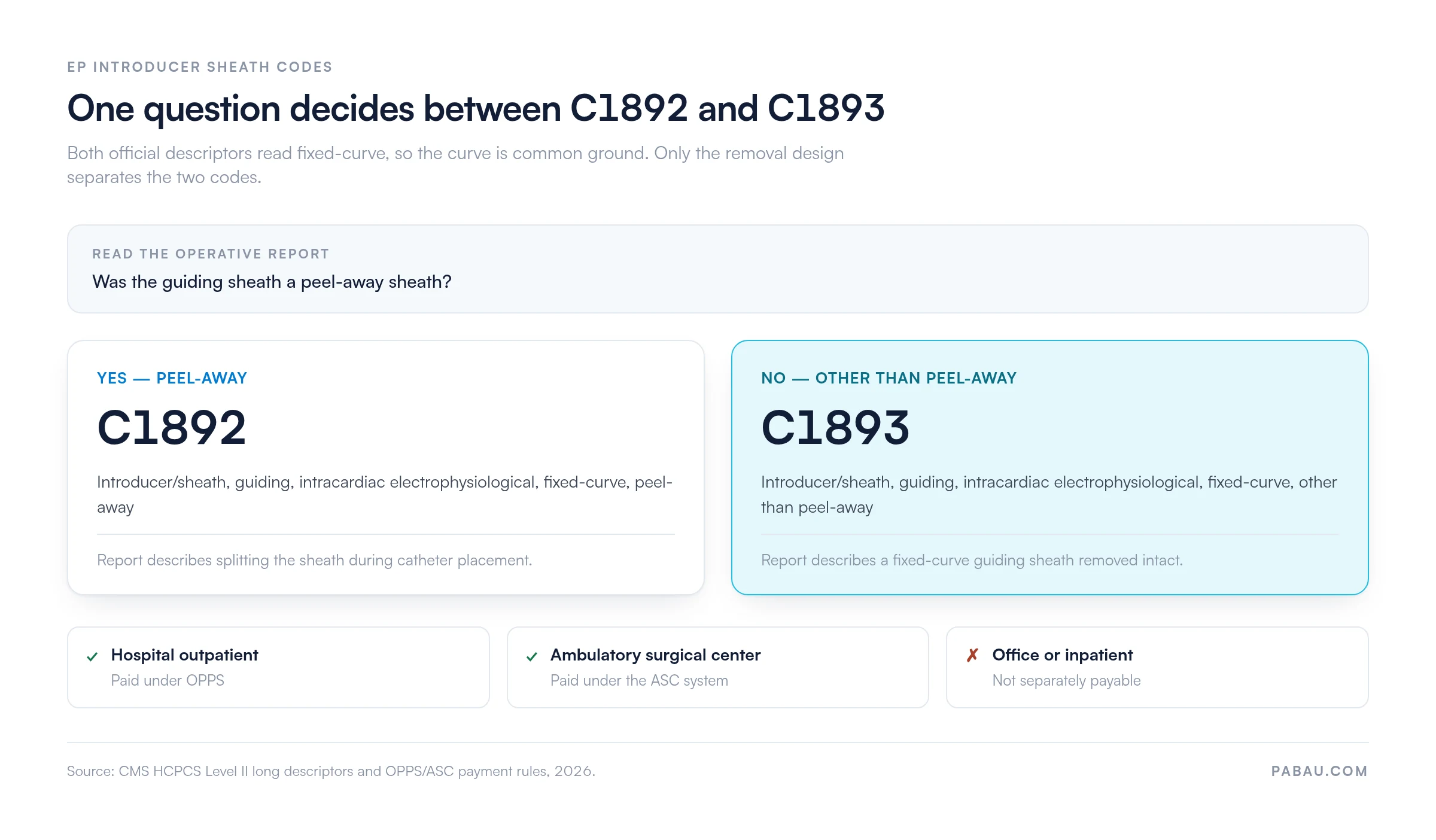
The selection criterion is the operative report itself. If the physician documents a peel-away sheath, or describes splitting the sheath during catheter placement, C1892 is the code. If the report describes a guiding sheath with no peel-away feature, C1893 is correct. Query the physician when the wording is ambiguous, rather than picking the likelier code.
A wrong guess costs more than the query does. The denial comes back, the corrected claim goes out, and payment slips by weeks. Good denial management starts with accurate first-pass coding.
C-series device codes can carry modifiers, but applicability depends on the payer, the claim type, and the clinical scenario. No modifier is universally required for C1893. The categories below are the ones that come up most often on facility device claims of this type.
Always verify modifier requirements with the specific Medicare Administrative Contractor (MAC) jurisdiction and the payer claim edit policies. Do not append a modifier to C1893 simply because it appears on a related procedure line. Each modifier needs its own clinical and administrative basis under the payer guidelines. An unjustified modifier is a compliance exposure rather than a coding shortcut. AAPC’s HCPCS code reference adds modifier guidance by code category.
Claim errors on C1893 fall into four categories: the wrong code of the pair, the wrong setting, weak documentation, or the wrong unit count. Auditing EP device claims against operative reports each quarter shows which category your facility actually has. A denial codes reference then traces which payer edit fired on the ones that came back.
The broader framework of clean claim submission keeps C1893 lines from cycling back as avoidable denials. Charge entry is where device lines disappear, so the facility charge sheet needs a dedicated field for HCPCS device codes beside the procedure CPT code.
C1893 rarely travels alone on an EP claim. Billing teams report several C-series codes from the same case, and every descriptor is refreshed annually with the OPPS final rule. The NLM HCPCS Level II API exposes the full C-series set for facilities that build code lookups into their billing systems.
The Addendum B routine is identical for every facility-billed product code. C1825 for neurostimulators and P9010 for whole blood each carry their own status indicator and APC assignment. Learning to read one entry teaches you the rest of the file.
Outpatient cardiology facilities and ASCs report HCPCS Level II device lines beside CPT procedure codes on the same claim. Practice management software like Pabau holds both on one record, so the device line stays attached to the encounter it came from. Our claims management software submits the codes your coders enter, then tracks each line through to remittance. The Claim.MD integration sends the claim on to the payer electronically. Code selection stays where it belongs, with your coders and the operative report.
The same charge-capture problem turns up well outside cardiology. A physical therapy practice reports supply lines, and a regenerative medicine practice reports biologic product codes. Both lose the same revenue when the item never reaches the claim. One shared record makes the missing line visible before the batch goes out.
Build a two-step charge capture check for EP claims. First, confirm the procedure CPT code is entered against the correct attending provider. Second, confirm the device HCPCS codes from the operative report are on the claim before it is batched. A missing device line is recoverable revenue nobody collects.

Pabau submits and tracks the HCPCS and CPT codes your coders enter, then follows each line to remittance. Device lines stop slipping between the operative report and the facility claim.

C1893 is a narrow code with outsized weight on EP facility reimbursement. The deciding detail at charge entry is whether the sheath peeled away, because both codes in the pair are fixed-curve. Only the operative report settles that question.
Get the setting, the unit count, and the Addendum B status indicator right, and the device line stops being the one that comes back. Facilities that audit a quarter of EP claims against operative reports usually find one error category doing most of the damage. Fixing that one is worth more than a general push on denials.
Book a demo to see how Pabau submits and tracks device lines on outpatient facility claims.

Billing the peel-away half of the pair? HCPCS Code C1892 walks through the descriptor, the documentation cues, and the billing settings for the peel-away sheath.
Need the code for the catheter that runs through the sheath? HCPCS Code C1730 covers the diagnostic and ablation electrophysiology catheter with 19 or fewer electrodes.
Coding a sheath that is not an EP guiding sheath? HCPCS Code C1894 explains where the non-laser, non-guiding introducer belongs on a facility claim.
Billing other implantable device categories? HCPCS Code C1825 applies the same Addendum B reading routine to neurostimulator device billing.
HCPCS Code C1893 reports an introducer/sheath, guiding, intracardiac electrophysiological, fixed-curve, other than peel-away. CMS maintains it as a Level II device code. Hospital outpatient departments and ambulatory surgical centers bill it when that sheath is used during an EP study or ablation. The line recovers the device cost separately from the procedure CPT code.
Yes. C1893 is an OPPS C-series code and is payable to hospital outpatient departments under OPPS. In an ambulatory surgical center, the same code is paid under the separate ASC payment system. Payment depends on the APC assignment and the status indicator in the current CMS OPPS Addendum B file. Medicaid managed care and commercial payers set their own policies, so verify each one.
No single modifier is universally required for C1893. Modifier -59 may apply when a payer bundles the device into the procedure APC and a separate line is clinically justified. Laterality modifiers (-LT/-RT) are required by some MACs.
The 2026 payment rate for C1893 is published in CMS OPPS Addendum B for calendar year 2026. Rates change annually with the OPPS final rule, and a pass-through adjustment may also apply. Download the official Addendum B file from CMS to read the current rate. ASC facility rates for the code sit in ASC Addendum AA instead.
Bill one unit of C1893 per fixed-curve sheath used during the procedure. If two separate fixed-curve guiding sheaths are documented in the operative report, two units are appropriate. Billing multiple units without matching operative documentation is a compliance risk, and it may trigger a medical review request.



