CPT code 93503: Swan-Ganz catheter billing and modifiers
CPT code 93503: Official descriptor and procedure overview In the AMA CPT code s...

Last Updated: Oct 23, 2026

CPT code 24115 describes excision or curettage of a bone cyst or benign tumor of the humerus, with autograft.
The descriptor includes obtaining the graft, so the harvest is bundled into 24115 and is never billed as a separate code.
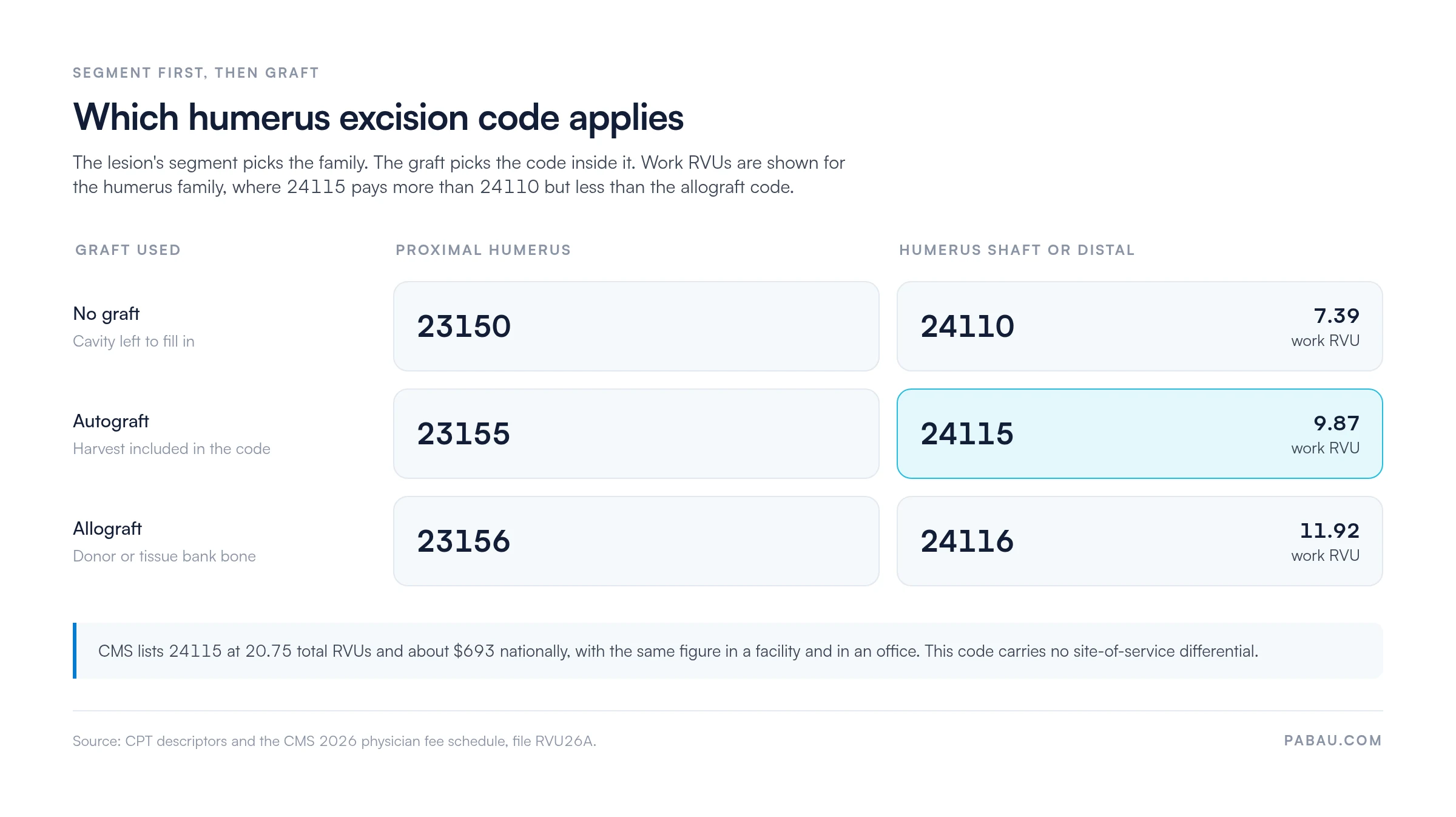
CPT 24110, 24115 and 24116 differ only by the graft, whether none, an autograft, or an allograft. None of them involves bone cement or internal fixation.
A lesion in the proximal humerus is coded from the 23150, 23155 and 23156 family instead, so confirm the humeral segment first.
CMS pays about $693 for 24115 in 2026, and the amount does not change between a facility and an office setting.
CPT 24115 carries a 90-day global period, so a return to the operating room in that window needs modifier 78 or 79.
Practice management software like Pabau submits 24115 claims through the Claim.MD clearinghouse, with built-in CPT and ICD-10 catalogs to reduce coding errors.
CPT code 24115 is a surgical procedure code maintained by the American Medical Association (AMA). It sits in the Musculoskeletal System section, under Excision Procedures on the Humerus (and/or Elbow). The full official descriptor reads: Excision or curettage of bone cyst or benign tumor, humerus; with autograft (includes obtaining graft).
Two pathological presentations account for most claims under this code. The first is a cystic lesion of the humerus, typically a solitary (unicameral) or aneurysmal bone cyst. The second is a benign neoplasm at the same site, such as an enchondroma or an osteochondroma. Both weaken the bone, so the surgeon curettes the lesion and then packs the resulting defect.
What sends the claim to 24115 rather than a neighboring code is the graft. The surgeon harvests bone from the patient, usually from the iliac crest or a local site, and fills the cavity with it. The parenthetical “includes obtaining graft” means that harvest is already paid for inside 24115. CPT repeats that wording in other graft families, including the spine autograft code 20936.
These three codes describe the same operation on the same bone. They diverge on one variable only, which is what went into the defect after the lesion came out. No other technique detail moves the claim from one code to the next.
The operative report has to name the graft material for the coder to land on the right code. A note that says “the cavity was packed with graft” supports 24110 as easily as 24115, and payers read the ambiguity in their own favor. If the surgeon took bone from the patient, the note should say autograft and name the donor site.
Downcoding runs in the other direction too. Coders who default to 24110 whenever the graft type is unstated leave the harvest work unpaid, even though the surgeon performed it. Both errors trace back to the same root cause, which is a descriptor the note never mirrors. Guidance on reading these families sits in AAPC’s orthopedic coding reference.
CPT 24115 sits inside a grid with two axes. One axis is the bone segment involved. The other is the graft. Fix the segment first, then pick the graft column, and the code follows without guesswork.
Read down the grid and the pattern holds at every site. Each site gets three codes, and the graft column always runs in the same order. Sports medicine practices and orthopedic groups bill these codes often. The grid belongs in the billing workflow as a lookup rather than in a coder’s memory. Both axes fit in a single view, with the humerus family’s work values alongside them.
One piece of misinformation about this code circulates widely, so it is worth naming. Several reference sites describe 24115 as the version of 24110 performed “with methyl methacrylate and internal fixation”. No code in the 24110 to 24126 range carries either element in its descriptor.
Methyl methacrylate appears in the CPT code set only inside unrelated spine device descriptors. Internal fixation appears as a separate add-on in the femur family, at 27358, and it does not extend to the humerus. So a surgeon who cements a humeral defect and applies a plate does not thereby land on 24115. The graft is what the code pays for.
Practically, that matters at two moments. A coder reading a cement-and-plate operative note must code the reconstruction from its own descriptors rather than reaching for 24115. And an auditor who finds 24115 on a claim will look for a graft in the note, not for an implant log.
Modifier selection for CPT code 24115 follows standard orthopedic surgical rules. Each modifier serves a specific claims purpose. Applying the wrong one, or omitting one that is required, risks a denial or a compliance flag.
Always verify modifier requirements against current payer-specific policies. Prior to surgery, conduct insurance eligibility verification to confirm coverage and any modifier restrictions the payer applies to orthopedic surgical codes.
Every CPT 24115 claim needs a supporting ICD-10-CM diagnosis code that establishes medical necessity. The paired diagnosis has to match the pathology documented in the operative and pathology reports. Payers, Medicare included, will deny the claim if the linked diagnosis does not describe a bone cyst or benign tumor of the humerus.
Note that the M85.4 series covers solitary cysts and the M85.5 series covers aneurysmal cysts. Coders who reach for a similar-looking M85.3 code land on osteitis condensans instead, which will not support this procedure. Verify all diagnosis codes against the current CDC/NCHS ICD-10-CM tables before submitting, since the tables are updated each October.
For physical therapy practices and orthopedic groups, post-surgical coding carries a basic compliance requirement. The diagnosis code has to match both the clinical documentation and the current ICD-10-CM edition. Run the pairing through a crosswalk tool before submission, so a code that no longer supports medical necessity is caught early.
Medicare reimbursement for CPT 24115 comes from the CMS Physician Fee Schedule. The schedule multiplies Relative Value Units (RVUs) by a geographic adjustment factor and the annual conversion factor. Rates vary by locality. The figures below are national averages from the 2026 RVU file. Verify them against the current CMS lookup before using them for contract negotiations or budget planning.
Part of the work value in 24115 covers the graft harvest, which is why it sits above 24110 and its 7.39 work RVUs. It does not sit at the top of the family. CMS values the allograft code 24116 at 11.92 work RVUs, so the autograft code pays less than its allograft neighbor. Check the current file before you assume the harvest makes 24115 the higher-paying option.
CPT 24115 pays the same in both settings. CMS marks the practice expense RVU as NA for the site-of-service distinction, so the facility and non-facility totals are identical at 20.75 RVUs. There is no higher office rate to claim on this code.
Most surgical codes do split. A facility bills Medicare separately for its own costs, so the physician receives only the professional component. An office-based practice absorbs that overhead instead, and Medicare pays it more. That mechanism is switched off for 24115. Most orthopedic excision procedures of this complexity happen in a facility setting in any case.
The 2026 conversion factor is the RVU-to-dollar multiplier that CMS sets each November for the following calendar year. No code-specific descriptor changes were noted for 24115 in 2026. The conversion factor adjustment still moves the dollar reimbursement for every surgical code. Confirm the current factor through the CMS lookup before finalizing contract rates or patient estimates.
Practices managing high volumes of orthopedic billing benefit from connecting claims straight to a clearinghouse. Electronic claims via Claim.MD let orthopedic billing teams submit CPT 24115 with built-in CPT and ICD-10 catalogs. Those catalogs remove a manual keying step before the claim reaches the payer.
Run your CPT 24115 claims through an eligibility check before the procedure date. Many commercial payers require prior authorization for bone excision surgeries, and submitting without an authorization number is a top denial reason for this code family. Build the authorization step into your surgical scheduling workflow, not as a post-scheduling task.
CPT code 24115 carries a 90-day global period. Routine post-operative care by the operating surgeon is already included in the surgical fee. That covers the day of surgery through the 90th post-operative day, so those visits cannot be billed separately. Knowing which services are bundled, and which are billable, keeps the practice clear of overpayments and recoupment requests.
Several services are bundled into the global period. They include the immediate post-operative care on the day of surgery and all related post-op visits through day 90. Wound care and suture removal are bundled, as is any complication managed without a return to the operating room. Care of the graft donor site is bundled too, since the harvest belongs to the same code.
Services billable separately during the global period include:
Tracking electronic remittance advice through the 90-day window helps practices spot a payer that is bundling a legitimate separate service into the global period. An ERA may show a denial code for global period inclusion on a service that should be separately payable. The operative date and the modifier documentation then become the basis for the appeal.
Claims for CPT 24115 that survive a payer audit share one characteristic. The operative report makes the code selection self-evident. Auditors reviewing this code look for two details above all. They want the humeral segment treated, and an explicit autograft with a named donor site. When either is missing, the reviewer has grounds to downcode to 24110.
The harvest detail is worth dwelling on. Because 24115 includes obtaining the graft, that work is never billed on its own line, and coders sometimes conclude it does not need documenting. The opposite is true. The harvest description is the evidence that separates 24115 from 24110 and from the allograft code 24116.
Whoever handles the claim should have the operative note in front of them before it goes out. A graft field on the surgical superbill should offer three choices, none, autograft, or allograft. It stops a coder from defaulting to 24110 when the note supports 24115.
Rejections and audit findings on 24115 cluster around five errors. Each one has a documentation fix that costs less than the appeal it prevents.
Billing 24115 when the operative report does not describe an autograft is a false claim risk. Two versions of this show up in audits. In the first, no graft was placed at all, which makes 24110 the correct code. In the second, the surgeon used donor bone, which makes 24116 the correct code.
Payers now run pre-payment edits that compare 24115 against the rest of the record. A claim with no harvest described in the note, and no donor site mentioned anywhere, invites a request for records.
The phrase “includes obtaining graft” inside the 24115 descriptor settles this one. Reporting a bone graft harvest code such as 20900 or 20902 alongside 24115 for the same session is unbundling, and NCCI edits catch it. The harvest is part of the 24115 service rather than an add-on to it.
Effective denial management workflows should include a bundling check before submission. For guidance on the denial codes that come back when an edit fires, see the denial codes in medical billing reference.
A cyst in the proximal humerus belongs to 23150, 23155, or 23156, not to the 24000 series. The technique may be identical, so the note reads as a match for 24115 to anyone skimming for the word autograft. The anatomy is what decides the family, and it decides first.
This one rarely produces a clean denial. It produces a paid claim that an audit later reverses, which is the more expensive outcome. Ask the coder to confirm the segment from the operative note or the imaging report before the code is chosen.
Submitting CPT 24115 with a placeholder ICD-10 code, such as M79.9 for an unspecified soft tissue disorder, is a medical necessity failure. The diagnosis has to reflect the confirmed or probable pathology documented at the time of surgery.
Practices whose billing sits apart from clinical documentation hit this often. The claim goes out before the pathology report comes back. Consider holding the 24115 claim until pathology is confirmed, particularly when the working diagnosis is uncertain.
Billing a post-operative visit inside the 90-day window without modifier 24 is a consistent audit finding for orthopedic codes. The same applies when nothing in the record shows the visit was unrelated to the surgery. Train front-desk and billing staff to flag every visit within 90 days of a 24115 procedure date for physician review before billing.
Write down which modifier scenarios your practice supports and how each one has to be documented. The modifier on a global-period visit belongs on the claim before it reaches the clearinghouse, not after a denial comes back.
Build a CPT 24115 checklist into your post-operative workflow. Confirm the operative note names the humeral segment, states autograft explicitly, and describes the donor site and harvest. Check that no separate harvest code is on the claim. Confirm the ICD-10 code matches the pathology report, and that the patient file carries the global period end date. Five minutes of review prevents the most common 24115 denials.
In most orthopedic practices, the 24110-to-24116 decision happens twice. The surgeon dictates the note, and days later a coder reads it and picks a code. Between those two moments the graft detail either survives in writing or it does not, and the claim value turns on that.
Practice management software like Pabau closes that distance by keeping the operative record and the claim in one system. The surgical note template can require the graft type and the donor site before it is signed, so the coder is never guessing from prose. Claims management software then carries built-in CPT and ICD-10 catalogs, which means 24115 and M85.421 are picked from a list rather than typed from memory.
Claims go out electronically through the Claim.MD clearinghouse, and remittance advice comes back into the same patient record. So when a 24115 claim is questioned, the note, the diagnosis, the submission date, and the payer response all sit together. Your billing team answers the records request in minutes instead of rebuilding the file from three systems.

Pabau’s claims management software connects to the Claim.MD clearinghouse. Submit CPT 24115 and related orthopedic codes electronically, with built-in code catalogs that cut errors before claims reach the payer.

CPT 24115 comes down to two questions, asked in order. Which segment of the humerus held the lesion, and what filled the defect afterwards. Answer the first wrong and you are in the 23150 family. Answer the second wrong and you are on 24110 or 24116.
The graft harvest is the detail that gets lost. It is bundled into the code and never billed separately. It still has to appear in the operative note, because it is the only evidence that 24115 was the right choice. The setting matters less than coders expect, since this code pays the same in a hospital and in an office.
Practices that bill this family regularly do better by building the graft question into the note template rather than catching it at the coding desk. Book a demo to see how Pabau keeps orthopedic documentation, claims, and remittance in one place.

Billing a graft whose harvest sits inside the code? CPT 20922 applies the same includes-obtaining rule to a fascia lata graft.
Adding traction to an orthopedic claim? CPT 20650 sets out when skeletal traction is separately payable and when it is bundled.
Coding an excision further down the upper limb? CPT 26170 shows how the palm carries its own excision family and its own documentation demands.
Need the diagnosis code for a fracture that failed to unite? ICD-10 S52.136N covers radial neck nonunion, including the seventh-character rules.
Draining a bursa in the forearm or wrist? CPT 25031 covers incision and drainage at that site, with the modifiers it usually needs.
CPT 24115 bills the excision or curettage of a bone cyst or benign tumor of the humerus when the defect is filled with an autograft. The descriptor states that the code includes obtaining the graft, so harvesting the bone is part of the same code. If no graft was placed, report 24110 instead.
All three describe the same procedure on the humerus and differ only by graft material. CPT 24110 uses no graft. CPT 24115 uses an autograft taken from the patient during the same session. CPT 24116 uses an allograft from a donor or tissue bank. None of the three involves bone cement or internal fixation.
Yes. The descriptor states that the code includes obtaining the graft, so the harvest is bundled into 24115. Reporting a separate harvest code such as 20900 or 20902 for the same session is unbundling, and NCCI edits will catch it. Document the donor site anyway, since it is the evidence that supports 24115 over 24110.
No. A proximal humerus lesion is coded from the shoulder family: 23150 without a graft, 23155 with an autograft, and 23156 with an allograft. Codes 24110 through 24116 cover the rest of the humerus. Confirm the segment in the operative note or the imaging report before choosing the family.
Use LT or RT for the left or right side, and modifier 50 for a bilateral procedure. Modifier 51 covers multiple procedures in the same session. Modifier 59, or an X-modifier, marks a distinct procedural service. Modifier 78 applies to an unplanned return to the operating room in the global period. Modifier 79 covers an unrelated procedure in that window, and modifier 80 an assistant surgeon. Always verify requirements against the payer’s policy for the current code year.
The usual pairings are M85.421 and M85.422 for a solitary bone cyst of the right or left humerus. An aneurysmal bone cyst of the upper arm uses M85.521 or M85.522. A benign neoplasm uses D16.01 or D16.02, and D48.0 covers a lesion of uncertain behavior. The selected diagnosis must match the pathology documented in the operative and pathology reports.
CPT 24115 has a 90-day global period. Routine post-operative care by the operating surgeon through day 90 is bundled into the surgical fee. Care of the graft donor site is bundled as well. Separate billing in this window needs a modifier. Use 24 for an unrelated office visit, 78 for a complication requiring a return to the operating room, or 79 for an unrelated procedure.
Medicare pays roughly $693 nationally for CPT 24115 in 2026, from 9.87 work RVUs and 20.75 total RVUs. The amount is the same in a facility and in an office, because CMS publishes no site-of-service differential for this code. Your locality adjustment then moves the final figure up or down.
Prior authorization requirements for CPT 24115 vary by payer and plan. Medicare typically does not require it for this code, but many commercial insurers and Medicare Advantage plans do. Check the requirement with each payer before scheduling the procedure. Submitting without a required authorization number is a leading cause of denial for orthopedic surgical codes in this family.