CPT code 93503: Swan-Ganz catheter billing and modifiers
CPT code 93503: Official descriptor and procedure overview In the AMA CPT code s...

Last Updated: Oct 23, 2026

CPT code 22844 describes posterior segmental instrumentation, such as pedicle fixation, spanning 13 or more vertebral segments.
It is an add-on code with a ZZZ global period, so it must be reported alongside a primary spinal arthrodesis code.
Segment selection is the top audit trigger. Report 22842 for 3 to 6 segments, 22843 for 7 to 12, and 22844 for 13 or more.
Count every vertebra the construct spans, including levels that carry no hardware, rather than counting anchor points.
Only one segment-range code is reported per session, but pelvic fixation code 22848 is separately reportable with 22844.
Practice management software like Pabau tracks add-on code pairings and submits clean claims electronically to US payers.
CPT code 22844 covers posterior segmental instrumentation spanning 13 or more vertebral segments. It is an add-on code, so it never goes on a claim without a primary spinal arthrodesis procedure beside it.
A construct running from the upper thoracic spine to the pelvis can span 15 or 16 vertebrae. That count is what separates 22844 from the shorter-construct codes in the same family. Spinal surgery medical billing turns on the level list in the operative note, and one vertebra changes the answer.
CPT code 22844 is published in the American Medical Association code set. The descriptor reads: Posterior segmental instrumentation (e.g., pedicle fixation, dual rods with multiple hooks and sublaminar wires); 13 or more vertebral segments. The code sits in the Surgery / Musculoskeletal / Spine section and carries a ZZZ global period, which confirms its status as an add-on code.
The parenthetical examples in the descriptor are illustrative, not exhaustive. Pedicle screw and rod constructs are the most common hardware billed under this code. Dual rod systems with hooks, sublaminar wires, or hybrid combinations also qualify. The construct still has to span 13 or more vertebral segments, and the note has to say so.
22844 is the top of the segmental instrumentation ladder. There is no longer-construct code above it, so a 13-segment construct and a 17-segment construct are both reported as one unit of 22844.
A construct only reaches 13 segments in a handful of clinical situations. Nearly all of them involve deformity correction rather than a focal degenerative problem. Knowing which cases plausibly reach that length helps a coder spot a segment count that looks too high for the operation described.
Focal one-level or two-level degenerative cases never support this code. A single-level lumbar fusion with pedicle screws at two vertebrae is non-segmental instrumentation, reported with 22840 instead.
Count the vertebrae the construct spans, from the most cephalad anchor point to the most caudal one. Every vertebra inside that span counts, including levels that received no hardware at all. Interspaces are never counted, and skipped levels are not subtracted.
Two worked examples show how quickly the code changes:
One further point trips up coders. The instrumentation count is independent of the arthrodesis count, so the fusion may cover fewer segments than the hardware spans. Code each from its own documented level list rather than reusing one number for both lines.
Before coding any long spinal construct, find the most cephalad and most caudal instrumented level in the dictation. Write both on the charge ticket. Then count every vertebra between them, including untouched levels. Counting the span rather than the anchor points removes most 22842, 22843, and 22844 selection errors.
CPT code 22844 is an add-on code, and that single fact drives every billing rule that follows. It cannot be reported on a claim by itself. It must always accompany a primary spinal arthrodesis procedure. For a long posterior construct that is usually a posterior deformity fusion code such as 22804, or 22812 for the anterior equivalent.
National Correct Coding Initiative (NCCI) edits enforce that pairing, so submitting 22844 without an eligible primary code triggers an automatic edit. Sound medical billing compliance means pre-scrubbing every spinal claim for correct primary-to-add-on pairing before submission.
Beyond the pairing requirement, four rules govern correct billing of this code:
Proactive management of claim denials for these codes means auditing the operative note before coding, not after the remittance arrives. Flag any dictation where the documented span sits near the 12 to 13 boundary and query the surgeon before submission.
Routing spinal claims through the Claim.MD integration catches common pairing errors at the clearinghouse, before they ever reach the payer. The denial codes that come back on a rejected line name the edit that fired. That tells you whether the primary code or the segment count was the problem.
CPT code 22844 belongs to the 22840 to 22848 family of spinal instrumentation add-on codes. Within the segmental group, code selection depends entirely on the number of vertebral segments the construct spans. The decision table below is where most coding errors start.
The boundary cases deserve the most attention. A construct spanning exactly 12 segments maps to 22843, and one spanning exactly 13 maps to 22844. When the operative note is ambiguous, query the surgeon. Guessing at a threshold count is an audit liability, and the payment difference between the two codes runs to roughly $150 per case.
Long constructs pull in more hardware and more technique codes than a short fusion, so they attract more bundling edits. Four relationships account for most of them.
Revision deformity surgery is where this pair goes wrong most often. The deciding question is whether the levels changed.
If hardware is removed and replaced at exactly the same levels, 22849 is the only instrumentation code reported. The segment-range codes do not apply, however long the original construct was.
If the revision extends the construct to new levels, report the insertion code that matches the new total span. A T5 to L1 construct extended to T2 to the pelvis now spans well past 13 vertebrae, so 22844 applies and 22849 does not.
As an add-on code, CPT code 22844 has a limited modifier profile. Most modifiers used with primary surgical codes do not transfer. The modifiers below are the ones that matter for long-construct instrumentation, where two surgeons and an assistant are common.
Modifier 51 does not apply to CPT code 22844. Add-on codes are exempt from the multiple-procedure reduction, so appending it is a coding error that can cause a denial. Modifier 50 is wrong for the same family of reasons, because CPT treats spinal instrumentation as inherently bilateral.
Some practice management systems suggest modifier 51 for any secondary procedure on a claim. Billing teams should configure their software to suppress that prompt for ZZZ global-period codes.
Medicare reimbursement for CPT code 22844 is published annually through the CMS Physician Fee Schedule lookup tool. The code carries the same total RVU in facility and non-facility settings, and these procedures are performed almost exclusively in a hospital. Geographic Practice Cost Index (GPCI) adjustments then move the national amount up or down by locality.
The step between the range codes is worth knowing before you submit. At 2026 national rates, 22842 pays roughly $680 and 22843 roughly $728, against about $875 for 22844. A miscount that drops a long construct into 22843 gives up around $150 per case, as the ladder below shows.
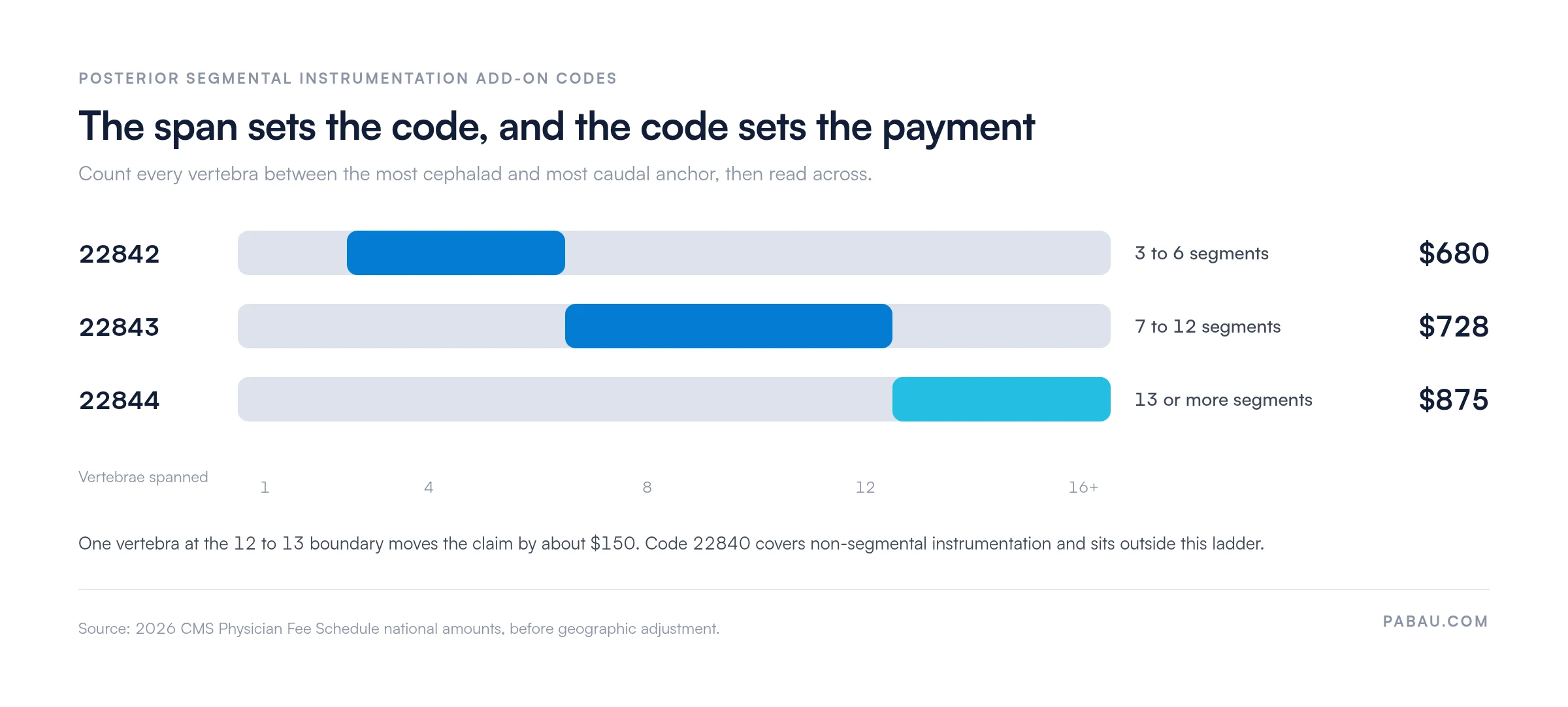
Important caveat: These figures reflect 2026 published national data and should be verified against the CMS lookup before billing. Rates change every January 1 and can be adjusted mid-year.
Commercial rates for this code are negotiated individually and usually exceed Medicare. Contact each payer’s provider relations team for contracted amounts, then check remittance postings against the amount you expected.
CPT code 22844 must be supported by an ICD-10-CM diagnosis that establishes medical necessity for a long posterior construct. Payers cross-reference the diagnosis against the procedure to confirm the extent of surgery was warranted. The AAPC CPT-to-ICD-10 crosswalk is a useful starting point, though payer-specific coverage policies may narrow the accepted list.
Verify each diagnosis against the payer’s Local Coverage Determination before submitting, since coverage differs by plan. Site-unspecified codes such as M41.20 are a weak match for a 13-segment construct, so use the anatomically specific code the imaging supports.
Prior authorization rules vary by payer, so confirm insurance eligibility and authorization status before the case is scheduled.
Thin operative documentation is the second most common reason these claims are denied or down-coded. An operative report supporting 22844 needs to address four elements to survive a payer audit or a Recovery Audit Contractor review.
Practices with steady spinal surgery volume benefit from a documentation template that prompts surgeons to address each element above. Submitting a clean claim from the start reduces the appeal work that follows a denial. Each denied claim can easily consume 30 to 60 minutes of staff time.
Five errors account for most denials and down-codes on this code. Each one is visible in a pre-submission review.
Spinal surgery billing turns on add-on relationships that have to be validated claim by claim. One mismatched pairing creates a denial that costs more to appeal than the line is worth. The two usual culprits are 22844 sent without a qualifying primary, and the wrong segment-range code.
Pabau, our practice management software, carries claims management software built for work like this. Billing teams get a structured workflow for tracking code combinations and validating add-on pairings. Claims then go out electronically to thousands of US payers through the Claim.MD clearinghouse integration.
Surgical superbills carry the primary arthrodesis code and its instrumentation add-on straight through to the claim. Coders are not rebuilding the charge ticket from scratch for every long construct.
Connecting the clinical note to the claim in one system leaves fewer places for a code-pairing error to enter. It also means fewer records requests to answer months later.
Practices that run musculoskeletal rehabilitation alongside surgery work in our physical therapy EMR, and sports medicine groups in our sports medicine software. Either way, spinal surgery charges route through the same clearinghouse pathway as the rehabilitation codes. That consolidates payer management across the episode of care.
Audit every 22844 claim from the past 90 days on two filters. First, any claim where 22844 is the only surgical code on the line, since it cannot stand alone. Second, any claim where the documented span is 12 segments or fewer, which belongs to 22843. Resubmit the corrected claims while the timely filing window is still open.

Pabau’s claims management tools help orthopedic and spinal surgery practices pair add-on codes correctly, scrub claims before submission, and track reimbursement across multiple payers. See how it works for your practice.

CPT code 22844 is precise by design. It needs 13 or more vertebral segments, a posterior approach, and a primary arthrodesis code on the same claim. Almost every denial on it traces back to one of two errors. Either the span was counted from anchor points instead of vertebrae, or the operative note never listed the levels.
Both are cheaper to fix before submission than after. Write the top and bottom instrumented level on the charge ticket, count the vertebrae between them, and the code selection stops being a judgment call.
Pabau’s claims management and clearinghouse integration helps spinal surgery practices enforce code-pairing rules and submit clean claims at the first pass. That protects the reimbursement on the longest, most valuable cases on the schedule.
Book a demo to see how Pabau handles complex surgical billing workflows.

Billing a shorter posterior construct instead? CPT code 22842 covers the 3 to 6 segment range and where it stops applying.
Need the primary arthrodesis code that pairs with a thoracic construct? CPT code 22532 walks through lateral extracavitary arthrodesis billing.
Coding an anterior cervical fusion this week? CPT code 22554 covers the anterior cervical fusion rules and its own add-on pairings.
Treating a vertebral fracture rather than a deformity? CPT code 22328 covers posterior open treatment of a vertebral fracture.
Billing a percutaneous procedure instead of an open fusion? CPT code 22512 explains the vertebroplasty add-on and how its levels are counted.
CPT code 22844 is an add-on procedure code for posterior segmental instrumentation spanning 13 or more vertebral segments. The hardware may be pedicle fixation, dual rods with multiple hooks, sublaminar wires, or a hybrid of these. It belongs to the 22840 spinal instrumentation family and must always be reported alongside a primary spinal arthrodesis code.
Yes. CPT 22844 carries a ZZZ global period, which is the designation for add-on codes. It cannot be billed alone and must be submitted on the same claim as an eligible primary spinal fusion or arthrodesis code.
The difference is the number of vertebral segments the construct spans. CPT 22843 covers 7 to 12 segments, while CPT code 22844 covers 13 or more. Both are add-on codes in the same family, and the level list in the operative report decides which one is billed.
Count every vertebra the construct spans, from the most cephalad anchor point to the most caudal one. Levels inside that span count even if they carry no hardware, and interspaces are never counted. A construct running from T4 to S1 spans 15 vertebrae, so it is reported with 22844.
No. The three segment-range codes are mutually exclusive for a single posterior construct, and only one is reported per operative session. They are not additive, so a 15-segment construct is one unit of 22844 rather than a combination of the shorter codes. Pelvic fixation code 22848 is separately reportable when the construct is anchored to the pelvis.
The operative report must name the most cephalad and most caudal instrumented levels and list the levels between them. It also needs the hardware type, the primary fusion procedure with its own levels, and the clinical justification for a long construct. A vague phrase such as long-segment instrumentation is the most common audit trigger for this code.
Modifier 62 applies when two surgeons each perform a distinct part of the instrumentation, which is common on long deformity constructs. Modifier 80, 82, or AS may apply to assistant-at-surgery services depending on who assisted and the teaching status of the hospital. Modifier 51 does not apply to CPT code 22844 and should never be appended.
The 2026 national Medicare amount is roughly $875 before geographic adjustment, based on a total RVU of 26.20 and a work RVU of 16.01. That sits above 22843 at about $728 and 22842 at about $680. Verify the current figure on the CMS fee schedule lookup, since rates change each January.
Prior authorization requirements vary by payer and plan. Medicare does not require prior authorization for CPT code 22844 in most circumstances, but many commercial insurers require pre-certification for elective spinal deformity surgery. Always verify the requirement with the specific payer before the case is scheduled.