CPT code 21011: Excision of soft tissue tumor of the face
CPT code 21011: Official descriptor and procedure overview CPT code 21011, as pu...

Last Updated: Oct 8, 2026
K0743 is the HCPCS Level II code for suction pump, home model, portable, for use on wounds.
The pump has to be durable, it has to work without a collection canister, and it has to appear on the PDAC Product Classification List. Even then, Medicare denies K0743 as not reasonable and necessary wherever the disposable device coded A9272 could serve the same purpose.
Let Pabau's smart automation suggest the right codes, reduce claim denials, and keep your practice compliant—effortlessly.
Automate repetitive tasks and focus on what matters most—your patients.
Reduce coding errors and ensure compliance with the latest regulations.
Clean claims, fewer denials, and faster reimbursements.
Powerful insights and reporting to help your practice thrive.
HIPAA compliant SOC 2 certified GDPR-compliant Trusted by 4,000+ clinics worldwide

HCPCS code K0743 covers a portable, home-model suction pump for wounds, billed under the Medicare DME benefit as a Level II K-code.
A K0743 system runs without a collection canister, so a canister-based pump belongs under negative pressure wound therapy code E2402.
CMS denies K0743 as not reasonable and necessary wherever the disposable device coded A9272 could serve the same purpose.
Only pumps that PDAC has reviewed and published on the Product Classification List may be billed with K0743.
Dressings bill separately by pad size, with K0744 up to 16 square inches, K0745 up to 48, and K0746 above that.
K0743 describes a suction pump, home model, portable, for use on wounds. CMS created it on July 1, 2011 alongside three dressing codes for the same therapy. The pump applies controlled subatmospheric pressure to a wound while the patient stays at home.
Short description: Suction pump, home model, portable, wound.
Long description: Suction pump, home model, portable, for use on wounds.
K0743 sits in the Level II HCPCS set maintained by the Centers for Medicare and Medicaid Services (CMS). K-codes exist for DME that does not fit the established A, E, or L ranges. This one is scoped tightly to the portable home pump used on wounds, not to general-purpose suction equipment in a facility.
A K0743 system holds exudate in the dressing rather than in a collection canister. Once a device drains into a canister, Medicare treats it as negative pressure wound therapy, and it bills as E2402 instead. Canisters are the defining part of that therapy, which is why the two code families never overlap.
Coders who reach for K0743 on a canister-based wound vac get a denial and a corrected claim. So look at the device in front of you, not at the brand name on the box, before you pick the code.
Here is the quick-reference set, in the order a claim usually needs it.
Medicare reimbursement rates for K0743 come from the DMEPOS fee schedule, not from the physician fee schedule. Amounts move with the MAC jurisdiction and the state, so no single national figure applies.
Pull the current one from the CMS DMEPOS fee schedule or from your MAC’s published file before you quote a patient.
No dollar figure appears on this page on purpose. K0743 amounts change every January and differ by region. A published national average is how billing teams end up under-collecting, or quoting a patient the wrong balance.
Check the rate before the quote, then check it again after the annual update.
Query the CMS DMEPOS fee schedule by your own MAC jurisdiction and state rather than taking a national figure. Then set a calendar reminder for January, when the annual update lands. Quotes and patient estimates should move with the new amounts, not trail them by a year.
Medicare rarely pays K0743, and the reason sits in the policy rather than in the patient’s record. Policy article A52519 holds that a covered DME item is not reasonable and necessary when a non-covered alternative exists.
For wound suction, that alternative is the disposable device coded A9272. So when K0743 is billed, CMS denies it as not reasonable and necessary.
The second barrier is product classification. The Pricing, Data Analysis and Coding (PDAC) contractor runs a coding verification review on each product. Only pumps it then publishes on the Product Classification List may be billed as K0743. A pump missing from that list is denied on coding grounds, whatever the clinical picture.
Where a pump does clear both hurdles, the clinical standard is still narrow. LCD L33612 treats wound suction as appropriate only when the volume of exudate exceeds what surgical dressings and wound fillers can hold. The criteria a record has to satisfy are these:
Read the current LCD and policy article before you dispense. Both are revised periodically, and the MAC applies whichever version was in force on the date of service.
The record has to exist before the device ships. Medicare will not accept a note assembled after a claim is questioned. Thin documentation is the most common reason a K0743 payment gets taken back later.
One practical note on the order. A standard written order can be signed at any point before the claim goes out. Writing it after delivery still leaves an awkward sequence in the file. Reviewers read dates first.
Practices billing physician-administered drugs carry the lot detail onto the claim itself. Every Part B line for HCPCS code J7328 needs the 11-digit NDC of the lot given, with the N4 qualifier.
An enrolled DME supplier files K0743 with the DME MAC on the 837P transaction, or on the CMS-1500 for a paper claim. The route is ordinary DMEPOS. These six steps are where the claims usually come apart:
Run one last check before you transmit:
That check is what turns a submission into a clean claim, and a clean claim is the only kind Medicare pays on the first pass.
K0744, K0745 and K0746 are absorptive wound dressings for the same pump, and they split by pad size rather than by dressing type. Bill them on their own claim lines.
They are not folded into the pump’s allowance, and the tier you choose has to match the pad you supplied.
Put the pump, the disposable alternative and the dressing tiers side by side and the coding decision gets short. The chart below is that decision in one view.
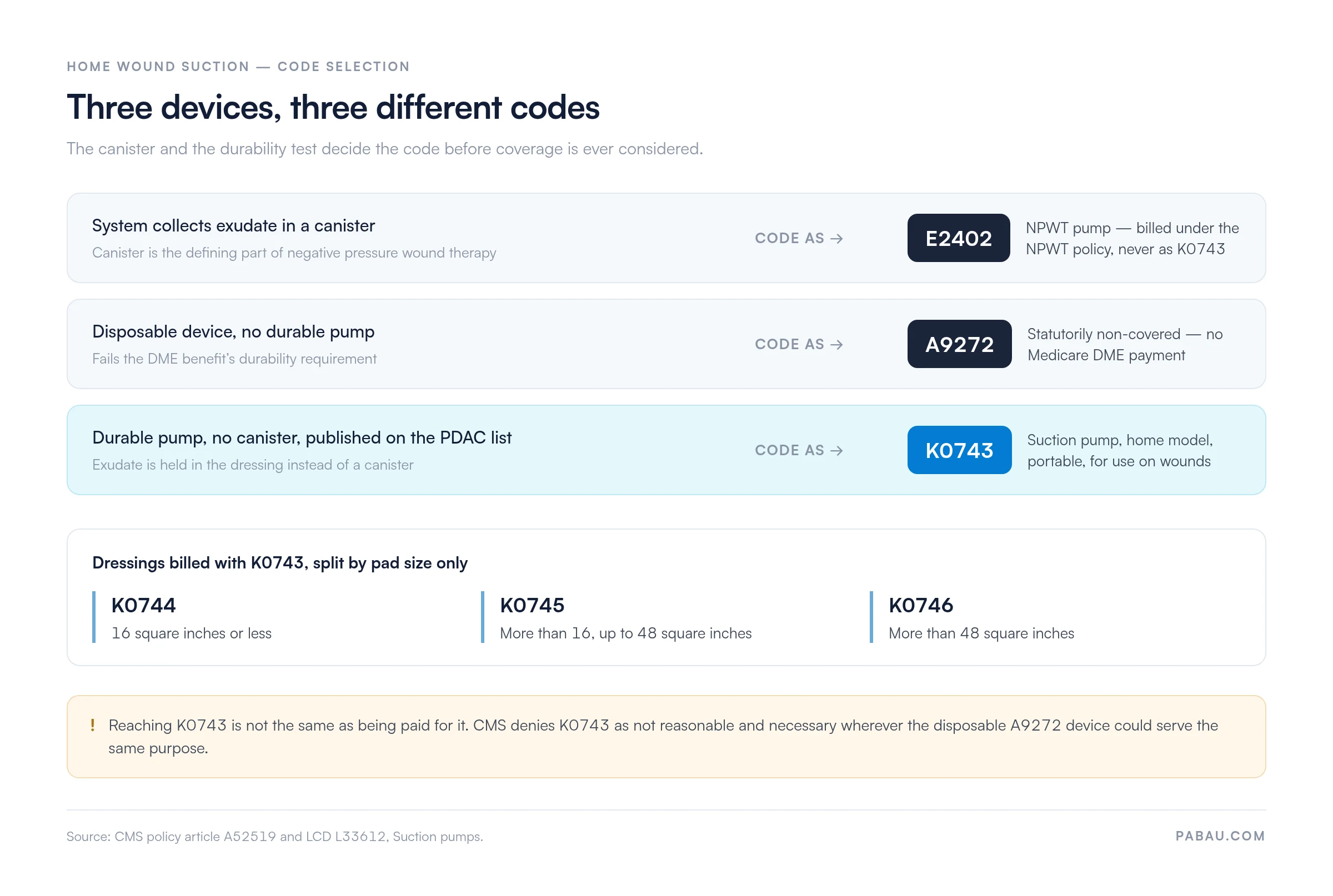
Measure the pad before you pick the dressing code. K0744, K0745 and K0746 differ only by pad size, so a dressing billed one tier too high reads as an overpayment in a post-payment review. Record the pad dimensions on the delivery note, and the claim and the record will agree a year from now.
There is no covered-diagnosis list for K0743. The policy article restricts diagnosis codes for tracheal suction supplies such as A4605 and A4624, but it publishes no equivalent list for the wound pump.
Code the wound the record documents, at the highest level of detail the note supports. The codes below are the ones that commonly carry these claims.
Specificity is what gets these lines past the front-end edits. A wound code without site or laterality trips an edit at the MAC. The claim comes back for a detail the chart already contained, before a human ever reads the note.
Our ICD-10-CM code reference is a quick way to confirm the exact subcode before you submit.
In most DME billing teams the order lives in one system, the wound assessment in another, and the claim in a third.
When a K0743 denial lands, somebody has to reassemble all three before an appeal can start. That reassembly is where the filing window quietly runs down.
Pabau, practice management software used by healthcare practices, keeps the record and the claim in one place. Staff log the wound assessment, the signed order and the delivery confirmation against the patient record.
The billing team then builds the claim from that same record, so no one re-keys a date or a code between systems.
Claim status and remittances come back into the same place, which makes denial patterns easy to see by code. If K0743 lines keep failing for one reason, the team spots it in weeks rather than at the end of the quarter.
Our claims software for billers handles the submission and the tracking, so the follow-up work sits beside the clinical record it came from.

Pabau links the order, the clinical note and the delivery record to the claim built from them, then tracks what the payer sends back. Billing teams see denial patterns by code without building a separate report.

K0743 is a code where the selection decision matters more than the paperwork. Check the device first: durable, no canister, and published on the PDAC list. If a canister is involved, the claim belongs under E2402, and no amount of documentation will rescue a K0743 line.
Then answer the harder question honestly. If the disposable A9272 device could serve this patient, CMS says K0743 is not reasonable and necessary, and the claim will deny. Suppliers who make that call before delivery stop absorbing the cost of equipment they were never going to be paid for.
Keeping the order, the delivery record and the claim in one system is what makes that call defensible a year later. Book a demo to see how Pabau ties wound care documentation to the claim that follows it.

Billing the dressings as well as the pump? HCPCS code K0744 covers the smallest pad tier, for dressings of 16 square inches or less.
Supplying a larger dressing pad? HCPCS code K0745 covers pads over 16 and up to 48 square inches, the tier billers most often get wrong.
The device has a collection canister? HCPCS code E2402 is the negative pressure wound therapy pump code, and the one that applies instead of K0743.
New to billing the DME benefit? Medicare billing walks through enrollment, claim routing and the rules behind every DMEPOS submission.
Working through repeated denials? Denial management in healthcare sets out how to categorize, track and appeal denied claims without losing the filing window.
Only with an Advance Beneficiary Notice signed before delivery. The ABN has to name the item, the reason you expect a denial, and an estimated cost. Without one on file, the supplier absorbs the charge and cannot collect it from the beneficiary.
Use GA when a signed ABN is on file. Use GZ when it is not, which tells Medicare you expect a not reasonable and necessary denial and hold no notice. Statutorily excluded items, such as the disposable device coded A9272, take GY instead.
Not necessarily. Part C plans write their own medical policy and are not bound by the DME MAC coverage determination for suction pumps. Check the plan’s own policy and its prior authorization requirements through the provider portal before the device leaves your warehouse.
One calendar year from the date of service. Medicare rejects claims received after that, and a denial you intend to appeal still has to be filed inside the window. Track the delivery date rather than the order date, since delivery is the date of service.