Yeoman’s Test Template
Yeoman’s test is a prone provocation test for sacroiliac joint (SIJ) pain....

4
Last Updated: Sep 28, 2026
A vitamin C protocol is a written clinical framework for giving vitamin C to patients safely. It sets out who can receive it, the dose and route, and how each treatment is screened, monitored and recorded. Practices that use one consistently keep care standardized across practitioners and easier to audit.
Use the template below as a starting point for a vitamin C protocol covering oral and IV use, dosing reference values, safety screening and monitoring. Pair it with digital intake forms so screening answers are captured before the first dose is given.
A clinical form for vitamin C infusions with sections for staffing requirements, a documentation checklist, contraindications, vital-sign limits, adverse reactions and a signed dosing order.
Download template
A vitamin C protocol standardizes dose, route, screening and monitoring for every patient.
Oral and IV vitamin C follow different dosing logic, so document each route separately.
Screen for G6PD deficiency and kidney history before any high-dose IV protocol starts.
Recording each dose on the patient record keeps follow-up and audits traceable.
Oral and IV vitamin C are separate pathways, so each route needs its own section of the protocol. Oral use is a daily schedule measured against reference intake values. IV use is given in the practice, and it depends on preparation, infusion and observation.
Practices running IV programs often use IV therapy EMR software to keep these records together.
IV ascorbic acid also needs a licensed source. Compounding is regulated, so the product should come from a licensed compounding pharmacy that follows USP standards, not from in-house preparation. The FDA’s overview of dietary supplements explains the oral side of that regulatory picture.
Practices usually build a protocol around a documented clinical need rather than general wellness interest. Common indications include the following, and the prescriber should confirm each one before treatment starts.
Capture the indication on the same IV therapy intake form you use for other infusions. That way the reason for treatment is on record before the first dose.
The template follows the workflow a practitioner runs for every patient. Work through these four stages in order and keep each one on the patient’s record.
Align the wording of your local version with your practice’s policies, because a template cannot replace your prescriber’s judgment.
Reference values for adults come from the NIH Office of Dietary Supplements. It publishes the recommended dietary allowance (RDA) and the tolerable upper intake level (UL). The table sets these out by group.
The UL covers food and supplements combined. It doesn’t apply to people receiving vitamin C as medical treatment under a physician’s care, which is why IV doses need their own section.
Oral absorption also drops as the dose climbs. About 70% to 90% is absorbed at 30 to 180 mg a day, but above 1 g a day absorption falls below 50%. Record a stated reason for any oral dose above the UL.
IV vitamin C bypasses the gut, so it produces plasma levels far higher than oral doses can reach. The prescriber selects the dose for each patient, and the protocol records that order.
FDA-approved ascorbic acid injection is labeled for short-term treatment of scurvy when oral dosing isn’t possible. Wellness and aesthetic infusions fall outside that label, so the record should show why the prescriber ordered each one.
Vitamin C also goes into mixed infusions such as the Myers cocktail protocol, alongside magnesium, calcium and B vitamins. Record each ingredient’s dose separately, so the vitamin C total stays visible.
Every IV session record should hold the following details.
Log catheter-site problems in the same record, since infiltration and phlebitis are among the most common IV therapy complications.
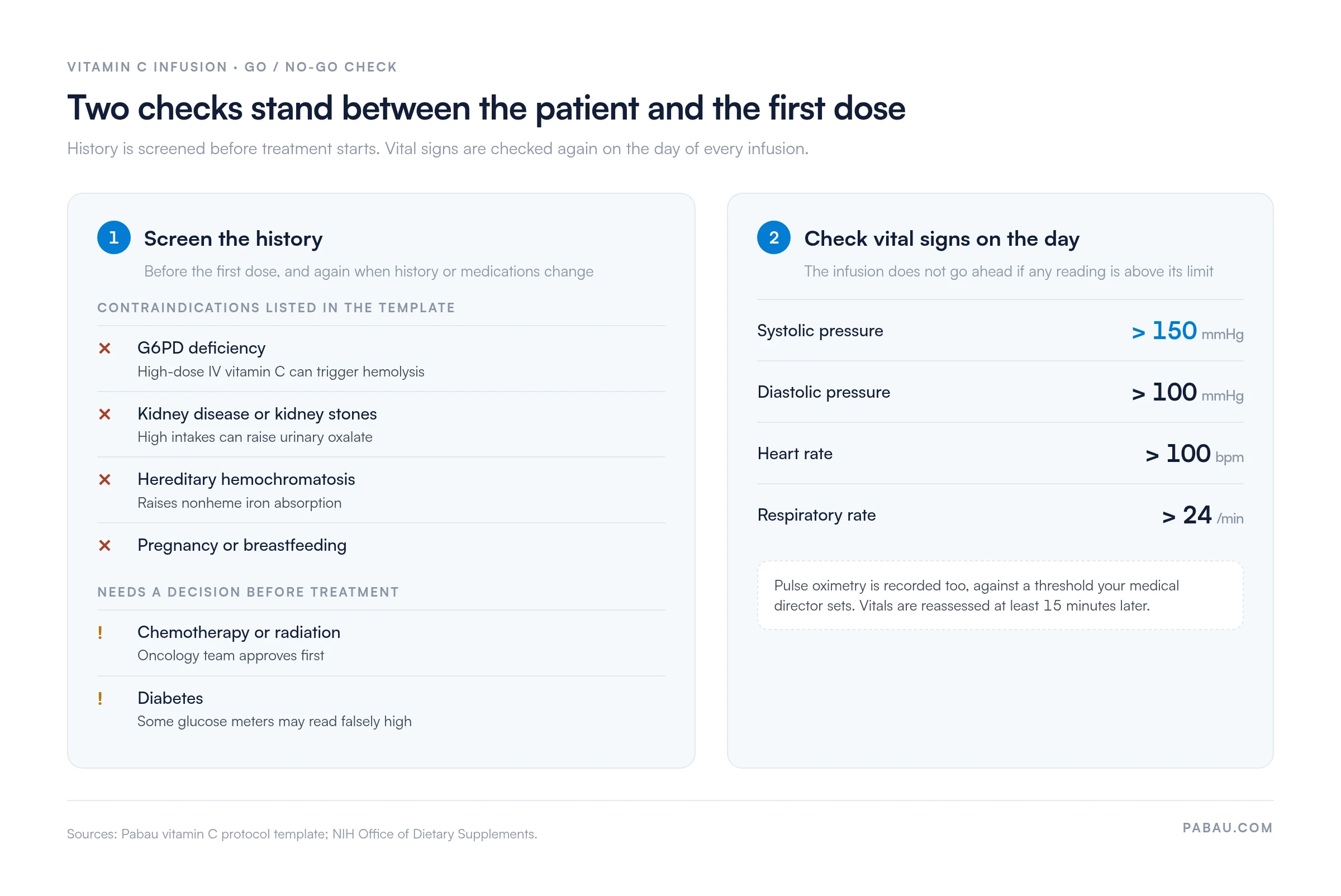
Screen every patient before the first dose, and repeat the screen whenever their history or medications change. These conditions most often stop or modify a vitamin C protocol.
The template also sets vital-sign limits for the day of treatment. An infusion doesn’t go ahead if systolic pressure exceeds 150, diastolic exceeds 100, heart rate exceeds 100, or respiratory rate exceeds 24. Pulse oximetry is recorded too, against a threshold your medical director sets. The chart below puts both checks side by side for the treatment room.
The body needs vitamin C to make collagen, which is why aesthetic practices add it to skin programs. Low vitamin C status weakens connective tissue, but extra doses in well-nourished patients have less evidence behind them.
Write the aesthetic indication with the same care as a clinical one. Describe it as supporting normal collagen formation, avoid promises about wrinkles, and record the treatment it accompanies, such as a peel or microneedling course.
Topical vitamin C serums sit outside this protocol, since they are applied rather than dosed. Note any serum on the patient record, so the practitioner sees the full regimen at each review.
Monitoring is what makes a protocol auditable. Set the review interval when the protocol starts, and record each review on the patient’s file.
Plasma vitamin C is the usual measure of status, so a baseline level makes later reviews easier to interpret. Pause the protocol and refer back to the prescriber if a patient reports flank pain or blood in their urine.
Between reviews, send patients home with vitamin C injection aftercare instructions, so they know which symptoms to report.
The download is a clinical form for vitamin C infusions. Oral protocols can reuse its screening, monitoring and sign-off sections. It covers the following.
Many practices run vitamin C protocols from a printed form, a separate consent tool and a spreadsheet of doses. At review time, someone has to rebuild the patient’s history from three places.
Pabau, the practice management platform we build for aesthetic, longevity and IV practices, keeps those steps on one patient record. Patients complete the medical questionnaire and consent through digital forms before they arrive. Practitioners then log the dose, route and vital signs in that visit’s treatment notes.
Automated appointment reminders bring patients back for their review dates, and inventory tracking shows how much vitamin C stock is left. Your medical director can then audit the protocol without chasing paper.

Pabau’s digital forms capture screening answers before the first dose, and treatment notes log each infusion. Your team can show the full protocol history at any review or audit.

A vitamin C protocol earns its keep at the moments nobody plans for. A patient with undiagnosed G6PD deficiency books an infusion, or an inspector asks why a 10,000 mg dose was given.
Download the template, fill in your medical director, approved providers and vital-sign limits, and have your prescriber sign the dosing section. Then screen every patient against it before the first dose, oral or IV.
The protocol protects your practice only when each session is recorded against it. Book a demo to see how Pabau keeps screening, consent and dosing records together for every vitamin C patient.

Offering other injectable vitamins? The vitamin D3 injection consent form covers dosage, protocol and aftercare for vitamin D3 injections.
Adding vitamin B6 to your menu? The vitamin B6 injection guide pairs a dosing table with a consent template.
Running B12 infusions too? The IV B12 informed consent form covers safety risks, contraindications and post-injection care.
Opening an IV practice in California? IV hydration business requirements in California explains ownership, licensing and startup costs.
A vitamin C protocol is a written clinical framework for giving vitamin C to patients. It sets out who can receive it, the dose and route, and how each treatment is screened, monitored and recorded.
The tolerable upper intake level for adults is 2,000 mg a day from food and supplements combined. That limit doesn’t apply to people receiving vitamin C as medical treatment under a physician’s care.
The template lists G6PD deficiency, kidney disease, hemochromatosis, pregnancy and breastfeeding as contraindications. Vital signs outside the protocol’s limits also stop an infusion on the day.
It depends on state regulations. The template assumes a physician, APRN or registered nurse gives the infusion, after an RN, PA, physician or APRN completes the pre-treatment evaluation.
Set the review interval when the protocol starts, and review sooner if a patient’s medications or history change. Record each review and the prescriber’s decision on the patient’s file.