Maja Popovska

Gene test: Types, how it works, and what results mean
A gene test is a laboratory analysis of your DNA, chromosomes, or proteins that ...

Last Updated: Sep 22, 2026
Clinician-reviewed
A longevity membership pricing model takes one of three shapes: An annual program, a monthly membership, or a package of session credits. Your margin on any of them has to come from your own cost to serve. A 2025 review in Aging notes that longevity clinic profitability is not disclosed, and only program fees are public.
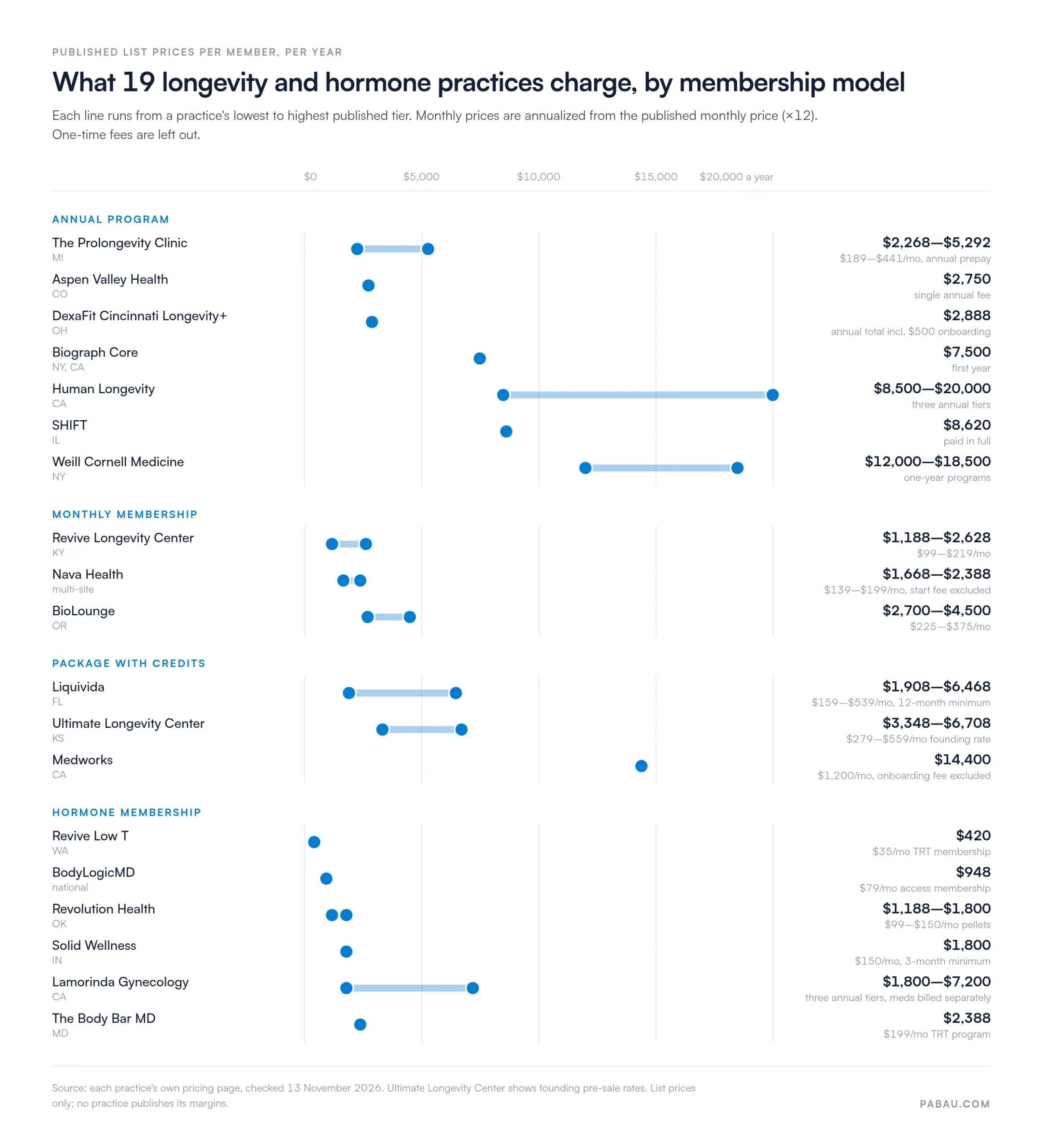
Those public fees span a wide band. Named practices publish prices from $35 a month for a TRT membership to $20,000 a year for a concierge tier, both checked November 13, 2026. This guide sets 19 practices’ published prices side by side, then gives you the member margin worksheet to price your own tiers.
Start from scratch, or upload this PDF or any form you already use, and Pabau's AI Form rebuilds it with tick boxes, text fields and a signature. Attach it to the treatment once, and every patient gets it on time.
AI Form rebuilds the consent, history and aftercare forms you already use. You review each one, then publish.
Patients complete forms on their phone before they arrive, so the front desk stops retyping paper.
Every signed form is versioned and attached to the treatment record, ready when you need it.
Set how long a consent stays valid. Returning patients skip forms they have already signed.
Supports HIPAA and GDPR compliance AES-256 encryption 4.8 on G2 4.7 on Capterra Trusted by 4,000+ practices worldwide

Longevity memberships are sold as an annual program, a monthly membership or a package of credits, and each one moves cash differently.
Named practices publish fees from $35 a month for a TRT membership to $20,000 a year for a concierge tier, checked November 13, 2026.
No practice publishes its margins, so the member margin worksheet prices each tier from your own lab, clinician, credit, supply and payment costs.
Hormone memberships split on one question: Whether medication, pellets and labs sit inside the fee or are billed beside it.
Billing terms move cash as much as price does, from onboarding fees and minimum terms to prepay reductions and credit rollover rules.
Longevity practices sell memberships three ways: An annual program paid upfront or in installments, a monthly membership, or a package of credits. Whichever you choose, a 2025 review in Aging found that clinics publish only their program fees, never their profitability.
The model decides when cash arrives, what you owe the member, and what you have to track. Most published menus mix them, such as a monthly fee that buys credits. Membership also sits beside other revenue lines, which our guide to functional medicine business models covers.
The annual program is the dominant high-end format, and its billing varies more than its length. SHIFT in Chicago collects its $8,620 Primary Care membership in full at sign-up and renews it annually. The Prolongevity Clinic sets one-year terms, paid quarterly or prepaid annually at a 10% fee reduction.
DexaFit Cincinnati spreads its $2,888 Longevity+ year into a $500 onboarding payment plus 12 monthly installments of $199. Biograph prices Core at $7,500 for the first year, takes a $500 deposit, and says later years vary by tier. Aspen Valley Health, a hospital-run program, charges $2,750 per member per year, cash pay.
Several annual sellers also publish a one-off entry product. Human Longevity sells Genomics for All at $599 one-time below its $8,500 to $20,000 annual tiers. Weill Cornell Medicine lists a $7,500 baseline assessment beside its $12,000 one-year program.
A monthly membership fee is a recurring charge a member pays each month for a set bundle of visits, tests, sessions or discounts.
For you, the fee is a revenue line you can forecast, and it shrinks the month someone leaves. Monthly recurring revenue is the number of members (N) times the monthly fee (P). Revive Longevity Center in Lexington, Kentucky, charges $99, $169 or $219 a month for 8, 12 or 20 recovery sessions.
Nava Health charges a $199 start fee, then $139 or $199 a month, and says members can cancel anytime. BioLounge in Portland, Oregon, prices its two precision health tiers at $225 and $375 a month.
A credit package charges a monthly fee for a fixed number of session credits, so your cost depends on how many members redeem. Medworks in Los Angeles charges $1,200 a month for six monthly credits, after a $1,500 clinical onboarding fee.
Liquivida in Fort Lauderdale sells 6, 12 or 18 credits for $159, $349 or $539 a month. Its therapies cost one to three credits each, and its credits expire at the end of each month. Ultimate Longevity Center bundles hyperbaric sessions into founding rates of $279 and $559 a month, and its VIP tier adds one IV service a month.
If IV sessions are on your credit menu, our guide on how to open an IV therapy clinic covers the setup costs behind them.
Named longevity practices publish fees from $99 a month for a recovery membership to $20,000 a year for a concierge program.
The benchmarks below come from each practice’s own pricing pages, checked November 13, 2026. Each figure is a list price, and no practice in the table publishes what a member costs it to serve. That makes published longevity clinic membership pricing a positioning check rather than a cost base.
Prices also vary by location inside one brand. Ultimate Longevity Center’s Raleigh location lists founding rates of $303 and $599 a month against $279 and $559 in Overland Park. Some practices publish no prices. Cenegenics says program pricing is discussed during a consultation.
For a lab-only reference point, Function Health lists $365 for its first year of 160+ lab tests. Function Health is a testing membership rather than a practice, so it sits outside the table. Plotted per year, the published prices cluster far lower than the luxury programs suggest.
Hormone membership pricing turns on one decision: Whether medication, pellets and labs sit inside the monthly fee or are billed beside it.
The six practices below publish their hormone membership pricing, checked November 13, 2026. Read the medication and labs columns first, because they decide what your S and L lines carry in the worksheet.
Across those pages, six pricing shapes show up:
The all-in shape is the simplest to sell and the hardest to price. Every medication refill and quarterly panel lands on your cost line, so a supplier price rise cuts your margin the same month. The access shape moves that exposure to the patient.
Each tier should state its lab cadence, clinician touchpoints, imaging, credits, member discounts, rollover rule and exclusions. Published tiers differ on exactly these seven lines.
Writing each line down is also how you cost the tier, because every inclusion becomes a letter in the worksheet. Here is how the published pages handle each one:
Biomarker panels in these tiers are tests, and each page sells them as data for a clinician to review. Name the panel and its cadence in the tier, and leave the interpretation to the visit.
The member margin worksheet subtracts one member’s monthly cost to serve from their monthly fee, then divides the result by the fee.
Because no practice publishes this figure, you build it from your own invoices and schedules. The request we hear most from owners is to price a 12-month package and then see whether it still pays. The member margin worksheet answers that per tier.
Monthly contribution per member: M = P − (L + C + K + S + F)
Margin %: M ÷ P
Each letter is a monthly figure for one member on one tier:
Run it once per tier. A tier with a negative M loses money on every member, however many you sign.
Every number in the worksheet comes from a document you already hold. This table says which one, and how to turn it into a monthly figure.
Imaging you buy per scan belongs in L or S. Imaging equipment you own belongs in fixed costs, below. For F, Prolongevity’s fee schedule lists card processing at 2.75% + 30c, plus 1% for Amex. Software can carry usage-based credits too, as Pabau, the practice management platform we build, does for SMS and telehealth.
Break-even members equals your fixed monthly costs, X, divided by the monthly contribution per member, M.
Break-even members = X ÷ M
Monthly recurring revenue (MRR) = N × P
X is what you pay whether or not anyone joins: Rent, salaried staff outside C, equipment leases and base software fees. N is your count of active members. If you are pre-launch, X comes from the budget you set to start a functional medicine practice.
Recheck the count after each billing run. Cancellations lower N, and a tier mix that drifts toward your cheapest tier lowers the average M.
Published pages give you the revenue side of the worksheet, and only that side. Two of them show how billing terms change P and cash timing:
The prepaying Prolongevity member pays $252 less a year, and the practice holds a full year of fees on day one. Neither page publishes a cost per member, so the cost side stays with your own numbers.
Published terms show six cash-flow levers: Onboarding fees, minimum terms, prepay reductions, installments, credit rollover rules and founding rates.
Each one moves money earlier or locks a member in for longer. The table pairs each lever with the practices that publish it.
Cancel-anytime terms sit at the other end. Nava Health, BodyLogicMD and The Body Bar MD all publish month-to-month memberships with no long contract. That lowers the barrier to joining and puts all the retention risk on the practice.
Owners setting up a membership usually describe the same job. They want to sell a 12-month package, paid in full or monthly, and stop reconciling it in spreadsheets.
Pabau runs booking, charting, consent forms, payments and memberships for practices that offer aesthetics, hormone therapy, weight loss and longevity care in one system. In Pabau’s clinic membership software, a perk can cover any service, a category, or wallet credit with rollover.
Because rollover applies to wallet credit, a credit package can carry unused credit into the next period. Pabau’s till sells 2 to 12 month installment plans through Stripe, so an annual program can be paid in full or monthly. Gift cards are supported too.
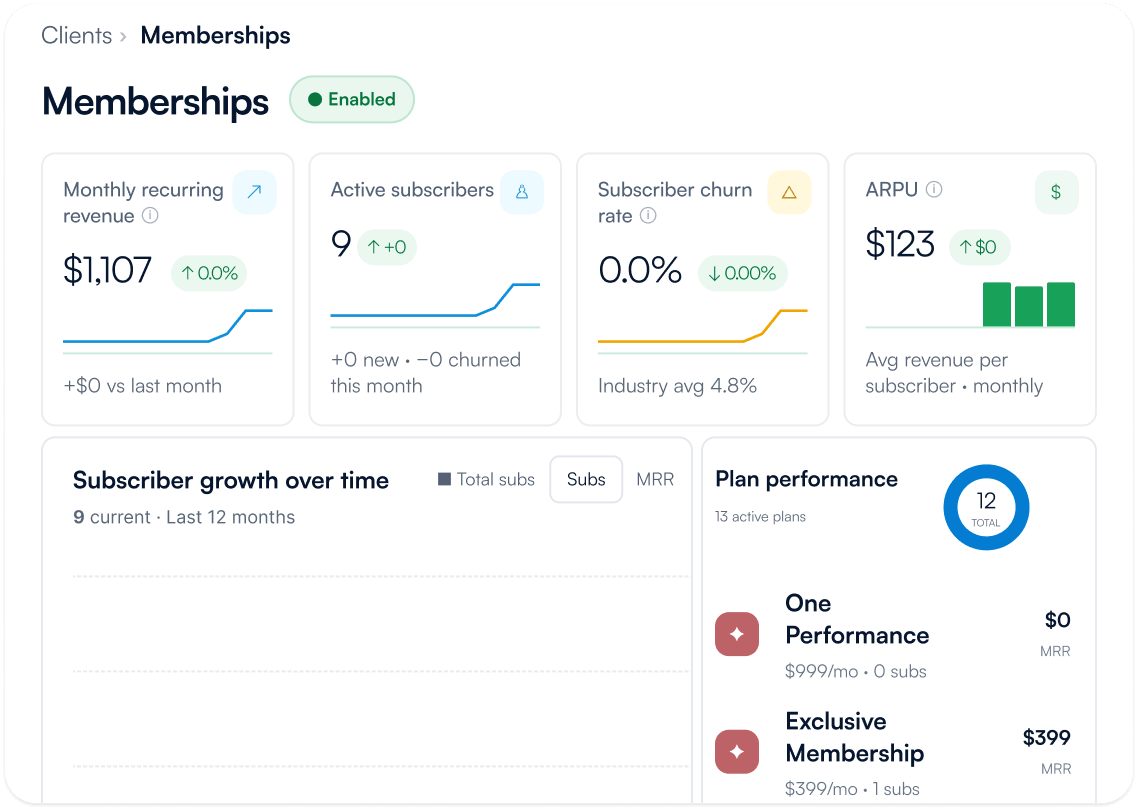
Members can view, pause and cancel their membership in the patient portal, within the sections the practice switches on. The memberships dashboard shows monthly recurring revenue, churn and top plans, which gives you N and P for the worksheet.
For the L line, practices can switch on Labs. Quest orders go from the patient record with the practice’s own Quest login, and results import automatically. A biomarker-over-time chart on the patient record tracks each panel’s results. Our guide to choosing a functional medicine EMR covers what else to check in a lab workflow.
Pabau handles self-pay, memberships and insurance billing in one system, in the US, UK and Australia. US claims run through Claim.MD inside Pabau’s claims management software.
Every Pabau plan includes the core features, and add-ons enhance the experience. Setup runs through structured onboarding, and Pabau is rated 4.8 on G2 and 4.7 on Capterra. The wider specialty setup is on our longevity clinic software page.

Pabau handles recurring memberships and treatment packages for hormone, GLP-1 and longevity programs. The till sells 2 to 12 month installment plans, and wallet credit can roll over.

Pick the model your cash flow can carry before you pick a price. An annual program funds you early and commits you to a year of delivery. A monthly membership spreads revenue thinner and exposes it to every cancellation.
Then price each tier from the member margin worksheet, using your lab invoices, clinician hours and redemption history. Use the published prices here as a positioning check, and leave them out of your cost base.
If your current tools can’t model credits, installments and rollover together, what you bill will drift from what you priced. Book a demo to see Pabau run your membership tiers, credit packages and installment plans from one system.

Weighing memberships against other revenue lines? Functional medicine business models that scale compares the models practices use to grow recurring revenue.
Still planning your launch budget? How to start a functional medicine practice walks through the setup costs that become your fixed costs.
Adding IV sessions to your credit menu? How to open an IV therapy clinic covers the setup steps behind an IV service line.
Choosing an EMR for a functional or longevity practice? Functional medicine EMR explains what to look for in charting and lab workflows.
Need a nutrition handout for members? Longevity diet plan template gives you a ready-made plan to share after a consultation.
A monthly membership fee is the recurring amount a member pays each month for a defined bundle of visits, tests, credits or discounts. Published longevity examples run from $99 to $1,200 a month. Set yours from the contribution the member margin worksheet gives each tier.
Published longevity clinic membership pricing ran from $99 a month to $20,000 a year when we checked 13 practices on November 13, 2026. Annual programs mostly sit between $2,268 and $20,000 a year. Monthly memberships run from $99 to $375 a month, and credit packages from $159 to $1,200.
Hormone membership pricing works either way, and the published pages show both. The Body Bar MD includes TRT medication in $199 a month, while BodyLogicMD and Revive Low T bill medication separately. Including it simplifies the sale but puts every refill on your cost line.
A capped rollover is the published middle ground. Medworks rolls credits over for one month, up to 12 at a time, while Liquivida lets longevity credits expire monthly. Rollover feels fairer to members but raises the delivery you owe, so cap it.
Yes. A membership fee is usually self-pay, but labs, imaging and some visits can still go to insurance. Pabau handles self-pay, memberships and insurance billing in one system, with electronic claims in the US, UK and Australia.